
Disposable Single-Gas Monitors: When Is Maintenance-Free the Right Call?
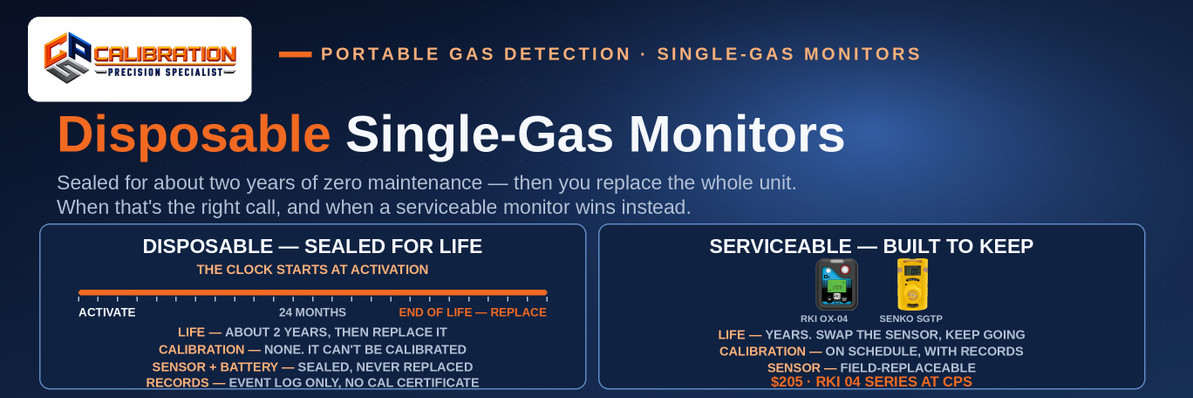
A disposable single-gas monitor is a sealed detector — most often for hydrogen sulfide (H2S) or carbon monoxide (CO) — that you turn on once and wear for a fixed life, typically two years, with no calibration, no sensor replacement, and no battery service of any kind; when its countdown ends, you replace the whole instrument. Maintenance-free is the right call when the monitor is a consumable: large fleets, contractor and visitor crews, short projects, and sites with no calibration program to run. It is the wrong call when you need calibration records, a gas outside the common few, or an instrument that can be repaired instead of replaced — a serviceable monitor like RKI's CO-04 ($205) swaps its sensor in the field and keeps working for years.
Every other instrument category on this site assumes the instrument is an asset: you buy it, you maintain it, it serves for years. Disposable monitors break that assumption on purpose, and buyers who shop them with an asset mindset misjudge them in both directions — dismissing them as throwaway junk, or buying them for jobs where the missing maintenance turns into missing protection. This post works through what the disposable class actually is, puts it head to head against the serviceable single-gas monitors CPS sells, and ends with the decision criteria. If you're still deciding between one gas and several, start with our comparison of single-gas vs. multi-gas detectors; this post is about the split inside the single-gas shelf itself.
What Is a Disposable Single-Gas Monitor?
A disposable monitor is a personal gas detector built as a sealed unit. The sensor, the battery, and the electronics are enclosed for the instrument's whole life: there is no battery door to open, no sensor to pull, nothing to charge. You activate it — usually a single button press — and from that moment it runs continuously, sampling the air by diffusion and alarming with sound, light, and vibration when its one gas crosses the setpoints.
The best-known example of the class is Honeywell's BW Clip — a brand CPS services but doesn't stock, named here because it defines the category. Its published specifications are the class in miniature: two-year and three-year versions for H2S and CO, two-year versions for O2 and SO2; no calibration, no sensor replacement, no battery replacement or charging across that whole life; an automated internal self-test; and automatic logging of the 35 most recent gas events and bump test results. Other lines in the class run on the same pattern — 24-month operating lives, typically rated at two minutes of alarm time per day. Two years of continuous operation is the class standard, and the display counts down the life remaining so the end never arrives as a surprise.
What the sealing buys is the complete absence of a maintenance program. There is no calibration bench, no docking schedule, no sensor inventory, no "who forgot to bump the monitors" conversation. The monitor's entire service department is the trash can at end of life and a fresh unit off the shelf.
Disposable vs. Serviceable, Head to Head
| Disposable single-gas monitor | Serviceable single-gas monitor | |
|---|---|---|
| Working life | Fixed: typically about 2 years of continuous operation from activation, then done | Open-ended: the instrument serves for years; wear parts are replaced as they age |
| Calibration | None — the standard models cannot be calibrated at all | Required on schedule (RKI's CO-04 listing: calibrate at least every six months, sooner if a bump test fails) |
| Sensor and battery | Sealed — never replaced; a dead sensor ends the instrument's life | Field-replaceable sensor (RKI 04 Series); batteries are 2 AAA cells, up to 9,000 hours on the CO-04 |
| Records it produces | An on-board event log (the BW Clip stores its 35 most recent gas events and bump results) | Full datalogging, plus calibration records — the proof a compliance program runs on |
| Gas coverage | The common few: H2S and CO above all, plus O2 and SO2 in the major lines | Wide: the RKI 04 Series alone runs from $205 CO, H2S, and O2 models to $520 toxic-gas models |
| Cost shape | One purchase per life cycle, zero maintenance spend — repeated in full every cycle | Purchase plus upkeep: sensors run $121–$1,365 across the serviceable lines, in-house calibration is $55 for a single-gas monitor at CPS |
| CPS examples | The class CPS services but stocks the other side of (see below) | RKI CO-04 — $205 · SENKO SP-SGTP — replaceable sensor and battery |
Neither column is the "good" one. Each is a bet about where your money and your risk sit: the disposable bets that maintenance labor and infrastructure cost more than instruments; the serviceable bets the opposite.
When Is a Disposable Monitor the Right Call?
- The fleet is big and the gas is boring. If you are issuing H2S monitors to hundreds of workers, the per-unit economics of zero maintenance dominate. Nobody calibrates 300 disposables, because there is nothing to calibrate — issue, wear, replace. Fleet managers buy disposables the way they buy hard hats.
- The wearers aren't yours. Contractors, outage crews, and visitors need a monitor at the gate, not a place in your calibration program. A disposable issued for a turnaround runs the length of the job and never has to be collected, downloaded, serviced, and reissued. When the project ends, so does the paperwork — there isn't any.
- The project is shorter than the instrument. A two-year monitor bought for a nine-month construction job is not wasted money; it's a monitor whose whole life fits inside the project, with no residual asset to store, maintain, or lose afterward.
- There is no calibration program to join. A remote site or a small operation with no dock, no bench, and no technician gains nothing from a serviceable monitor it will never actually service — an unmaintained serviceable monitor is worse than a disposable, because its neglect is invisible. The disposable's honesty is the point: its protection doesn't depend on anyone doing anything.
- The hazard is exactly the class's coverage. H2S in oil and gas and wastewater, CO around combustion — the disposable class exists because these two gases account for an enormous share of personal monitoring. If your one gas is its gas, the narrow menu costs you nothing.
When Is Maintenance-Free the Wrong Call?
- Your program runs on records. Auditors, insurers, and corporate safety departments ask for calibration records, and a monitor that cannot be calibrated cannot produce one — an event log is not a calibration certificate, as our post on what a calibration certificate actually proves works through. If anyone will ever ask "show me this instrument was reading accurately on that date," the disposable's answer is a countdown timer. Serviceable monitors on a docking or bench program generate the paper trail as a byproduct.
- Your gas isn't on the short menu. Disposables cover H2S, CO, O2, and SO2. Need ammonia, chlorine, nitrogen dioxide, hydrogen, or any of the longer toxic list, and you're in serviceable territory whether you wanted to be or not — the RKI 04 Series' toxic models exist precisely because those gases never made it into a throwaway housing.
- The sensor might die young. A sensor's life is not guaranteed to match the housing's. Poisoning, fouling, and hard exposure can kill a sensor well inside two years — the subject of our post on what happens when a sensor is poisoned. In a serviceable monitor that's a sensor swap and a calibration. In a disposable, the whole instrument is the loss, at month eight as surely as at month twenty-four.
- The crew is permanent and the math has time to run. A core crew wearing monitors for five years cycles a disposable two and a half times. The serviceable monitor bought once, fed a sensor when it needs one — the end-of-life signs and real replacement costs are in our post on when to replace a gas detector sensor — and calibrated on schedule, usually wins the long math, and it wins by more the better your calibration discipline already is.
- You need the instrument to do more. Pumped sampling, full datalog downloads, configurable setpoints beyond the basics — the disposable's sealed simplicity is the feature, and it caps what the instrument can ever be asked to do.
The Clock Is the Catch: Managing a Disposable Fleet
The one management task a disposable fleet does have is the clock, and it surprises buyers the first time: the life countdown starts at activation, not at first use. A disposable activated in January and shelved until June has spent five of its twenty-four months monitoring a storeroom. The buying discipline follows directly:
- Activate at issue, not at receiving. Leave units dormant until the day they go on a belt. Stock that arrives pre-activated is already spending its life.
- Buy against start dates. For a project fleet, time the purchase so activation day and mobilization day are the same week.
- Label the end date at issue. The display counts down, but a date written on the unit is what a supervisor actually checks.
- Know your model's pause button, if it has one. Some two-year H2S and CO models offer a hibernation case that pauses the clock when the unit is idle a week or more — Honeywell rates the extension at up to a year. It's model-specific, not a class feature; check before you count on it.
- And keep bump testing. Maintenance-free never meant verification-free. The daily discipline is the same one that applies to any personal monitor — challenge the sensor with gas before the shift and confirm it alarms, the routine our bump test vs. calibration post separates out. Disposables are built to be bump tested, several of them through docking stations that log the result; what they skip is calibration and repair, not proof.
What CPS Stocks — and Why It's the Serviceable Side
Our single-gas shelf is serviceable instruments, and that's a deliberate fit with the rest of what CPS does. The RKI 04 Series starts at $205 — field-replaceable sensor, two AAA batteries good for up to 9,000 hours of operation, a three-year warranty, datalogging on board. SENKO's SP-SGTP is built around replacing both the sensor and the battery for long-term industrial use. Both plug into the calibration side of our business — bump testing, scheduled calibration, and sensor replacement are the service work we do every day, in-house calibration for a single-gas monitor is $55 — so the instruments we sell are the instruments we can keep honest for their whole lives.
That doesn't make the disposable the wrong buy — for the fleets and projects above, it may be exactly right, and we'd rather tell you that than sell you a program you don't need. It does mean the honest comparison has to include what happens in year three: our customers' monitors are on their second sensor and still working.
Frequently Asked Questions
What is a disposable gas detector? A disposable gas detector is a sealed, single-gas personal monitor — most often for hydrogen sulfide (H2S) or carbon monoxide (CO) — that runs continuously for a fixed life, typically about two years, with no calibration, no sensor replacement, and no battery service. When its life countdown ends, the whole instrument is replaced. Honeywell's BW Clip is the best-known example: two- and three-year versions, an automatic self-test, and a log of its 35 most recent gas events.
How long do disposable gas detectors last? About two years of continuous operation is the class standard — 24 months is the standard rating across the class, typically based on two minutes of alarm time per day, and Honeywell sells the BW Clip in two-year and three-year versions. The countdown starts when the unit is activated, not when it's first worn, and the display shows the life remaining the whole way down.
Do disposable gas detectors need to be calibrated? The standard models can't be — that's the design. A disposable monitor is factory-set and sealed; there is no calibration adjustment to make and no sensor to span. What it still needs is a bump test: a brief challenge with gas to prove the sensor responds and the alarms fire. Maintenance-free means no calibration and no repairs, not no verification.
Do you still have to bump test a disposable gas detector? Yes. A bump test is the one check that proves the sensor and alarms work today, and it applies to every personal monitor before use — disposable or not. Disposables are built for it: several models bump test through docking stations that log the result automatically, and the BW Clip records its bump results alongside its gas events. What you skip with a disposable is calibration, not proof.
Can you replace the sensor or battery in a disposable gas detector? No — both are sealed inside for the instrument's whole life, and opening the unit isn't part of any service procedure. That's the trade at the center of the class: a sensor that dies early, from poisoning, fouling, or hard exposure, ends the whole instrument's life. In a serviceable monitor like RKI's CO-04 ($205), the same event is a field sensor swap and a calibration.
What happens when a disposable gas detector expires? Its life countdown reaches zero and the instrument is done — it can no longer be relied on or reset for another term. You replace it with a new unit and dispose of the old one under your site's electronic-waste and battery rules. Plan replacements before the date arrives: a fleet activated on the same day reaches end of life on the same day.
Are disposable gas detectors cheaper? Per purchase, generally yes — and per maintenance invoice, entirely: the maintenance spend is zero. Over years, it depends on the cycle count. A permanent crew replaces each disposable every two years or so, at full unit cost each time; a serviceable monitor costs more to keep — sensors run $121–$1,365 across the lines CPS carries, and in-house calibration is $55 for a single-gas monitor — but the instrument itself is bought once. Short horizons favor disposable; long ones favor serviceable.
Can you turn off a disposable gas detector to extend its life? No. Once activated, a disposable runs continuously until its life ends — the countdown doesn't pause for nights, weekends, or shelf time. The one exception is model-specific: some two-year H2S and CO models offer a hibernation case that pauses the clock during idle periods of a week or more, extending life by up to a year. Check whether your model has one before counting on it.
What gases can a disposable gas detector detect? A short list: hydrogen sulfide and carbon monoxide are the core of the class — both are offered in two- and three-year versions by the major lines — and oxygen and sulfur dioxide round it out in two-year models. Anything beyond that list — ammonia, chlorine, nitrogen dioxide, hydrogen, and the rest of the toxic-gas catalog — is serviceable-monitor territory, which is one reason CPS's single-gas shelf is built around instruments like the RKI 04 Series.
Disposable or replaceable-sensor monitor: which should I buy? Buy disposable when the monitor is a consumable: big fleets, contractor and visitor crews, projects shorter than the instrument's life, and sites with no calibration program to plug into. Buy replaceable-sensor when the monitor is an asset: permanent crews, programs that must produce calibration records, gases beyond H2S, CO, O2, and SO2, and anywhere a dead sensor should cost a sensor — not a whole instrument. The decision framework in our single-gas vs. multi-gas comparison covers the gas-count half of the same choice.
The Bottom Line
A disposable monitor is not a cheap version of a real monitor — it is a different purchase: protection sold by the life cycle instead of by the instrument. Where the wearers rotate, the gas is H2S or CO, the project has an end date, and nobody's job is calibration, that purchase is the smart one, and its zero-maintenance honesty beats a serviceable monitor nobody services. Where the crew is permanent, the records matter, the gas list runs long, or a sensor's early death shouldn't total the instrument, the serviceable monitor earns its upkeep. Decide which of those two buyers you are before you price either one.
Not sure which side of the line your fleet falls on? Tell us the gas, the headcount, and how long the job runs — that is usually enough to call it. Call 865-900-8844 or reach us through Contact Us. Browse the serviceable side in our Single Gas Monitors category, and see the upkeep half of the comparison at Calibration Services.
CPS Calibrations · 109 S. Front Street, Rockwood, TN 37854 · Calibration Gas · Calibration Services · Contact Us
Need a calibration you can file?
In-house calibration at CPS in Rockwood, Tennessee — $55 for single-gas instruments, $90 for 4- and 5-gas — every channel, as-found and as-left data, full certificate.
See Calibration Servicesor call 865-900-8844
Recent Posts
-

Can You Add a Pump to a SENKO SGT-P or MGT?
Yes — SENKO's SP-Pump101 external sampling pump ($330, part AAA006000) fits the SGT, SGT-P, and MGT, …Nov 12th 2026 -

What Refrigerant Detection Does a Grocery Store Need?
A grocery store needs refrigerant detection in three places: low-mounted carbon dioxide (R-744) sens …Nov 11th 2026 -

What Is LEL and UEL? The Explosive Range, Gas by Gas
The LEL is the lowest concentration of a gas in air that can explode, and the UEL is the highest: me …Nov 10th 2026