
When Should You Replace a Gas Detector Sensor — and What Does It Cost?
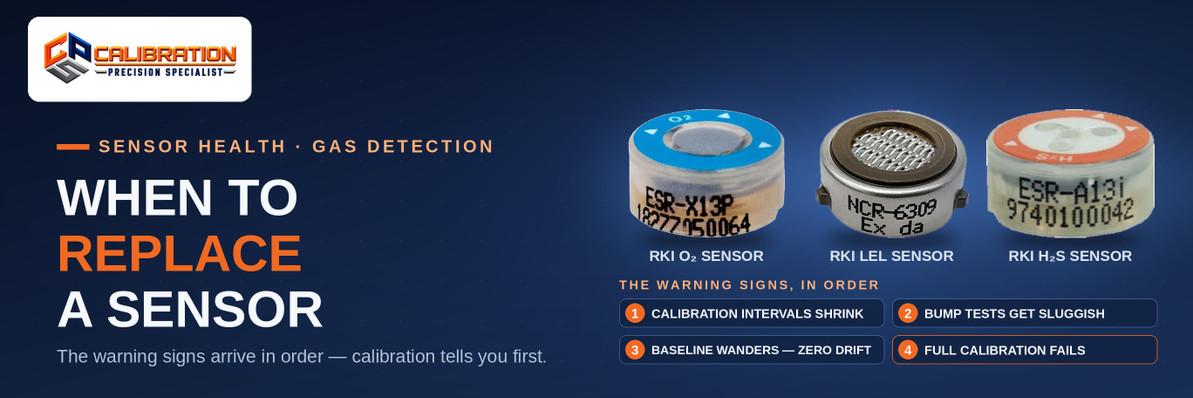
Replace a gas detector sensor when it can no longer be calibrated back to the certified gas value — the endpoint OSHA's guidance names, when the instrument either fails full calibration or refuses the adjustment and comes out of service. The warning signs arrive earlier, in order: shrinking calibration intervals, sluggish bump-test response, a wandering baseline, and repeated failed calibrations. The cost is usually modest: genuine RKI sensors for the standard channels of a GX-3R are $160 each (a full sensor set is $575), SENKO's standard channels are $121, specialty toxics run $228–$275, and PID sensors top the range at $848–$1,365.
Sensors are consumables wearing a permanent-looking disguise. Every electrochemical cell is spending itself from the day it is made, every catalytic bead is ageing with every exposure, and the instrument around them will happily outlive two or three sets. This post covers when the spend is due — the signs, in the order you'll meet them, and the service lives manufacturers actually publish — and then what it costs, with real prices from our own listings instead of ranges from memory. Whether to buy the manufacturer's sensor or an aftermarket one is its own question, answered in OEM vs. aftermarket gas detector sensors.
What Are the Signs a Sensor Is at End of Life?
They form a progression, and each stage has a correct response short of replacement — until the last one.
- Calibration intervals shrink. The instrument that held calibration for a full cycle starts drifting out of tolerance early. OSHA makes the underlying habit explicit: keep calibration records for the life of the instrument, because the record is what lets you track a sensor's drift and identify when it needs replacement. A sensor consuming calibration effort faster and faster is spending its remaining life.
- Bump tests get sluggish. The channel still responds, but slowly and weakly — it reaches alarm late, or barely. A sensor whose output is fading fails the spirit of the bump test before it fails the letter of it.
- The baseline wanders. Zero drift, readings that creep in clean air, negative readings that keep coming back after proper re-zeroing. (That symptom has other causes too — a dirty zero and cross-interference among them — so rule those out before blaming the sensor.)
- Full calibration fails. This is the decisive sign. OSHA's bulletin: if the instrument fails the full calibration, remove it from service and contact the manufacturer for assistance or service — and OSHA notes that a sensor damaged by degradation or exposure often displays a failure message during calibration, or will not allow the operator to fully adjust the display reading. A sensor that cannot be adjusted to the certified value is not "close enough." It is done.
- The instrument says so. Sensor-error and sensor-alarm indications at startup — BW's MicroClip manual, for example, shows a sensor alarm as an error naming the sensor during startup and "Err" during operation — are the instrument reporting a channel it can no longer trust.
How Long Do Gas Detector Sensors Actually Last?
Publishers' figures vary by brand and channel, so here is what the manufacturers themselves put in print for the lines we sell — life expectancy under normal service, not a promise, and always shortened by heat, poisons, over-range exposure, and hard use:
| Channel | Published service life | Source |
|---|---|---|
| O₂ and LEL (RKI 03 Series) | Life expectancy over 2 years | RKI 03 Series literature |
| H₂S and CO (RKI 03 Series) | Life expectancy over 3 years | RKI 03 Series literature |
| O₂ (RKI GX-3R, current generation) | 3–5 year life span for the electrochemical O₂ sensor | RKI GX-3R literature |
| Warranty backstop (RKI GX-3R) | 3-year warranty on instrument and sensors (1 year for the ammonia sensor) | RKI GX-3R specification |
The oxygen channel deserves its footnote: the common galvanic O₂ cell consumes its own anode in normal operation, in air, whether the instrument is working or sitting in a drawer — which is why O₂ is usually the first sensor in any instrument to need replacing, and why it gets its own post: why oxygen sensors die — and how to make them last. Electrochemical toxics age by exposure as much as by time; catalytic LEL beads age by poisoning events as much as by either.
What Does a Replacement Sensor Cost? Real Prices
Every figure below is a live CPS listing price, checked against the store for this post — genuine manufacturer sensors, the same ones our bench fits:
| Sensor | Fits | Price |
|---|---|---|
| RKI O₂ sensor, 0–25% vol | GX-3R, GX-3R Pro, GX-Force, GX-6100, GX-9000 | $160 |
| RKI LEL catalytic sensor, 0–100% LEL | GX-3R, GX-3R Pro, GX-Force, GX-6100 | $160 |
| RKI CO sensor, 0–2,000 ppm | GX-3R family, GasWatch 3, CO-04, GX-6100 | $160 |
| RKI H₂S sensor, 0–200 ppm | GX-3R family, GasWatch 3, HS-04, GX-6100 | $160 |
| RKI CO/H₂S combo sensor | GX-3R family, GasWatch 3, 04 Series, GX-6100 | $255 |
| RKI CO₂ IR sensor, 0–10% vol | GX-6000, GX-6100 | $420 |
| RKI specialty toxics (HCN, NO₂, SO₂, NH₃) | GX-6000, GX-6100 | $275 |
| RKI PID sensor, 10.6 eV, 0–4,000 ppm | GX-6000, GX-6100 | $1,365 |
| SENKO O₂ sensor | SGT-P, MGT, SP-MGTP | $121 |
| SENKO CO or H₂S sensor | SGT-P | $121 each |
| SENKO CO & H₂S dual sensor | MGT, SP-MGTP | $161 |
| SENKO specialty toxics (NO₂, SO₂, NH₃) | SGT-P, SP-MGTP | $228 |
| SENKO PID sensor, 10.6 eV, 0–4,000 ppm | SP-MGTP | $848 |
Read the table as a structure, not just a list. The everyday channels — O₂, LEL, CO, H₂S — are the cheap seats: $121–$160 a channel, and $575 replaces every sensor in a GX-3R (LEL $160 + O₂ $160 + CO/H₂S combo $255). Specialty toxics roughly double that. Infrared and PID are the premium tier, with PID sensors the single most expensive consumable in portable gas detection at either brand — $848 at SENKO, $1,365 at RKI. Fixed instruments run higher still: replacement sensors for RKI's GD-70D sample-draw transmitter list at $415–$945 depending on gas.
Should You Replace the Sensor — or the Instrument?
The honest arithmetic, using the GX-3R as the example: a full sensor set is $575 against $640 for a new GX-3R. That looks close until you account for what the $640 buys — a new instrument with new sensors, a fresh 3-year warranty, and a new battery — versus what the $575 buys: new sensors inside an instrument whose battery, pump (if fitted), case, and remaining life are whatever they were. The working rules:
- One channel gone, instrument young: replace the sensor. $121–$255 restores a warranted instrument to full service; nothing else makes sense.
- Several channels fading together on an old instrument: price the full set against a new instrument before ordering. Sensors that age together usually die together, and three individual replacements across six months of downtime can cost more than the swap.
- PID channel gone: do this maths explicitly. At $848–$1,365, a PID sensor is a significant fraction of a new instrument's price, and the lamp-based channel is often the reason the instrument was bought — or the reason to change platforms.
- Any age, if you send it to us: the bench verdict comes first and free of obligation — we calibrate every channel, and if a channel won't calibrate, we tell you exactly which sensor it needs and what it costs before any money moves. That's calibration services.
Can You Replace a Sensor Yourself?
On the instruments built for it, yes — the portable lines we sell use plug-in sensors designed for field replacement, and the procedure is: power down, swap the sensor, then calibrate before use, because a new sensor has never met your instrument's calibration. Two cautions from the manuals: BW's MicroClip manual warns to use only sensors specifically designed for the detector and to observe ESD handling — a reminder that "fits the socket" and "is the right sensor" are different claims, which is the whole argument in our OEM vs. aftermarket sensors post. And a new sensor that won't calibrate is a warranty conversation, not a reason to force the adjustment — sensors carry their own coverage (the GX-3R's sensors sit inside its 3-year warranty).
The Bottom Line
A sensor is finished when calibration says so: drift that accelerates, bump responses that fade, a baseline that wanders, and finally a full calibration the instrument cannot complete — OSHA's endpoint, after which the instrument comes out of service. Everything before that endpoint is a warning you're meant to use. The replacement itself is rarely the expensive part — $121–$160 for the channels that protect people every day, $575 for every sensor in the most common 4-gas instrument we sell — and the expensive mistake is the other one: months of recalibrating a dead sensor and trusting what it says.
Sensor failing calibration, or a quote for a swap? CPS stocks genuine RKI and SENKO replacement sensors and fits them on our own bench. Call 865-900-8844 or reach us through Contact Us.
Frequently Asked Questions
When should you replace a gas detector sensor? When it can no longer be calibrated back to the certified gas value. That is the endpoint in OSHA's calibration guidance: an instrument that fails a full calibration is removed from service for manufacturer assistance or repair, and OSHA notes a failing sensor often shows a failure message or won't allow the reading to be fully adjusted. The warnings come earlier — calibration intervals that keep shrinking, sluggish bump-test response, a wandering or repeatedly negative baseline — and each is a reason to plan the replacement rather than be surprised by it.
How much does a replacement gas detector sensor cost? At CPS, the everyday channels are $121–$160: SENKO's O₂, CO, and H₂S sensors are $121 each; RKI's O₂, LEL, CO, and H₂S sensors for the GX-3R family are $160 each, with the CO/H₂S combo sensor at $255 — $575 replaces every sensor in a GX-3R. Specialty toxic sensors run $228 (SENKO) to $275 (RKI), RKI's CO₂ infrared sensor is $420, and PID sensors top the range at $848 (SENKO) to $1,365 (RKI). Fixed-detector sensors cost more — RKI GD-70D replacements list at $415–$945.
How long do gas detector sensors last? By the manufacturers' own published figures for the lines we sell: RKI's 03 Series literature gives a life expectancy of over 2 years for its O₂ and LEL sensors and over 3 years for H₂S and CO; the current GX-3R's electrochemical oxygen sensor carries a published 3–5 year life span. Treat those as normal-service expectations, not guarantees — heat, humidity extremes, sensor poisons, corrosive gases, and over-range exposures all shorten real life, which is why the instrument's calibration history is a better predictor than the calendar.
What are the signs a gas sensor is going bad? In the order they usually appear: calibration intervals shrink (the instrument drifts out of tolerance sooner each cycle); bump-test response gets slow and weak; the baseline wanders, with zero drift and recurring negative readings in clean air; and finally the instrument fails a full calibration or refuses the adjustment entirely. Startup sensor errors — BW's MicroClip, for instance, names the failed sensor during its self-test — are the instrument reporting the same conclusion directly.
Can a gas detector sensor be replaced, or do you replace the whole detector? The sensor, in most portable instruments — the lines we sell use plug-in sensors designed for replacement, and one failed channel on a young instrument is a $121–$255 part, not a new detector. Replace the instrument instead when several channels are fading together on an older unit: price the full sensor set ($575 for a GX-3R) against a new instrument ($640 for a GX-3R, including new sensors and a fresh 3-year warranty) and account for the old unit's battery and remaining life before deciding.
Do you have to calibrate after replacing a sensor? Yes — before the instrument goes back into service. A new sensor has never been calibrated in your instrument, and BW's MicroClip manual states the rule for its own line plainly: new sensors should be calibrated; activate the detector and calibrate the sensor. A bench replacement at CPS includes that calibration and its certificate, so the instrument returns ready to work rather than ready to be set up.
Why do oxygen sensors need replacing more often than other sensors? Because the common galvanic oxygen cell consumes itself doing its job: its anode material is spent by reacting with the oxygen it measures, continuously, whenever it is exposed to air — in service and on the shelf alike. Toxic electrochemical sensors, by contrast, mainly spend themselves on exposure to their target gases. The result is that O₂ is normally the first channel in a multi-gas instrument to fade, which is why it gets its own post — why oxygen sensors die, and the storage and handling habits that extend their life.
Is it worth replacing a sensor in an old gas detector? Usually, if it's one channel. The test is comparative: a single $160 sensor restoring a sound instrument is cheap protection; a $575 full set inside an instrument with an ageing battery and no warranty is close to the $640 price of a new GX-3R with fresh everything. Age alone doesn't decide it — condition does. If you're unsure, send it in: a calibration bench can tell you exactly which channels are failing and what each path costs, before you commit to either.
Are expensive sensors like PID worth replacing? They're the case that deserves explicit maths. A PID sensor is $848 (SENKO SP-MGTP) to $1,365 (RKI GX-6000/GX-6100) — a large fraction of the instrument's value — so compare it against a new instrument and against how much the PID channel is actually used. If VOC measurement is the instrument's purpose, the sensor is the instrument, and replacement restores it fully. If the PID was a just-in-case channel, the honest answer may be a non-PID configuration at replacement time.
Can a sensor be damaged before its expected life is up? Yes, and it's common. OSHA's drift catalogue reads like a list of ways sensors die early: exposure to high concentrations of target gases, catalytic LEL sensors exposed to volatile silicones, hydride gases, halogenated hydrocarbons, and sulfide gases, electrochemical toxics exposed to solvent vapours and corrosive gases, and plain physical shock and vibration. A two-year sensor can be a two-month sensor in the wrong atmosphere — one more reason the calibration record, not the purchase date, is what schedules a replacement.
CPS Calibrations · 109 S. Front Street, Rockwood, TN 37854 · Calibration Gas · Calibration Services · Contact Us
Recent Posts
-

Why Does Gas Detector Data Logging Matter? The Paper Trail Your Incidents Need
Gas detector data logging matters because it is the only objective record of an incident: a data-log …Oct 22nd 2026 -
What Is a Confined Space? OSHA's Definition, the 3 Tests, and When It Becomes Permit-Required
A confined space is a space that passes all three of OSHA's tests at the same time: it is large enou …Oct 21st 2026 -
PID vs. LEL for VOC Detection: Which Sensor Do You Actually Need?
Use a PID to detect VOCs and an LEL sensor to detect explosive atmospheres — they measure different …Oct 21st 2026