
Single-Gas vs. Multi-Gas Detectors: How to Choose
Ask a room of safety managers which is better — single-gas or multi-gas detectors — and you'll start an argument that goes nowhere. It's the wrong question.
The right question is: what atmosphere are you sending your people into? A worker tending an inerted nitrogen line faces one hazard. A contractor opening a manhole faces four. The instrument that protects the first one leaves the second one unprotected, and the instrument that protects the second one is overkill — and over-budget — for the first. Here's how to match the detector to the job, with the ownership math most buyers never see.
What Each One Actually Is
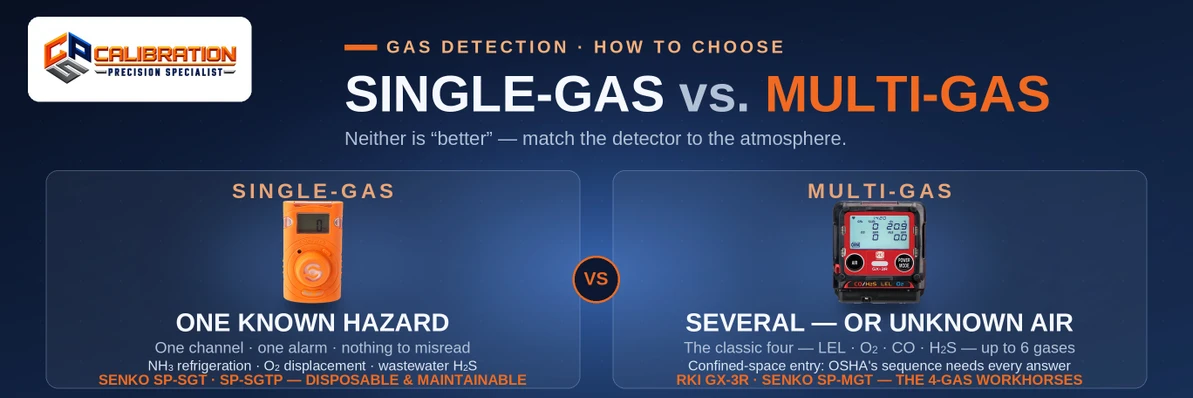
A single-gas detector watches one gas and nothing else. Oxygen depletion, hydrogen sulfide, carbon monoxide, ammonia — one channel, one alarm, one job. The RKI OX-04, for example, is a dedicated oxygen monitor: 0–40% volume range, IP67 enclosure, datalogging, and up to 3,000 hours of runtime on two AAA batteries. SENKO's SP-SGT takes the concept further as a disposable single-gas unit — wear it for its service life, then replace it — while the maintainable SP-SGTP gives you a single-gas detector you can keep in service with a replaceable sensor and battery.
A multi-gas detector watches several gases at once — typically the classic four: combustible gas (LEL), oxygen, carbon monoxide, and hydrogen sulfide. The RKI GX-3R and SENKO SP-MGT are the workhorses here, and the range stretches to five and six gases: the RKI GX-3R Pro adds a fifth toxic channel, and the pumped SENKO SP-MGTP covers up to six.
Neither is "better." They're built for different atmospheres. The trick is knowing which atmosphere you're in.
When Single-Gas Wins
Single-gas detectors earn their keep in four situations:
One known hazard, nothing else. A refrigeration tech who works around ammonia. A crew in a nitrogen-inerted room where the only credible hazard is oxygen displacement. Wastewater operators where H₂S is the gas that kills people. When your hazard survey names one gas, a single-gas detector gives you exactly the protection you need — and nothing you're paying to carry around.
Simplicity under stress. One channel means one reading and one alarm to interpret. For workers who aren't gas-detection specialists — maintenance techs, drivers, contractors, visitors — there's real safety value in an instrument that can't be misread. No scrolling through channels, no wondering which reading is which.
Battery life and cost. A single electrochemical channel sips power. The OX-04 runs thousands of hours on alkaline AAAs; a 4-gas instrument with a pump needs recharging every shift or two. And the purchase price is a fraction of a multi-gas unit — which matters when you're equipping 40 people instead of 4.
Disposable coverage for short-term exposure. Contractors on a two-week job. Visitors touring a plant. Emergency responders who need something on their chest right now. A disposable single-gas unit like the SP-SGT is personal protection without an asset-management program attached: hand it out, it does its job for its service life, done.
When Multi-Gas Is the Only Right Answer
Confined space entry. This is the big one, and it's not a judgment call — it's how the regulation is built. OSHA's testing sequence for permit spaces calls for checking oxygen first, then flammable gases and vapors, then toxic air contaminants, before anyone goes in. You cannot complete that sequence with a single-gas detector. Entry teams carry multi-gas instruments because the space demands four answers, not one.
Unknown or variable atmospheres. If the gas mixture changes from job to job — a contractor who works refineries one week and chemical plants the next, a hazmat team, a utility crew opening vaults across a city — you can't pre-select the one gas that matters. Multi-gas is insurance against the hazard you didn't expect.
Fewer instruments to manage. One 4-gas detector replaces four single-gas units on a belt. That means one instrument to bump test, one to charge, one to calibrate, one to train on, one data log to pull. For a dedicated safety tech or an entry attendant, consolidation is a genuine operational win.
Better records. Multi-gas instruments log all channels together with timestamps. When you need to show what the atmosphere was during an entry or an incident — for OSHA, for an investigation, for your own lessons-learned — one synchronized log beats four separate ones.
The Ownership Math Nobody Shows You
The purchase price is the smallest part of the decision. Here's what the instrument costs you over its life:
Calibration gas. Every channel needs its own span gas. A 4-gas detector gets bumped and calibrated with a 4-gas mix — one bottle, one regulator, one procedure. But if you run four single-gas detectors for four different gases, you need four different single-gas bottles. The math flips depending on your mix: one multi-gas instrument is simpler to feed than four singles, but a fleet of fifty single-gas O₂ monitors all drink from the same cheap bottle.
Sensor replacement. Sensors are consumables with different clocks. Electrochemical toxic and oxygen sensors typically last 2–3 years; catalytic LEL sensors and infrared sensors run longer. A multi-gas instrument carries four or five replacement schedules at once — when the O₂ sensor ages out, you're opening up a working instrument to service one channel. A single-gas detector has exactly one sensor to replace, on one schedule, with no guesswork about which channel is due.
Bump testing and calibration time. A 4-gas bump test takes a couple of minutes with a docking station. A single-gas bump takes seconds. But multiply by your fleet: fifty singles take longer than ten 4-gas units, even though each individual test is faster. Your headcount decides which side of that equation you're on.
Training. Four gases means four alarm setpoints, four response behaviors, and a worker who has to know which channel is in alarm and what it means. One gas means one response. For a transient or low-training workforce, simplicity isn't a nice-to-have — it's the safety feature.
A Simple Decision Framework
Walk through these four questions in order:
- What does your hazard survey say? If it names one gas in one location, start with single-gas. If it names several, or says "it depends," start with multi-gas.
- Does anyone enter confined spaces? If yes, you need multi-gas for the entry team. Full stop. Singles can supplement it — an attendant wearing a dedicated H₂S single-gas alongside the entrant's 4-gas is common and smart — but they can't replace it.
- How many people need protection? Equipping a handful of specialists? Multi-gas. Equipping dozens of workers against one known hazard? Single-gas, by a mile.
- What's your maintenance capacity? A 4-gas fleet needs 4-gas calibration gas, docking stations, and someone who understands all four channels. A single-gas fleet needs one gas and one procedure. Match the fleet to the shop that maintains it.
And the answer is often both. The best-protected facilities we see run multi-gas for entry teams and specialists, and single-gas for everyone else — dedicated O₂ monitors in inerted areas, disposable H₂S units for visitors and contractors, a 4-gas on every entry attendant's chest. The categories aren't rivals. They're layers.
The Calibration Angle
Here's where this connects to our benches: we calibrate every channel — whether that's the one channel in your single-gas O₂ monitor or all six in a pumped multi-gas unit. Every toxic, LEL, and oxygen channel gets challenged with its own NIST-traceable calibration gas — single-gas bottles for singles, multi-gas mixes for multis — and the certificate shows as-found and as-left for each channel separately. Gas detection and process instruments alike: temperature, flow, pressure, and gas, we calibrate every channel and prove it on paper.
If you're rethinking your fleet mix — or you've got a drawer of single-gas units and a cabinet of 4-gas units and no consistent calibration program across them — call us at 865-900-8844. Ship your detectors to our lab or have us come to your facility and we'll put every channel on a documented schedule.
The Bottom Line
Single-gas detectors are the right answer when the hazard is known, the workforce is large, and simplicity is safety. Multi-gas detectors are the right answer when the atmosphere is unknown, the space is confined, and the regulation names four gases. Most real facilities need both — layered, not competing. Start with your hazard survey, count your people, be honest about your maintenance capacity, and buy the instrument that matches the atmosphere, not the catalog page.
Shopping for monitors? Browse single-gas monitors — the RKI OX-04, disposable SENKO SP-SGT, and maintainable SENKO SP-SGTP — or portable multi-gas monitors: the RKI GX-3R, GX-3R Pro, SENKO SP-MGT, and pumped SP-MGTP. Need your fleet verified? Ship your detectors to our lab or have us come to your facility — gas detection and process instruments alike.
Frequently Asked Questions
Can a single-gas detector be used for confined space entry? Not as the entry instrument. OSHA's testing sequence requires checking oxygen, then flammable gases, then toxic contaminants before entry — one single-gas detector can't produce all three answers. Single-gas units are fine as supplements (e.g., a dedicated H₂S monitor on the attendant), but the entrant's pre-entry testing needs multi-gas.
Is a 4-gas detector always safer than a single-gas detector? Only if the atmosphere actually contains the gases it watches. A 4-gas detector is no protection against ammonia, chlorine, or sulfur dioxide — gases it doesn't have channels for. "Safer" comes from matching channels to hazards, not from channel count. A single-gas NH₃ monitor protects a refrigeration tech better than a 4-gas unit does.
How long do single-gas detector sensors last? About the same as the equivalent channel in a multi-gas unit: electrochemical oxygen and toxic sensors typically 2–3 years, depending on the gas and conditions. Disposable units like the SENKO SP-SGT are rated for a fixed service life — when it's done, you replace the unit, not the sensor. Maintainable singles like the SP-SGTP and the RKI OX-04 take replacement sensors.
Do single-gas detectors need calibration too? Yes — one channel, one calibration. A single-gas detector gets bump tested and calibrated with a single-gas bottle on the same schedule as any multi-gas channel. Simpler procedure, same discipline. Skipping it because "it's only one gas" is how single-gas detectors fail silently.
What's cheaper to own: one 4-gas detector or four single-gas detectors? It depends on headcount and gases. One 4-gas unit is cheaper to buy and simpler to calibrate than four singles covering four gases. But fifty single-gas O₂ monitors for fifty workers in an inerted area are far cheaper than fifty 4-gas units — and each one is simpler to train on and maintain. Count your people and your gases before you count your dollars.
Can I bump test a 4-gas detector with single-gas bottles? You can challenge individual channels with single-gas bottles, but a proper bump test should verify every channel responds — which means either a multi-gas mix or sequential single-gas challenges for each channel. In practice, a 4-gas mix bottle and a docking station is faster, cheaper per test, and harder to get wrong.
Recent Posts
-

What Is an Ultrasonic Gas Leak Detector?
An ultrasonic gas leak detector is a fixed detector that finds leaks by listening instead of samplin …Oct 21st 2026 -

Open-Path vs. Point Gas Detectors: What's the Difference?
The difference between an open-path and a point gas detector is what each one measures: an open-path …Oct 21st 2026 -

What Does IDLH Mean?
IDLH stands for Immediately Dangerous to Life or Health, and it is NIOSH's escape line: the maximum …Oct 21st 2026