
What Does IDLH Mean?
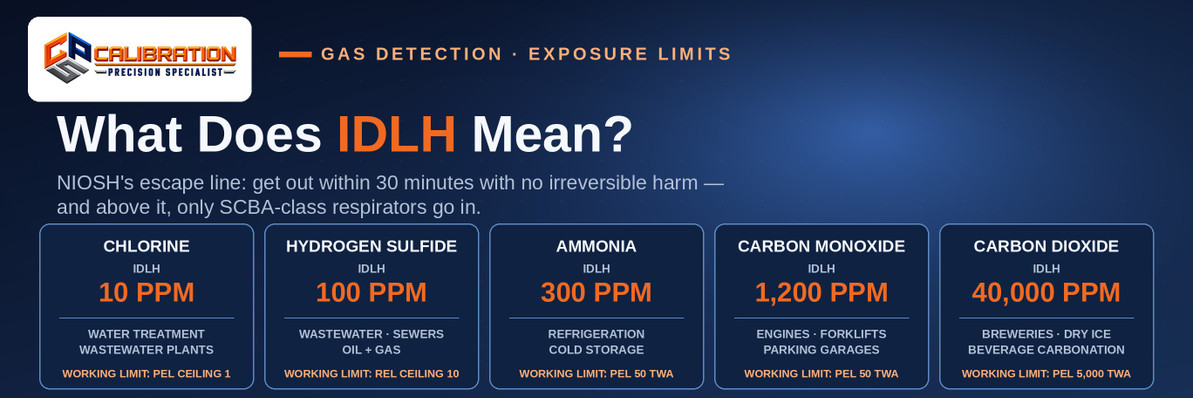
IDLH stands for Immediately Dangerous to Life or Health, and it is NIOSH's escape line: the maximum concentration of a gas from which a worker could escape within 30 minutes without irreversible health effects and without symptoms that would impair the escape itself. Above that line — or whenever the concentration is unknown — OSHA permits only the highest class of breathing protection, a pressure-demand SCBA or supplied air backed by an auxiliary SCBA. For the gases CPS customers meet most, the line sits at 10 ppm for chlorine, 100 ppm for hydrogen sulfide, 300 ppm for ammonia, 1,200 ppm for carbon monoxide, and 40,000 ppm for carbon dioxide.
IDLH gets quoted constantly in safety meetings and misread almost as often. It is not an exposure limit like the PELs and TLVs your monitors alarm against, it is not a "safe for 30 minutes" rating, and it is not set by OSHA. It is a single bright line drawn for two decisions: can a worker get out alive if their protection fails, and what class of respirator is allowed past this point. This post works through the definition word by word, the 30 minutes everyone misreads, the values for the gases you are actually likely to meet, and where IDLH sits next to the working limits it gets confused with — the TWA and STEL alarms covered in our post on what TWA and STEL alarms mean.
What Does IDLH Stand For — and Who Sets It?
IDLH stands for Immediately Dangerous to Life or Health. The values are published by NIOSH — the National Institute for Occupational Safety and Health — in the NIOSH Pocket Guide to Chemical Hazards, where every chemical entry carries an IDLH line next to its exposure limits.
One point that surprises people: the IDLH numbers themselves do not appear in OSHA's regulations. OSHA has said so directly — IDLH levels are specified by NIOSH, and employers use the NIOSH value when selecting respirators under OSHA's respiratory protection standard, 29 CFR 1910.134. So IDLH is a NIOSH number with OSHA consequences: NIOSH draws the line, and OSHA's respirator rules make crossing it the most demanding entry condition in the standard. OSHA's confined space rule uses the same concept from the other direction — an atmosphere at or above IDLH is a hazardous atmosphere, and it is one of the conditions that makes a space permit-required.
What Is the Definition of an IDLH Atmosphere?
NIOSH's current definition describes an IDLH condition as one that poses a threat of exposure to airborne contaminants when that exposure is likely to cause death or immediate or delayed permanent adverse health effects, or prevent escape from the environment. The Pocket Guide phrases the value itself as the maximum level from which a worker could escape within 30 minutes without escape-impairing symptoms or irreversible health effects.
Unpacked, an IDLH value has to pass three tests:
- You can still get out. The concentration must not kill or incapacitate a worker during the escape — no collapse, no loss of consciousness on the way to the door.
- The harm must not be permanent. Escaping counts for nothing if the exposure causes immediate or delayed irreversible damage — the definition explicitly covers effects that show up after the worker is safely out.
- Nothing may impair the escape itself. Severe eye irritation that blinds you to the exit, coughing fits, disorientation — a concentration that produces those fails the test even if it would not, by itself, kill. This is why intensely irritating gases carry strikingly low IDLH values: chlorine's is just 10 ppm.
Where Does the 30 Minutes Come In — and What Doesn't It Mean?
Thirty minutes is the escape assumption NIOSH used when setting the values. In NIOSH's own framing, 30 minutes is considered the maximum time for escape, chosen to build a margin of safety into the calculation: the value is set low enough that a healthy worker whose respirator has failed can get out within that window without irreversible harm.
Read that carefully, because this is the most dangerous misreading in gas detection: the 30 minutes is not a permitted stay time. It is not a rating that says "this atmosphere is safe for half an hour." The current NIOSH definition attaches no exposure duration to IDLH at all — workers are not supposed to be in an IDLH atmosphere for any length of time unless they are equipped for exactly that condition, in SCBA-class protection, under a program with attendants and rescue in place. The 30 minutes is a design assumption for an escape that should take far less than that, not a budget you are allowed to spend.
What Are the IDLH Values for Common Gases?
These are the current NIOSH Pocket Guide values for the gases CPS customers monitor most — with the working limit beside each one, because the gap between the two numbers is the whole lesson:
| Gas | IDLH (NIOSH) | Working limit for comparison | Where you meet it |
|---|---|---|---|
| Chlorine (Cl₂) | 10 ppm | OSHA PEL ceiling 1 ppm | Water and wastewater treatment |
| Hydrogen sulfide (H₂S) | 100 ppm | NIOSH REL ceiling 10 ppm (10-minute) | Wastewater, sewers, oil and gas |
| Ammonia (NH₃) | 300 ppm | OSHA PEL 50 ppm TWA | Refrigeration, cold storage, fertilizer |
| Carbon monoxide (CO) | 1,200 ppm | OSHA PEL 50 ppm TWA | Engines, forklifts, parking garages, boiler rooms |
| Carbon dioxide (CO₂) | 40,000 ppm | OSHA PEL 5,000 ppm TWA | Breweries, beverage carbonation, dry ice |
Every IDLH on that table is 6 to 24 times higher than the limit the same worker labors under all shift. That is not sloppiness — it is the difference between a concentration you can breathe for a working lifetime and a concentration you can survive escaping from. Two entries deserve a closer look:
- Hydrogen sulfide at 100 ppm is the cruelest value on the list, because of what happens to your warning system right at that level: H₂S paralyzes the sense of smell at around 100 ppm, so the rotten-egg odor disappears precisely when the atmosphere turns IDLH — the subject of our post on why you can't smell hydrogen sulfide. At its IDLH, hydrogen sulfide takes away the only detector you were born with.
- Carbon monoxide at 1,200 ppm sits against an OSHA PEL of 50 ppm, a NIOSH recommended limit of 35 ppm, and a NIOSH ceiling of 200 ppm — four numbers for one gas, each answering a different question. Our post on carbon monoxide exposure limits works through all of them.
And carbon dioxide's 40,000 ppm is worth pausing on: it is 4% of the air in the space. CO₂ is a normal constituent of air and a gas workers underestimate precisely because it feels benign — but at 8 times its own PEL, it is an IDLH atmosphere by the same definition as chlorine at 10 ppm.
IDLH vs. PEL, REL, and TLV: What's the Difference?
This is the confusion that matters most, so here it is head to head:
| PEL / REL / TLV | IDLH | |
|---|---|---|
| Set by | OSHA (PEL), NIOSH (REL), ACGIH (TLV) | NIOSH |
| Legal force | The PEL is law; REL and TLV are recommended limits | Not a regulation itself — OSHA's respirator standard keys off the NIOSH value |
| What it answers | How much can a worker breathe, shift after shift, without harm? | Can a worker escape this concentration without permanent harm — and what respirator may enter it? |
| Time basis | 8-hour time-weighted average, short-term limits, ceilings | An escape assumption of up to 30 minutes — not a permitted exposure duration |
| What crossing it means | Overexposure: correct the conditions, the program, or the protection | Emergency territory: only SCBA-class respirators, attendants, and a rescue plan belong past this line |
The plain-English version: a PEL is a limit you work up to and stay under, all day, every day. An IDLH is a line you never plan to cross at all. Working limits protect your health across a career. The IDLH protects your life across the next few minutes. An atmosphere between the PEL and the IDLH is an overexposure problem. An atmosphere at the IDLH is a potential fatality with an escape window.
What Does IDLH Decide? Respirators and Entry
IDLH values were established for respirator selection in the first place, and that is still their day job. The logic under OSHA 1910.134 and the NIOSH Pocket Guide's own respirator tables runs like this:
- Below the IDLH, air-purifying respirators may be used, if the respirator's assigned protection factor is adequate for the concentration and the cartridge or canister is right for the gas. This is the world of half-mask and full-facepiece cartridge respirators, chosen by the numbers.
- At or above the IDLH — or whenever the concentration is unknown — the menu collapses to two entries, both rated at an assigned protection factor of 10,000: a full-facepiece pressure-demand SCBA, or a pressure-demand supplied-air respirator used with an auxiliary SCBA. Unknown is treated as IDLH until testing proves otherwise, because an unmeasured atmosphere has to be assumed to be the worst one it could be.
- Escape is a separate, narrower category. Escape respirators exist so a worker already inside can get out when conditions fail — they are egress equipment, not a license to enter or stay.
The same line drives confined space decisions. An IDLH atmosphere inside a space is a hazardous atmosphere under OSHA 1910.146: entry runs on a permit, with pre-entry testing, an attendant stationed outside, an entry supervisor, and a rescue plan that does not consist of the attendant climbing in — which is why our walkthrough of how to test a confined space before entry treats the pre-entry readings as the moment the IDLH question gets answered, before anyone goes in.
Is an Oxygen-Deficient Atmosphere IDLH?
Yes — and it is the most common IDLH condition of all, because it carries no ppm number of its own. OSHA's confined space definitions put an oxygen-deficient atmosphere at below 19.5% oxygen (and oxygen-enriched at above 23.5%), and oxygen-deficient atmospheres are treated as IDLH for respirator selection: no air-purifying respirator adds oxygen, so there is nothing to filter your way out with.
This is also where methane and other combustible gases meet the IDLH concept. Methane has no toxic IDLH value in the way chlorine does — its dangers are that it burns and that it displaces oxygen. A rising combustible reading and a falling oxygen reading are frequently the same event seen from two sides, which is why the standard 4-gas monitor watches both at once: %LEL tells you how close the mixture is to burning, and the oxygen channel tells you how much breathable air the gas has pushed out of the space. Either one, at its limit, ends the entry.
What Does IDLH Mean for Your Gas Detector?
Your monitor's alarms are not set at IDLH values, and they should not be. Instantaneous alarms, TWA alarms, and STEL alarms are working-limit instruments — they trip at or near the PEL, REL, or TLV so you can correct conditions long before an atmosphere becomes an escape problem. (Our post on TWA and STEL alarms covers how those setpoints are built.)
IDLH is the context those alarms sit inside:
- It is the reason the low numbers matter. A hydrogen sulfide alarm at 10 ppm is not the instrument being jumpy — it is sounding at one-tenth of the concentration where your sense of smell fails and escape becomes the only plan.
- It is the ceiling on entry decisions. When a pre-entry test or a fixed reading approaches an IDLH value, the question stops being "what respirator" and becomes "who is the rescue team."
- It is the number behind escape equipment. Escape respirators staged at a chlorine system or an ammonia plant are sized against the IDLH scenario — the atmosphere at its worst credible moment, with one job: get the wearer out.
The monitors that guard these gases day to day — single-gas monitors for chlorine, ammonia, CO, and CO₂ service, and 4-gas instruments like the RKI GX-3R and the SENKO SP-SGT for H₂S — earn their keep in the wide space between the working limit and the IDLH. That space is where every incident is still preventable.
Frequently Asked Questions
What does IDLH stand for? IDLH stands for Immediately Dangerous to Life or Health. It is a NIOSH designation for a concentration of airborne contaminant that is likely to cause death or immediate or delayed permanent adverse health effects, or to prevent escape from the environment. Each value is set so a worker could escape within 30 minutes without irreversible harm or escape-impairing symptoms.
What is the IDLH for hydrogen sulfide? The NIOSH IDLH for hydrogen sulfide (H₂S) is 100 ppm. That is 10 times the NIOSH recommended ceiling of 10 ppm — and it is approximately the concentration at which H₂S paralyzes the sense of smell, so the gas's rotten-egg warning disappears right at the IDLH level.
What is the IDLH for carbon monoxide? The NIOSH IDLH for carbon monoxide (CO) is 1,200 ppm. For comparison, the OSHA permissible exposure limit is 50 ppm as an 8-hour average, the NIOSH recommended limit is 35 ppm with a 200 ppm ceiling, and the ACGIH threshold limit value is 25 ppm — the IDLH is the escape line far above all three working limits.
What is the IDLH for chlorine? The NIOSH IDLH for chlorine is 10 ppm — the lowest value among the common industrial gases, because chlorine's severe eye and respiratory irritation would impair escape at higher levels. The OSHA permissible exposure limit for chlorine is a ceiling of 1 ppm, so the IDLH is 10 times the concentration a worker may never exceed in normal work.
What is the IDLH for ammonia? The NIOSH IDLH for ammonia is 300 ppm. The OSHA permissible exposure limit is 50 ppm as an 8-hour average and the ACGIH threshold limit value is 25 ppm — relevant anywhere ammonia refrigeration or cold storage is in use, where a major leak can carry a machine room from working levels to IDLH quickly.
What is the IDLH for carbon dioxide? The NIOSH IDLH for carbon dioxide (CO₂) is 40,000 ppm — 4% of the atmosphere, and 8 times the OSHA permissible exposure limit of 5,000 ppm. CO₂'s high number reflects its lower acute toxicity per ppm, not safety: at 40,000 ppm it is an IDLH atmosphere by the same definition as any other gas on the list.
Who sets IDLH values — OSHA or NIOSH? NIOSH sets IDLH values; they are published in the NIOSH Pocket Guide to Chemical Hazards. The numbers do not appear in OSHA's regulations, but OSHA's respiratory protection standard (29 CFR 1910.134) requires respirator selection that accounts for IDLH conditions, and OSHA directs employers to the NIOSH values for that purpose.
Does IDLH mean you can stay in the atmosphere for 30 minutes? No. The 30 minutes is the maximum escape time NIOSH assumed when setting the value — the concentration is low enough that a worker whose respirator failed could escape within 30 minutes without irreversible harm. It is not a safe exposure duration and not a permitted stay time; the current NIOSH definition attaches no exposure duration to IDLH at all.
What respirator is required in an IDLH atmosphere? Only the highest-protection class: a full-facepiece pressure-demand self-contained breathing apparatus (SCBA), or a pressure-demand supplied-air respirator used in combination with an auxiliary SCBA — both assigned a protection factor of 10,000 in the NIOSH Pocket Guide. Air-purifying (cartridge) respirators are not permitted for entry into IDLH or unknown atmospheres; they appear only as escape devices.
Is an oxygen-deficient atmosphere considered IDLH? Yes. An atmosphere below 19.5% oxygen is oxygen-deficient under OSHA's definitions, and oxygen-deficient atmospheres are treated as IDLH for respirator selection — because no air-purifying respirator can add oxygen. Any atmosphere whose oxygen content is unknown is likewise treated as IDLH until testing proves otherwise.
The Bottom Line
IDLH is a line, not a limit: the concentration NIOSH set at the edge of escape, above which survival depends on SCBA-class protection, an attendant, and a plan — and below which working limits like the PEL do the everyday protecting. The numbers are worth memorizing for your own gases — chlorine 10 ppm, hydrogen sulfide 100 ppm, ammonia 300 ppm, carbon monoxide 1,200 ppm, carbon dioxide 40,000 ppm — not because you will ever plan to be near them, but because they tell you what your alarm setpoints are standing guard against. Every alarm that trips at 10 or 35 or 50 ppm is buying distance from that line. Keep the distance, respect what the line means, and never let the 30 minutes in the definition talk you into thinking it is time you have to spend.
Not sure your alarm setpoints, respirator selections, or entry procedures line up with the IDLH values for your gases? That is a conversation worth having before the next entry, not after it — call 865-900-8844 or reach us through Contact Us. The instruments that stand watch between the working limit and the line are in our Portable Gas Detection lines, and the service side lives at Calibration Services.
CPS Calibrations · 109 S. Front Street, Rockwood, TN 37854 · Calibration Gas · Calibration Services · Contact Us
Recent Posts
-
PID vs. LEL for VOC Detection: Which Sensor Do You Actually Need?
Use a PID to detect VOCs and an LEL sensor to detect explosive atmospheres — they measure different …Oct 21st 2026 -

Semiconductor (MOS) Gas Sensors: Where They Work and Where They Lie
A semiconductor (MOS) gas sensor measures gas with a heated film of metal oxide — usually tin dioxid …Oct 21st 2026 -

What Do Firefighters Use a Gas Meter For?
Firefighters use a gas meter — usually a 4-gas monitor reading oxygen (O₂), combustible gas as a per …Oct 21st 2026