
Why Can't You Smell Hydrogen Sulfide? Olfactory Fatigue Explained
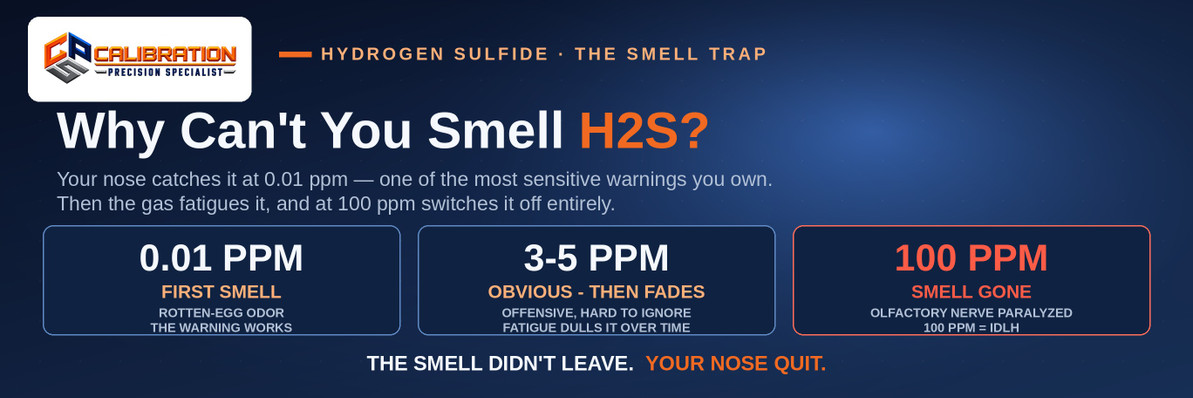
You can't smell hydrogen sulfide at high concentrations because the gas disables your sense of smell: most people first detect its rotten-egg odor at 0.01 to 1.5 ppm, but with continued exposure olfactory fatigue dulls the smell, and at 100 ppm — the concentration NIOSH classifies as Immediately Dangerous to Life or Health (IDLH) — H2S paralyzes the olfactory nerve, with OSHA's effects table listing loss of smell within 2 to 15 minutes. The fading smell does not mean the gas is gone; it means your nose has quit, often while the concentration is unchanged or rising.
Hydrogen sulfide is the rare hazard that comes with its own warning label built into the human body — and then corrupts it. Almost every other deadly industrial gas problem starts with "you can't detect it without an instrument." H2S starts with the opposite problem: you can detect it, superbly, at levels far below danger — and that early success teaches a trust the gas later exploits. This post climbs the concentration ladder rung by rung: what your nose reports at each level, what the gas is actually doing to the nerve behind the report, why the smell can come back and mislead you a second time, and what workers in H2S country — wastewater plants, sewers, oil and gas fields, manure pits, pulp mills — wear instead of relying on the oldest sensor they own. For the industry where this kills most quietly, see our companion post on why hydrogen sulfide is so dangerous in wastewater.
At What Concentration Can You Smell Hydrogen Sulfide?
Lower than almost anything else you will ever meet at work. The published odor threshold for H2S is 0.01 to 1.5 ppm — the range across which people first notice the rotten-egg smell — and some individuals detect it lower still. For scale, that threshold sits roughly one hundred to ten thousand times below the concentrations that injure, which is why the smell feels like such a dependable alarm:
- 0.01–1.5 ppm — first noticeable rotten-egg odor. The warning is genuine: H2S is present.
- 3–5 ppm — the odor becomes offensive, hard to ignore. This is the level that convinces people their nose is a reliable instrument.
- Around 30 ppm — the odor's character changes to sweet or sickeningly sweet. Most people do not recognize this as the same gas getting stronger; it reads as a different smell, not a worse one.
Notice what the ladder is doing. The signal is loudest — unmistakable, offensive, impossible to sleep through — at concentrations twenty to thirty times below the danger line. Every experience a worker has with H2S at these levels teaches the same lesson: "when it's bad, I'll smell it." The lesson is true at 3 ppm. It is lethally false at 100.
Why Does the Smell Fade? Olfactory Fatigue
Part of the answer is ordinary physiology that has nothing to do with poison. Your sense of smell is built to report change, not steady state: hold any constant odor in front of it — perfume you put on this morning, a scented candle, the background smell of your own plant — and the receptors progressively stop reporting it. That adaptation is called olfactory fatigue, and under normal circumstances it is a feature: it frees your attention for the new smell, the one that might matter.
H2S weaponizes the feature in two stages:
Stage one — fatigue. With continued exposure at moderate levels, the smell of H2S dulls even though the concentration has not changed. A worker who enters an area, registers a strong odor, and works on will, minutes later, perceive a weaker smell — and the only instrument he is consulting tells him conditions are improving. They are not. His receptors have adapted; the atmosphere is whatever it was, or worse.
Stage two — paralysis. At higher concentrations the mechanism stops being adaptation and becomes damage to the signal path itself. In the 100 to 150 ppm range, H2S overwhelms the olfactory nerve — the safety literature's term is olfactory paralysis — and smell does not fade, it ends. This is not the nose getting used to the gas. It is the gas switching the nose off.
The distinction matters because the rescue logic differs. A fatigued nose recovers (more on that below, and on why the recovery is its own trap). A paralyzed one means the worker has already absorbed a dose at the IDLH level — and, critically, he received his loudest warning half an hour earlier, at a concentration he could have walked away from.
What Happens at 100 ppm — the IDLH, Where the Smell Shuts Off
The cruelest number in H2S safety is the coincidence at the center of the ladder: 100 ppm is both the NIOSH IDLH and the level at which the smell disappears. IDLH — Immediately Dangerous to Life or Health — is defined by its effect on escape: a concentration that interferes with a worker's ability to get out. H2S earns the classification in part precisely because of what it does to the warning system. OSHA's concentration-and-effect table for the 100 ppm row reads like a countdown:
| At 100 ppm | Time |
|---|---|
| Coughing, eye irritation, loss of smell | 2–15 minutes |
| Altered breathing, drowsiness | 15–30 minutes |
| Throat irritation | 1 hour |
| Death may occur | after 48 hours |
And the ladder does not stop at the IDLH. At 500 to 700 ppm, staggering and collapse arrive within 5 minutes. At 700 to 1,000 ppm, H2S causes rapid unconsciousness — "knockdown" — within one to two breaths, breathing stops, and death follows within minutes. A worker whose nose quit at 100 ppm and who reads the silence as safety is standing at the bottom of that staircase, unable to smell the next five hundred ppm at all.
Here is the full smell ladder in one view — what your nose reports versus what is actually happening:
| Concentration | What your nose reports | What is actually happening |
|---|---|---|
| 0.01–1.5 ppm | First rotten-egg smell | Trace H2S present — the warning is genuine |
| 3–5 ppm | Offensive, hard to ignore | Still 20–30× below the IDLH |
| ~30 ppm | Odor turns sweet, sickeningly sweet | Same gas, stronger — most people don't recognize it |
| 50–100 ppm | Smell may seem to fade as you stay | Eye and throat irritation building; fatigue setting in |
| 100 ppm | Smell disappears in 2–15 minutes | IDLH — the olfactory nerve is paralyzed |
| 100–150 ppm | Nothing | Olfactory fatigue/paralysis (OSHA) |
| 700–1,000 ppm | Nothing you will ever report | Knockdown in 1–2 breaths |
Why Is the Fading Smell So Dangerous? The Trap, Step by Step
Put the pieces together in the sequence they actually happen in the field:
- The worker smells H2S and is reassured by smelling it. Detection feels handled. He has, in his own mind, a running monitor: his nose.
- The smell fades. Fatigue — or, at 100 ppm, paralysis — removes the signal. His monitor now reads zero.
- He interprets the zero the way every human interprets a fading alarm: the hazard passed. "It cleared out." "The pump cycle ended." "Must have been a whiff off the surface."
- Meanwhile the concentration is unchanged or rising. H2S is rarely steady. It is stored dissolved in sewage, sludge, and process liquids and released in pulses when they are disturbed — a pump start, a jetting pass, sludge being moved. The release that follows the fade can be the biggest one of the shift.
- And the gas is not where his nose was. H2S is heavier than air (vapor density 1.19), so it pools at the bottom of wet wells, manholes, pits, and tanks — the subject of our explainer on where gas goes when it leaks. The air at the rim, where he stood when he "checked," can be a fraction of the air at the work level below him.
Every step is reasonable. The conclusion is fatal. That is what makes the smell trap different from simple carelessness: it is not workers ignoring a warning, it is workers obeying a warning system that has been turned off by the hazard itself. The wastewater industry's version of this sequence — and the incident pattern where a second worker enters to rescue the first and collapses in the same air — is documented in our post on H2S in wastewater.
Does Your Sense of Smell Come Back After H2S Exposure?
Usually, yes — and that is the last turn of the trap. Olfactory fatigue is temporary: take the nose out of the odor and, given time in clean air, sensitivity recovers. The worker who climbs out of a structure for lunch can smell H2S again when he returns — and now he has a new piece of false evidence. He smelled it this morning, it faded, he left, he smells it again now, and the story his senses tell him is that the smell tracks the gas: present when present, gone when gone. Nothing in that story is true at the concentrations that matter. What recovered was his nose. The space kept its own schedule the whole time.
Two more honest complications:
- Noses differ. The published odor threshold is a range — 0.01 to 1.5 ppm — because sensitivity varies widely from person to person, and some individuals are far less sensitive than the average the range is built on. A coworker saying "I can barely smell anything" may be reporting his own threshold, not the atmosphere. Add a head cold, allergies, or a respirator half-mask worn wrong, and two people in the same space can honestly give opposite reports about the same air.
- Recovery is not an all-clear. A smell that returns after a break tells you the receptors reset. It tells you nothing about whether the concentration in the space fell, held, or tripled while you were gone. Only an instrument answers that question, and it answers it in numbers.
The rule that follows is the one written into every competent H2S program: odor is evidence of presence, never evidence of absence. If you smell H2S, gas is there. If you stop smelling it, you have learned something about your nose and nothing about the air.
What Actually Warns You? The Instrument in Your Breathing Zone
The fix is not a better nose; it is replacing the nose's job with a sensor that does not adapt, does not fatigue, and does not get paralyzed at the IDLH. An electrochemical H2S cell reports the same concentration at minute forty as at minute one, and it alarms at setpoints chosen to leave an escape margin — H2S programs commonly alarm at or below the NIOSH ceiling of 10 ppm, a full factor of ten below the concentration where your smell quits. The layers work the same way they do in wastewater:
- A personal H2S monitor on every worker in H2S areas, clipped in the breathing zone — the air the worker actually breathes, not the air at the hatch. SENKO's SP-SGT disposable single-gas detector covers H2S (0–100 ppm) at $163 and runs its service life with no sensor or battery changes; RKI's HS-04 ($205) is a dedicated 0–200 ppm H2S monitor. The full range is in single-gas monitors.
- A multi-gas monitor for anyone who descends. H2S below grade rarely travels alone — the same oxygen-free conditions displace oxygen and generate methane — so entries are made on a 4-gas instrument like the RKI GX-3R ($640), with the space tested from outside, top to bottom, before entry: the sequence in our post on how to test a confined space before entry.
- Bump testing and calibration behind both. An electrochemical cell that has drifted or aged reads low in real gas — a displayed all-clear that is nearly as dangerous as a paralyzed nose, because it is wrong in the same direction. The instrument only replaces the nose if it is verified: bump test before the day's use, calibrate on schedule.
- And the behavioral rule that costs nothing: an alarm is an exit, immediately, and a faded smell is never a re-entry permit. Investigate from clean air, with an instrument, from outside the space.
Frequently Asked Questions
Why can't you smell hydrogen sulfide at high concentrations? Because at 100 ppm and above, hydrogen sulfide paralyzes the olfactory nerve — the nerve that carries smell. OSHA's effects table lists loss of smell within 2 to 15 minutes at 100 ppm, and the 100–150 ppm range is classified as olfactory fatigue or paralysis. The gas does not become odorless; your detector for it is switched off, at exactly the concentration NIOSH sets as the IDLH.
At what ppm can you smell hydrogen sulfide? Most people first smell hydrogen sulfide at 0.01 to 1.5 ppm — the published odor threshold range for its rotten-egg odor — and some detect it lower. By 3 to 5 ppm the smell is offensive and hard to ignore. That sensitivity is real, but it describes the bottom of the ladder only: the warning is loudest at concentrations twenty to thirty times below the dangerous range.
What does hydrogen sulfide smell like? Rotten eggs — at low concentrations. Around 30 ppm the odor's character changes to sweet or sickeningly sweet, a shift most people do not recognize as the same gas getting stronger. And above 100 ppm it smells like nothing at all, because the olfactory nerve is paralyzed. An H2S smell that changes character, or fades, is a reason to leave and test with an instrument — never a reason to relax.
What is olfactory fatigue? Olfactory fatigue is the temporary loss of sensitivity to a constant odor: your smell receptors adapt to an unchanging stimulus and stop reporting it, the way you stop noticing perfume you are wearing. With hydrogen sulfide it happens with continued exposure at moderate levels, long before outright paralysis — the smell seems to weaken while the concentration is unchanged. It is the first stage of the H2S smell trap, and it is why a fading odor can never be read as a clearing atmosphere.
At what level does hydrogen sulfide paralyze your sense of smell? At about 100 ppm. OSHA's table records loss of smell after 2 to 15 minutes at 100 ppm and classifies 100–150 ppm as olfactory fatigue or paralysis. The number deserves emphasis because of what it coincides with: 100 ppm is also the NIOSH IDLH for H2S — the level defined as immediately dangerous to life or health. The warning system fails at the exact concentration where escape becomes urgent.
If the rotten-egg smell goes away, is the hydrogen sulfide gone? No — that inference is the trap that kills. A fading H2S smell means your receptors have fatigued or, at 100 ppm and above, your olfactory nerve has been paralyzed; it says nothing about the concentration, which may be unchanged or rising. H2S is also released in pulses when sewage, sludge, or process liquids are disturbed, so the largest release can come after the smell fades. Treat a vanished smell as a failed warning, exit, and test from clean air with an instrument.
Does your sense of smell come back after hydrogen sulfide exposure? Generally yes: olfactory fatigue is temporary, and after time in clean air the sense of smell recovers. That recovery is itself misleading — a worker who leaves and returns can smell the gas again and conclude the smell tracks the concentration, when all that recovered was his nose. A returning smell is not an all-clear and a missing smell is not an all-clear; only a calibrated instrument measures the air.
Why can one person smell H2S and another person can't? Because odor thresholds vary widely between people — the published H2S threshold is a range, 0.01 to 1.5 ppm, precisely because sensitivity differs, and some individuals are far less sensitive than average. Colds, allergies, and nasal congestion blunt smell further. Two workers in the same atmosphere can honestly report different smells, which is why "I can't smell anything" from one crew member never clears a space for anyone.
Is 100 ppm hydrogen sulfide dangerous? Yes — 100 ppm is the NIOSH IDLH for hydrogen sulfide, the level classified as Immediately Dangerous to Life or Health. At 100 ppm OSHA's table lists coughing, eye irritation, and loss of smell within 2 to 15 minutes, altered breathing and drowsiness within 15 to 30 minutes, and death may occur after 48 hours. Above it the ladder steepens fast: collapse within 5 minutes at 500–700 ppm and knockdown within one to two breaths at 700–1,000 ppm.
How do you detect hydrogen sulfide if you can't smell it? With a personal gas monitor worn in the breathing zone. An electrochemical H2S sensor does not fatigue or lose sensitivity at the IDLH the way the olfactory nerve does, and monitors alarm at setpoints far below 100 ppm, leaving time to escape. At CPS, the SENKO SP-SGT covers H2S (0–100 ppm) at $163 and the RKI HS-04 covers 0–200 ppm at $205; workers entering spaces where H2S can collect go on a 4-gas monitor such as the RKI GX-3R ($640). Bump test before use and calibrate on schedule — an unverified monitor is just a quieter version of the same false confidence.
The Bottom Line
You can't smell hydrogen sulfide at high concentrations because the gas takes the sense away: a superb warning at 0.01 ppm, dulled by olfactory fatigue as exposure continues, and switched off entirely at 100 ppm — the IDLH — where OSHA clocks the loss of smell at 2 to 15 minutes. Every part of that design invites the same fatal misreading, that a fading smell means clearing air. It means the opposite of information: your nose has quit, the concentration is whatever it is, and the only report worth acting on comes from an instrument that doesn't adapt, doesn't fatigue, and doesn't get paralyzed. Smell H2S and you know it's present. Stop smelling it and you know nothing — get out, and let a monitor do the smelling.
Working around H2S? Put a real sensor in the breathing zone — start with single-gas monitors like the SENKO SP-SGT ($163 in H2S configuration) or the RKI HS-04 ($205) — and read how the same trap plays out plant-wide in why hydrogen sulfide is so dangerous in wastewater. Not sure which layer your crew is missing? Call us at 865-900-8844.
CPS Calibrations · 109 S. Front Street, Rockwood, TN 37854 · Calibration Gas · Calibration Services · Contact Us
Recent Posts
-

PID vs. LEL for VOC Detection: Which Sensor Do You Actually Need?
Use a PID to detect VOCs and an LEL sensor to detect explosive atmospheres — they measure different …Oct 21st 2026 -

Semiconductor (MOS) Gas Sensors: Where They Work and Where They Lie
A semiconductor (MOS) gas sensor measures gas with a heated film of metal oxide — usually tin dioxid …Oct 21st 2026 -

What Do Firefighters Use a Gas Meter For?
Firefighters use a gas meter — usually a 4-gas monitor reading oxygen (O₂), combustible gas as a per …Oct 21st 2026