
What Happens When a Gas Detector Sensor Is Poisoned — and Can It Be Recovered?
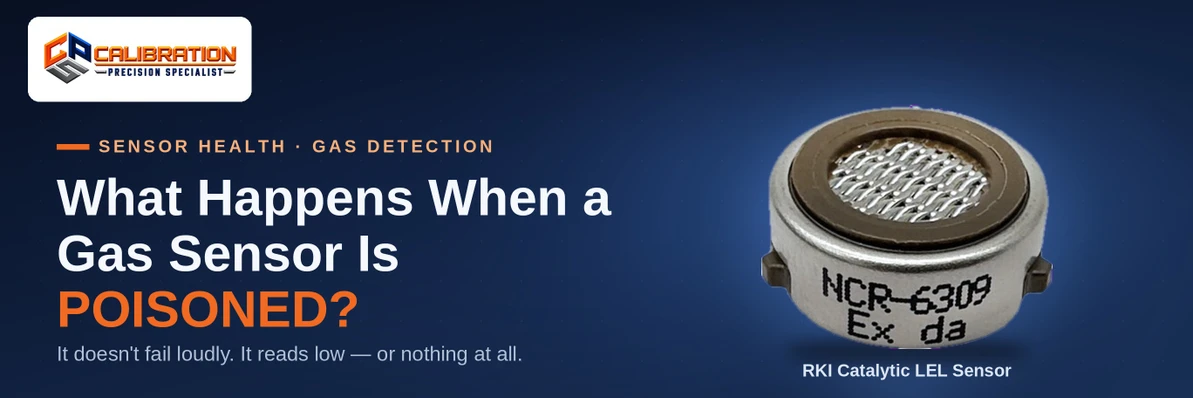
A poisoned catalytic LEL sensor does not read high or throw an error — it reads low, or zero, in combustible gas that is actually there, and it responds more slowly the worse the poisoning gets. True poisoning is permanent: silicones, lead, and sulfur compounds coat or react with the catalyst, and no cleaning or calibration restores it — the sensor has to be replaced. Temporary inhibition is different: halogenated compounds can desensitize a bead for a while, and that sensor can often recover in clean air.
Here is the uncomfortable part. A poisoned sensor's zero still looks perfect. The instrument powers up normally, sits at 0% LEL in clean air, and gives you no fault code — because nothing is electronically wrong with it. The failure is chemical, it is silent, and the only routine check that exposes it is putting known gas on the sensor: a bump test. This post covers what poisoning actually is, how a poisoned sensor reads and responds, how you catch it, and the honest answer on recovery.
First, How a Catalytic Bead Sensor Works
A catalytic bead sensor (also called a pellistor) holds two small beads in a bridge circuit. The active bead is coated with a catalyst and electrically heated to several hundred degrees; the reference bead is identical but inactive, so it cancels out changes in temperature, pressure, and humidity. When combustible gas reaches the hot catalyst, it oxidises — effectively burns — on the bead's surface. That combustion adds heat, the bead's electrical resistance rises, the bridge unbalances, and the instrument converts the change into a %LEL reading. No burn, no signal: everything a catalytic sensor reports starts with gas physically burning on that catalyst surface. That is also exactly why poisoning is so effective against it — block the catalyst, and you block the measurement at its source. (How the reading itself is scaled is covered in our post on what LEL means.)
Poison or Inhibitor? The Difference Decides Everything
Manufacturers draw a hard line between two kinds of contamination, and the line decides whether your sensor lives or dies.
Poisons cause permanent damage. Honeywell's LEL sensor guidance lists the acute poisons plainly: silicone-containing compounds, lead-containing compounds, sulfur-containing compounds, phosphates and phosphorus-containing compounds, and HMDS (hexamethyldisilazane). These substances coat the catalyst or react with it, and the sensitivity they take does not come back. Honeywell's sensor health-and-safety note for its catalytic sensors says the same of silicones, chlorinated hydrocarbons, and compounds containing lead or sulfur: they "can cause an irreversible decrease in sensitivity."
Inhibitors cause temporary sensitivity loss. Honeywell classifies hydrogen sulfide, halogenated hydrocarbons (Freons, trichloroethylene, methylene chloride), and styrene as chronic poisons — "also called inhibitors" — that act more slowly, and notes that exposure to clean air will often let the sensor "burn off" these compounds. MSA's LEL sensor training material draws the same distinction: inhibitors bond to the catalyst's reaction sites and can be reversed, while poisons bond permanently. Industrial Scientific describes inhibitors the same way — they desensitize the bead and may shorten its life, but after a calibration and bump test the sensor may still be usable.
One honest complication: manufacturers do not all file the same chemical in the same drawer. Sulfur compounds appear on Honeywell's acute-poison list, while other industry sources treat sulfides mainly as inhibitors whose effect ranges from temporary to unrecoverable depending on dose. Treat any sulfur exposure as serious, test the sensor, and let the bump test — not a chart — decide.
What Poisons a Catalytic LEL Sensor?
Silicon is the poison you will actually meet. Honeywell calls silicon the most common of the acute poisons and lists where it hides: lubricants, adhesives, silicone rubbers including caulking and sealant compounds, waxes and polishes, and firefighting and vapor-suppression foams. Its guidance adds the everyday traps — do not use polishes, cleaners, or lubricants containing silicones around the instrument, and even cosmetic or medicinal hand creams containing silicones are a hazard to a sensor being handled. MSA's training material puts silicone in the highest poison category and names caulks, epoxies, silicone-based cleaning products, greases, and degreasers.
The dose required is small. Honeywell: "Just a few parts per million (ppm) of these compounds are sufficient to degrade the sensing performance of a catalytic bead LEL sensor," and poisoning is dosage dependent — concentration multiplied by time. Sensor maker Nemoto's pellistor technical note likewise puts the threshold for silicones and organometallic compounds (tetraethyl lead, organophosphorus compounds) at levels above about 2 ppm in continuous exposure, with permanent effect. Lead compounds, phosphate esters, and sulfur compounds round out the classic poison list; high concentrations of combustible gas itself can add a physical version of the same problem, laying down carbon soot on the bead.
How a Poisoned Sensor Reads and Responds
This is the section that matters in the field, because a poisoned sensor does not behave like a broken instrument. It behaves like a healthy instrument that has quietly lost its hearing.
- It under-reads, in proportion to the sensitivity it has lost. The reading error is a scaling error, not an offset. As an illustration of the math: if poisoning has taken half the sensor's sensitivity, an atmosphere that is truly at 50% LEL will display about 25% LEL. Half the sensitivity, half the reading — all the way down.
- At the end of the process, it reads zero in real gas. A fully poisoned bead cannot burn gas at all, so it produces no signal no matter how much combustible gas is present. One widely retold industry case describes a poisoned sensor that "would happily read zero all day long" in a high gas concentration — and was only caught because someone bump-checked it.
- It responds more slowly. Inhibition and partial poisoning slow the sensor as well as shrink it — industry guidance on inhibitors notes they slow sensor response and can leave a sensor unable to measure methane while it still responds to pentane, because methane is the harder gas to burn. A bump test that eventually gets there, but takes far too long doing it, is a sensor telling you something.
- Its zero is perfect — and meaningless. Zero only proves the sensor reads nothing in air that has nothing in it. A poisoned sensor zeros beautifully. Only span gas exposes lost sensitivity, which is why a detector can pass every power-up self-check and still be blind.
- Its alarms may never fire. Alarms trigger on the displayed value, not the true one. If poisoning halves the reading, the true atmosphere has to reach twice the alarm setpoint before the instrument reacts — and a fully poisoned sensor never reaches the setpoint at all.
- Calibration "fixes" it — briefly, then stops working. Early sensitivity loss can be spanned back up: the calibration raises the gain to compensate. But the catalyst keeps losing ground, so calibrations are needed more often, the span adjustment grows each time, and eventually there is not enough signal left to adjust — the calibration fails outright. Industrial Scientific's version is blunt: if the sensor is poisoned, it will not be able to read the calibration gas applied and will show a failed calibration.
None of this announces itself. There is no "poisoned" fault code, because the electronics are fine. Which leads to the only defence that works.
How You Catch It: The Bump Test Is the Whole Game
Every manufacturer source on this subject lands in the same place: poisoning can only be identified by applying known gas. Industrial Scientific: if there is any chance the LEL sensor may have been poisoned, calibrate it immediately — a sensor that reads the calibration gas and responds will detect gas in the field; a poisoned one fails. The daily bump test is the routine version of that check, and it is the only point in a detector's day where it has to prove it can still see gas. A bump that fails, or that creeps up slowly instead of snapping to value, means the instrument comes out of service — not after the shift, now. (When a bump fails, work through the non-sensor causes too — our post on why bump tests fail covers the full list.) If poisoning is suspected after a known exposure — a silicone spray used nearby, a sealant job, a foam discharge — do not wait for tomorrow's bump: test with certified calibration gas immediately, in clean air, and judge the response time as well as the number.
Can a Poisoned Sensor Be Recovered?
Split the answer the way the manufacturers do.
Inhibited — often, yes. If the contamination is an inhibitor, running the sensor in clean air can burn the compounds off the catalyst and restore sensitivity. Retest afterwards with a bump test and a full calibration before returning the instrument to service — "recovered" is something the gas proves, not something the clock proves. Repeated or heavy inhibitor exposure can still end the sensor: Honeywell warns that operated continuously in an atmosphere containing these chemicals, catalytic bead output ultimately falls to zero.
Poisoned — no. Industrial Scientific states it without hedging: once these poisons encapsulate the catalytic bead, there is no way to remove them and the sensor must be replaced. There is no washing procedure, no solvent soak, no burn-off cycle that strips a silicone or lead layer off a catalyst and hands you back the original sensor. Anyone selling you a cleaning fix for a truly poisoned catalytic bead is selling you a detector that still reads low. Replacement is the repair — for a common instrument it is a modest part: a genuine RKI catalytic LEL replacement sensor for the GX-3R family is $160 at CPS, and the swap is a bench job, not a new instrument.
What About the Other Sensor Types?
- Infrared (IR) LEL sensors cannot be poisoned. There is no catalyst to coat — the sensor measures light absorption. Industrial Scientific lists IR sensors as "not susceptible to poisons and inhibitors that can damage catalytic bead LEL sensors," and Honeywell describes its infrared LEL sensor as immune to airborne contaminants such as greases and silicones. Dirt or condensation on the optics can still block the light path, and standard IR cannot see hydrogen at all — but the poisoning failure mode simply does not exist. Our catalytic bead vs. infrared comparison works through when that immunity is worth paying for. Poison-resistant catalytic sensors are the middle path: they tolerate exposure better, but no catalyst is poison-proof under continuous exposure.
- Electrochemical toxic sensors are damaged differently. They are not coated the way a catalyst is, but OSHA's calibration guidance lists exposure damage among the routine causes of sensor drift and failure — sustained over-range gas, corrosive gases, and solvent vapours degrade electrodes and electrolyte, showing up as drift, slow response, and eventually a sensor that will not calibrate. Some of that is recoverable rest-and-recalibrate territory; a sensor that has been chemically beaten up usually is not. Their related quirk — responding to the wrong gas entirely — is covered in our post on electrochemical cross-sensitivities.
- Oxygen cells are consumed rather than poisoned. A galvanic O₂ cell is a battery that burns itself up measuring oxygen; its end looks like poisoning's end (weak, slow, won't hold calibration) but the cause is exhaustion, not contamination — the subject of our post on why oxygen sensors die.
- PID sensors foul — and fouling can be cleaned. A PID losing sensitivity is usually looking at a dirty lamp window, not a dead sensor. Honeywell's own troubleshooting for a PID that is losing sensitivity but still calibrates points first at the lamp: clean it, recalibrate, and verify in the field. That contrast is the cleanest way to remember the whole subject — a fouled lamp wipes clean; a poisoned catalyst does not.
How Do You Prevent Sensor Poisoning?
- Keep silicones away from instruments. No silicone sprays, sealants, lubricants, waxes, or polishes on or near a detector that is powered on — a heated bead pulls vapor straight onto the catalyst. Do not store detectors where silicone products are curing.
- Watch the invisible exposures. Hand creams, cleaning products, mold-release agents, and adhesives all carry silicones; Honeywell's guidance extends to not using plastic parts made with silicone mold-release agents and silicone-rubber gaskets around LEL sensors.
- Use the manufacturer's filters where offered, and change them on schedule — Honeywell recommends changing the filter weekly in poison-prone service, or immediately after a known exposure. Filters trade away some response to heavy hydrocarbons, so fit them for the environment, not by default.
- Cut exposure time. Turn the monitor off when it is not in use in a contaminated area, and clean the pump and replace tubing, filters, and gaskets after a serious exposure so the instrument does not keep dosing itself.
- Bump test daily, without exception. Prevention fails quietly; the bump test is what turns a silent failure into a caught one. A detector whose history you do not know — borrowed, rented, back from another crew — gets bumped before it gets trusted.
What to Do If You Suspect Poisoning
- Take the instrument out of service. A detector you suspect is not a detector you carry into the next space while you "keep an eye on it."
- Test it in clean air with certified gas. Bump test first; if the response is low or slow, run a full zero-and-span calibration with calibration gas you trust. Methane-based test gas is the sternest test of a catalytic bead — a tired sensor loses methane first.
- If it recovers fully and promptly, it was most likely inhibition: document it, watch it, and bump it before every use.
- If it fails, responds slowly, or needs a huge span adjustment, replace the sensor. Do not keep re-calibrating a dying bead back into service — each "successful" calibration buys a detector that reads lower than the truth. CPS's calibration services bench runs exactly this triage: we calibrate every channel, and when a channel won't calibrate, we tell you which sensor it needs and fit the genuine part.
Frequently Asked Questions
Can a poisoned gas detector sensor be fixed? A truly poisoned catalytic LEL sensor cannot be fixed — Industrial Scientific states that once poisons encapsulate the catalytic bead there is no way to remove them, and the sensor must be replaced. An inhibited sensor is a different case: inhibition is temporary sensitivity loss, often from halogenated compounds, and it can frequently recover in clean air, after which a bump test and full calibration prove whether it is back. "Poisoned" means replaced; "inhibited" means retest.
What poisons a catalytic LEL sensor? Honeywell's LEL guidance lists the acute poisons: silicone-containing compounds, lead-containing compounds, sulfur-containing compounds, phosphates and phosphorus-containing compounds, and HMDS. Silicones are the most common in practice — they are in lubricants, adhesives, caulks and sealants, waxes and polishes, and firefighting foams. Honeywell warns that just a few parts per million of these compounds are enough to degrade a catalytic bead's performance.
What are the signs of a poisoned LEL sensor? The signs only appear when the sensor is challenged with gas: readings that come in low against known gas, a bump test that fails or responds unusually slowly, calibrations needed more and more often with growing span adjustments, and finally a failed calibration. In clean air there are usually no signs at all — the zero reads a perfect 0% LEL, the instrument shows no fault, and that false normality is exactly what makes poisoning dangerous.
Will a poisoned sensor pass a bump test? A fully poisoned sensor will not — it cannot respond to the bump gas, which is precisely why the daily bump test is the defence against poisoning. A partially poisoned or inhibited sensor may eventually trigger the bump alarms but respond slowly or read low, and that counts as a fail too: bump criteria include response within the manufacturer's time and reading limits. Industry guidance adds that methane bump gas exposes a weakening catalytic sensor earliest, because methane is the hardest common gas for the bead to burn.
Can you clean a poisoned catalytic sensor? No. There is no wash, solvent, or burn-off procedure that removes a poison layer — silicone, lead, and similar poisons bond to or coat the catalyst permanently, and the lost sensitivity does not come back. Cleaning is the right remedy for a different problem: a fouled PID lamp, which Honeywell's troubleshooting does tell you to clean when a PID loses sensitivity. For a poisoned catalytic bead, the repair is a replacement sensor.
Does silicone poison a gas sensor? Yes — silicone is the most common acute poison of catalytic LEL sensors, per Honeywell. It reaches the bead as vapour from sealants and caulks, silicone lubricants, adhesives, waxes and polishes, mold-release agents, and even silicone-containing hand creams, then breaks down on the hot catalyst and coats it. The effect is permanent and dosage dependent: a heavy exposure can damage a sensor quickly, and low-level exposure accumulates — sensor maker Nemoto puts the noticeable-effect threshold at above about 2 ppm in continuous exposure.
What's the difference between sensor poisoning and inhibition? Poisoning is permanent: substances like silicones and lead compounds coat the catalyst or react with it, the sensitivity loss is irreversible, and the sensor must be replaced. Inhibition is temporary: halogenated compounds and similar vapours bond to the catalyst's reaction sites and desensitize the bead, but exposure to clean air can burn them off and restore response — MSA's sensor training draws exactly this line. Repeated or continuous inhibitor exposure can still kill the sensor, so "temporary" is a description of one exposure, not a lifetime guarantee.
Will calibration fix a poisoned sensor? No — calibration can only compensate while sensitivity remains. Early on, a span calibration raises the instrument's gain and the readings come back, but the catalyst keeps losing sensitivity, the adjustments grow, and eventually the sensor cannot reach the calibration value at all: Industrial Scientific notes that a poisoned sensor will not be able to read the calibration gas applied and will show a failed calibration. A detector needing ever-more-frequent calibration is showing you the poisoning timeline.
Can an infrared gas sensor be poisoned? No. An infrared LEL sensor has no catalyst — it measures how much infrared light the gas absorbs — so catalytic poisoning does not apply. Industrial Scientific states IR LEL sensors are not susceptible to the poisons and inhibitors that damage catalytic bead sensors, and they are also not damaged by high gas concentrations. Their real limits are different: fouled or blocked optics, and blindness to hydrogen, which standard IR LEL sensors cannot detect.
How long does sensor poisoning take? It depends on dose — concentration multiplied by exposure time — and Honeywell states plainly that catalytic LEL poisoning is dosage dependent. A single heavy exposure to a silicone spray or similar poison can damage a sensor in one event; low-level exposure to a few parts per million degrades performance gradually over days to weeks of accumulated exposure. There is no safe timetable to plan around, which is why the daily bump test, not the calendar, is the control.
The Bottom Line
A poisoned LEL sensor is the failure mode with no alarm of its own: it reads low or zero, responds late, zeros perfectly, and lets calibration buy it a little time before it fails for good. Poisons — silicones above all — end the sensor permanently; inhibitors cost it sensitivity it can often win back in clean air. You cannot see either condition without putting gas on the sensor, so the routine is simple: keep silicones away from your instruments, bump test every day, and when a bead fails or crawls, replace it instead of coaxing it.
Detector reading low, slow, or failing its bump? Send it to the bench or call us first — 865-900-8844 — or reach us through Contact Us. We calibrate every channel — and when a channel won't calibrate, we'll tell you straight whether it's a cleaning, a recovery, or a sensor.
CPS Calibrations · 109 S. Front Street, Rockwood, TN 37854 · Calibration Gas · Calibration Services · Contact Us
Recent Posts
-

What Is a Confined Space? OSHA's Definition, the 3 Tests, and When It Becomes Permit-Required
A confined space is a space that passes all three of OSHA's tests at the same time: it is large enou …Oct 21st 2026 -

PID vs. LEL for VOC Detection: Which Sensor Do You Actually Need?
Use a PID to detect VOCs and an LEL sensor to detect explosive atmospheres — they measure different …Oct 21st 2026 -

Semiconductor (MOS) Gas Sensors: Where They Work and Where They Lie
A semiconductor (MOS) gas sensor measures gas with a heated film of metal oxide — usually tin dioxid …Oct 21st 2026