
How Do You Bump Test a Gas Detector? A Step-by-Step Guide
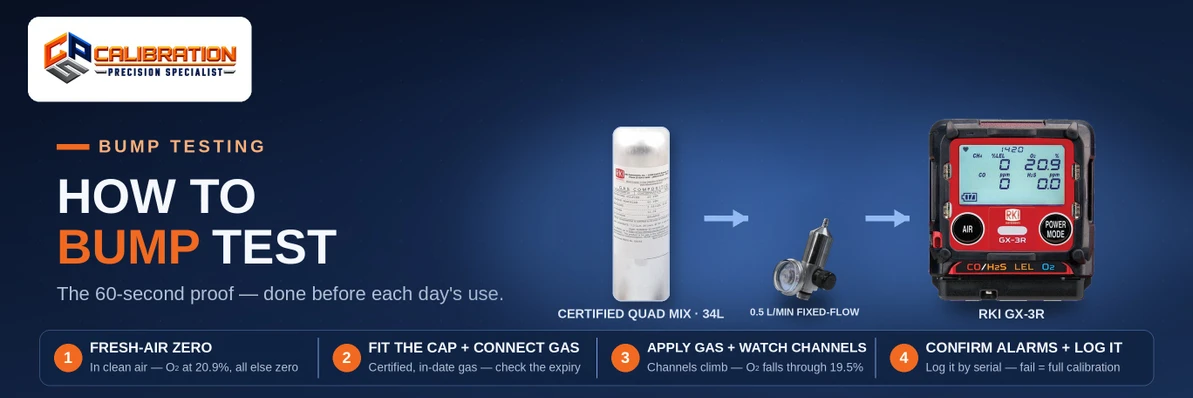
To bump test a gas detector, take it to air you know is clean, zero it, then apply certified test gas at a concentration high enough to trigger the alarms and confirm that every sensor responds and every alarm — audible, visual, and vibrating — activates. OSHA's Safety and Health Information Bulletin on direct-reading monitors, which carries the ISEA position statement, says a bump test or calibration check should be conducted before each day's use in accordance with the manufacturer's instructions; an instrument that fails the bump test gets a full calibration before further use, and one that fails calibration comes out of service.
That is the whole job. It takes about a minute, it uses a few cents' worth of gas, and it is the only routine check that proves the complete chain — sensor, electronics, and alarms — works before a worker trusts it. This guide walks the procedure step by step, what a genuine pass looks like, and what to do when it isn't one. If your question is instead why instruments fail this test, that is a separate post — why bump tests fail — and if you want the bump test's place next to full calibration, see bump test vs. calibration.
What Is a Bump Test, Exactly?
OSHA defines the bump test (also called a function check) as a qualitative check in which a challenge gas is passed over the sensors at a concentration and for an exposure time sufficient to activate all alarm settings. Its purpose is to confirm two things: that gas can actually reach the sensors, and that all of the instrument's alarms function. OSHA is equally clear about what it is not — a bump test does not provide a measure of the instrument's accuracy. A detector can pass a bump test while reading 15% low; proving accuracy is the calibration check's job, where the reading is compared against the cylinder's certified concentration (OSHA puts the typical acceptable window at ±10–20% of the test-gas concentration, with the manufacturer's tolerance governing).
So the daily rhythm the guidance describes is: bump test before each day's use; calibration check or full calibration on the manufacturer's schedule — and immediately whenever a bump test fails. Our post on how often gas detectors should be calibrated lays out those intervals brand by brand.
What Do You Need to Bump Test?
- The detector, charged, warmed up, and past its startup self-tests.
- Certified test gas, in date. OSHA's rules are blunt: only use certified, traceable test gas, and never use it after its expiration date. The concentration must be high enough to trigger the alarms — the standard quad mix most 4-gas instruments bump against is H₂S 25 ppm / CO 50 ppm / CH₄ 50% LEL / O₂ 12% in nitrogen, the mix in our 4-gas calibration gas listing ($184; 34 L cylinder $195). Which mix your instrument needs is covered in what calibration gas do you need for a 4-gas detector.
- The right regulator. A diffusion instrument bumped through a calibration cap takes a fixed-flow regulator matched to the manual — 0.5 L/min is the common specification (it is the flow BW's MicroClip manual calls for, for both its bump test and, as a range of 250–500 ml/min, its calibration). A pumped instrument or a docking station takes a demand-flow regulator instead. Our fixed-flow vs. demand-flow post explains why the pairing matters.
- The calibration cap or adapter for your model, with its hose — and nothing else. BW's manual is typical: only use the calibration cap during the calibration span process and for bump tests.
- A log. OSHA recommends documenting testing and keeping calibration records for the life of the instrument; a bump log by serial number is what turns "we test them" into proof.
Step by Step: How to Bump Test a Gas Detector
Step 1 — Go to air you know is clean, and power up there. The bump test starts in an atmosphere that is genuinely free of the target gases, at a normal 20.9% oxygen. Parking lots beat loading docks; anywhere near running engines, welding, or process vents can contaminate both the zero and the test. Let the instrument finish its startup sequence and sensor warm-up before you touch it.
Step 2 — Fresh-air zero. With the instrument in that clean air, run its zero (fresh-air) adjustment so the toxic and LEL channels read zero and oxygen reads 20.9%. This is the baseline the bump is judged against — zeroing in dirty air manufactures exactly the false baseline that later shows up as drifting or negative readings in clean air.
Step 3 — Fit the cap and connect the gas. Attach the calibration cap over the sensor area, with the hose running to the regulator on the test-gas cylinder. Check the cylinder label against the instrument's span settings and check the expiration date — out-of-date gas invalidates the test before it starts.
Step 4 — Apply the gas and watch every channel. Open the regulator and let the gas flow. Each toxic and LEL channel should climb toward the cylinder's concentration; the oxygen channel does the opposite, falling from 20.9% toward the mix's oxygen content (12% in the standard quad mix) and through its low alarm at 19.5%. A pumped instrument — or one on a long sample hose — needs the draw time added before the clock starts: the gas has to travel the hose before the sensors see any of it.
Step 5 — Confirm every alarm fires. This is the point of the exercise. Audible, visual, and vibrating alarms must all activate, on the channels the gas is challenging. BW's manual states the standard plainly: expose the detector to a gas concentration that exceeds the alarm setpoints and manually verify that the audible and visual alarms are activated. A sensor that responds but an alarm that stays silent is a failed bump test.
Step 6 — Close the regulator, remove the cap, let it clear, and log it. The detector will stay in alarm until the gas clears from the sensors — that is normal. Record the date, the instrument serial number, the result per channel, and the gas lot or expiration. Pass: the instrument goes to work. Fail: it goes to the next section, not into the field.
What Does a Pass Look Like?
| Channel | What you should see | What it proves |
|---|---|---|
| LEL | Reading climbs to the cylinder's %LEL (50% on a standard quad mix) and the alarms fire | The combustible sensor breathes and responds |
| O₂ | Reading falls from 20.9% toward the mix's O₂ content and crosses the 19.5% low alarm | The oxygen sensor is alive — on an oxygen-depleted mix, falling is the response |
| CO / H₂S | Readings climb to the labelled ppm (50 / 25 on the standard mix) and the alarms fire | The toxic sensors respond at real-world concentrations |
| All | Audible, visual, and vibrating alarms all activate | The warning chain a worker depends on is complete |
On timing: judge the response against the instrument's own specification, not a stopwatch habit. RKI, for example, specifies the GX-3R's response at within 30 seconds (T90) — a healthy instrument on a short cap connection should be most of the way to the cylinder value and into alarm in that order of time. Electrochemical toxics are the slow end of the set, and the oxygen channel's fall always looks lazier than the toxics' climb. Sluggish is a finding; absent is a failure.
What Do You Do When a Bump Test Fails?
The sequence is fixed by the guidance, and it has no branch that ends with "use it anyway":
- Full calibration, before further use. ISEA's position, carried in OSHA's bulletin: any instrument that fails a bump test must be adjusted by means of a full calibration procedure before further use. BW's manual says the same in fewer words — calibrate if the readings are not within the specified limits.
- If it fails the full calibration, remove it from service. A sensor that cannot be brought back to the certified gas value is done; OSHA's direction is to take the instrument out of service and contact the manufacturer or service — which is where our calibration services bench takes over.
- Do not confuse a failed test with a faulty test. Expired gas, the wrong regulator, and a cap that doesn't seal all fail good instruments. That differential diagnosis — gas, delivery, environment, then sensor — is the whole subject of why bump tests fail.
Bump Testing a Fleet: Docks Do This Automatically
Everything above is the manual method, and it stays the reference method — a dock does the same steps, mechanised. A docking station applies the gas, watches the response and the alarms, logs the result against the serial number, and flags failures for calibration, which the same dock then runs. The stations are strictly model-specific — our comparison of RKI calibration stations covers which dock fits which monitor and what each one automates. For a handful of instruments the manual test is a minute each; for a fleet reporting for a shift, the dock is what makes "before each day's use" actually happen every day.
The Bottom Line
Bump testing is a one-minute proof, done before each day's use: clean air, fresh-air zero, certified in-date gas through the right regulator and cap, every channel responding — oxygen by falling — and every alarm firing. It proves function, not accuracy; accuracy is calibration's job, on the manufacturer's schedule and immediately after any failed bump. Keep the gas in date, keep the log by serial number, and never let a failed instrument talk its way back into service.
Need the gas, the regulator, or a hand with a fleet's testing routine? CPS stocks the calibration gas and regulators for the instruments we sell and the ones we service — and we calibrate every channel, on the bench or at your site. Call 865-900-8844 or reach us through Contact Us.
Frequently Asked Questions
How do you bump test a gas detector? Take the instrument to air that is known to be clean, power it up and let it warm up, then run a fresh-air zero so the toxic and LEL channels read zero and oxygen reads 20.9%. Fit the calibration cap, connect certified in-date test gas through the correct regulator, and apply the gas. Every challenged channel should respond — toxics and LEL climbing toward the cylinder's concentrations, oxygen falling toward the mix's oxygen content — and the audible, visual, and vibrating alarms must all activate. Close the regulator, remove the cap, let the readings clear, and log the result against the instrument's serial number.
How often should you bump test a gas detector? Before each day's use. That is the ISEA position statement carried in OSHA's Safety and Health Information Bulletin on calibrating and testing direct-reading portable gas monitors, and it matches the manufacturers' instructions — BW, for example, recommends bump testing the sensors before each day's use with a gas concentration that exceeds the alarm setpoints. Also bump test after any event that could have hurt the instrument: a drop, immersion, an over-range alarm, or exposure to sensor poisons or contaminants.
Does a bump test prove a gas detector is accurate? No. OSHA defines the bump test as a qualitative function check: it confirms that gas can reach the sensors and that all the alarms work, and it does not provide a measure of the instrument's accuracy. Accuracy is verified by a calibration check — comparing the reading to the cylinder's certified concentration, typically within ±10–20% per OSHA, with the manufacturer's tolerance governing — or by a full calibration, which adjusts the reading to the certified value.
What gas do you use for a bump test? Certified, traceable test gas that has not passed its expiration date, at concentrations high enough to trigger the instrument's alarms. For most 4-gas instruments that is the standard quad mix — H₂S 25 ppm, CO 50 ppm, CH₄ 50% LEL, O₂ 12%, balance nitrogen ($184 at CPS; the 34 L cylinder is $195). OSHA's calibration rules are explicit: the instrument can only be as accurate as the test gas, the supplier should provide a certificate of analysis for every cylinder, and expired gas — particularly reactive gases like H₂S — must never be used.
How long should a bump test take? About a minute of gas application for a diffusion instrument on a calibration cap. Judge the response against the instrument's own specification: RKI specifies the GX-3R's response time at within 30 seconds (T90), so a healthy instrument should be most of the way to the cylinder value and into alarm in roughly that window. Pumped instruments and long sample hoses add the sample's travel time before the sensors see gas at all, and the oxygen channel — which responds by falling from 20.9% — always looks slower than the toxics' climb.
What happens if a gas detector fails a bump test? It does not go back into service. The ISEA protocol carried in OSHA's bulletin requires a full calibration before further use; if the instrument then fails the full calibration, it is removed from service for manufacturer assistance or repair — most often a sensor replacement. Failures are not always the sensor: expired gas, the wrong regulator flow, and a poorly sealing calibration cap all fail healthy instruments, so work the delivery chain before condemning the instrument.
Do you zero a gas detector before a bump test? Yes — zero first, in air you know is clean. The zero sets the baseline the bump is judged against: toxic and LEL channels at zero, oxygen at 20.9%. Zeroing in contaminated air teaches the instrument that the contamination is "zero," and the error follows it into clean air as drifted or negative readings. OSHA's bulletin likewise directs operators to zero the instrument before a calibration check to ensure the results are accurate.
Can you bump test with expired calibration gas? No. OSHA's calibration rules state that test gas must be certified and used before its expiration date — full stop. Reactive components such as hydrogen sulfide and chlorine are only stable for a limited period, so an expired cylinder can deliver less gas than its label claims: a healthy instrument then "fails," or worse, a weak instrument appears to respond adequately. An expired cylinder invalidates the test in both directions.
What is the difference between a bump test and a calibration check? A bump test is qualitative — gas on, alarms fire, done — and it proves function only. A calibration check is quantitative: the instrument is exposed to the same certified gas and its reading is compared with the cylinder's concentration; if the response falls within the manufacturer's acceptable range (typically ±10–20% of the test-gas concentration, per OSHA), accuracy is verified. A failed calibration check leads to a full calibration, which adjusts the instrument to read the certified value.
Do docking stations replace manual bump testing? They perform the same test automatically — applying the gas, judging the sensor response and alarms, logging the result by serial number, and running a full calibration when a bump fails. What they replace is the labour and the paperwork, not the requirement: the test still has to happen before each day's use. Docks are model-specific — an RKI SDM-3R only takes GX-3R-family instruments — so a mixed fleet may need more than one station, or a manual routine for the odd instruments out.
CPS Calibrations · 109 S. Front Street, Rockwood, TN 37854 · Calibration Gas · Calibration Services · Contact Us
Recent Posts
-

What Is a Confined Space? OSHA's Definition, the 3 Tests, and When It Becomes Permit-Required
A confined space is a space that passes all three of OSHA's tests at the same time: it is large enou …Oct 21st 2026 -

PID vs. LEL for VOC Detection: Which Sensor Do You Actually Need?
Use a PID to detect VOCs and an LEL sensor to detect explosive atmospheres — they measure different …Oct 21st 2026 -

Semiconductor (MOS) Gas Sensors: Where They Work and Where They Lie
A semiconductor (MOS) gas sensor measures gas with a heated film of metal oxide — usually tin dioxid …Oct 21st 2026