
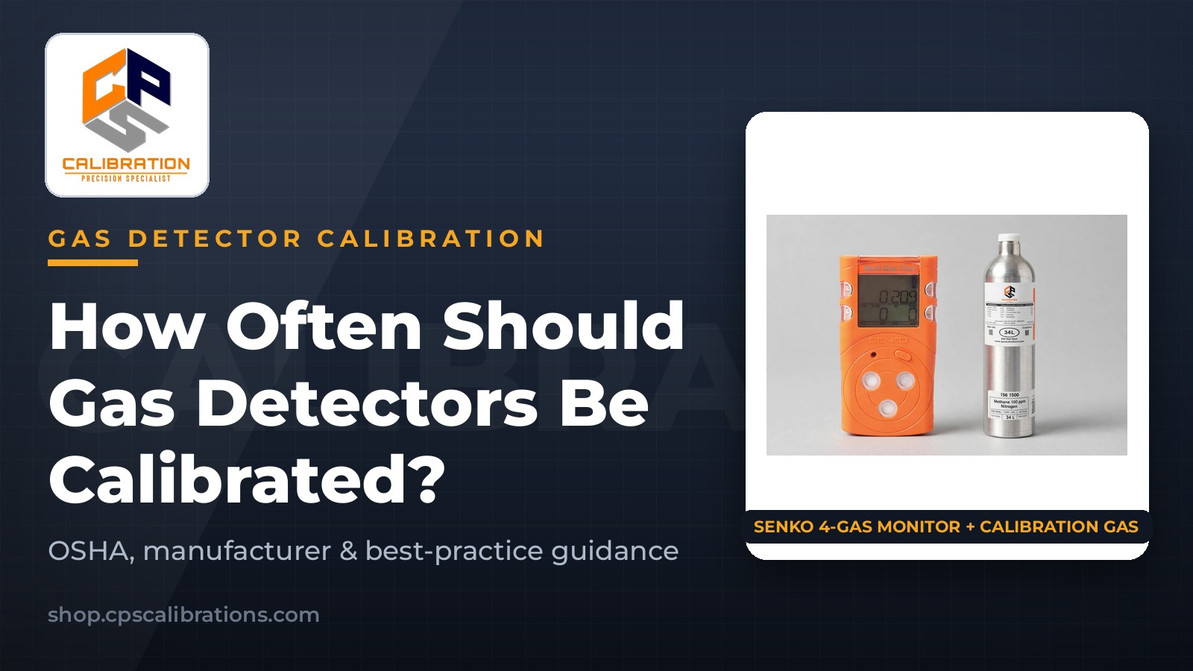
How Often Should Gas Detectors Be Calibrated? OSHA, Manufacturer & Best Practices
How Often Should Gas Detectors Be Calibrated? OSHA, Manufacturer & Best Practices
If you use gas detectors to keep your people safe, calibration isn't optional — it's the difference between a detector you can trust and one that's just making noise. But "how often" is where most people get confused, because OSHA, MSHA, and the manufacturers don't all say the exact same thing.
Here's the straight answer, plus what we recommend based on what we see every day at CPS Calibrations.
The Short Answer
- Bump test: before each day's use (or daily in high-risk environments)
- Full calibration: every 30 to 180 days depending on your sensors, environment, and how the detector is used — with 6 months as a common defensible interval for many workplaces
If you only remember one thing: a bump test checks that it responds, calibration checks that it's accurate. You need both.
What OSHA Actually Requires
OSHA doesn't give you a single number. Under 29 CFR 1910.146 (confined spaces) and 1910.120 (hazardous waste operations), OSHA requires calibration per the manufacturer's guidelines. In other words, OSHA points you back to RKI, MSA, BW/Honeywell, Industrial Scientific, and the rest.
That means your written safety program should say "we calibrate per manufacturer instructions" — and then you actually have to do it.
What MSHA Requires
MSHA is more specific. Under 30 CFR 75.320, methane detectors in underground coal mines must be calibrated at least every 31 days. If you're in mining, that's your floor — not a suggestion.
What ANSI/ISA Recommends
ANSI/ISA-60079-29-2 (the standard for flammable gas detectors) recommends:
- Daily bump tests in high-risk environments
- Full calibration every 1 to 3 months, depending on exposure and conditions
This is the standard most safety managers point to when they want something defensible in an audit.
What Manufacturers Typically Say
Most manufacturers land in the same range:
- Bump test: daily, or before each use
- Full calibration: every 30 to 180 days based on usage, sensor type, and environment
For example, catalytic bead (LEL) sensors and electrochemical sensors (CO, H2S, O2) drift over time. PID and IR sensors have their own drift characteristics. The harsher the environment — heat, humidity, dust, sensor poisons like silicones — the more often you should calibrate.
WatchGas puts it plainly in their technical notes: calibrate the first time a monitor is used, then at regular intervals not to exceed 6 months, with a daily bump test to verify sensor and alarm response.
Bump Test vs. Calibration: What's the Difference?
This is the #1 point of confusion we hear.
Bump test: You expose the detector to a known gas concentration just long enough to verify the sensors respond and the alarms activate. It does NOT adjust the readings. Think of it as a "are you alive?" check. Do it before each day's use.
Calibration: You expose the detector to a certified calibration gas and adjust the sensor readings to match the known concentration. This corrects for drift. Think of it as "are you accurate?" Do it on your regular schedule (monthly, quarterly, etc.).
A detector can pass a bump test and still be out of calibration. That's why you need both.
How to Calibrate: The Basic Steps
Every model is a little different, so always follow your manufacturer's manual. But the general process is:
- Start in clean air. Zero the detector in fresh air per the manual.
- Attach the calibration cap and connect your regulator to the calibration gas cylinder.
- Apply gas at the specified flow rate — typically 0.5 L/min for most portable detectors (check your manual).
- Enter calibration mode on the detector and let the readings stabilize.
- Span adjust so the readings match the cylinder's certified concentration.
- Verify alarms activate at the correct setpoints.
- Document it — date, gas lot number, who did it, next due date.
Use only NIST-traceable calibration gas, and check the expiration date on the cylinder. Expired gas is one of the most common reasons calibrations fail.
What Happens If You Don't Calibrate Often Enough?
- Sensor drift: readings creep away from reality, usually reading low — the dangerous direction
- Failed bump tests: you'll burn through sensors faster
- OSHA citations: "not per manufacturer guidelines" is an easy citation to write
- Liability: if there's an incident and your calibration records are thin, that's a problem
What We Recommend for Most Workplaces
Based on what we see from customers across refining, oil & gas, utilities, water/wastewater, and construction:
- Confined space entry (4-gas: LEL/O2/CO/H2S): bump test before each use, full calibration monthly
- General industrial use: bump test daily, full calibration every 3 months
- Light/occasional use in clean environments: bump test before each use, full calibration every 6 months
- After any incident: if a detector takes a hard fall, gets soaked, or alarms in a high-gas event — bump test it, and calibrate if there's any doubt
When in doubt, calibrate more often. Calibration gas is cheap. An inaccurate detector isn't.
What You Need to Do It Right
At minimum, you need:
- Calibration gas matched to your sensors — for a standard 4-gas monitor that's typically H2S, CO, CH4 (methane, for LEL), and O2 in a single cylinder
- The right regulator — CGA-600 and C-10 are the two most common for portable calibration cylinders; check your cylinder's connection
- Calibration cap and tubing for your specific detector model
If you're running RKI GX-3R or GX-3R Pro monitors, a 4-gas mix (H2S 25 ppm / CO 50 ppm / CH4 50% LEL / O2 12%, nitrogen balance) is the standard workhorse. Single-gas cylinders cover everything else — ammonia, chlorine, sulfur dioxide, hydrogen cyanide, and more.
FAQ
Do I need to calibrate a brand-new gas detector?
Yes. Calibrate it before first use, then put it on your regular schedule.
Does calibration gas expire?
Yes. Check the date on the cylinder. Most mixes are good for 12-24 months unopened. Don't use expired gas — the concentration isn't certified anymore.
Can I use bump gas for calibration?
Bump gas verifies response; calibration gas adjusts accuracy. Some products can do both if the concentration is certified, but don't assume — check the label.
How do I know what gas concentration to buy?
Match it to your detector's span values in the manual. When in doubt, call us — tell us your detector model and we'll match it.
The Bottom Line
Calibrate per your manufacturer's schedule, bump test before each use, and document everything. If your environment is harsh or the application is high-risk, calibrate more often — monthly is cheap insurance.
Need help picking the right gas or regulator for your detector? Call CPS Calibrations at 865-900-8844 or browse our calibration gas selection. Tell us your detector model and we'll make sure you get the right mix.
Recent Posts
-

Electrochemical Toxic Sensors: Cross-Sensitivities That Fool Your Readings
Your carbon monoxide alarm goes off in the battery room. You sweep the area — there's no CO source a …Oct 8th 2026 -

Why Oxygen Sensors Die — and How to Make Them Last
Every 4-gas monitor has an oxygen channel, and it's the only channel with a built-in expiration date …Oct 7th 2026 -
Catalytic Bead vs. Infrared LEL Sensors: When Each Wins
Most gas detectors read %LEL the same way on the display. What's happening behind that number is any …Oct 6th 2026