
RKI Calibration Stations: Which Docking Station Does Your Monitor Need?
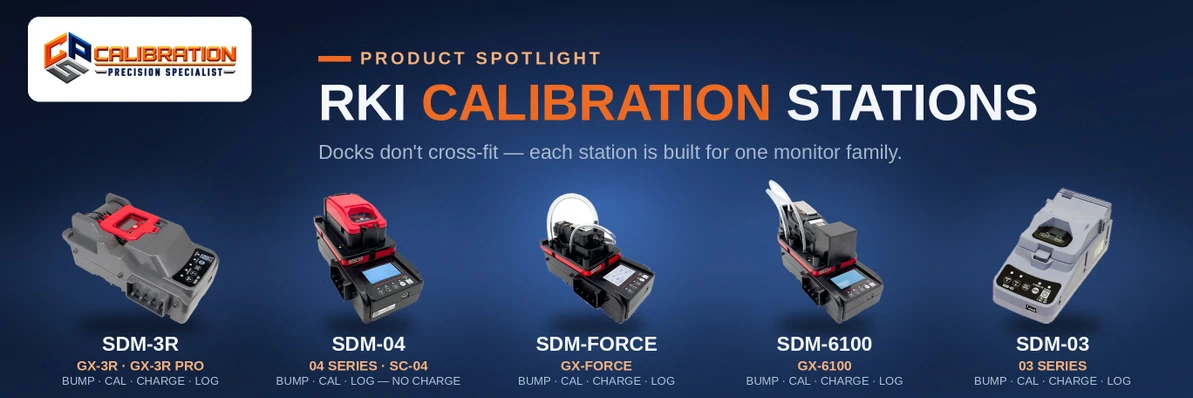
RKI calibration stations are model-specific: every SDM docking station fits exactly one instrument family and no other — the SDM-3R ($1,322) takes the GX-3R and GX-3R Pro, the SDM-04 the 04 Series and SC-04, the SDM-Force the GX-Force, the SDM-6100 the GX-6100, and the SDM-03 the older 03 Series. What each station automates is the same maintenance routine — bump test, full calibration, charging where the instrument is rechargeable, and a dated pass/fail record kept automatically — so the buying decision is not which dock you like best, but which monitor you own, and whether your fleet size and record-keeping burden justify automating the routine instead of running it by hand.
That one fact — docks do not cross-fit — shapes everything below. This guide walks the five RKI stations CPS sells, what each one does and costs, how a dock actually differs from calibrating by hand, and the honest cases where a docking station earns its place and where it doesn't.
Are RKI Docking Stations Interchangeable Between Models?
No. An RKI docking station is built around one instrument family: the cradle, the gas path, and the communication link are all made for that monitor's shape, sensors, and firmware. An SDM-3R will not accept a GX-Force, an SDM-Force will not take a GX-3R, and no adapter changes that. Within a family there is some breadth — the SDM-3R covers both the GX-3R and the GX-3R Pro, and the SDM-04 covers the 04 Series range with dedicated versions for the SC-04 — but across families, the dock you need is the dock named for your instrument.
| Station | Fits | Price (live, as listed) | Gas inlets | What it automates |
|---|---|---|---|---|
| SDM-3R | GX-3R, GX-3R Pro | From $1,322; configured kits to $2,695 | 1–3 | Bump test, calibration, alarm check, charging; records to USB flash drive or PC; up to 10 modules linked |
| SDM-04 | 04 Series, SC-04 (dedicated SC versions) | From $1,675; configured kits to $2,330 | 1–2 as configured | Bump test, calibration; records to USB flash drive; PC software included; up to 10 modules linked. No charging — the 04 Series runs on AAA batteries |
| SDM-Force | GX-Force | From $1,645; configured kits to $2,430 | 1–2 as configured | Charging, bump test, calibration; records to USB flash drive; PC software included; up to 10 modules linked |
| SDM-6100 | GX-6100 | From $2,020; configured kits to $2,885 | Configuration-dependent | Bump test, calibration, charging; calibration and event records to USB flash drive |
| SDM-03 | 03 Series (GP-03, OX-03, CO-03, HS-03) | $1,334; configurations $1,326–$1,850 | Single-gas station | Bump test, calibration, charging; calibration and bump records kept for download |
Two pricing notes before the details. First, every station is sold by configuration: the headline price buys the station itself, and the price climbs as you add gas inlets (solenoids), demand-flow regulators, cylinder holders, and calibration gas — which is why the ranges above are wide. Second, a station with more gas inlets costs more because it does more: extra inlets let the dock apply a second or third gas automatically, which matters for instruments carrying sensors a single quad mix can't span.
What Does a Docking Station Do That Manual Calibration Doesn't?
The chemistry is identical. A dock applies the same calibration gas, to the same sensors, as a technician with a regulator and a calibration cup. What changes is who runs the steps and who keeps the record:
- Dock: seat the instrument, press BUMP or CAL. The station zeroes the instrument, applies each gas through a demand-flow regulator at the flow the instrument expects, judges every sensor pass or fail against its set tolerances, and — on RKI's SDM software — can be set to follow a failed bump test with an automatic calibration. When it finishes, it files a dated record of what was done, to which instrument, and how each sensor scored. On most stations it charges the instrument while it sits there.
- By hand: the operator connects the regulator and calibration cup, applies gas for the right time, reads each channel, adjusts span where the instrument allows it, and writes the result in a logbook or spreadsheet. Done carefully, the calibration is just as good — the record, however, is only as good as the operator's discipline, and every step depends on the person doing it that day.
The gas hardware matters either way. Docking stations feed through demand-flow regulators, which deliver gas only as the instrument draws it; our guide to fixed-flow vs. demand-flow regulators covers how to choose and set up the manual side of that hardware.
So the dock's real product is not calibration — it is consistency and documentation. Every bump test run the same way, by any operator, on any shift, with a record that exists whether or not anyone remembered to write it down. That is what fleets and safety managers are actually buying.
SDM-3R: The Dock for the GX-3R and GX-3R Pro
The SDM-3R is the station for RKI's smallest 4-gas monitors — the GX-3R and the 5-gas GX-3R Pro. Docked, it charges the instrument, runs the bump test, calibrates, performs alarm checks, and can turn the instrument on and off and sync its date and time as part of the routine. It works standalone with no computer at all: in standalone use it stores up to 200 calibration records, 214 bump-test records, or 469 alarm-check records internally, and copies them out on a USB flash drive.
For fleets, up to 10 SDM-3R modules connect together under a PC, and modules can be manifolded so several stations share calibration-gas cylinders and regulators instead of each needing its own. Configurations run from the station alone through 1, 2, or 3 gas inputs, with or without demand-flow regulators, up to full kits bundling a cylinder — 34L, 58AL, or 116AL — and holder. It is listed from $1,322, with configured kits running to $2,695, and carries a 1-year warranty. If you are weighing the monitor itself first, see Is the RKI GX-3R Worth It? and our head-to-head GX-3R vs. GX-3R Pro — the dock decision follows the instrument decision, because both monitors share this one station.
SDM-04: The Dock for the 04 Series and SC-04
The SDM-04 serves RKI's pocket single-gas line — the full 04 Series — plus dedicated SC versions built for the SC-04 super-toxic models, with their own configurations and gas kits (ammonia and HCN cylinders among them). It bump tests and calibrates automatically, saves the records, and copies them to a USB flash drive; RKI's PC controller software is included for viewing and archiving records, archiving to a network location, and retrieving data under software control. Like the SDM-3R, it scales: up to 10 SDM-04 stations can run connected to one PC, and the PC-controlled setup can also configure the 04 Series instruments themselves.
One honest difference from the other stations here: the SDM-04 does not charge, because there is nothing to charge. The 04 Series runs on two AAA batteries — up to 9,000 hours of operation on the HS-04 and CO-04 — so the dock's job is testing, calibration, and records only. RKI's datasheet gives the station four calibration-gas ports, with connections for up to three cylinders; CPS configurations are built with 1 or 2 gas inlets (solenoids), with or without demand-flow regulators, or as complete kits with a cylinder and holder. It is listed from $1,675, with configured kits to $2,330. The instruments it serves are walked through model by model in RKI 04 Series: Which Single-Gas Monitor Do You Need?
SDM-Force: The Dock for the GX-Force
The SDM-Force is the maintenance station for the GX-Force, RKI's pumped 4-gas monitor. Used standalone it charges the instrument's lithium-ion battery, calibrates, and bump tests, with all records stored automatically for later upload to a PC via USB flash drive — the PC software and flash drive are included. Connected to a PC it does more: automated calibration and bump testing, archiving of the instrument's datalog data, and configuration of the GX-Force itself, with up to 10 SDM-Force stations running simultaneously.
RKI's datasheet gives the SDM-Force three calibration-gas ports; CPS configurations are fitted with 1 or 2 gas inlets, with or without a demand-flow regulator, and the complete kits add a 4-gas cylinder (34AL or 58AL) and holder. It is listed from $1,645, with configured kits to $2,430. Because the GX-Force is a pumped instrument, its dock is also what keeps pre-entry bump testing fast enough to actually happen every shift — the instrument side of that story is in Does the RKI GX-Force Have a Built-In Pump?
SDM-6100: The Dock for the GX-6100
The SDM-6100 is the single-module station for the GX-6100, RKI's pumped 6-gas PID monitor. It bump tests, calibrates, and charges the instrument, and stores calibration and event data to the included flash drive. This is the station where configuration matters most, because the GX-6100 itself is the most configurable monitor RKI makes: the kits reflect the instrument's extra channels, including a version bundling a 34AL isobutylene cylinder for the PID channel, and a top configuration running two demand-flow regulators with both a 34L cylinder of 50% volume methane in nitrogen (for the percent-volume channel) and a 34AL quad-mix cylinder.
It is listed from $2,020 for the base station, with configured kits to $2,885 — the highest headline of the five, matched to the most capable instrument of the five. What those channels are and what they cost to configure is covered in What Can the RKI GX-6100 Detect?
SDM-03: The Dock for the 03 Series
The SDM-03 is the single-module station for RKI's earlier single-gas line — the GP-03 (LEL), OX-03 (oxygen), CO-03 (carbon monoxide), and HS-03 (hydrogen sulfide). As a single-gas station it is built around one instrument and one gas at a time: it bump tests, calibrates, and charges the instrument automatically, and records the calibration and bump-test data for download.
Configurations run from the station on its own to complete kits with a demand-flow regulator and a cylinder matched to the instrument's gas — CO, methane, H₂S, or nitrogen for the OX-03's zero. The station is listed at $1,334, with configurations from $1,326 to $1,850. Plenty of 03 Series monitors are still in daily service, and this is the dock that keeps their bump and calibration records in the same shape as the newer fleets'.
Do You Actually Need a Docking Station?
A dock earns its place when the routine it automates is your bottleneck:
- A fleet of the same model. Five GX-3Rs bumped by hand every morning is five chances for a skipped step; five docked is one repeatable routine. The multi-module systems (up to 10 stations on one PC, on the SDM-3R, SDM-04, and SDM-Force) exist precisely for this.
- Bump-test records that have to survive an audit. If your program requires a dated pass/fail record for every instrument, every day, the dock produces it as a by-product. A logbook produces it only when someone writes it.
- Multiple users and shifts. The dock removes operator technique from the result — the newest hire's bump test runs exactly like the safety manager's.
- Instruments that come back to one place. Docks live where instruments are stored and charged, so the test happens where the monitor already is.
It is hard to justify when:
- You run one or two instruments. The manual routine takes minutes, and the hardware is a regulator, a calibration cup, and the gas you already buy.
- Use is occasional. A station that runs twice a month automates very little.
- Your manual records are genuinely disciplined. If the logbook is complete and current, the dock's documentation advantage shrinks to convenience.
On cost, be clear-eyed about what drives it: the station itself, priced by family and by configuration — gas inlets, regulators, bundled cylinders, and how many modules a fleet needs. The dock does not remove the consumables: every bump and calibration still draws calibration gas, and cylinders still expire on schedule. What the money buys is labor consistency and the paper trail, not cheaper chemistry — and whether that trade pays depends on your fleet size and your audit exposure, not on the dock.
What a Docking Station Does Not Replace
A dock automates the routine. It does not repeal the maintenance underneath it:
- Sensors still age out. A dock will faithfully report a dying sensor every single morning — that is its job — but the fix is still a sensor replacement, not another calibration. A failed calibration in a dock means exactly what a failed calibration by hand means.
- Calibration gas still expires. The station draws from the same cylinders manual calibration uses; an expired cylinder makes dock records as worthless as handwritten ones. The gas itself still has to match your instrument — see What Calibration Gas Do You Need for a 4-Gas Detector?
- A bump test is still not a calibration. The dock makes both easy, but they remain different checks: the bump proves the sensors respond and the alarms fire; the calibration sets accuracy. Skipping the second because the first is automated is the one failure mode a dock can't protect you from.
Browse the RKI instruments we carry, or call us at 865-900-8844 and tell us which monitors you run — we will match the station and configuration to the fleet. And if you would rather hand the routine off entirely, we calibrate every channel, on the bench or at your site.
Frequently Asked Questions
Does the GX-3R need a docking station? No. The GX-3R and GX-3R Pro calibrate perfectly well by hand with a calibration cup, a demand-flow regulator, and the correct gas. The SDM-3R docking station ($1,322 as listed) automates that routine — bump test, calibration, alarm check, and charging — and keeps the pass/fail records automatically. It becomes worth buying when you run several GX-3R-family instruments, bump test daily, or need records that survive an audit.
Can one RKI docking station calibrate different models? No. RKI's SDM stations are model-specific: each one fits a single instrument family. The SDM-3R takes the GX-3R and GX-3R Pro; the SDM-04 takes the 04 Series and SC-04; the SDM-Force takes only the GX-Force; the SDM-6100 takes only the GX-6100; the SDM-03 takes the 03 Series. A station bought for the wrong family cannot calibrate your instruments at all, so match the dock to the monitor model first.
How much is the SDM-3R? The SDM-3R is listed from $1,322 on our store. It is sold by configuration — 1, 2, or 3 gas inputs, with or without demand-flow regulators, and in full kits with a calibration-gas cylinder and holder — and fully configured kits run to $2,695. The right configuration depends on whether your GX-3R or GX-3R Pro carries a fifth sensor that needs its own gas.
How much do RKI docking stations cost? As listed on our store, the five stations start at: SDM-3R $1,322, SDM-03 $1,334, SDM-Force $1,645, SDM-04 $1,675, and SDM-6100 $2,020. Every model is priced by configuration — gas inlets, demand-flow regulators, bundled cylinders — and configured kits run from there up to $2,885 for the SDM-6100. Current pricing for each configuration is on the station's product page.
Docking station vs. manual calibration — which is better? Neither calibrates more accurately when both are done correctly — they apply the same gas to the same sensors. The docking station is better at consistency and documentation: it runs the identical routine for every operator and files a dated pass/fail record automatically. Manual calibration is better on hardware cost: a regulator and calibration cup do the same chemistry for far less money. Fleets with daily bump-test records to keep usually land on the dock; one or two instruments usually land on manual.
Does the SDM-04 charge the 04 Series monitors? No — and it doesn't need to. The 04 Series runs on two AAA batteries (up to 9,000 hours of operation on the HS-04 and CO-04), so there is no rechargeable battery for a dock to charge. The SDM-04 bump tests, calibrates, and keeps the records. The other stations in RKI's current line — SDM-3R, SDM-Force, SDM-6100, and SDM-03 — do charge their instruments while docked.
What calibration gas does a docking station use? The same gas you would use by hand: the mix your instrument's calibration is set for, delivered through a demand-flow regulator. A 4-gas monitor's station runs the standard quad mix; instruments with extra channels need their extra gases on their own inlets — a PID channel needs isobutylene, a percent-volume channel needs its %-volume methane mix. That is why stations are configured with 1, 2, or 3 gas inputs, and why the gas has to be in date: the dock cannot rescue an expired cylinder.
Does a docking station keep calibration records? Yes — that is half of what you are paying for. RKI's SDM stations store bump-test and calibration results automatically and copy them to a USB flash drive; the SDM-3R in standalone use holds up to 200 calibration records, 214 bump-test records, or 469 alarm-check records internally. PC software — included with the SDM-04 and SDM-Force, and available in PC-controlled SDM-3R setups — archives the records, including to a network location, for audit retrieval.
Can you connect multiple RKI docking stations together? Yes, on the current multi-gas and single-gas docks: up to 10 SDM-3R, SDM-04, or SDM-Force modules can be connected to a single PC and run as one system, and SDM-3R modules can also be manifolded to share calibration-gas cylinders and regulators across stations. That is what turns a dock from a bench accessory into a fleet maintenance system — one operator can process a rack of instruments with one set of records.
Does a docking station replace calibration gas or sensor replacement? No. The station automates the test routine; it consumes the same calibration gas as manual calibration, and that gas still expires on the date on its certificate. Sensors still age out on their own schedule — the dock will detect and report a failing sensor, and can calibrate around drift only within the sensor's adjustment range. A sensor that fails calibration in a dock needs replacement, exactly as it would by hand.
CPS Calibrations · 109 S. Front Street, Rockwood, TN 37854 · Portable Gas Detection · Calibration Gas · Calibration Services · Contact Us
Recent Posts
-

What Is a Confined Space? OSHA's Definition, the 3 Tests, and When It Becomes Permit-Required
A confined space is a space that passes all three of OSHA's tests at the same time: it is large enou …Oct 21st 2026 -
PID vs. LEL for VOC Detection: Which Sensor Do You Actually Need?
Use a PID to detect VOCs and an LEL sensor to detect explosive atmospheres — they measure different …Oct 21st 2026 -

Semiconductor (MOS) Gas Sensors: Where They Work and Where They Lie
A semiconductor (MOS) gas sensor measures gas with a heated film of metal oxide — usually tin dioxid …Oct 21st 2026