
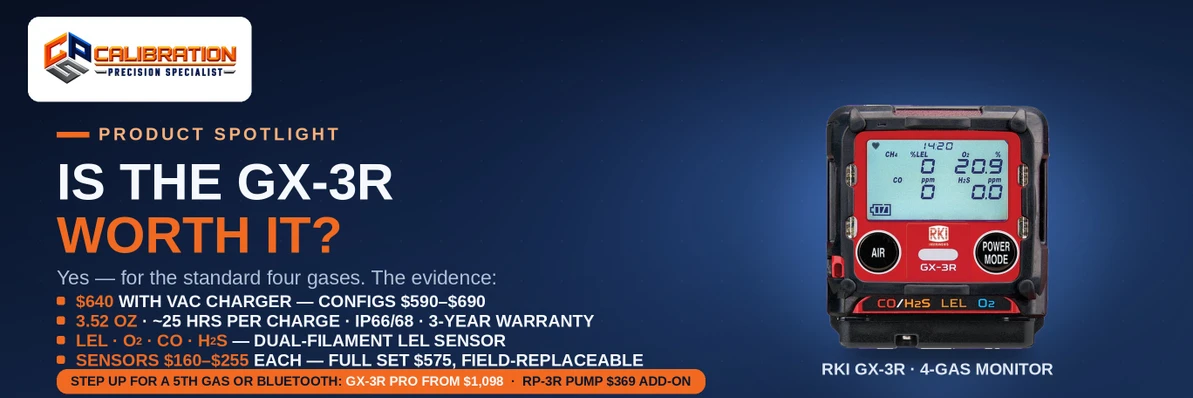
Is the RKI GX-3R Worth It?
Yes — for standard 4-gas personal monitoring, the RKI GX-3R is worth its $640 price: it is the smallest and lightest 4-gas monitor RKI makes at 2.2 × 2.55 × 1.02 in. and 3.52 oz (3.70 oz with its rubber boot), it monitors LEL, O₂, CO, and H₂S simultaneously, runs about 25 hours per charge on its rechargeable lithium-ion battery, and carries an IP66/68 enclosure and a 3-year warranty. It is not worth it if your work needs a built-in pump, a fifth gas, PID/VOC detection, or Bluetooth — the GX-3R is diffusion-only (the clip-on RP-3R pump, $369, adds remote sampling), has no PID channel, and Bluetooth is a GX-3R Pro feature, not a GX-3R feature.
That is the whole review in one paragraph. The rest of this post is the evidence — what the size actually buys you, what the four channels cover, what the monitor costs to keep over its life, and the specific jobs where a cheaper SENKO or the bigger GX-3R Pro is the smarter spend.
What Is the RKI GX-3R, and Who Is It For?
The RKI GX-3R is a portable personal gas monitor that simultaneously measures the standard confined-space quartet — combustible gas (LEL), oxygen (O₂), carbon monoxide (CO), and hydrogen sulfide (H₂S) — by diffusion, and displays all four readings on a large auto-backlit LCD. Operation is two buttons (POWER/MODE and AIR), alarms are audible (up to 100 dB at 30 cm), visual, and vibrating, with three user-adjustable alarm levels plus TWA and STEL alarms. RKI lists it for confined spaces, personal monitoring, refineries and petrochemical plants, oil and gas, utilities, water and wastewater, fire services, and construction.
It's built for a specific buyer:
- Crews standardizing on one personal 4-gas monitor for every worker, where the monitor has to be worn — not carried, not shared, not left in the truck.
- Confined-space entrants who wear continuous monitoring inside the space, with pre-entry testing handled from outside (see the pump discussion below — and our post on how to test a confined space before entry).
- Wastewater, utility, and municipal crews whose daily hazard set is exactly LEL/O₂/CO/H₂S — the H₂S case is laid out in our post on why hydrogen sulfide is so dangerous in wastewater.
- Fleets that service their own instruments: the GX-3R's sensors and filters are field-replaceable, and its records and calibration can be automated with a docking station.
If your hazard assessment names a gas outside the standard four, stop here and read the limits section first — no configuration of the GX-3R adds a channel.
Why Does the Size Actually Matter?
Every 4-gas monitor measures the same four gases. The GX-3R's claim is geometric, and it matters more than it sounds. OSHA defines the breathing zone as a ten-inch radius around the worker's nose and mouth — the air a monitor must sample to represent what the worker is actually breathing. A monitor that rides in a pocket, on a belt at the back, or in the truck samples somewhere else. At 3.52 oz and 2.2 × 2.55 × 1.02 in. without its boot (2.4 × 2.63 × 1.06 in. and 3.70 oz with the boot fitted), the GX-3R is smaller than many single-gas monitors, so it clips to a collar or lapel inside that ten-inch radius and stays there for the whole shift. RKI markets it as the world's smallest and lightest 4-gas monitor, and nothing else in our portable multi-gas monitors range contradicts that.
The rest of the build serves the same wear-it-all-day purpose:
- Battery: rechargeable lithium-ion, approximately 25 hours of operation per charge and approximately 3 hours to recharge — a full shift plus margin, back to full overnight or between shifts.
- Sealing: IP66/68 (RKI rates the enclosure to 2 m immersion for 1 hour), with a drop height rating of 23 ft in RKI's specifications — rain, washdowns, dust, and the drop off the tailgate are working conditions, not incidents.
- Operating range: −4°F to +122°F continuous, 10–90% RH non-condensing.
- Non-compliance indicator: if the instrument hasn't been bump tested, calibration is due, or it has recorded a gas alarm event, its three LED lights flash every 30 seconds until the condition is resolved — a supervisor can see an out-of-compliance monitor across a room without touching it.
The Four Channels — and What the Ranges Buy You
| Gas | Range | Resolution | Why the range matters |
|---|---|---|---|
| Combustible gas (LEL) | 0–100% LEL | 1% LEL | The standard confined-space flammability channel, on a catalytic sensor (below). |
| Oxygen (O₂) | 0–40.0% vol. | 0.1% | Reads well past the 23.5% enrichment alarm, so oxygen-enriched atmospheres — not just deficient ones — are measured, not just flagged. |
| Carbon monoxide (CO) | 0–2,000 ppm | 1 ppm | A wide ceiling: engine exhaust and process upsets that would over-range a narrower CO channel stay on scale. |
| Hydrogen sulfide (H₂S) | 0–200.0 ppm | 0.1 ppm | Fine resolution at the low end, where the exposure limits (10–20 ppm) actually live. |
All four channels respond with a T90 within 30 seconds. Three design details inside the sensor set are worth knowing before you compare prices:
- Dual-filament LEL sensor. The catalytic LEL sensor carries two active filaments in one sensor to resist silicone poisoning — if one filament is poisoned, the second takes over. Catalyst poisons are the classic way LEL sensors die quietly; this is RKI's engineering answer, and it's part of what the $640 buys over a budget 4-gas.
- Combo CO/H₂S micro sensor. CO and H₂S ride in a single dual sensor, which is how four channels fit in a 3.52 oz case. An H₂-compensated CO sensor configuration is also available for applications where hydrogen cross-interference would otherwise inflate CO readings.
- Long-life O₂ sensor. RKI rates the electrochemical O₂ sensor's life span at 3 to 5 years — relevant to the ownership math below.
The GX-3R sits in our diffusion monitors range: it samples the air that reaches the wearer. That sentence is both its strength and its main limit.
The Honest Limits
A spotlight that only praises is an ad. Here is what the GX-3R does not do:
- No built-in pump. Out of the box it is diffusion-only, so it cannot test a space before entry or sample a remote point. The fix is the clip-on RP-3R sample draw pump ($369): it snaps onto the GX-3R without tools, draws 0.50 LPM (0.35 LPM in ECO mode) on a single AA battery for about 10 hours (16 in ECO), and supports hose lengths up to 100 ft — with hose-and-probe configurations at $380–$460. A hand aspirator is the other RKI option. Note the RP-3R fits the GX-3R only; the Pro takes the separate RP-3R Pro. If pumped pre-entry testing is your primary job rather than an occasional one, start in pumped monitors instead.
- No fifth gas, no PID. There is no channel for CO₂, SO₂, NH₃, HCN, NO₂, PH₃, or VOCs, and no way to add one. Plants whose hazard assessment names a fifth gas need the GX-3R Pro or a different instrument family.
- No Bluetooth, no man-down or panic alarm. Those are GX-3R Pro features. The GX-3R logs — user ID, station ID, calibration and bump-test history, alarm events, and alarm interval trends — but the data comes off the instrument via an optional USB-to-IrDA download cable or the docking station, not live to a phone.
- It's not the cheapest 4-gas. The SENKO below starts lower, and if the monitor will live a gentle life on a small crew, the premium buys durability and sensor life you may never cash in.
GX-3R vs. SENKO SP-MGT vs. GX-3R Pro
| RKI GX-3R | SENKO SP-MGT | RKI GX-3R Pro | |
|---|---|---|---|
| Price | $640 (with 100–240 VAC charger) | From $485; standard 4-gas $589 catalytic / $735 NDIR | From $1,098 |
| Gases | 4: LEL, O₂, CO, H₂S | Up to 4: LEL, O₂, CO, H₂S in 1- to 4-gas layouts | Up to 5: standard 4 plus HCN, NH₃, NO₂, PH₃, SO₂, or CO₂ |
| Sampling | Diffusion; RP-3R clip-on pump optional | Diffusion; external pump accessory optional | Diffusion; RP-3R Pro clip-on pump optional |
| Battery | ~25 hours, ~3-hour recharge | ~25 hours catalytic; up to ~60 days NDIR | ~25 hours (Li-ion) |
| Ingress / warranty | IP66/68 · 3 years | IP67 · 2 years | IP66/68 · 3 years |
| Wireless | None — IrDA download | IR-Link accessory | Bluetooth with iOS/Android app; man-down and panic alarms |
The SENKO SP-MGT is the honest budget alternative: the standard 4-gas catalytic build at $589 undercuts the GX-3R by $51, and its NDIR version trades the catalytic LEL for infrared and runs up to about 60 days per charge. You give up a year of warranty, a step of ingress protection (IP67 vs. IP66/68), and RKI's dual-filament LEL and long-life O₂ sensor story. The GX-3R Pro is the step-up for a named fifth gas or Bluetooth supervision: same ~25-hour battery, IP66/68 build, and 3-year warranty in a larger 4.58 oz case, from $1,098. If neither a fifth gas nor Bluetooth is on your hazard assessment, the Pro's premium buys you channels you'll never calibrate — the GX-3R is the same core instrument without them.
What It Costs to Keep: Sensors, Calibration, and the Dock
Purchase price is the first year of ownership, not the whole of it. The GX-3R's upkeep math is unusually transparent because every wear part is priced and field-replaceable:
- Sensors. The LEL sensor is $160, the O₂ sensor is $160, and the CO/H₂S combo sensor is $255 (separate CO and H₂S sensors are $160 each; the H₂-compensated CO sensor is $255). A complete standard sensor set is therefore $575 — the number to hold against the 3-year warranty and the O₂ sensor's 3-to-5-year rated life when you compare total cost against cheaper monitors with sealed or costlier sensor arrangements.
- Charging configuration. The $640 price includes the 100–240 VAC charger. The battery-pack-only version (no charger) is $590, the 12 VDC vehicle-charger version is $640, and versions with both VAC + 12 VDC chargers or a USB charger are $690 — fleets standardizing on one charging method shouldn't pay for chargers they won't use.
- Calibration. Bump test before each day's use, and fully calibrate on the instrument's reminder cycle — the calibration interval is set to 90 days from the factory and is adjustable — and immediately after a failed bump, an over-range exposure, or a suspected poisoning event. One quad calibration gas cylinder (CH₄/LEL, O₂, CO, H₂S in a single mix) covers all four channels in a single calibration. If a bump fails and you don't know why, our post on why bump tests fail walks the delivery faults that cause most of them.
- The dock. For fleets, the SDM-3R docking and calibration station (from $1,322, depending on configuration) automates charging, bump testing, calibration, and alarm checks, stores the records, works standalone with USB flash-drive transfer, and links up to 10 modules — it serves the GX-3R and GX-3R Pro alike.
- Filters and small parts. Sensors and filters are user-replaceable with basic tools; the hydrophobic dust filter is a $20 wear item, and keeping filters fresh is the cheapest sensor-life insurance there is.
When a GX-3R comes to CPS — shipped to our Rockwood lab or serviced on-site at your facility — we calibrate every channel and report as-found and as-left readings. Browse the wider RKI Instruments range for where the GX-3R sits in the line.
Choose the GX-3R When… / Look Elsewhere When…
Choose the GX-3R when:
- Your hazard set is the standard four gases — LEL, O₂, CO, H₂S — and the program problem is wear compliance: monitors that get clipped on and forgotten about because they weigh 3.52 oz.
- You want a 3-year warranty, IP66/68 sealing, and field-replaceable sensors with published prices ($160 LEL, $160 O₂, $255 CO/H₂S combo) instead of a sealed unit or a ship-it-back service model.
- Occasional remote sampling is enough — the $369 RP-3R clip-on covers pre-entry checks when they come up, without paying for a pumped instrument for every worker.
- You're building a fleet program: datalogging on every unit, a non-compliance indicator supervisors can read at a glance, and the SDM-3R dock to automate bump, calibration, and records.
Look elsewhere when:
- Your hazard assessment names a fifth gas (CO₂, SO₂, NH₃, HCN, NO₂, PH₃) or VOCs — that's GX-3R Pro or PID territory; the GX-3R has no channel for them at any price.
- You need Bluetooth supervision, man-down, or panic alarms — Pro features, absent here by design.
- Pumped sampling is the daily job, not the exception — a purpose-built pumped monitor will serve you better than a diffusion unit wearing a clip-on pump full-time.
- The budget is firm and the duty is light — the SENKO SP-MGT's standard 4-gas catalytic build at $589 covers the same four gases for less, with a 2-year warranty.
The Bottom Line
The RKI GX-3R is worth $640 when the thing you're buying is compliance you can see: the smallest, lightest 4-gas monitor in its class, worn in the breathing zone all shift, with a 25-hour battery, IP66/68 sealing, a dual-filament LEL sensor, field-replaceable sensors at published prices, and a 3-year warranty behind it. It's not worth it when the job needs a pump every day, a fifth gas, a PID, or Bluetooth — those are different instruments, and RKI sells one of them as the GX-3R Pro. For the standard confined-space quartet on a working crew, this is the monitor the rest of the category is measured against.
Ready to put one on a collar? Start with the RKI GX-3R in the charging configuration your fleet will actually use, add the RP-3R pump if pre-entry sampling is in your procedures, and keep a quad cylinder from our calibration gas range matched to it. Not sure whether your hazard list fits in four channels? Call us at 865-900-8844 and read us the assessment — that conversation is the purchase. Browse the full portable gas detection lineup for the wider picture.
Frequently Asked Questions
How much does the RKI GX-3R cost? $640 with the Li-ion battery pack and a 100–240 VAC charger (SKU 72-RA-C). The battery-pack-only version with no charger is $590, the 12 VDC vehicle-charger version is $640, and versions with both VAC and 12 VDC chargers or a USB charger are $690. Every version monitors the same four gases — LEL, O₂, CO, and H₂S — the price difference is only the charging hardware included.
What gases does the RKI GX-3R detect? Four gases simultaneously: combustible gas (LEL) from 0–100% LEL, oxygen (O₂) from 0–40.0% by volume, carbon monoxide (CO) from 0–2,000 ppm, and hydrogen sulfide (H₂S) from 0–200.0 ppm, with response times (T90) within 30 seconds. An H₂-compensated CO sensor configuration is available. The GX-3R has no PID channel and no fifth-gas option — it cannot measure VOCs, CO₂, SO₂, NH₃, HCN, NO₂, or PH₃.
How long does the RKI GX-3R battery last? Approximately 25 hours of operation per charge on its rechargeable lithium-ion battery, with a recharge time of approximately 3 hours. If you add the RP-3R clip-on pump, the pump runs on its own single AA battery — about 10 hours at its 0.50 LPM flow rate or about 16 hours in 0.35 LPM ECO mode — independent of the monitor's battery.
How small is the RKI GX-3R? It measures 2.2 in. wide × 2.55 in. high × 1.02 in. deep and weighs 3.52 oz (about 100 g) without its rubber boot; with the boot fitted it is 2.4 × 2.63 × 1.06 in. and 3.70 oz. RKI markets the GX-3R as the world's smallest and lightest 4-gas monitor — small enough to clip inside the breathing zone, the ten-inch radius around the nose and mouth where exposure sampling is supposed to happen.
Does the RKI GX-3R have a pump? No. The GX-3R is a diffusion monitor — it samples the air around the wearer. For pre-entry and remote sampling, the RP-3R clip-on sample draw pump ($369; hose-and-probe configurations $380–$460) snaps onto the GX-3R without tools, draws 0.50 LPM (0.35 LPM in ECO mode), and supports hose lengths up to 100 ft. A hand aspirator is also available. The RP-3R fits the GX-3R only; the GX-3R Pro requires the separate RP-3R Pro pump.
Does the RKI GX-3R have Bluetooth? No. Bluetooth wireless communication — with the RK Link app on iOS and Android — is a GX-3R Pro feature, as are the man-down and panic alarms. The GX-3R does datalog: it records user ID, station ID, calibration and bump-test history, alarm events, and alarm interval trends, and the records download via an optional USB-to-IrDA cable or through the SDM-3R docking station.
How long do GX-3R sensors last, and what do replacements cost? The sensors are field-replaceable. RKI rates the oxygen sensor's life span at 3 to 5 years. At current CPS prices, replacement sensors cost $160 for the LEL sensor, $160 for the O₂ sensor, and $255 for the combined CO/H₂S sensor — $575 for a complete standard sensor set (separate CO and H₂S sensors are $160 each, and the H₂-compensated CO sensor is $255). A sensor that will no longer hold calibration is at end of life; the fix is replacement, not repeated adjustment.
How often does the RKI GX-3R need to be calibrated? Bump test before each day's use, and fully calibrate on the instrument's reminder cycle — the calibration interval is factory-set to 90 days and is adjustable — plus immediately after a failed bump test, an over-range exposure, or suspected sensor poisoning. One quad calibration-gas cylinder containing CH₄/LEL, O₂, CO, and H₂S calibrates all four channels together, and the GX-3R's non-compliance indicator flashes its LEDs every 30 seconds when a bump test or calibration is overdue or an alarm event is unresolved.
What warranty does the RKI GX-3R have? Three years for materials and workmanship. The enclosure is rated IP66/68 — dust-tight and sealed against immersion (RKI rates it to 2 m for 1 hour) — and RKI's specifications list a 23 ft drop height. The instrument operates from −4°F to +122°F and alarms audibly (up to 100 dB at 30 cm), visually, and by vibration.
What's the difference between the RKI GX-3R and the GX-3R Pro? The GX-3R Pro adds a fifth sensor channel — your choice of HCN, NH₃, NO₂, PH₃, SO₂, or CO₂ — plus Bluetooth communication with a phone app, man-down and panic alarms, and an alkaline battery option, in a larger case (2.9 × 2.6 × 1.06 in., 4.58 oz) starting at $1,098. The standard GX-3R is 4-gas only with no Bluetooth, at $640. Both run about 25 hours per charge, carry IP66/68 sealing and a 3-year warranty, and are serviced by the same SDM-3R docking station — buy the Pro only if the fifth gas or the wireless features are on your hazard assessment.
CPS Calibrations · 109 S. Front Street, Rockwood, TN 37854 · Portable Gas Detection · Calibration Gas · Calibration Services · Contact Us
Recent Posts
-

What Is a Confined Space? OSHA's Definition, the 3 Tests, and When It Becomes Permit-Required
A confined space is a space that passes all three of OSHA's tests at the same time: it is large enou …Oct 21st 2026 -
PID vs. LEL for VOC Detection: Which Sensor Do You Actually Need?
Use a PID to detect VOCs and an LEL sensor to detect explosive atmospheres — they measure different …Oct 21st 2026 -

Semiconductor (MOS) Gas Sensors: Where They Work and Where They Lie
A semiconductor (MOS) gas sensor measures gas with a heated film of metal oxide — usually tin dioxid …Oct 21st 2026