
Why Is Hydrogen Sulfide (H2S) So Dangerous in Wastewater?
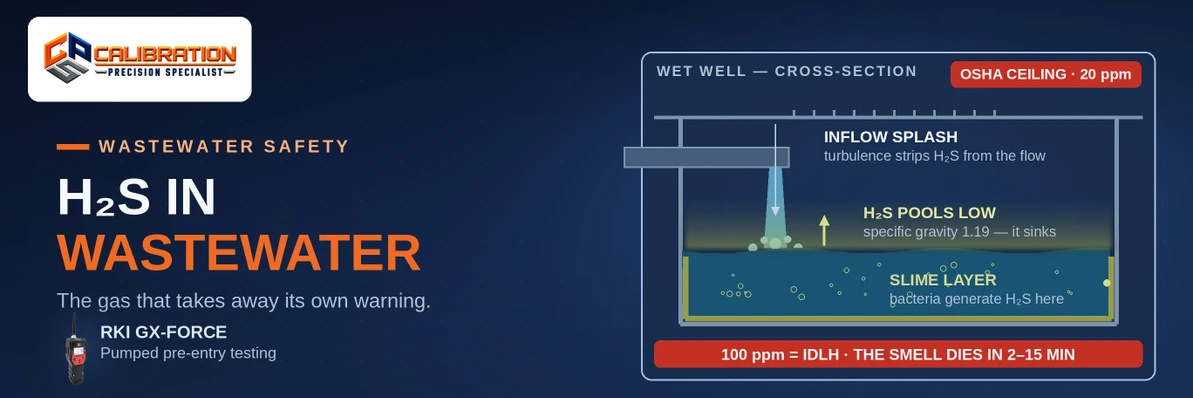
Hydrogen sulfide (H2S) is so dangerous in wastewater because it is generated continuously by sulfate-reducing bacteria in oxygen-free sewage, it is heavier than air (specific gravity 1.19) so it pools in wet wells, manholes, and lift stations, and at 100 ppm — the concentration NIOSH classifies as Immediately Dangerous to Life or Health (IDLH) — it paralyzes the sense of smell within 2 to 15 minutes, removing the rotten-egg warning at exactly the concentration where the gas becomes life-threatening; at 700 to 1,000 ppm it causes rapid "knockdown" and death within minutes. The only reliable warning is a calibrated personal H2S or multi-gas monitor worn in the breathing zone, backed by pumped pre-entry testing of any low or enclosed space before a worker descends into it.
Every industry has a signature gas hazard. For wastewater, it is H2S, and it is not imported — the process makes it, stores it dissolved in the flow, and releases it at the exact structures workers have to enter and maintain. This post covers where it comes from, where it collects, what each concentration does to the body, the exposure limits that govern the work, and the detection layers that keep a routine wet-well job from becoming a fatality investigation.
Where Does the H2S in Wastewater Come From?
Raw sewage carries sulfate and organic matter, and wherever that flow sits without oxygen — a long gravity sewer, a force main, a wet well between pump cycles, sludge and grit deposits — sulfate-reducing bacteria in the slime layer on the pipe wall convert the sulfate into sulfide as part of their normal metabolism. That sulfide dissolves in the wastewater, mostly invisibly and with little odor while it stays in solution. It becomes airborne H2S gas when conditions change:
- Turbulence strips it out. Wherever the flow drops, splashes, or is agitated — a manhole with a drop connection, a force main discharging into a wet well, the headworks where raw influent arrives — dissolved sulfide comes out of solution and into the air above the flow.
- Warm weather accelerates it. Bacterial activity rises with temperature and warm sewage holds less dissolved gas, so H2S generation and release peak in summer — the same season ventilation is most miserable and monitors are most likely to be "forgotten" in the truck.
- Low pH releases more of it. As sewage turns septic and its pH falls, a larger share of the dissolved sulfide converts to the gaseous H2S form.
- Disturbance releases it all at once. Jetting a line, pulling a pump, stirring sludge, or starting a pump that has sat idle can liberate in minutes the sulfide that built up over hours or days. A classic wastewater calculation puts the stakes plainly: 1 mg/L of dissolved sulfide can produce roughly 300 ppm of H2S in a closed headspace — three times the IDLH level, from water that looked and smelled unremarkable.
That last point is why H2S incidents so often begin with a space that "tested fine this morning." The gas load of a wet well is not a fixed property; it is a balance between generation, dissolution, and release, and maintenance work itself tips the balance.
Where in a Wastewater System Does H2S Collect?
H2S is about 19% heavier than air, so released gas sinks and stratifies at the bottom of still, low, enclosed spaces — and wastewater infrastructure is a catalog of exactly those spaces:
| Location | Why H2S builds up there |
|---|---|
| Manholes and gravity sewer reaches | Long, slow, oxygen-free flow generates sulfide; the manhole shaft traps the heavy gas below street level. |
| Wet wells and lift stations | Stagnant sewage between pump cycles goes septic; each pump start agitates the surface and releases a pulse of gas into the well. |
| Force main discharge points | Sewage that traveled the main under pressure arrives fully anaerobic and sulfide-laden, then outgasses violently at the turbulent discharge. |
| Headworks, screens, and grit chambers | First turbulence the raw influent meets — the plant's highest routine H2S readings are often here. |
| Primary clarifiers, sludge holding, and thickeners | Settled solids decompose without oxygen; disturbing or pumping sludge releases stored sulfide. |
| Anaerobic digesters and gas-handling areas | Digestion produces biogas (methane with H2S in it); leaks and maintenance openings combine a toxic hazard with a flammable one. |
Two properties make these locations treacherous together. First, the hazard is at the bottom — a worker can breathe acceptable air standing at the rim of a wet well while the air at the pump level, where the work is, is past IDLH. Second, the same structures are permit-required confined spaces, which is why H2S detection and the confined space testing sequence belong in the same procedure — our post on how to test a confined space before entry covers that sequence step by step.
Why Can't You Trust the Rotten-Egg Smell?
Because H2S disables the only detector that notices it at low levels — your nose — right as concentrations become lethal:
- 0.01 to 1.5 ppm is the odor threshold range. The rotten-egg smell is obvious at a few ppm and becomes offensive around 3 to 5 ppm. At these levels the smell is a genuine warning, and it is the reason people believe they can detect this gas.
- Around 30 ppm the odor character changes to sweet or sickeningly sweet — a change most people do not recognize as the same gas getting stronger.
- At 100 ppm, H2S causes olfactory fatigue: the sense of smell is lost after 2 to 15 minutes of exposure. At 100 to 150 ppm the olfactory nerve is effectively paralyzed.
- Above that, there is no smell at all — not because the gas left, but because the sensor did.
Read that ladder as a trap: the warning is loudest when the concentration is a hundred times below the dangerous range, and it switches off at exactly the concentration — 100 ppm, the IDLH level — where escape becomes urgent. A worker who climbs down, notices the smell fade, and concludes the space "cleared out" has the situation precisely backwards. Odor is evidence H2S is present. Absence of odor is evidence of nothing.
What Does Each Concentration of H2S Do to the Body?
H2S is a chemical asphyxiant: like cyanide, it inhibits the cellular machinery (cytochrome c oxidase) that lets tissue use oxygen, so organs are starved of oxygen even while the blood carries it. It is also a direct irritant to eyes and airways. OSHA's concentration-and-effect table, condensed:
| Concentration | Effects |
|---|---|
| 0.01–1.5 ppm | Odor threshold — rotten-egg smell first noticeable. |
| 2–5 ppm | Prolonged exposure: nausea, tearing eyes, headache, loss of sleep; airway constriction in some asthma patients. |
| 20 ppm | Possible fatigue, loss of appetite, headache, irritability, poor memory, dizziness. OSHA's ceiling limit (below). |
| 50–100 ppm | Eye irritation ("gas eye") and respiratory tract irritation after about 1 hour. |
| 100 ppm | IDLH. Coughing, eye irritation, loss of smell in 2–15 minutes; altered breathing and drowsiness in 15–30 minutes; death may occur after 48 hours. |
| 200–300 ppm | Marked eye and respiratory irritation after 1 hour; pulmonary edema (fluid in the lungs) possible from prolonged exposure. |
| 500–700 ppm | Staggering and collapse within 5 minutes; serious eye damage in 30 minutes; death in 30–60 minutes. |
| 700–1,000 ppm | Rapid unconsciousness — "knockdown" — within 1 to 2 breaths; breathing stops; death within minutes. |
| 1,000–2,000 ppm | Nearly instant death. |
Notice the shape of the risk. This is not a gas where doubling the concentration doubles the symptoms in a predictable, escapable way: the gap between "my eyes are watering" and "collapse in five minutes" is a factor of about five in concentration, and a disturbed sludge blanket or a pump start can multiply a wet well's concentration by far more than that in a single event. It is also worth putting the toxicity in perspective against the flammability crews are trained to watch: H2S does not reach its lower explosive limit until about 4.3% — 43,000 ppm. Its IDLH level, 100 ppm, is less than 1/400th of that. In wastewater, H2S will poison a worker at concentrations where a combustible-gas reading barely registers.
What Are the Exposure Limits for H2S?
| Limit | Value | What it means in practice |
|---|---|---|
| OSHA PEL — ceiling (general industry) | 20 ppm | Exposure must never exceed 20 ppm. |
| OSHA PEL — peak | 50 ppm, once per shift, up to 10 minutes | Permitted only if there is no other measurable exposure that shift. |
| NIOSH REL — ceiling | 10 ppm, 10-minute | NIOSH's recommended ceiling; many utilities set first alarm at or below this value. |
| ACGIH TLV | 1 ppm TWA / 5 ppm STEL | The most protective widely used guideline — a sign of where professional consensus puts chronic risk. |
| NIOSH IDLH | 100 ppm | Immediately Dangerous to Life or Health: the level that interferes with the ability to escape. |
For confined space entry permits, H2S is commonly carried with an acceptable entry condition of 10 ppm — the figure our confined space post uses — precisely because it holds a margin below every enforceable ceiling. Whatever limits a program adopts, one rule follows from the table: any personal-monitor alarm in a wet well, manhole, or headworks area is an exit signal, not a finish-the-task signal. The distance from a 20 ppm ceiling to a 100 ppm IDLH is one pump cycle.
H2S Doesn't Just Threaten People — It Eats the Plant
Above the waterline in sewers, manholes, and wet wells, airborne H2S is absorbed into the moist biofilm on concrete and metal, where sulfur-oxidizing bacteria convert it to sulfuric acid. That biogenic acid attacks concrete crowns, mortar, reinforcing steel, and copper electrical contacts — the familiar pattern of a manhole whose crown is crumbling while its submerged walls are sound, and of lift-station control panels that fail from corroded contacts in rooms that "don't even smell that bad." A fixed H2S measurement at a headworks or wet well is therefore doing two jobs at once: it is a life-safety alarm and the earliest corrosion data a utility gets. Plants that trend it can schedule rehabilitation from numbers instead of from a collapse.
How Do You Detect H2S Reliably? Three Layers
No single instrument covers a wastewater system, because the exposure happens in three different geometries:
Layer 1 — a personal H2S monitor on every worker in H2S areas. The baseline protection is a single-gas H2S monitor clipped in the breathing zone of everyone who works around collection and treatment structures — operators on rounds, mechanics pulling pumps, contractors jetting lines. It samples the air the worker actually breathes, alarms audibly, visually, and by vibration, and it never relies on smell. The RKI HS-04 ($205) is a dedicated 0–200 ppm H2S monitor; SENKO offers the same coverage two ways — the disposable SP-SGT ($165, H2S version 0–100 ppm) that runs its full service life with no sensor or battery changes, and the maintainable SP-SGTP ($172 in H2S configuration), whose replaceable $121 H2S sensor makes it the cheaper instrument to keep for years. Browse the full single-gas monitors range.
Layer 2 — a multi-gas monitor wherever the space can hold more than one hazard. H2S in wastewater rarely travels alone: the same anaerobic conditions produce methane, sewage and digester areas can displace oxygen, and engines and processes add carbon monoxide. A single-gas monitor says nothing about the oxygen a worker is about to run out of. Anyone descending into a wet well, manhole, or tank should be on a 4-gas instrument — the RKI GX-3R ($640) or the SENKO SP-MGT ($485) — reading LEL, O2, CO, and H2S together. See portable multi-gas monitors for the range.
Layer 3 — pumped pre-entry testing, and fixed detection where nobody stands watch. Before entry, the space is tested from outside with a pumped instrument — the RKI GX-Force ($794) — at the top, middle, and bottom, because the H2S layer sits at the bottom where the entrant is going (see pumped monitors). And for the structures that are unstaffed most of the day — lift stations, headworks, digester buildings — fixed detection watches continuously: a fixed H2S sensor point such as RKI's 0–100 ppm plug-in sensor for fixed and sample-draw systems ($205) reporting to a controller like the Beacon 110 ($1,275), or a standalone explosion-proof head like the SENKO SI-200E ($950), alarms the day the concentration climbs — not the day someone opens the hatch.
And the layer under all three: calibration and bump testing. An electrochemical H2S sensor that has drifted, been poisoned, or simply aged past its life will read low in real gas — the most dangerous failure mode there is, because it converts a lethal space into a displayed "all clear." Bump test before the day's use, calibrate on schedule with in-date calibration gas (quad-mix contains the H2S channel's standard 25 ppm test concentration), and treat a failed bump as a stop, not an annoyance — our post on why bump tests fail shows how often the fault is delivery, not the sensor. CPS calibrates every channel and reports as-found and as-left readings, in our Rockwood lab or on site at your plant.
The Rules That Keep H2S Crews Alive
- Your nose is not a monitor. Smell proves H2S is present; losing the smell at high concentration proves only that the gas disabled your sense of smell. Instruments make the call.
- Test before entry, at the bottom, from outside. The acceptable reading at the rim says nothing about pump level. Pumped testing, top to bottom, before descent — every entry, every shift, after every break.
- Monitor continuously while anyone is inside or below grade. Conditions change with pump cycles and disturbed sludge. The entrant wears a running multi-gas monitor, not the memory of the morning's test.
- An alarm means out — immediately, without finishing the task. At H2S speeds, the walk back up the ladder is the exposure budget. Investigate from clean air.
- Never enter to rescue. The recurring wastewater tragedy is sequential: one worker collapses, a second enters to help and collapses in the same air, sometimes a third. Retrieval systems, an attendant who never enters, and a rescue plan that does not depend on a coworker's lungs are what break the sequence.
- Ventilate, then retest — in that order, both halves. Ventilation dilutes H2S; only retesting proves the space reached and holds acceptable levels, and ventilation that is keeping a space acceptable does not get shut off while people are in it.
- Respect the disturbance spike. Jetting, sludge pumping, pump pulls, and first-flush storm flows are peak-release work. Schedule the monitoring for the task, not for the average day.
The Mistakes We See Most Often
- Judging a wet well by the smell at the hatch — the two errors (odor present but low, odor absent but lethal) in a single habit.
- One 4-gas monitor shared by a crew — worn by whoever is "going down," while the helper at the pump panel and the operator at the valves breathe unmonitored air in the same structure.
- Testing only at the opening and clearing the whole depth on that reading, when H2S stratifies at the bottom by design.
- Assuming a quiet space is a safe space — sulfide sits dissolved and invisible in still sewage until the first disturbance, which is usually the worker's own task.
- Skipping the bump test because the monitor "worked yesterday" — an H2S cell can be dead today from age, poisoning, or a wet filter, and it will not announce it.
- Storing monitors in the wet well room — chronic low-level H2S exposure ages sensors and corrodes charging contacts, quietly shortening the instrument's honest life.
The Bottom Line
Hydrogen sulfide is wastewater's silent killer for three compounding reasons: the process generates it continuously in every oxygen-free reach of the system, it pools at the bottom of the exact structures crews must enter, and at its IDLH concentration of 100 ppm it switches off the sense of smell that workers instinctively rely on — with knockdown concentrations only a pump cycle or a disturbed sludge blanket away. The defenses are equally specific: a personal H2S monitor on every worker in H2S areas, a 4-gas monitor on anyone who descends, pumped testing at every level before entry, fixed detection in unstaffed structures, and bump testing and calibration treated as part of the entry procedure rather than paperwork after it.
Equipping a wastewater crew? Start with single-gas monitors for plant-wide H2S coverage — the HS-04, the maintainable SENKO SGT-P, or the disposable SENKO SGT — and portable multi-gas monitors for the crews who go below grade. Not sure which layer your plant is missing? Call us at 865-900-8844 and describe the structure — we will help you match the instrument to the space. Monitors due before the next wet-well job? Book on-site calibration or ship them to our Rockwood lab.
Frequently Asked Questions
Why is hydrogen sulfide called the silent killer in wastewater? Because it removes its own warning. H2S is obvious by smell at low concentrations (odor threshold 0.01–1.5 ppm), but at 100 ppm — its IDLH level — it paralyzes the sense of smell within 2 to 15 minutes, so the rotten-egg odor disappears while the gas is at its most dangerous. It is also colorless and heavier than air, so it accumulates invisibly at the bottom of wet wells, manholes, and lift stations.
At what ppm is hydrogen sulfide dangerous? The enforceable lines come well before collapse: OSHA's ceiling limit is 20 ppm (with a single 10-minute peak to 50 ppm per shift), NIOSH recommends a 10 ppm 10-minute ceiling, and 100 ppm is Immediately Dangerous to Life or Health. Serious harm escalates fast above that — collapse within 5 minutes at 500–700 ppm, and rapid knockdown and death within minutes at 700–1,000 ppm.
Is hydrogen sulfide heavier than air? Yes. Its specific gravity is 1.19, so it sinks and collects in low, still, enclosed places — the bottoms of wet wells, manholes, lift stations, tanks, and pits. That is why confined spaces are tested at the top, middle, and bottom, and why a clear reading at the opening does not clear the air at pump level.
Where is H2S worst in a wastewater plant? Wherever sewage is oxygen-free, still, and then disturbed: wet wells and lift stations, force main discharge points, manholes on long gravity reaches, headworks and grit chambers, sludge holding and thickening, and anaerobic digester areas. Concentrations spike when flow is agitated — pump starts, jetting, sludge disturbance — and in warm weather, when bacterial generation peaks.
Can you smell hydrogen sulfide before it becomes dangerous? At low levels, yes — that is the trap. The smell is strong and offensive in the 1–5 ppm range, but olfactory fatigue sets in around 100 ppm and the odor fades or vanishes. Any safety decision based on smell is backwards: presence of odor confirms the gas, absence of odor confirms nothing. Only an instrument reading is evidence.
What kind of gas detector do wastewater workers need for H2S? At minimum, a personal single-gas H2S monitor worn in the breathing zone for anyone working in H2S areas — instruments such as the RKI HS-04 or the SENKO SGT-P / SGT in their H2S versions. For entry into wet wells, manholes, and other confined spaces, a 4-gas monitor (LEL, O2, CO, H2S) is required in practice, with pumped pre-entry testing from outside before descent, because those spaces can simultaneously hold low oxygen and methane.
Why do H2S incidents so often kill more than one worker? Because the first victim collapses silently in air that looks and — thanks to olfactory fatigue — may smell harmless to the rescuer, who then enters without respiratory protection or testing and is overcome by the same atmosphere. Confined space programs break this chain with an attendant who never enters, retrieval equipment, and a rescue plan that does not rely on unprotected entry.
Does ventilation make an H2S space safe to enter? Ventilation with clean air dilutes H2S and is the standard control, but the space is only acceptable after retesting — in the entry order and at all levels — confirms concentrations are below the permit's limits, and ventilation must keep running while entrants are inside if it is what holds the space acceptable. A blower aimed into a wet well does not by itself make the bottom of the well safe.
How often does an H2S sensor need calibration? Bump test before each day's use and fully calibrate at the manufacturer's interval — and immediately after a failed bump, an over-range exposure, or any reading that does not match conditions. Electrochemical H2S cells are consumables with a finite service life (typically about 2 years); a monitor that will not hold calibration is telling you the cell is at end of life, and the correct response is a sensor replacement, not another adjustment.
CPS Calibrations · 109 S. Front Street, Rockwood, TN 37854 · Portable Gas Detection · Calibration Gas · Calibration Services · Contact Us
Recent Posts
-

Flame Detector vs. Gas Detector: What's the Difference — and Do You Need Both?
A gas detector and a flame detector guard opposite ends of the same incident: a gas detector reads l …Oct 21st 2026 -

How Do You Test a Flame Detector? Self-Tests, Test Lamps, and NFPA 72
You test a flame detector with light, not gas — there is no span gas, no zero gas, and never an open …Oct 21st 2026 -

Why Does a Flame Detector False Alarm — and Which Type Won't?
A flame detector false alarms because something that is not a fire is producing the signal it watche …Oct 21st 2026