
Why Bump Tests Fail (It's Not Always the Sensor)
The bump test takes less than a minute, and when it fails, the sensor takes the blame almost every time. Sometimes that's fair — sensors do die. But in our experience, most failed bump tests are not sensor failures at all. They're delivery failures: the gas never reached the sensor, didn't reach it at the right concentration, or wasn't given enough time to register. The instrument gets pulled, a good sensor gets replaced, and the real problem — a tired cylinder, a leaking cap, a mismatched regulator — is still sitting in the gang box waiting to fail the next detector too.
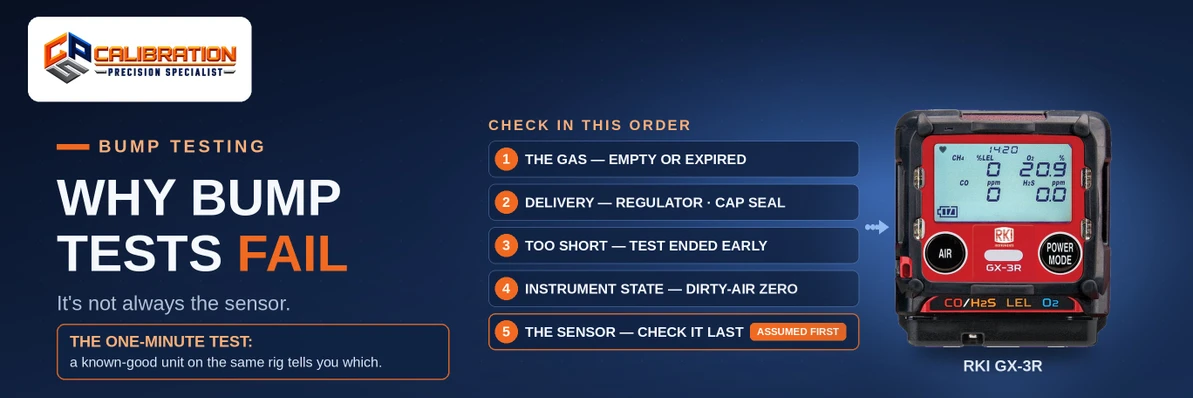
Here's how a bump test actually works, the failure causes in the order you should check them, and the one-minute test that separates a rig problem from an instrument problem.
What a Bump Test Actually Checks
A bump test (also called a functional test) exposes each sensor to a known concentration of gas high enough to trigger its alarm, and confirms two things: the sensor responds, and the instrument alarms — audible, visual, and vibrating — within the manufacturer's specified time.
That's all it checks. A bump test does not verify accuracy, and it does not adjust anything. An instrument can pass a bump test while reading 15% low, which is why bump tests never replace calibration — they sit between calibrations as a daily go/no-go proof that the sensor is alive and the alarms work. When a bump test fails, the correct response is a full calibration before the instrument goes back into service. But before you calibrate — and definitely before you condemn a sensor — work the list below. Calibrating against the same bad gas delivery that failed the bump just bakes the problem in.
Cause 1: The Gas Itself
Start with the cylinder, because it's the cheapest fix and the most common culprit.
- Empty or nearly empty. A cylinder that hisses faintly may not sustain the flow a fixed-flow regulator is rated to deliver. Check the gauge — and remember a disposable cylinder with a stripped or cross-threaded connection can read pressure and deliver almost nothing.
- Expired. Reactive gases — hydrogen sulfide, chlorine, sulfur dioxide, ammonia — degrade in the cylinder, faster in steel than in aluminum. An expired bottle can deliver a fraction of its labeled concentration: enough to move a needle, not enough to cross an alarm setpoint. Expired gas doesn't just fail bump tests; it invalidates calibrations done with it.
- Wrong concentration for the alarm points. Bump gas has to exceed each channel's low alarm. A mix blended for a different instrument configuration — say, a low-range oxygen channel or a nonstandard CO setpoint — can leave one channel permanently short of its alarm no matter how healthy the sensor is.
- Wrong gas for the configuration. A 4-gas cylinder only bumps the four channels it's blended for. Add a sensor the mix doesn't cover — a PID, a specialty toxic — and that channel will "fail" every time until it's bumped with its own gas.
Our standard 4-gas calibration gas (H₂S 25 ppm / CO 50 ppm / CH₄ 50% LEL / O₂ 12%) is blended to clear the standard alarm points on the RKI and SENKO fleets we support — and the lot and expiration are on the label for a reason. Check them first, not last. (Gas shelf life gets its own post in this series — it's a bigger topic than it looks.)
Cause 2: Gas That Never Arrives — Delivery
If the gas is good, the next question is whether it physically reached the sensors.
- The regulator doesn't match the job. Manual bump tests and calibrations on diffusion instruments use a fixed-flow regulator — typically 0.5 L/min — like the CGA-600 fixed-flow regulator. A demand-flow regulator on a diffusion instrument delivers gas only when the instrument draws it — and a diffusion instrument never draws. The result is a bump test where almost no gas flows and every channel fails together. (Fixed-flow vs. demand-flow has its own post in this series; the short version is: pumped instrument or docking station, demand-flow; diffusion instrument by hand, fixed-flow.)
- The calibration cap isn't sealing. The cap is a gasketed fitting, not a hat. A cracked cap, a missing O-ring, the wrong cap for the model, or a cap pressed over a sensor guard caked with mud will leak most of the gas to atmosphere. If the readings climb slowly and stall below the alarm, suspect the seal before the sensor.
- Blocked sensor paths. Dust caps left on, clogged filters, insect nests, ice, dried mud, and tape residue over sensor ports all starve the sensors. On pumped instruments like the RKI GX-Force, add kinked or cracked sample hose, a blocked inlet, and a pump running weak — the instrument can only test the gas its pump actually pulls in.
- Leaks between cylinder and cap. Old tubing goes porous and hard. Flex the hose during a test and watch the readings: if they jump when you move the tubing, you've found your "sensor problem."
Cause 3: The Test Was Too Short
Sensors don't respond at the same speed, and a bump test cut short fails healthy instruments.
Electrochemical toxic sensors typically need tens of seconds to climb to alarm concentration. The oxygen channel works in reverse — it has to fall from 20.9% to below its low alarm (19.5% on most configurations) — and a sluggish-looking O₂ reading early in the test is often just physics, not failure. Pumped instruments add sample-draw time on top: the gas has to travel the full length of the hose before the sensors see any of it, so a 30-foot draw can add many seconds before the clock even starts.
Cold weather stretches all of this. Electrochemical sensors respond measurably slower near and below freezing. Give the test the manufacturer's full response window, in the order the manual specifies, before you call it a fail. A "failed" sensor that passes when the test runs its full course wasn't failed — the test was.
Cause 4: The Instrument's State, Not Its Sensors
- Zeroed in dirty air. A fresh-air zero performed in contaminated air — next to running equipment, inside a process area, over an open sample — teaches the instrument that background gas is "zero." Readings are then suppressed by exactly that amount, and low-concentration bump gas may never cross the alarm. Always zero in air you're sure is clean.
- Still warming up. Sensors and the instrument's compensation need their warm-up period after power-on. Bumping during warm-up produces erratic, usually low, responses.
- Alarms disabled or muted. Some configurations allow alarms to be turned off, latched differently, or set to vibrate-only in certain modes. The sensor may be responding perfectly while the alarm check "fails." Verify the display is actually climbing — that tells you whether you're chasing a sensing problem or an alarming problem, and they're different repairs.
- Calibration-due lockout and fault states. Instruments with overdue-calibration lockouts, sensor faults already showing at power-on, or a pump-fault flag will fail a bump for administrative reasons. Read the screen before you open the gas valve; the instrument often tells you what's wrong if you let it finish its self-check.
Cause 5: It Really Is the Sensor
After the gas, the delivery path, the timing, and the instrument state check out, then yes — the sensor is the likely story. The honest sensor failures look like this:
- End of life. Electrochemical sensors are consumables with a finite service life; oxygen sensors deplete whether they're used or shelved. A sensor that responds more slowly every week, or needs span adjustments that keep growing, is finishing — not failing mysteriously.
- Poisoning. Catalytic LEL sensors are permanently desensitized by silicones, sulfur compounds, and lead — a poisoned bead can read fresh air perfectly and barely respond to gas. This is the failure a bump test exists to catch, because zero and fresh-air checks won't reveal it.
- Over-range damage. A sensor flooded with gas far above its range — an LEL sensor left in a high-hydrocarbon atmosphere, an H₂S sensor hit with a massive release — can come back reading low, or not come back at all.
- One channel, consistently. Genuine sensor failure usually takes out one channel while the others respond normally on the same gas, same cap, same test. When all four channels fail together, that's the rig talking — sensors rarely conspire.
The One-Minute Test That Tells You Which Problem You Have
When a detector fails its bump, don't troubleshoot the detector first. Troubleshoot the test:
- Put a second, known-good instrument on the same rig — same cylinder, same regulator, same cap. If it also fails, your problem is gas or delivery, full stop. If it passes cleanly, the rig is proven and the first instrument needs attention.
- Watch the readings, not just the pass/fail. Climbing-but-slow points to timing, cold, or a tiring sensor. No movement at all points to delivery or a dead channel. Movement on some channels only points to gas blend or a single sensor.
- Change one thing at a time. Swap the cap, then the hose, then the cylinder. Shotgunning parts wastes the diagnostic information the failure was giving you.
This is the same discipline we use on the bench for every instrument family — gas, temperature, flow, and pressure alike: prove the reference and the rig before you condemn the instrument. Half of troubleshooting is refusing to replace the part that isn't broken.
When Failing Bumps Are a Pattern, Automate the Test
If your fleet bumps manually every morning, technique varies by whoever's holding the cap — how long they flow gas, how hard they press the cap, whether they record the result at all. Docking stations remove the technique from the test: fixed flow, fixed duration, every channel, with a stored pass/fail record. The SENKO SGT Docking Station II does this for SENKO SGT fleets, and RKI's SDM stations do the same for RKI fleets — one button, the same test every time, and a record an auditor can read. A station won't fix expired gas, but it makes delivery and timing failures obvious instead of arguable, and it turns "did everyone bump today?" into a report instead of a memory.
And when an instrument fails on a proven rig? It comes out of service — that's not negotiable. A full calibration is the next step; if it won't calibrate or won't hold span, the sensor gets replaced. Ship it to our Rockwood lab or have us come to your facility, and we'll tell you which of the five causes it actually was — with as-found data on the certificate, not a guess. Questions about a detector that keeps failing its morning bump? Call us at 865-900-8844 before you order a sensor. Odds are decent you don't need one.
The Bottom Line
A failed bump test is information, not a verdict. Most failures trace back to the gas — empty, expired, or blended below the alarm points — to delivery — wrong regulator, leaking cap, blocked filter — or to a test that ended before the sensors could answer. Real sensor death happens, but it usually takes one channel, not four. Prove the rig with a second instrument, change one thing at a time, and only then spend money on sensors.
Bump-testing supplies that won't fail you first: fresh, in-date calibration gas, the right regulator for the job, and portable gas detection from RKI and SENKO. Detector out of service after a failed bump? Ship it to our lab or book an on-site visit — gas detection and process instruments alike.
Frequently Asked Questions
What should I do first when a detector fails its bump test? Take it out of service, then test the test: put a known-good instrument on the same cylinder, regulator, and cap. If it fails too, the problem is the gas or the delivery setup. If it passes, run a full calibration on the failed instrument — and only replace a sensor if it won't calibrate or won't hold span.
Can expired calibration gas cause a bump test to fail? Yes — it's one of the most common causes. Reactive gases like H₂S degrade in the cylinder over time, so an expired bottle can deliver well below its labeled concentration: enough to move the reading, not enough to cross the alarm setpoint. Expired gas also invalidates any calibration performed with it.
Why did all four channels fail at the same time? Simultaneous failure of every channel almost always points to the rig, not the sensors: an empty or expired cylinder, a demand-flow regulator used on a diffusion instrument, a calibration cap that isn't sealing, or a blocked sample path on a pumped unit. Sensors wear out individually; they rarely all die on the same morning.
Why does my oxygen channel seem to fail first or respond slowly? The oxygen channel works in reverse — during a bump it must fall from 20.9% to below its low alarm point (typically 19.5%), driven by the low-oxygen bump gas (12% O₂ in a standard 4-gas mix). That takes time, and electrochemical oxygen sensors also slow down in cold weather and near end of life. Give it the manufacturer's full response window before calling it a failure.
Is a bump test the same as a calibration? No. A bump test is a functional check: it confirms the sensors respond to gas and the alarms activate. It does not check accuracy against a tolerance and adjusts nothing. Calibration sets the instrument's readings against a known standard. A failed bump test calls for a full calibration before the instrument returns to service.
How often should bump tests be done? Before each day's use is the standard practice recommended by manufacturers and OSHA guidance for direct-reading instruments. Instruments that sit in a docking station can be bumped automatically on a schedule, but the principle is the same: a functional proof, close to the work, not a calibration certificate from last quarter.
CPS Calibrations · 109 S. Front Street, Rockwood, TN 37854 · Portable Gas Detection · Calibration Gas · Calibration Services · Contact Us
Recent Posts
-

Open-Path vs. Point Gas Detectors: What's the Difference?
The difference between an open-path and a point gas detector is what each one measures: an open-path …Oct 21st 2026 -

What Does IDLH Mean?
IDLH stands for Immediately Dangerous to Life or Health, and it is NIOSH's escape line: the maximum …Oct 21st 2026 -

Carbon Dioxide vs. Carbon Monoxide: What's the Difference?
Carbon dioxide (CO2) and carbon monoxide (CO) differ by one oxygen atom — and by almost everything t …Oct 21st 2026