
RKI GX-3R vs. GX-3R Pro: What's the Difference?
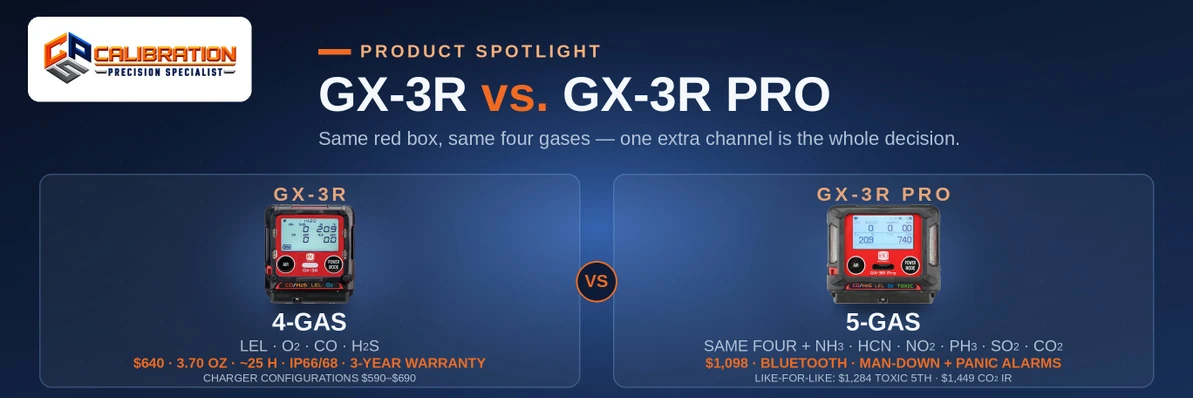
The difference between the RKI GX-3R and the GX-3R Pro is one sensor channel and the features built around it. The GX-3R ($640) monitors four gases — LEL, O₂, CO, and H₂S. The GX-3R Pro ($1,098) monitors those same four plus a fifth, swappable channel chosen from NH₃, HCN, NO₂, PH₃, SO₂, or CO₂, and adds Bluetooth wireless communication plus man-down and panic alarms. Everything else is shared platform: both are diffusion monitors in an IP66/68 case with roughly 25 hours of rechargeable battery runtime, a 3-year warranty, the same core-four replacement sensors, and the same SDM-3R docking station.
That's the whole comparison in one paragraph — but "one extra channel" undersells what changes in practice, and the $458 gap deserves an honest accounting. Here's the full head-to-head.
The Head-to-Head: GX-3R vs. GX-3R Pro
| RKI GX-3R | RKI GX-3R Pro | |
|---|---|---|
| Gases monitored | Up to 4: LEL, O₂, CO, H₂S | Up to 5: LEL, O₂, CO, H₂S + one fifth gas |
| Fifth-gas options | — | NH₃ 0–400 ppm · HCN 0–30 ppm · NO₂ 0–20 ppm · PH₃ 0–20 ppm · SO₂ 0–100 ppm · CO₂ (IR) 0–10,000 ppm or 0–10% vol. |
| Price | $640 (charger configurations $590–$690) | $1,098 (configured builds $1,005–$1,575) |
| Sampling | Diffusion; optional clip-on pump | Diffusion; optional clip-on pump |
| Clip-on pump | RP-3R — $369 | RP-3R Pro — $367 |
| Docking station | SDM-3R — $1,322 (shared) | SDM-3R — $1,322 (shared) |
| Battery | Rechargeable Li-ion, ~25 hours, ~3-hour recharge | Rechargeable Li-ion, ~25 hours (~16 hours with the IR CO₂ sensor), ~3-hour recharge; alkaline pack option |
| Size / weight | 2.4″ W × 2.63″ H × 1.06″ D with boot · ~3.70 oz | ~2.9″ W × 2.6″ H × 1.06″ D · ~4.58 oz |
| Ingress protection | IP66/68 | IP66/68 |
| Alarms | Audible, visual, vibration | Audible, visual, vibration + man-down and panic alarms |
| Connectivity | — | Bluetooth wireless (live readings to the RKI phone app) |
| Warranty | 3 years | 3 years* |
*The Pro's listing notes that manufacturer warranty terms and sensor-specific limitations may apply.
Both instruments cover the same core measuring ranges — LEL 0–100% in 1% increments, O₂ 0–40.0% vol., H₂S 0–200.0 ppm, CO 0–2,000 ppm, with T90 response within 30 seconds — and both run the same simple 2-button operation with an auto-backlit LCD. Browse the wider range under portable multi-gas monitors and diffusion monitors to see where the pair sits.
What the Fifth Channel Actually Buys
The Pro's fifth channel is not a generic "extra." It's a named gas, on the same instrument the worker already wears, alarming through the same buzzer, LEDs, and vibration motor. In practice, that replaces a second instrument:
- NH₃ (0–400 ppm) for ammonia refrigeration plants, cold storage, and fertilizer handling — the NH₃ replacement sensor is a $255 part when the channel needs renewal.
- HCN (0–30 ppm) for fire service overhaul and plastics/chemical work, where hydrogen cyanide rides along with the CO a standard 4-gas already sees.
- NO₂ (0–20 ppm) around diesel equipment, welding, and ice arenas, where nitrogen dioxide is the hazard a 4-gas is blind to.
- PH₃ (0–20 ppm) for grain fumigation and semiconductor work.
- SO₂ (0–100 ppm) for pulp and paper, power generation, and chemical processing.
- CO₂ by infrared (0–10,000 ppm or 0–10% vol.) for beverage carbonation, fermentation, dry-ice handling, and modified-atmosphere spaces — the CO₂ IR sensor is a $420 part.
The alternative for each of those jobs is a 4-gas on one hip and a single-gas toxic monitor on the other — two instruments to buy, bump, calibrate, and keep track of, and two chances for one of them to be sitting in the truck. The Pro folds the fifth gas into the unit that's already clipped on. This is the instrument side of the question we covered in specialty gas mixes: when standard 4-gas isn't enough.
The Pro also adds two things that have nothing to do with gas channels: Bluetooth, which streams live readings to RKI's phone app (the GX-3R Pro manual rates the connection at about 30 feet, unobstructed) so an attendant or supervisor can watch an entrant's air from outside the space, and man-down and panic alarms, which turn the monitor into a lone-worker safety device as well as a gas detector. For confined-space work — where our post on how to test a confined space before entry lays out the testing sequence — a live readout at the attendant's position is a genuine capability gain, not a gadget.
What Stays the Same
Buyers cross-shopping these two often assume the Pro is "the bigger, better instrument" across the board. It isn't — it's the same instrument with one more channel:
- The core four sensors are shared. The LEL, O₂, CO, and H₂S replacement sensors are the same parts on both models — LEL and O₂ sensors are $160 each, and the CO/H₂S combo sensor is $255 — so a fleet running both models stocks one set of core spares.
- The dock is shared. The SDM-3R docking and calibration station ($1,322) is built for the GX-3R and the GX-3R Pro — one station bump-tests and calibrates a mixed fleet.
- The runtime is shared. Both run about 25 hours on the rechargeable Li-ion pack with about a 3-hour recharge.
- The build is shared. IP66/68 dust and water protection, impact-resistant rubber boot, field-replaceable sensors and filters, non-compliance indicator, and a 3-year warranty on both.
One honest exception: the clip-on pumps are model-specific. The GX-3R takes the RP-3R ($369); the Pro takes the RP-3R Pro ($367). They are priced almost identically, but they are not the same part — order the pump that matches the instrument. Either pump converts its diffusion monitor into a pre-entry sampling tool (see pumped monitors).
What the Pro Costs, Configuration by Configuration
The $1,098 headline is the product's listed price; the Pro's 32 configurations move with the fifth sensor and the battery/charger package. Like-for-like — Li-ion pack with the 100–240 VAC charger, the same package the GX-3R's $640 buys:
- No fifth sensor fitted: $1,029
- Fifth toxic sensor (SO₂, NO₂, HCN, PH₃, or NH₃): $1,284
- Fifth CO₂ infrared sensor (either range): $1,449
Across all battery and charger packages, Pro builds run $1,005 to $1,575. The GX-3R's five charger configurations run $590 (Li-ion pack only, no charger) to $690 (dual VAC + 12 VDC charger packages), with the standard VAC-charger build at $640.
The Honest Trade-Offs
- The $458 gap is real money if the fifth gas never shows up. If your hazard assessment names only the standard four gases — the classic confined-space quartet — the Pro's fifth channel is a channel you paid for, and will pay to maintain, that reads nothing your work produces. The GX-3R is the right buy for pure 4-gas work, full stop.
- The fifth channel has carrying costs. Its sensor is a consumable: $255 to replace a toxic channel, $420 for the CO₂ IR channel. And it has to be bump-tested and calibrated with gas that actually contains that gas — a quad-mix cylinder will never verify an NH₃ or CO₂ channel. Budget the calibration gas to match the configuration, the same discipline behind our post on why bump tests fail.
- The CO₂ build trades runtime. With the infrared CO₂ sensor fitted, RKI rates the Pro's Li-ion runtime at about 16 hours instead of 25 — still a full shift and then some, but the longest-runtime configuration is the electrochemical toxic build.
- The Pro is slightly larger and heavier — about 2.9″ wide and 4.58 oz against the GX-3R's 2.4″ and 3.70 oz with boot. Both are still among the smallest multi-gas monitors made; the difference is noticeable on a shirt pocket, irrelevant on a harness.
Calibration: The Fifth Channel Is a Fifth Obligation
Whichever model you choose, the upkeep rule is the same one we give every H₂S customer (see why hydrogen sulfide is so dangerous in wastewater): bump test before the day's use, calibrate on schedule, and match the gas to every channel on the instrument. A Pro with an SO₂ channel needs SO₂ in its span gas; a Pro with CO₂ needs a CO₂ mix. When a unit comes to CPS — shipped to our Rockwood lab or serviced on site — we calibrate every channel, including the fifth.
Choose the GX-3R When… / Choose the GX-3R Pro When…
Choose the GX-3R ($640) when:
- Your hazard assessment covers the standard four gases — LEL, O₂, CO, H₂S — and nothing else. Confined-space entry, personal monitoring, and general plant work live here.
- Smallest and lightest wins: at ~3.70 oz with its boot, it's the one workers forget they're wearing.
- You're equipping a fleet at a price, and one shared SDM-3R dock will serve every unit.
Choose the GX-3R Pro ($1,098) when:
- Your hazard assessment names a fifth gas — ammonia, HCN, NO₂, PH₃, SO₂, or CO₂ — and you want it on the same instrument as the core four, not on a second unit.
- An attendant or supervisor needs to see the entrant's readings live — Bluetooth to the phone app covers about 30 feet unobstructed.
- Lone-worker coverage matters: man-down and panic alarms ride on the instrument the worker already wears.
- The hazard changes by job: the fifth sensor is a swappable, field-replaceable part ($255 toxic / $420 CO₂ IR), so one Pro can be re-roled as the work changes.
The Bottom Line
The GX-3R and GX-3R Pro are the same ultra-compact RKI platform — same core sensors, same ~25-hour battery, same IP66/68 build, same dock, same 3-year warranty. The GX-3R is the complete 4-gas answer at $640. The Pro, at $1,098 ($1,284 configured with a toxic fifth channel and the standard charger), buys a fifth gas channel plus Bluetooth and man-down/panic alarms. If a fifth gas is on your hazard assessment, the Pro replaces a second instrument and earns its price the first week. If it isn't, the GX-3R does the whole job for $458 less — and nothing about the Pro makes the standard four gases any safer.
Ready to spec one? Start with the GX-3R and GX-3R Pro configuration lists, browse the full RKI Instruments lineup and our portable gas detection range, and keep the calibration gas matched to every channel you choose. Not sure whether your fifth gas justifies the Pro? Call us at 865-900-8844 and name the gas and the space — that conversation is the decision.
Frequently Asked Questions
What's the difference between the RKI GX-3R and GX-3R Pro? The GX-3R monitors four gases — LEL, O₂, CO, and H₂S — and costs $640. The GX-3R Pro ($1,098) monitors those same four plus a fifth, swappable channel (NH₃, HCN, NO₂, PH₃, SO₂, or CO₂) and adds Bluetooth communication and man-down and panic alarms. Both share the same platform: IP66/68 case, ~25-hour rechargeable battery, same core-four sensors, same SDM-3R dock, and a 3-year warranty.
How much more does the GX-3R Pro cost than the GX-3R? $458 at the headline prices — $1,098 against $640. Configured like-for-like with the Li-ion pack and 100–240 VAC charger, a Pro with a fifth toxic sensor is $1,284 and a Pro with the infrared CO₂ sensor is $1,449; across all battery and charger packages, Pro builds run $1,005–$1,575, while GX-3R charger configurations run $590–$690.
What fifth gases can the GX-3R Pro measure? Six options: ammonia (NH₃, 0–400 ppm), hydrogen cyanide (HCN, 0–30 ppm), nitrogen dioxide (NO₂, 0–20 ppm), phosphine (PH₃, 0–20 ppm), sulfur dioxide (SO₂, 0–100 ppm), and carbon dioxide (CO₂) by infrared sensor in 0–10,000 ppm or 0–10% volume ranges. One fifth channel is fitted at a time, alongside the standard LEL, O₂, CO, and H₂S channels.
Is the GX-3R Pro worth $458 more than the GX-3R? It is worth it when your hazard assessment names a fifth gas — ammonia at a refrigeration plant, HCN in fire overhaul, CO₂ around carbonation or dry ice — because the Pro then replaces a separate single-gas instrument for that toxic, and adds Bluetooth live readings plus man-down and panic alarms. It is not worth it for standard 4-gas work alone: the core four channels, sensors, battery, and dock are identical, and the unused fifth channel still costs $255 (toxic) or $420 (CO₂ IR) each time its sensor needs replacement.
Can a GX-3R be upgraded to a GX-3R Pro? No. The GX-3R and GX-3R Pro are two separate instruments, and RKI offers no conversion or upgrade kit — the fifth sensor channel, Bluetooth, and man-down/panic alarms are Pro hardware. Sensors are field-replaceable within each model (including swapping the Pro's fifth sensor for a different fifth gas), but a GX-3R cannot gain a fifth channel. If a fifth gas is even a likely future requirement, buy the Pro first.
Do the GX-3R and GX-3R Pro use the same docking station and charger? The docking station, yes: the SDM-3R ($1,322) is built for both models, so one station bump-tests and calibrates a mixed fleet, and both models use Li-ion charger packages with about a 3-hour recharge. The clip-on sampling pumps are model-specific, though — the RP-3R ($369) fits the GX-3R and the RP-3R Pro ($367) fits the Pro.
How long does the battery last on the GX-3R vs. the GX-3R Pro? About the same: roughly 25 hours per charge on the rechargeable Li-ion pack for the GX-3R, and roughly 25 hours for the GX-3R Pro with an electrochemical fifth sensor (about 23 hours with Bluetooth running). The exception is the Pro's infrared CO₂ configuration, which RKI rates at about 16 hours. Both recharge in about 3 hours, and the Pro also offers an alkaline battery pack option.
Is the GX-3R Pro bigger than the GX-3R? Slightly. The GX-3R measures 2.4″ W × 2.63″ H × 1.06″ D with its boot and weighs about 3.70 oz. The GX-3R Pro measures about 2.9″ W × 2.6″ H × 1.06″ D and weighs about 4.58 oz — roughly half an inch wider and just under an ounce heavier, in exchange for the fifth sensor bay. Both remain among the smallest multi-gas monitors available.
How much do replacement sensors cost for the GX-3R and GX-3R Pro? The core four sensors are the same parts on both models: LEL $160, O₂ $160, CO $160, H₂S $160, and the CO/H₂S combo sensor $255. The Pro's fifth channel costs $255 for any of the toxic sensors (NH₃, HCN, NO₂, PH₃, SO₂) and $420 for either infrared CO₂ sensor (0–10,000 ppm or 0–10% vol.). All of them are field-replaceable.
Which one should a confined space crew buy, the GX-3R or the GX-3R Pro? Buy the GX-3R ($640) if the crew's spaces present only the standard four hazards — LEL, O₂, CO, H₂S — which covers most permit-entry work; add the RP-3R clip-on pump ($369) for pre-entry sampling. Buy the GX-3R Pro ($1,098) if any space on the program adds a named fifth gas — ammonia, CO₂, SO₂, NO₂, HCN, or PH₃ — or if the attendant needs live Bluetooth readings from the entrant's instrument. Either way, both units dock on the same SDM-3R and carry a 3-year warranty.
CPS Calibrations · 109 S. Front Street, Rockwood, TN 37854 · Portable Gas Detection · Calibration Gas · Calibration Services · Contact Us
Recent Posts
-

What Is a Confined Space? OSHA's Definition, the 3 Tests, and When It Becomes Permit-Required
A confined space is a space that passes all three of OSHA's tests at the same time: it is large enou …Oct 21st 2026 -
PID vs. LEL for VOC Detection: Which Sensor Do You Actually Need?
Use a PID to detect VOCs and an LEL sensor to detect explosive atmospheres — they measure different …Oct 21st 2026 -

Semiconductor (MOS) Gas Sensors: Where They Work and Where They Lie
A semiconductor (MOS) gas sensor measures gas with a heated film of metal oxide — usually tin dioxid …Oct 21st 2026