
What Can the RKI GX-6100 Detect? The Pumped 6-Gas PID Monitor Explained
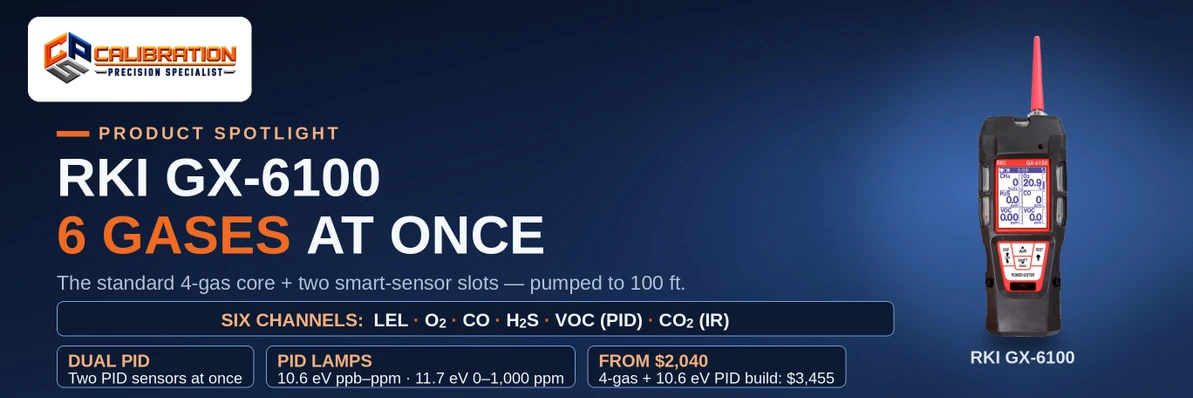
The RKI GX-6100 is a pumped portable gas monitor that measures up to six gases simultaneously: the standard confined-space four — combustible gas (LEL), oxygen (O₂), carbon monoxide (CO), and hydrogen sulfide (H₂S) — plus two interchangeable smart-sensor channels that can add a PID for VOCs (0–4,000 ppm, with a library of more than 600 gases), an infrared sensor for CO₂, methane, or hydrocarbons, a specialty toxic (NH₃, Cl₂, HCN, NO₂, PH₃, SO₂, or N₂H₄), or a thermal-conductivity sensor reading combustible gas to 100% volume. Its built-in pump draws about 0.45 L/min from up to 100 ft away, and CPS lists 288 configurations from $2,040 for the standard 4-gas build to $5,207 fully loaded — the 4-gas + 10.6 eV PID build is $3,455.
That lead paragraph is the whole instrument in one breath, and it is worth unpacking slowly, because the GX-6100 is not really one product. It is a platform: a pumped 4-gas core with two empty chairs next to it, and what you seat in those chairs decides what the instrument can detect, what it costs, and what it costs to keep. This spotlight covers what it detects, how the configurations work, what the specs mean in the field, and the honest limits — including the upkeep bill that comes with PID ownership.
What Is the GX-6100, and Who Is It For?
The RKI GX-6100 is RKI's current flagship pumped portable — the next-generation successor to the GX-6000 — built around a standard 4-gas core (LEL/O₂/CO/H₂S) and two interchangeable smart-sensor slots that auto-recognize the sensors installed in them. An internal sample-draw pump pulls air through a probe and hose at approximately 0.45 L/min, with a maximum sampling range of 100 ft. The unit is IP67, intrinsically safe (IECEx, ATEX, and cCSAus approvals), and sized at about 2.6 × 7.9 × 2.2 in. and 17.6 oz with the lithium-ion battery pack.
It is built for the jobs a standard 4-gas cannot finish:
- HazMat response and leak investigation, where the first question is "what else is in this air?" — a PID channel and a specialty toxic in the same instrument as the confined-space core.
- Industrial hygiene and VOC screening, where ppb-to-ppm VOC readings ride along on pre-entry and perimeter surveys instead of traveling as a separate PID instrument.
- Confined-space entry with a named extra hazard — ammonia refrigeration, chlorine service, fumigation phosphine, hydrogen cyanide — that a 4-gas has no channel for. Our post on how to test a confined space before entry covers the entry sequence this instrument slots into.
- Specialty and high-range combustible work, including % volume measurement for purging and inerting via the thermal-conductivity (TC) sensor, and hydrazine (N₂H₄) monitoring for aerospace and propellant applications.
- Landfill, remediation, and perimeter monitoring, where methane needs both a %LEL and a % volume answer and VOCs are part of the picture.
If none of that sounds like your work — standard four gases, personal monitoring, all shift — read the comparison section before you read the price table. This is a specialist's instrument, and it is priced like one.
What Can the GX-6100 Detect? Every Channel, With Ranges
Every GX-6100 configuration starts from the same core and adds channels from the two smart slots. The full detection menu, with the ranges from the product listing:
| Channel | Sensor type | Range |
|---|---|---|
| Combustible gas (LEL) | Catalytic (R sensor) | 0–100% LEL |
| Oxygen (O₂) | Electrochemical | 0–40.0% vol. |
| Carbon monoxide (CO) | Electrochemical | 0–2,000 ppm |
| Hydrogen sulfide (H₂S) | Electrochemical | 0–200 ppm |
| VOCs — PID 10.6 eV, low range | Photoionization | 0–40,000 ppb |
| VOCs — PID 10.6 eV, high range | Photoionization | 0–4,000 ppm |
| VOCs — PID 11.7 eV | Photoionization | 0–1,000 ppm |
| Benzene-specific — PID 10.0 eV | Photoionization + pre-filter tube | 0–50 ppm |
| Carbon dioxide (CO₂) | Infrared (NDIR) | 0–10,000 ppm or 0–10% vol. |
| Methane (CH₄) | Infrared (NDIR) | 0–100% LEL / 0–100% vol. |
| Hydrocarbons (HC) | Infrared (NDIR) | 0–100% LEL / 0–30% vol. |
| Ammonia (NH₃) | Electrochemical | 0–400 ppm |
| Chlorine (Cl₂) | Electrochemical | 0–10 ppm |
| Hydrogen cyanide (HCN) | Electrochemical | 0–15 ppm |
| Nitrogen dioxide (NO₂) | Electrochemical | 0–20 ppm |
| Phosphine (PH₃) | Electrochemical | 0–20 ppm |
| Sulfur dioxide (SO₂) | Electrochemical | 0–99.9 ppm |
| Hydrazine (N₂H₄) | Electrochemical | 0–10 ppm |
| Combustible gas, % volume | Thermal conductivity (TE 7561) | 0–100% vol. |
| Combustible gas, ppm leak check | MOS semiconductor | CH₄ 0–5,000 ppm; isobutane 0–2,000 ppm |
Three things in that table deserve emphasis. First, the standard core is wider than the classic personal-monitor spec — CO reads to 2,000 ppm and O₂ to 40% vol., ranges aimed at response and process work rather than just entry compliance. Second, the PID options are genuinely different instruments: the 10.6 eV low-range sensor reads VOCs in parts per billion (0–40,000 ppb) for hygiene screening, while the high-range version trades sensitivity for span (0–4,000 ppm). Third, the TC sensor answers a question no LEL sensor can: not "how close to flammable is this?" but "how much combustible gas is actually here?" — the % volume reading that purge, inerting, and line-clearing work runs on. RKI's own GX-6100 vs. GX-6000 comparison makes the same point: measuring combustibles in ppm, %LEL, and % volume in one monitor is the platform's headline upgrade.
How Do GX-6100 Configurations Work? 288 Builds, Five Choices
There is no single GX-6100 price because there is no single GX-6100. Our listing carries 288 configurations, built from five choices:
- Standard core: the LEL/O₂/H₂S/CO 4-gas set — or no standard sensors at all, for dedicated smart-sensor builds (RKI designs the GX-6100 to also run as a single-gas PID unit).
- PID/VOC slot: none, the 10.6 eV PID (0–4,000 ppm), or the 11.7 eV PID (0–1,000 ppm).
- Specialty slot: none, or one of CO₂ IR (10,000 ppm or 10% vol.), methane IR, hydrocarbon IR, NH₃, Cl₂, HCN, NO₂, PH₃, SO₂, or N₂H₄.
- TC sensor: none, or the TE 7561 thermal-conductivity sensor (0–100% vol. combustible).
- Battery/charger: lithium-ion pack with AC charger, or a combination alkaline + lithium-ion pack set (+$170).
What the main paths cost, all with the lithium-ion battery pack:
| Configuration (all include LEL/O₂/CO/H₂S core) | Price |
|---|---|
| Standard 4-gas, no smart sensors | $2,040 |
| 5-gas: + NH₃, HCN, NO₂, PH₃, or SO₂ | $2,315 |
| 5-gas: + Cl₂ | $2,450 |
| 5-gas: + methane IR or hydrocarbon IR | $2,460 |
| 5-gas: + CO₂ IR (either range) | $2,510 |
| 5-gas: + N₂H₄ (hydrazine) | $2,565 |
| Add the TE 7561 TC (% volume) sensor to any build | +$167 |
| 5-gas: + PID 10.6 eV (0–4,000 ppm) | $3,455 |
| 6-gas: PID 10.6 eV + CO₂ IR | $3,925 |
| 5-gas: + PID 11.7 eV (0–1,000 ppm) | $4,345 |
| Fully loaded: PID 11.7 eV + N₂H₄ + TC, both battery packs | $5,207 |
Read the deltas and the configuration logic explains itself: a specialty electrochemical channel adds $275–$525, the infrared channels $420–$470, the PID is the expensive chair at +$1,415 (10.6 eV) or +$2,305 (11.7 eV), and the TC sensor is the bargain at +$167. Two honest notes on the extremes: the cheapest variants on the listing ($1,597) are no-standard-core specialty builds pairing an IR sensor with the TC sensor — instruments for a specific measurement, not a cheap way into a 4-gas — and a PID-only build with no standard core is $3,255, which is why most buyers take the core: the full 4-gas + PID at $3,455 is the better instrument for $200 more. Not sure which specialty channel your hazard assessment actually names? That question is the whole purchase — call us at 865-900-8844 before you spec, or start from our post on specialty gas mixes: when standard 4-gas isn't enough.
The PID Channel: VOCs, Lamp Choices, and Benzene
A PID (photoionization detector) ionizes gas molecules with an ultraviolet lamp and reads the resulting current as a total-VOC concentration. The GX-6100's PID configurations carry a library of more than 600 VOCs with correction factors, a favorites list of 30, and a recent list of 8, so switching the target gas is a menu pick rather than a recalibration event. Our explainer on what a PID measures walks through the physics; the lamp choice is the part that matters here:
- 10.6 eV is the workhorse lamp — the widest practical VOC coverage, in a low range (0–40,000 ppb) for screening and a high range (0–4,000 ppm) for response. Both PID options in our online configurator are built on this lamp family and the 11.7 eV below.
- 11.7 eV ionizes compounds the 10.6 eV lamp cannot reach, at 0–1,000 ppm — but the lamp is a consumable with a short fuse: RKI warranties it for only two months, and the replacement lamp is the priciest of the set. Buy it for the compounds that need it, not as a default.
- 10.0 eV + benzene mode. RKI offers a benzene-specific version using the 10.0 eV PID sensor (VOC range 0–100 ppm) with Benzene Select Mode: a timed sample drawn through a pre-filter tube that strips out other VOCs so the reading is benzene specifically, at 0–50 ppm. Benzene pre-filter tubes and the holder ship with applicable benzene configurations. On our store, the 10.0 eV benzene PID sensor is listed as a GX-6100 sensor ($2,205) rather than as a configurator option, so a benzene build is a spec conversation — call us and we will build it correctly.
The platform also supports dual PID sensors — two PID lamps installed at once (for example, a broad-range 10.6 eV for the survey and the 10.0 eV for benzene confirmation) — a configuration RKI pioneered on this product line. And the honest limit that applies to every PID, this one included: a PID reads total ionizable VOCs against the target gas you select. It does not identify the individual compounds in a mixture, and it cannot see gases whose ionization energy exceeds the lamp's — methane (12.6 eV) is invisible to all three lamps, which is exactly why the IR and catalytic channels exist alongside it.
Pumped Sampling: 100 ft of Reach, and the Delay That Comes With It
The GX-6100's internal pump draws approximately 0.45 L/min and supports sampling up to 100 ft from the instrument — top, middle, and bottom of a vessel, the far side of a sump, down a duct — before anyone enters, and continuously while the work runs. Every unit ships with a probe with hydrophobic and dust filter and a 3 ft Teflon-lined sample hose; longer hose runs are an accessory decision, not an instrument limitation.
The physics tax is time. A sample drawn through 100 ft of hose takes real time to reach the sensors, and the reading only represents the far end once the full line has been swept — at long draws, allow minutes, not seconds, before you treat a pre-entry reading as final. We worked the draw-distance and delay math in full in our post on how far a pumped detector can draw a sample; the short version is that pumped reach and response delay are the same feature viewed from two ends, and the GX-6100's 100 ft rating is the top of the portable class alongside its own stablemates. Browse the wider pumped monitors range for how it sits against the rest of the field.
The Specs That Matter, and Why
| Specification | GX-6100 |
|---|---|
| Sampling | Internal pump, ~0.45 L/min, up to 100 ft |
| Battery | Li-ion up to ~28 hrs (~6 hr recharge); alkaline ~8 hrs; packs interchangeable |
| Size / weight | ~2.6 × 7.9 × 2.2 in.; ~17.6 oz with Li-ion pack |
| Ingress / temperature | IP67; −4°F to +122°F (−20°C to +50°C); 0–95% RH non-condensing |
| Alarms | Audible (~95 dB at 1 ft), visual (5 LEDs on 3 sides), vibration; man-down and panic alarms |
| Display | LCD with auto-rotation, peak-bar display, backlight; built-in LED flashlight |
| Data | Datalogging + snap logging; IrDA download; Bluetooth (RK Link alarm notifications) |
| Approvals | IECEx, ATEX, cCSAus intrinsically safe |
| Modes | Normal, Barhole, Inert, Leak Check (ppm), Benzene Select (with 10.0 eV sensor) |
Why these numbers matter, briefly: the 28-hour Li-ion runtime is double the GX-6000's 14 hours and covers extended response and turnaround work without a mid-incident charge — but the alkaline pack's ~8 hours is the honest backup figure, not a second full shift. The auto-rotating display and peak-bar sound like conveniences until you are reading the instrument at arm's length down a manhole ladder. The man-down and panic alarms plus Bluetooth RK Link notifications turn a solo worker's alarm into a message to registered contacts — the difference between an alarm someone hears and an alarm someone receives. And the LEL sensor protection mode guards the catalytic bead during high-gas exposure, which is the failure that quietly kills LEL sensors in exactly the atmospheres this instrument is bought for.
GX-6100 vs. GX-Force vs. SENKO SP-MGTP: Honest Context
- vs. the RKI GX-Force ($794): the GX-Force is RKI's pumped standard-4-gas instrument — same pump-draw concept, same R-sensor family, no smart slots. If your hazard assessment is LEL/O₂/CO/H₂S and nothing else, the GX-Force does the job for $1,246 less than the GX-6100's 4-gas build, and the GX-6100's extra money buys you channels you will never populate. The GX-6100 earns its price the day a fifth or sixth gas joins the assessment.
- vs. the SENKO SP-MGTP (top configuration $3,569): SENKO's pumped 6-gas tops out below the GX-6100's comparably equipped PID + CO₂ build ($3,925), and we will say so plainly. What the RKI premium buys is the platform around the reading: dual-PID capability, the TC % volume sensor, the N₂H₄ channel, Bluetooth alarm notification, 28-hour runtime — and RKI's sensor commonality, since the GX-6100's 4-gas R sensors are interchangeable with the GX-3R, GX-3R Pro, and GX-Force, which matters if your fleet is already RKI. If none of those are your deciding factors, the SENKO is a legitimate, cheaper 6-gas answer and we sell and service both.
Records and Datalogging
The GX-6100 logs interval trend data, alarm events, and calibration/bump records, downloadable over IrDA with RKI's Data Logger program. Capacity depends on the logging interval: at the factory 5-minute interval setting, the interval trend holds 300 hours of data; at a 10-minute interval, 600 hours; at a fast 10-second interval, 10 hours. Non-interval logs hold 100 alarm events, 100 trouble events, and 100 bump-test/calibration records before the oldest are overwritten. Snap logging captures on-demand readings outside the interval cycle, and user/station IDs (up to 128 each) tag sessions to a person and a place. Bluetooth handles the other direction of communication: alarm notifications out to registered contacts through the RK Link app.
Upkeep: The SDM-6100, PID Consumables, and Warranty
A 6-gas instrument is a program, not a purchase, and the GX-6100's upkeep has three line items to budget:
Calibration station. The SDM-6100 ($2,020) is the model's single-module docking station: it bump tests, calibrates, and charges the instrument, storing calibration and event data to the included flash drive. Listed versions run to $2,885 with demand-flow regulators and gas cylinders included — including a kit with a 34L methane 50% vol. cylinder for the TC channel, which tells you something important: every channel you add needs gas that covers it. A quad-mix cylinder verifies the standard core only; the PID channel spans on isobutylene, an SO₂ or NH₃ channel needs its own span gas, and the TC channel needs % volume methane. Match the calibration gas to the configuration you bought — and when a GX-6100 comes to us, in our Rockwood lab or on site, we calibrate every channel, not just the standard four.
PID consumables. The PID's ultraviolet lamp and electrode stack are wear parts — humidity, fouling, and plain hours dim a lamp long before the sensor around it dies. On our store: replacement electrode stacks run $116 (10.6 eV), $152 (10.6/11.7 eV), and $193 for the 10.0 eV benzene stack; the 10.6/10.0 eV replacement lamp is $284; and a full replacement PID sensor is $1,365 (10.6 eV high range) to $2,205 for the 10.0 eV benzene sensor. Standard-channel sensors are field-replaceable like the rest of the RKI line, and sensors, batteries, filters, and the pump itself are all user-swappable — downtime on this platform is measured in minutes, not in shipping labels.
Warranty. Per RKI's datasheet: 3 years materials and workmanship including the R sensors (the standard 4-gas set); 2 years for IR sensors and electrochemical smart sensors (except Cl₂); 1 year for the TE, Cl₂, and PID sensors; and 2 months for the 11.7 eV lamp. That last line is the one to plan around — if your application needs the 11.7 eV lamp, treat it as a consumable from day one.
The Honest Limits
- Price class. Even the 4-gas build is $2,040, and PID builds start at $3,455. This is a response/hygiene instrument, not a fleet personal monitor; outfitting a whole crew with GX-6100s to do standard 4-gas work is the wrong spend (that is GX-Force and GX-3R money).
- Size. At 7.9 in. tall and 17.6 oz, it is a hand-carried sampling instrument, not a clip-on personal monitor — roughly double the carry of a GX-3R-class unit. It goes to the work on a probe; it is not worn in the breathing zone all shift.
- PID is not identification. Total VOC against a selected target gas, with correction factors — powerful for screening and alarming, not a speciation lab. Benzene-specific measurement is a timed pre-filter-tube procedure in Benzene Select Mode, not a continuous benzene channel.
- Lamp care is real. PID output drifts as lamps foul; expect cleaning, electrode-stack replacement, and span checks on isobutylene as routine ownership, and short life from the 11.7 eV lamp in particular.
- Channels you do not calibrate do not count. A 6-gas configuration calibrated with 4-gas mix is a 4-gas monitor with two decorative channels. The configuration conversation and the calibration-gas conversation are the same conversation.
Choose the GX-6100 When… / A Simpler Monitor Is Enough When…
Choose the GX-6100 when:
- Your hazard assessment names a fifth or sixth gas — a specialty toxic, CO₂, or VOCs via PID — alongside the standard confined-space four.
- You need VOC numbers, not just alarms: ppb-level screening with the 10.6 eV low range, or benzene-specific measurement with the 10.0 eV sensor and pre-filter tubes.
- The work includes % volume combustible measurement (purging, inerting, line clearing) via the TC sensor, or ppm leak-check work.
- One pumped instrument must cover pre-entry testing to 100 ft and carry the specialty channels, instead of a 4-gas plus a separate PID unit.
A simpler monitor is enough when:
- The job is standard 4-gas pumped pre-entry work — the GX-Force ($794) does it in the same sensor family for far less.
- The job is personal 4-gas monitoring on the worker — a diffusion GX-3R-class unit is smaller, cheaper, and worn where the breathing zone actually is. See portable multi-gas monitors for the range.
- VOCs are an occasional question rather than a program — a survey rented or borrowed a few times a year beats owning a PID's lamp-and-calibration upkeep.
The Bottom Line
What can the RKI GX-6100 detect? Almost anything a portable is asked to: the standard confined-space four, VOCs from ppb screening to 4,000 ppm response, benzene specifically, CO₂ and hydrocarbons by infrared, six specialty toxics down to hydrazine, and combustible gas all the way to 100% volume — sampled through a pump that reaches 100 ft, logged for up to 300 hours at the factory interval, and backed by a 3-year warranty on the core instrument and sensors. The price of that breadth is literal: $2,040 to $5,207 depending on which chairs you fill, plus the PID consumables and per-channel calibration gas that keep it honest. Buy it for the channels your hazard assessment actually names, and it is the most capable pumped portable in the RKI lineup.
Ready to spec one? Start with the GX-6100 configuration list, keep the calibration gas matched to every channel you choose, and browse the full portable gas detection range for the simpler answers. Not sure which smart sensors — or whether you need them at all? Call us at 865-900-8844 and walk us through the application; with 288 builds on one product page, the configuration conversation is the purchase.
Frequently Asked Questions
How much does the RKI GX-6100 cost? It depends on configuration — CPS lists 288 builds. The standard 4-gas version (LEL, O₂, CO, H₂S) with lithium-ion battery pack and charger is $2,040. Adding a specialty toxic channel runs $2,315–$2,565; the 4-gas + 10.6 eV PID build is $3,455; PID + CO₂ infrared is $3,925; the 11.7 eV PID build is $4,345; and the fully loaded configuration (11.7 eV PID + hydrazine + TC sensor, both battery packs) is $5,207. The combination alkaline + lithium-ion battery option adds $170 to any build.
How many gases can the GX-6100 measure at once? Up to six simultaneously. Four channels are the standard core (LEL, O₂, CO, H₂S), and two interchangeable smart-sensor slots add two more — for example a PID for VOCs plus an infrared CO₂ sensor, or two PID sensors at once. Configurations without the standard core are also listed, down to a dedicated single-gas PID build.
What gases can the RKI GX-6100 detect? The standard core detects combustible gas (LEL, 0–100%), oxygen (0–40.0% vol.), carbon monoxide (0–2,000 ppm), and hydrogen sulfide (0–200 ppm). Smart-sensor options add VOCs via PID, carbon dioxide (0–10,000 ppm or 0–10% vol.), methane and hydrocarbons by infrared, ammonia (0–400 ppm), chlorine (0–10 ppm), hydrogen cyanide (0–15 ppm), nitrogen dioxide (0–20 ppm), phosphine (0–20 ppm), sulfur dioxide (0–99.9 ppm), hydrazine (0–10 ppm), and combustible gas at 0–100% volume via the thermal-conductivity sensor.
Does the GX-6100 measure VOCs? Yes. With a PID smart sensor fitted, the GX-6100 measures total VOCs using a library of more than 600 gases with correction factors. The 10.6 eV PID reads 0–40,000 ppb in its low range or 0–4,000 ppm in its high range; the 11.7 eV PID reads 0–1,000 ppm and reaches compounds the 10.6 eV lamp cannot ionize. A PID reads total ionizable VOCs against the target gas you select — it does not identify individual compounds in a mixture.
Can the GX-6100 detect benzene specifically? Yes, with the 10.0 eV benzene PID sensor installed. In Benzene Select Mode the instrument takes a timed sample through a pre-filter tube that removes other VOCs, giving a benzene-specific reading of 0–50 ppm; the same sensor reads general VOCs at 0–100 ppm. The benzene measurement is a timed sampling procedure, not a continuous channel. On the CPS store the 10.0 eV benzene sensor is listed separately at $2,205, so benzene builds are specced by phone at 865-900-8844.
Does the GX-6100 have a built-in pump, and how far can it sample? Yes — the pump is internal, draws approximately 0.45 L/min, and supports sampling up to 100 ft from the instrument through a probe and hose (a 3 ft Teflon-lined hose is included). Allow for draw delay: the sample must travel the full hose length before the reading represents the far end, so long draws need minutes of patience before a pre-entry reading is treated as final.
How long does the GX-6100 battery last? Up to approximately 28 hours on the rechargeable lithium-ion battery pack, with a recharge time of about 6 hours. The alkaline battery pack runs approximately 8 hours. The packs are interchangeable in the field, and CPS configurations offer lithium-ion alone or a combination set with both packs (+$170).
How much does it cost to replace a GX-6100 PID lamp or electrode stack? PID electrode stacks are $116 for the 10.6 eV version, $152 for the 10.6/11.7 eV version, and $193 for the 10.0 eV benzene version. The replacement 10.6/10.0 eV PID lamp is $284. If the whole sensor is needed, a replacement PID sensor runs $1,365 (10.6 eV high range) to $2,205 (10.0 eV benzene). RKI warranties PID sensors for 1 year and the 11.7 eV lamp for only 2 months, so lamp and stack replacement is a normal ownership cost to budget.
What calibration gas does a 6-gas GX-6100 need? Gas that covers every fitted channel. A standard quad mix (LEL/CO/H₂S/O₂) calibrates only the core; the PID channel spans on isobutylene; each specialty toxic channel needs its own span gas; and the TC channel needs % volume methane. The SDM-6100 calibration station ($2,020, up to $2,885 in gas-included kits) automates bump tests and calibrations for the station-supported channels. When CPS calibrates a GX-6100, we calibrate every channel fitted to the unit.
What's the difference between the RKI GX-6100 and the GX-6000? The GX-6100 is RKI's next-generation replacement for the GX-6000, which RKI has discontinued — the two share the same concept (up to 6 gases, two smart slots, internal pump, the same PID sensors), so GX-6000 users transition with minimal retraining. The GX-6100 doubles lithium-ion runtime from 14 to up to 28 hours, adds Bluetooth alarm notifications (the GX-6000 is IrDA-only), measures combustibles in ppm and % volume as well as %LEL with new MOS and TC sensor options, and uses the newer R-series 4-gas sensors shared with the GX-3R, GX-3R Pro, and GX-Force, warranted for up to 3 years.
CPS Calibrations · 109 S. Front Street, Rockwood, TN 37854 · Portable Gas Detection · Calibration Gas · Calibration Services · Contact Us
Recent Posts
-

What Is a Confined Space? OSHA's Definition, the 3 Tests, and When It Becomes Permit-Required
A confined space is a space that passes all three of OSHA's tests at the same time: it is large enou …Oct 21st 2026 -

PID vs. LEL for VOC Detection: Which Sensor Do You Actually Need?
Use a PID to detect VOCs and an LEL sensor to detect explosive atmospheres — they measure different …Oct 21st 2026 -

Semiconductor (MOS) Gas Sensors: Where They Work and Where They Lie
A semiconductor (MOS) gas sensor measures gas with a heated film of metal oxide — usually tin dioxid …Oct 21st 2026