
How Far Can a Pumped Gas Detector Draw a Sample — and How Long Until It Reads?
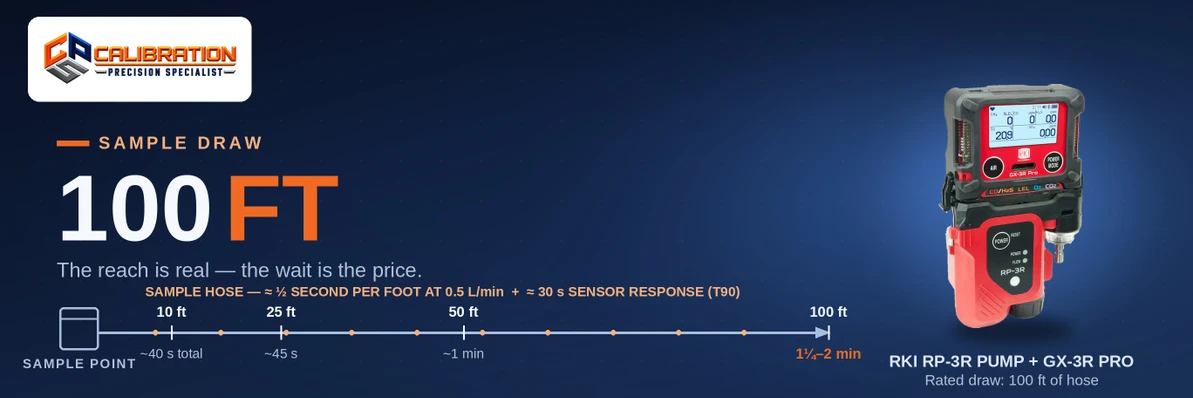
A pumped gas detector can draw a sample from up to about 100 feet away — the RKI GX-Force and the clip-on RKI RP-3R pump are rated for 100 ft of sample hose, and SENKO's SP-MGTP for 98 ft (30 m) — but the reading is not instant: the sample first has to travel the full length of the hose, which takes about ½ second per foot at a 0.5 L/min pump flow (about 46 seconds at 100 ft) and about 1 second per foot at 250 cc/min, and the sensors then need their own response time on top of that, roughly another 30 seconds (T90). Budget about 1¼ to 2 minutes for a stable, trustworthy reading at maximum hose length.
That two-part delay — hose travel time plus sensor response — is the number that decides how a pre-entry test actually gets run: how long the probe sits at each level, how far ahead of the entrant it has to stay, and why a reading that appears the second the probe goes in should make you suspicious, not confident. Here is how far each class of pumped instrument can draw, how the delay math works, and the field rules that keep a remote reading honest.
Why Does Pumped Sampling Exist in the First Place?
A diffusion detector can only measure the air that reaches the person wearing it. Pumped sampling exists for every situation where that is the wrong air, or the wrong order of events: testing a tank, vault, or manhole before anyone enters it, checking the bottom of a vessel from the top hatch, sampling a sump or duct run from outside it, or hunting a leak along flanges and valves without standing in the vapor. The pump moves the sampling point — to the end of a hose or probe — while the instrument and the operator stay in clean air.
The trade for that reach is time, and it is not a small one. Everything below follows from a single fact: a pumped instrument cannot begin measuring a space until the space's air has physically traveled to the sensors.
How Far Can Each Kind of Pumped Detector Draw?
Draw distance is set by the pump — how much flow it can sustain against the restriction of a long, narrow hose. The instruments fall into three classes, and the ratings cluster tightly:
| Instrument | Pump arrangement | Pump flow | Maximum draw |
|---|---|---|---|
| RKI GX-Force ($794) | Built-in pump, 4-gas | 0.5 L/min nominal (0.35 L/min minimum suction) | 100 ft |
| RKI RP-3R ($369) on a GX-3R | Clip-on pump for a diffusion monitor | 0.5 L/min high flow / 0.35 L/min ECO | 100 ft of hose |
| SENKO SP-MGTP (from $850) | Built-in pump, up to 6 gases | 250–300 cc/min | 98 ft (30 m) |
| SENKO SP-Pump101 ($330) on an SGT, SGT-P, or MGT | External add-on pump | 500 cc/min minimum (SENKO data sheet) | Probe length: 5 m ($130) or 10 m ($143) |
Three things to notice. First, ~100 ft is the practical ceiling for personal pumped instruments, whichever brand builds the pump — that is what a pump small enough to wear can pull through detector hose. Second, the add-on route reaches less far but costs less: the SP-Pump101's reach is the rigid probe you attach, 5 m or 10 m, which is exactly the right scale for manholes and underground checks, its designed job. Third, the maximum is a rating, not a suggestion to exceed: past the rated length, flow sags, the sample crawls, and the low-flow protection these pumps carry (both RKI pumps and the SP-Pump101 alarm on low flow) starts treating the line as blocked — because functionally, it is.
Why Isn't the Reading Instant? The Two Delays
Delay one: sample travel time. The air already sitting in the hose has to be pulled through and replaced by air from the sampling point before the sensors see anything new. Travel time is hose volume divided by pump flow:
Travel time = (hose length × hose volume per foot) ÷ pump flow
Typical detector sample hose has an inside diameter of about 4 mm (roughly 5/32 in.), which holds about 3.8 cc of air per foot (about 12.6 cc per metre). Divide that volume by the flow and you get the seconds each foot costs:
- At 0.5 L/min (GX-Force, RP-3R high flow): about 0.46 seconds per foot
- At 0.35 L/min (RP-3R ECO mode): about 0.66 seconds per foot
- At 300 cc/min (SP-MGTP, high end): about 0.77 seconds per foot
- At 250 cc/min (SP-MGTP, low end): about 0.92 seconds per foot
These aren't theoretical numbers. RKI's own manual for the RP-3R lists a sample draw time of approximately 46 seconds at its 0.5 L/min flow and 65 seconds at 0.35 L/min, alongside a maximum hose length of 100 ft — and the volume math above lands on 46 and 66 seconds for 100 ft of hose. The arithmetic and the manufacturer agree.
Delay two: sensor response time (T90). Once the new air arrives, the sensors still need time to react and settle — T90 is the time to reach 90% of the final reading. RKI specifies T90 within 30 seconds for methane, oxygen, CO, and H₂S on both the GX-Force and the diffusion GX-3R (within 40 seconds for hydrocarbon combustibles on the GX-Force). Electrochemical and catalytic sensors in the SENKO line respond in the same roughly-30-seconds class — fast by chemistry standards, but a real block of time that starts only after delay one finishes. (A PID channel, where fitted, responds in seconds; it is the electrochemical channels that set the pace.)
Total time to a reading you can act on = travel time + T90. Neither half can be skipped, and they never overlap.
How Long Do You Actually Wait? A Worked Example
Sample travel time alone, for typical ~4 mm ID hose, at the flows the instruments above actually run:
| Hose length | Air in the hose | 0.5 L/min (GX-Force / RP-3R high) | 0.35 L/min (RP-3R ECO) | 250–300 cc/min (SP-MGTP) |
|---|---|---|---|---|
| 10 ft | ~38 cc | ~5 s | ~7 s | ~8–9 s |
| 25 ft | ~96 cc | ~12 s | ~16 s | ~19–23 s |
| 50 ft | ~192 cc | ~23 s | ~33 s | ~38–46 s |
| 100 ft | ~383 cc | ~46 s | ~66 s | ~77–92 s |
Now add roughly 30 seconds of sensor response to any row and you have the real wait:
- Short checks are quick. A 10 ft hose on any of these pumps: the sample arrives in under 10 seconds, and the reading settles in about 40 seconds all-in. This is why bar-hole and valve checks feel responsive.
- Mid-length runs take about a minute. 50 ft on a GX-Force is ~23 seconds of travel plus ~30 seconds of response — call it a minute before the number means the far end of the hose.
- Maximum-length runs take 1¼ to 2 minutes. The GX-Force at 100 ft: ~46 + ~30 = about 76 seconds. The SP-MGTP at its 98 ft maximum: ~75–90 seconds of travel plus ~30 seconds of response — about 2 minutes. The SP-Pump101 sits between: at its 500 cc/min minimum flow, the 10 m probe's sample arrives in ~15 seconds, so the total is ~45 seconds — but that buys you 33 ft of reach, not 100.
- The wait repeats at every point. Stratified pre-entry testing samples top, middle, and bottom, then roughly every 4 feet of descent. Each new position gets its own travel-plus-response allowance; the probe does not get to keep the previous level's head start, because the hose now holds the previous level's air.
What Else Changes the Wait?
- Hose diameter matters more than hose length. Volume grows with the square of the bore: a 6 mm ID hose holds about 28 cc per metre (2.25× the 4 mm hose), and an 8 mm ID hose about 50 cc per metre (4×). Run 100 ft of 8 mm hose on a 250 cc/min pump and travel time alone passes 6 minutes — before the sensors have reacted to anything. Use the hose the instrument maker specifies; a fatter hose from the shelf is not an upgrade, it is a slower instrument.
- Real flow is lower than rated flow. Pump flow figures are nominal, measured with little restriction. Every foot of hose, every filter, and every bend adds back-pressure, so flow on a long line sags toward the pump's floor — the GX-Force, for example, is specified down to a 0.35 L/min minimum suction flow. Treat the table above as best-case and add margin on long runs.
- Filters add restriction, and dirty ones add more. The hydrophobic and dust filters in probes and pump inlets protect the sensors, but a wet, dusty, or clogged filter starves the pump — the sample slows, and on a badly blocked line the low-flow alarm trips. SENKO fits the SP-MGTP with filters in both the probe and the detector for this reason; they are maintenance items, not lifetime parts.
- The hose itself can steal reactive gas. Some toxic gases adsorb onto hose walls, which delays and depresses their readings on long runs. It is why SENKO Teflon-coats the SP-MGTP's internal gas line, and why reactive-gas work (H₂S, Cl₂, NH₃) on maximum-length lines deserves extra settling time beyond the plain math.
- Cold slows the chemistry. Electrochemical sensors react more slowly toward the bottom of their operating range, and cold, humid samples can condense in an unheated line. Winter pre-entry work on long hose runs is the worst case for every delay in this post at once — budget for it.
Pumped vs. Diffusion: What Changes on This Specific Question?
- Travel time: diffusion has none. A diffusion monitor like the RKI GX-3R ($640) starts its ~30-second sensor response the moment the atmosphere around it changes, because the atmosphere is already at the sensor. A pumped instrument adds the full hose delay in front of the same response.
- That lag cuts both ways during entry. A pumped monitor sampling from outside a space reports every change at the probe tip one travel-time late — at 100 ft, one to two minutes after it happens. That is acceptable for a pre-entry clearance and a poor substitute for a warning on the worker. It is the mechanical reason the standard pattern is pumped testing before entry and a diffusion monitor on the entrant during it.
- Reach: diffusion has none, either. The diffusion instrument's sampling point is wherever a person is standing. Everything the pump buys — the bottom of the tank, the far side of the sump, the space nobody has entered — it buys with delay as the price.
Our spotlight on the SENKO SP-MGTP vs. the diffusion SP-MGT works through the broader pumped-vs-diffusion purchase decision; this post is the timing half of that same choice.
Field Rules for Honest Remote Readings
- Budget about 1 second per foot, then add the sensor response. At 0.5 L/min the travel is nearer ½ second per foot, but flow sags on real lines. One second per foot plus ~30 seconds covers every instrument in the table with margin — and at maximum hose length, simply plan on 2 minutes per sampling point.
- Distrust a fast reading. If the display moves the instant the probe enters the space, you are reading the air that was already in the hose, the air at the opening, or — worse — clean air leaking in at a loose fitting and diluting the sample on its way. A genuine 100 ft reading cannot arrive in 10 seconds; physics does not negotiate.
- Distrust an instant "all clear" most of all. A leaking sample line reads low on everything, and on a pre-entry test low readings are the dangerous direction. The same delivery problems that fake sensor failures in bump tests — our post on why bump tests fail covers them — apply with interest at the end of 100 ft of hose.
- Re-wait when you move the probe. New level, new sample, new delay. Lowering the probe 4 more feet and reading immediately measures the previous level twice.
- Keep the line honest. Inspect hose and probe for cracks, kinks, and loose fittings before the test; keep filters clean and dry; if readings crawl or the low-flow alarm chatters, fix the sampling path before you blame a sensor.
The Mistakes We See Most Often
- Reading the display on the move — sweeping the probe through a space and treating the numbers as a map, when each one is a delayed average of wherever the probe was a minute ago.
- One wait for the whole space — allowing the full delay once at the top, then sampling middle and bottom on leftover time.
- Oversizing the hose — substituting larger-bore tubing and quadrupling the volume the pump has to clear.
- Exceeding the rated draw — adding hose past 100 ft because it physically connects, then trusting readings the pump could barely pull.
- Judging a bump test too early — applying gas at the probe tip and failing a healthy sensor that simply hadn't received the gas yet, or passing one on gas still in transit.
- Forgetting the pump is a wear item — tired pumps pull less flow, which quietly stretches every delay in this post; flow is part of calibration-grade maintenance, not an accessory spec.
The Bottom Line
A pumped detector's reach is about 100 ft — 100 ft for the RKI GX-Force and the RP-3R clip-on pump, 98 ft for the SENKO SP-MGTP, a 5 m or 10 m probe for the SP-Pump101 — and its price is time: roughly ½ to 1 second of sample travel per foot of hose, plus roughly 30 seconds of sensor response, every time the probe moves. Run the math before the entry, not during it: 2 minutes per point at maximum length, about a minute at 50 ft, about 40 seconds at 10 ft. The crews who get remote sampling right are not the ones with the longest hose — they are the ones whose procedure already has the wait built in.
Shopping for reach? Start with the full pumped monitors range — the GX-Force for a built-in-pump 4-gas, the SP-MGTP when the hazard list runs past four gases (its dedicated sampling probe is $280), and the RP-3R if your fleet already runs GX-3Rs. And keep the whole path — pump, filters, and every sensor channel — maintained: CPS calibrates every channel and reports as-found and as-left data, in our Rockwood lab or on site at your facility. Not sure which draw distance your spaces actually need? Call us at 865-900-8844 and describe the space.
Frequently Asked Questions
How far can a pumped gas detector draw a sample? About 100 ft at the top of the personal-instrument class. The RKI GX-Force's built-in pump is rated for a 100 ft sampling range, RKI supports up to 100 ft of hose on the clip-on RP-3R pump, and SENKO's SP-MGTP supports 98 ft (30 m) of hose. Add-on pumps for single-gas detectors reach as far as their probe: 5 m or 10 m for SENKO's SP-Pump101.
How long should I wait for a reading at the end of a 100 ft hose? Budget about 2 minutes. The sample itself takes ~46 seconds to travel 100 ft of typical hose at 0.5 L/min (RKI publishes ~46 seconds as the RP-3R's sample draw time, and ~65 seconds in its 0.35 L/min ECO mode), ~77–92 seconds at the SP-MGTP's 250–300 cc/min — and the sensors then need roughly another 30 seconds (T90) to settle on the new air.
Why does the reading take longer on a longer hose? Because the pump must first pull out all the air already sitting in the hose and replace it with air from the sampling point — that volume grows with every foot. Travel time = hose volume ÷ pump flow. Only when the space's air reaches the sensors does their response time start, so total delay is travel time plus T90, never one or the other.
Does hose diameter really change the delay? Yes — more than length does, foot for foot. Hose volume rises with the square of the inside diameter: typical ~4 mm ID hose holds ~3.8 cc per foot, a 6 mm ID hose holds ~2.25× that per foot, and 8 mm ID about 4×. The same 100 ft run that takes ~46 seconds to clear at 0.5 L/min in 4 mm hose takes over 3 minutes in 8 mm hose.
Can I just use a longer hose than the manufacturer rates? No. Past the rated length the pump cannot sustain its flow against the hose's restriction: the sample slows to a crawl, low-flow alarms trip, and any reading you do get has an unknown, much longer delay behind it. A pre-entry test run that way isn't a test. If the space is deeper than 100 ft, the answer is a different sampling plan — intermediate access points or a fixed/sample-draw system — not more hose.
My pumped detector responded almost instantly on a long hose. Should I trust it? No — a fast response on a long line is a warning sign, not a feature. The gas at the far end cannot physically arrive faster than the travel time, so an instant change means the instrument is reading air that was already in the hose, air at the opening, or clean air diluting the sample through a leaking fitting. Stop, check the sampling path, and re-test with the full wait.
How far can the SENKO SP-Pump101 sample? As far as its extension probe reaches: SENKO offers 5 m ($130) and 10 m ($143) probes for it. The pump itself flows at least 500 cc/min per SENKO's data sheet, so travel time is short — roughly 8 seconds for the 5 m probe and 15 seconds for the 10 m — and total time to a settled reading is dominated by the attached detector's sensor response, about 45 seconds all-in on the 10 m probe.
Pumped or diffusion — which reads faster? Diffusion, at the instrument's location: it skips travel time entirely and only waits on sensor response (~30 seconds T90 class). Pumped sampling is slower by exactly the hose delay, but it reads where no one is standing. That is why the two are paired in practice — pumped instruments clear the space before entry, diffusion monitors ride on the entrant and warn in real time during it.
CPS Calibrations · 109 S. Front Street, Rockwood, TN 37854 · Portable Gas Detection · Calibration Gas · Calibration Services · Contact Us
Recent Posts
-
Flame Detector vs. Gas Detector: What's the Difference — and Do You Need Both?
A gas detector and a flame detector guard opposite ends of the same incident: a gas detector reads l …Oct 21st 2026 -

How Do You Test a Flame Detector? Self-Tests, Test Lamps, and NFPA 72
You test a flame detector with light, not gas — there is no span gas, no zero gas, and never an open …Oct 21st 2026 -

Why Does a Flame Detector False Alarm — and Which Type Won't?
A flame detector false alarms because something that is not a fire is producing the signal it watche …Oct 21st 2026