
SENKO SP-MGTP vs. SP-MGT: When Do You Need a Pumped 6-Gas Monitor?
The SENKO SP-MGTP is a pumped multi-gas monitor that measures up to six gases at once, starting at $850 for the standard 4-gas catalytic build (O₂, CO, H₂S, CH₄) and running to $3,569 for a 6-gas PID + infrared CO₂ configuration. Its built-in pump draws 250–300 cc/min through up to 98 ft (30 m) of sample hose for pre-entry and remote sampling, and the IP67 unit runs on a rechargeable 4,000 mAh lithium-ion battery — about 30 hours in catalytic configurations, five days or more in infrared — with a 2-year warranty.
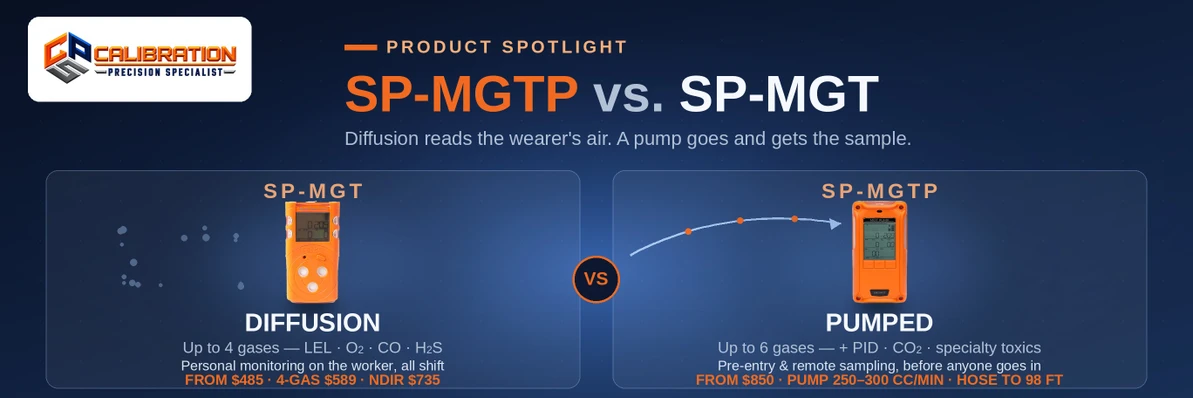
That's the short version. The longer one is about a distinction that decides real purchases: a diffusion monitor samples the air around the person wearing it, while a pumped monitor goes and gets the sample — from the far side of a door, the bottom of a vessel, or a space nobody has entered yet. If your work includes testing a space before a worker goes in, or your hazard list runs past the standard four gases, the SP-MGTP is the SENKO built for it. Here's how it's configured, what it costs, and how it stacks up against its diffusion sibling, the SP-MGT.
What Is the SENKO SP-MGTP, and Who Is It For?
The SENKO SP-MGTP is a portable sampling-type (pumped) multi-gas detector that monitors up to six gases simultaneously, using a mix of sensor technologies — electrochemical, catalytic, NDIR infrared, and PID — depending on the configuration you choose. Every configuration is built around the standard confined-space core of oxygen (O₂), carbon monoxide (CO), hydrogen sulfide (H₂S), and methane/LEL (CH₄), and from there the channels open up: infrared CO₂, a PID channel for volatile organic compounds (VOCs), and a specialty toxic channel chosen from SO₂, Cl₂, NH₃, H₂, NO₂, NO, HCN, HCl, H₂O₂, and HF configurations.
It's built for the crews whose hazard assessment doesn't fit in four channels or arm's reach:
- Confined-space entrants and attendants who test the space from outside before — and while — anyone goes in.
- Tank, vessel, and process-area work, where the sample point is somewhere a person isn't standing yet.
- Plants with a named specialty toxic — ammonia refrigeration, chlorine service, hydrogen, acid gases — that a standard 4-gas simply has no channel for.
- VOC screening work, where a PID channel (0–4,000 ppm) rides alongside the standard gases instead of traveling as a separate instrument.
The instrument itself is sized like a personal monitor, not a benchtop analyzer: 3.03 × 5.75 × 1.69 in. (77 × 146 × 43 mm), 17.29 oz (490 g), TPU-coated polycarbonate enclosure with an integrated belt clip, backlit LCD, and audible (90 dB), visual, and vibrating alarms. It's rated IP67 — dust-tight and sealed against immersion — and operates from −4°F to +122°F (−20°C to +50°C). SENKO backs it with a 2-year warranty.
Why Does Pumped Sampling Matter?
A diffusion instrument is passive: gas has to wander into the sensor on its own. That's exactly right for personal monitoring — the detector rides on the worker and samples the worker's breathing environment. But it has one hard limit: it can only test air that has already reached a person. For pre-entry work, that's backwards. The whole point is to know what the space holds before a body goes in to find out.
A pump reverses the flow of information. The SP-MGTP's built-in pump draws 250–300 cc/min and supports sampling hose up to 98 ft (30 m), so the attendant stands outside the space, lowers or extends the sample line, and reads the atmosphere at the far end — top, middle, and bottom of a vessel, the far side of a sump, down a duct run — before entry, and continuously while the work runs. The listing positions it exactly there: confined-space entry, tanks, vessels, process areas, and remote sampling applications.
Two honest caveats that come with any pumped instrument, and that we give every buyer:
- Draw time is real. The sample has to travel the full length of the hose before the sensors see it. The longer the line, the longer you wait before the reading represents the space — patience at the inlet is part of the procedure, not a malfunction.
- The pump tests what the hose reaches. A kinked, cracked, or blocked sample line gives you a confident reading of the wrong air. Pumped instruments earn their keep when the hose, probe, and filters are inspected like the safety equipment they are.
How Do You Configure One? Three Families, 36 Builds
There is no single "SP-MGTP price," because there is no single SP-MGTP. Our store lists 36 sensor combinations in three families, and the family you pick sets both the price and the battery life:
1. Catalytic LEL family. The standard 4-gas build (O₂/CO/H₂S/CH₄, catalytic) is the $850 starting point. Add one specialty toxic channel for a 5-gas build: SO₂, Cl₂, NH₃, H₂, NO₂, or NO at $1,200; H₂O₂, HF, or HCl at $1,350; HCN at $1,375. Add a PID instead and the 5-gas VOC build is $2,100. Catalytic configurations run approximately 30 hours per charge.
2. Infrared (NDIR) LEL family. Same layouts with infrared methane sensing: the 4-gas build is $1,507, specialty 5-gas builds run $1,944 (H₂O₂/HF/HCl $2,132, HCN $2,163), and the PID 5-gas build is $3,069. Infrared configurations run approximately 5 days or more per charge — the same physics we covered in the SP-MGT spotlight: no catalyst to poison, and far lower power draw.
3. Infrared CO₂ + CH₄ family. These builds carry both infrared CO₂ and infrared CH₄ alongside O₂/CO/H₂S: the 5-gas build is $2,007. Add a sixth channel and you're in true 6-gas territory — specialty toxics at $2,444 (H₂O₂/HF/HCl $2,632, HCN $2,663), and the top configuration, PID + CO₂ for a 6-gas VOC build, at $3,569.
Documented measuring ranges for the channels: O₂ 0–30% vol., CO 0–500 or 0–1,000 ppm, H₂S 0–100 or 0–200 ppm, CH₄ 0–100% LEL, CO₂ 0–5% vol. (NDIR), VOC 0–4,000 ppm (PID), NH₃ 0–100 ppm, SO₂ 0–20 ppm, H₂ 0–1,000 ppm, NO₂ 0–20 ppm, Cl₂ 0–20 ppm, HCN 0–50 ppm, HCl 0–20 ppm, NO 0–500 ppm, and H₂O₂ 0–100 ppm. If the gas on your hazard assessment isn't in that list, call us before you assume — configurations vary, and the right answer may be a different instrument entirely.
SP-MGTP vs. SP-MGT: Pumped 6-Gas vs. Diffusion 4-Gas
The SENKO SP-MGT is the diffusion sibling — we gave it and its docking station a full spotlight of their own. Side by side:
- Sampling: SP-MGTP — built-in pump, 250–300 cc/min, hose to 98 ft. SP-MGT — diffusion; it samples the air around the wearer.
- Channels: SP-MGTP — 4 to 6 gases; standard core plus CO₂, PID/VOC, and/or a specialty toxic. SP-MGT — up to 4 gases (LEL/O₂/CO/H₂S), in 1- to 4-gas layouts.
- Price: SP-MGTP — $850 to $3,569 depending on configuration. SP-MGT — starts at $485; the standard 4-gas is $589 (catalytic) or $735 (NDIR).
- Battery: SP-MGTP — 4,000 mAh lithium-ion; ~30 hours catalytic, ~5 days or more infrared. SP-MGT — 2,000 mAh lithium-ion over USB-C; ~25 hours catalytic, up to ~60 days NDIR.
- Build: Both are IP67 with a 2-year warranty. The SP-MGTP is the bigger instrument (490 g) because it carries a pump and a bigger battery; the SP-MGT is the compact wear-all-shift unit.
- Docking: Each has its own single dock — the SP-MGTP Single Dock (part # AAA108000, $1,335) for this unit, and the SP-MGT's dock options are covered in the SP-MGT spotlight.
Neither is the "better" detector. They answer different questions. The SP-MGT answers "what is the air around this worker, right now, all shift?" The SP-MGTP answers "what is the air in that space, before anyone goes in — and what's in it besides the standard four gases?"
The Extra Channels Are the Point: Specialty Gases
Most SP-MGTP buyers aren't buying a pump. They're buying the fifth and sixth channels. A standard 4-gas covers the classic confined-space quartet, but plenty of real hazard assessments name a gas outside it — ammonia around refrigeration, chlorine at a water plant, HCN, SO₂, NO₂, hydrogen, or a VOC picture that calls for a PID. We wrote a whole post on that moment — specialty gas mixes: when standard 4-gas isn't enough — and the SP-MGTP is the instrument side of the same conversation: one pumped unit that carries the standard core and the named toxic, instead of a 4-gas on one hip and a single-gas unit on the other.
The follow-through matters as much as the purchase: every channel you add is a channel that has to be bump-tested and calibrated with gas that actually contains it. A 4-gas cylinder will never verify an SO₂ or PID channel. Stock the calibration gas to match the configuration you bought — and when the unit comes to us, shipped to our Rockwood lab or serviced on-site at your facility, we calibrate every channel, not just the standard four.
Records, Exposure Math, and Upkeep
Like the rest of the SENKO portable line, the SP-MGTP keeps its own paper trail: 30 alarm events, 30 calibration records, and 30 bump-test records on board, plus two months or more of data logging, with TWA and STEL exposure monitoring for supported toxic sensors. An optional SENKO IR-Link supports configuration and data management.
For routine upkeep, the SP-MGTP Single Dock ($1,335, part # AAA108000) is the model's own single docking station, supplied with five adapters — the right-sized companion for an individual unit or a small pumped fleet, in the same way the MGT docks serve the diffusion side. Browse the rest of the SENKO lineup and our pumped monitors for where this unit sits in the range.
Choose the SP-MGTP When… / The SP-MGT Is Enough When…
Choose the SP-MGTP when:
- You test confined spaces, tanks, or vessels before entry, or sample points up to 98 ft from where the attendant stands.
- Your hazard assessment names a fifth or sixth gas — a specialty toxic, CO₂, or VOCs via PID — that a 4-gas has no channel for.
- One instrument needs to do pre-entry duty and carry the specialty channel, rather than pairing a 4-gas with a separate single-gas or PID unit.
The SP-MGT is enough when:
- The job is personal monitoring of the standard four gases on the worker, all shift — diffusion is the right tool and the smaller spend ($589 for the 4-gas catalytic, $735 NDIR).
- Nobody samples remotely: no pre-entry draw, no hose runs, no spaces tested from outside.
- Fleet simplicity wins — one configuration, USB-C charging, and run times up to ~60 days on the NDIR version.
And if your application sits between the two — pumped sampling, but only ever the standard four gases — the $850 catalytic SP-MGTP build is the honest middle: pump and remote draw, no channels you're paying to carry unused.
The Bottom Line
The SENKO SP-MGTP is what the SENKO portable line grows into when four diffusion channels stop covering the job: a pumped monitor, sampling at 250–300 cc/min over up to 98 ft of hose, in 36 configurations from the $850 standard 4-gas catalytic build to a $3,569 6-gas PID + CO₂ infrared build — IP67, 2-year warranty, with the records and docking support to run it as a program rather than a purchase. If your work is standard 4-gas personal monitoring, the SP-MGT does it for less and wears smaller. If your work starts with a sample drawn from a space nobody has entered yet, or a hazard list with a fifth name on it, this is the instrument.
Ready to spec one? Start with the SENKO SP-MGTP configuration list, compare it against the SENKO SP-MGT, and keep the calibration gas matched to every channel you choose. Not sure which specialty channel — or whether you need one at all? Call us at 865-900-8844 and walk us through the application; with 36 builds on one product page, the configuration conversation is the purchase. Browse the full portable gas detection lineup for the wider picture.
Frequently Asked Questions
How much does the SENKO SP-MGTP cost? It starts at $850 for the standard 4-gas catalytic configuration (O₂, CO, H₂S, CH₄). Five-gas specialty-toxic builds run $1,200–$1,375 with a catalytic LEL and $1,944–$2,163 with infrared; PID builds run $2,100 (catalytic) to $3,069 (infrared). The infrared CO₂ family starts at $2,007 for 5 gases, and the top 6-gas configuration — PID + CO₂ (IR) + CH₄ (IR) + O₂ + CO + H₂S — is $3,569.
How many gases can the SP-MGTP measure at once? Up to six simultaneously, depending on configuration. Every build carries the standard core (O₂, CO, H₂S, CH₄); from there you can add infrared CO₂, a PID channel for VOCs, and/or one specialty toxic — SO₂, Cl₂, NH₃, H₂, NO₂, NO, HCN, HCl, H₂O₂, or HF — for five- and six-gas combinations.
What's the difference between the SENKO SP-MGTP and the SP-MGT? Sampling and channels. The SP-MGT is a diffusion monitor for up to 4 gases — it samples the air around the wearer and is the personal-monitoring tool. The SP-MGTP adds a built-in pump that draws samples through up to 98 ft (30 m) of hose for pre-entry and remote testing, and expands to 5- and 6-gas configurations with CO₂, PID, and specialty toxic channels the SP-MGT doesn't offer.
How far can the SP-MGTP sample from? Its built-in pump draws approximately 250–300 cc/min and supports sampling hose lengths up to 98 ft (30 m). Remember that the sample takes time to travel the hose — the longer the line, the longer before the reading represents the far end — so allow the draw time before treating a pre-entry reading as final.
How long does the SP-MGTP battery last? It runs on a rechargeable 4,000 mAh lithium-ion battery. Operating time varies by sensor configuration: approximately 30 hours for catalytic (SP-MGTP-P series) configurations, and approximately five days or more for infrared (SP-MGTP-N series) configurations.
Is the SP-MGTP waterproof? It's rated IP67 — dust-tight and sealed against immersion — in a TPU-coated polycarbonate enclosure, with an operating range of −4°F to +122°F (−20°C to +50°C). Rain, washdowns, and industrial dust are working conditions for it, not incidents.
What calibration gas does a 5- or 6-gas SP-MGTP need? Gas that covers every channel on the unit. A standard 4-gas mix verifies only the four channels it's blended for — a specialty toxic or PID channel needs its own span gas. Match the gas to the configuration you bought; our post on specialty gas mixes walks through why, and our calibration gas page carries the range. When we service an SP-MGTP, we calibrate every channel.
Is there a docking station for the SP-MGTP? Yes — the SP-MGTP Single Dock (part # AAA108000, $1,335), a genuine SENKO single docking station for this model, supplied with five adapters. The SP-MGTP also stores 30 alarm events, 30 calibration records, and 30 bump-test records on board, plus two months or more of data logging.
CPS Calibrations · 109 S. Front Street, Rockwood, TN 37854 · Portable Gas Detection · Calibration Gas · Calibration Services · Contact Us
Recent Posts
-

How Many Gas Detectors Does a Facility Need?
A facility needs as many gas detectors as it takes to cover its credible leak scenarios — there is n …Oct 21st 2026 -

What Does SIL Mean for Gas Detection?
SIL — Safety Integrity Level — is a rating of a safety function, not of a single detector: under IEC …Oct 21st 2026 -

What Is an Ultrasonic Gas Leak Detector?
An ultrasonic gas leak detector is a fixed detector that finds leaks by listening instead of samplin …Oct 21st 2026