
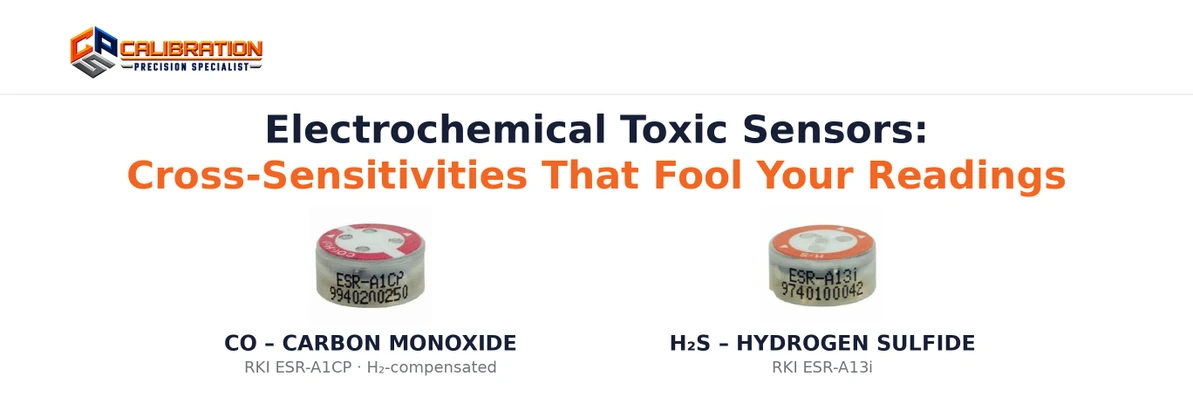
Electrochemical Toxic Sensors: Cross-Sensitivities That Fool Your Readings
Your carbon monoxide alarm goes off in the battery room. You sweep the area — there's no CO source anywhere. So you assume the sensor is broken, reset the alarm, and go back to work.
The sensor wasn't broken. It was doing exactly what electrochemistry does: responding to hydrogen.
This is cross-sensitivity — an electrochemical sensor reacting to a gas it wasn't built to detect. It's not a defect. It's not a calibration problem. It's inherent to how these sensors work, and if you don't know which extra gases your sensor "sees," you'll eventually make the wrong call at exactly the wrong moment. Here's what you need to know.
Why Electrochemical Sensors Cross-Respond
An electrochemical toxic sensor doesn't identify molecules the way a nose identifies smells. Inside the sensor, the target gas diffuses through a membrane and is oxidized or reduced at an electrode, producing an electrical current proportional to how much gas reacted. The instrument reads that current and calls it a concentration.
The catch: the electrode doesn't check IDs. Any gas that reacts at that electrode potential produces current too — and the instrument reports all of it as the target gas. The sensor isn't "seeing" carbon monoxide. It's counting electrons from every reaction happening at that voltage, and labeling the total "CO."
That's why cross-sensitivity can never be zeroed out by better manufacturing — it's the same chemistry doing the measuring. What manufacturers can do is characterize it (every reputable maker publishes a cross-sensitivity table in the sensor or instrument manual) and, in some cases, compensate for it. Your job is to know the table for the gases in your environment.
The Cross-Sensitivities You'll Actually Meet
These are the ones that show up in real facilities — RKI publishes them in the GX-3R/GX-6000 manuals, and SENKO's electrochemical channels behave the same way, because it's the chemistry, not the brand:
CO sensors and hydrogen — the big one. A standard CO sensor reads roughly 40–60% of ambient hydrogen as if it were carbon monoxide. Battery charging areas, refineries, wastewater plants, anywhere hydrogen evolves: the CO channel climbs and there's no CO anywhere. This is exactly why RKI builds its portable CO channel around a hydrogen-compensated sensor — the ESR-A1CP in the GX-3R family actively cancels most of the H₂ response. If your people work around hydrogen, an uncompensated CO sensor is the wrong tool.
H₂S sensors and mercaptans. Hydrogen sulfide sensors cross-respond to carbon monoxide (roughly 10–20%) and, more importantly, to sulfur compounds like mercaptans — the odorants added to natural gas. That "H₂S alarm" near a gas line or odorized-gas equipment is often the odorant, not H₂S. Same sensor, same chemistry, in RKI's ESR-A13i H₂S sensor and in SENKO's single-gas SP-SGT H₂S units.
NO₂, SO₂, and Cl₂ confuse each other. Nitrogen dioxide sensors respond strongly to chlorine and sulfur dioxide. Sulfur dioxide sensors respond to NO₂, H₂S, and mercaptans. Chlorine sensors see NO₂, ozone, and bromine. If your facility has more than one of these gases in the air — common in water treatment and chemical plants — a single toxic channel can't tell you which one is present. That distinction matters for response: different gases, different PPE, different medical treatment.
NH₃ sensors and amines. Ammonia sensors cross-respond to amines and some other nitrogen compounds. In fertilizer, refrigeration, or chemical operations using both, the reading needs a second opinion.
Negative cross-sensitivities exist too. Some gases suppress a channel's response instead of inflating it. They're less common, but they're the reason you should never assume "no alarm" means "no gas" when you know an interfering gas is present.
Why This Bites You in Real Life
Cross-sensitivity isn't a lab curiosity. It causes three specific operational problems:
Alarm fatigue. The costliest outcome. A CO channel that cries wolf every time someone charges forklifts in the battery room teaches workers that the alarm means nothing. Then one day it means something, and nobody moves. A false alarm is never harmless — each one spends a little of the crew's trust.
Wrong diagnosis, wrong response. You evacuate for carbon monoxide — but the gas was hydrogen. CO response and H₂ response are different plans: hydrogen is flammable, and the CO reading on your screen says nothing about explosion risk. Treating a hydrogen event as a CO event can leave the real hazard unevaluated. The instrument gave you a number; it didn't give you the gas.
Polluted exposure records. Data-logged false readings become your OSHA exposure records. If your logs show CO exposures that were really hydrogen, you've got paperwork that misstates what your people were exposed to — and a defense problem if anyone ever asks.
How to Work With Cross-Sensitivity
You can't eliminate it. You can manage it — and the facilities that do follow the same playbook:
- Know your background gases. Before you pick instruments, list what else is in the air where your people work. Hydrogen? Odorized natural gas? Chlorine near the water plant? The cross-sensitivity table only helps if you know which rows apply to you.
- Read the cross-sensitivity table. It's in the manual for your instrument — RKI and SENKO both publish them. Find your target gas, find the interferents, and note the percentages. A 60% H₂ response on CO is a different planning problem than a 5% one.
- Pick compensated sensors where they exist. Working around hydrogen? Use the hydrogen-compensated CO sensor — RKI's ESR-A1CP is standard in the GX-3R family for exactly this reason. Buying the right sensor variant once beats fighting false alarms for years.
- When a reading doesn't make sense, challenge it with single gas. Suspect the CO alarm is really hydrogen? Bump the instrument with a known CO-only check — or better, check the suspect gas with a single-gas detector for that gas. Two instruments agreeing beats one instrument guessing.
- Alarm first, diagnose second. The standing rule never changes: when the alarm sounds, people move first and you figure out the chemistry second. Cross-sensitivity is a diagnosis problem, and diagnosis happens after evacuation, not instead of it.
- Don't try to "calibrate out" a cross-sensitivity. Span calibration sets the gain for the target gas only. It does nothing to the sensor's response to interferents. A perfectly calibrated sensor cross-responds exactly as much as a perfectly calibrated sensor should.
The Calibration Angle
Here's where this connects to our benches: cross-sensitivity is one of the reasons we calibrate toxic channels with single-target gases and verify each channel independently. When a detector comes through our lab — a RKI GX-3R, a SENKO SP-MGT, a pumped SP-MGTP — every toxic channel gets challenged with its own NIST-traceable calibration gas, and the certificate shows as-found and as-left for each channel separately. If a channel is responding oddly, the data shows it before the sensor goes back into your facility.
We calibrate every channel — gas detection and process instruments alike. If your crew works around hydrogen, odorized gas, or mixed toxics and you're not sure your sensors are the right variants for the environment, call us at 865-900-8844. Ship your detectors to our lab or have us come to your facility — we'll verify every channel and tell you straight if a compensated sensor would serve you better.
The Bottom Line
An electrochemical sensor reports the chemistry happening at its electrode, not a certified list of molecules. Once you internalize that, cross-sensitivity stops being a surprise and becomes a planning input: know your background gases, read the table, buy compensated variants where they exist, and never let a confusing reading override the alarm. The sensor is honest about what it feels. It's your job to know what it's feeling.
Shopping for instruments or replacement sensors? Browse portable gas detection — 4-gas and 6-gas workhorses like the RKI GX-3R, SENKO SP-MGT, and pumped SENKO SP-MGTP — or shop toxic sensors directly: the H₂-compensated RKI CO sensor and the RKI H₂S sensor. Need your fleet verified? Ship your detectors to our lab or have us come to your facility — gas detection and process instruments alike.
Frequently Asked Questions
What is cross-sensitivity in a gas sensor? It's when a sensor responds to a gas other than its target. In electrochemical sensors, any gas that reacts at the sensing electrode produces current, and the instrument reports it as the target gas. It's inherent to the sensing chemistry — not a defect — and every manufacturer publishes cross-sensitivity data in the manual.
Does hydrogen really set off CO detectors? Yes. A standard uncompensated CO sensor reads roughly 40–60% of ambient hydrogen as carbon monoxide. In battery rooms, refineries, or anywhere hydrogen is present, this is the most common cause of mystery CO alarms. Hydrogen-compensated CO sensors, like RKI's ESR-A1CP, cancel most of this response.
Can cross-sensitivity be calibrated out? No. Calibration sets the sensor's response to its target gas; it doesn't change the chemistry that makes interferents react at the electrode. A perfectly calibrated sensor cross-responds just as much as it did before calibration. The fix is sensor selection (compensated variants) and knowing your environment.
Why does my H₂S alarm go off near natural gas lines? Usually mercaptans — the sulfur-based odorants added to natural gas so leaks can be smelled. H₂S sensors cross-respond to them strongly. The alarm is real chemistry; it's just not H₂S. This is one of the most common false-H₂S scenarios we see.
Which toxic sensors cross-respond the most? CO (hydrogen), H₂S (CO, mercaptans, sulfur compounds), NO₂ (chlorine, SO₂), SO₂ (NO₂, H₂S, mercaptans), Cl₂ (NO₂, ozone, bromine), and NH₃ (amines). Check the cross-sensitivity table in your instrument's manual for the exact percentages — they vary by sensor design.
Should I evacuate on an alarm I suspect is cross-sensitivity? Yes — always. Move people first, diagnose second. Cross-sensitivity is a diagnosis problem, and you diagnose after evacuation. Never let a suspicion about the chemistry override the alarm.
Recent Posts
-

Electrochemical Toxic Sensors: Cross-Sensitivities That Fool Your Readings
Your carbon monoxide alarm goes off in the battery room. You sweep the area — there's no CO source a …Oct 8th 2026 -

Why Oxygen Sensors Die — and How to Make Them Last
Every 4-gas monitor has an oxygen channel, and it's the only channel with a built-in expiration date …Oct 7th 2026 -
Catalytic Bead vs. Infrared LEL Sensors: When Each Wins
Most gas detectors read %LEL the same way on the display. What's happening behind that number is any …Oct 6th 2026