
SENKO SP-SGTP: Does This Single-Gas Monitor Have a Pump?
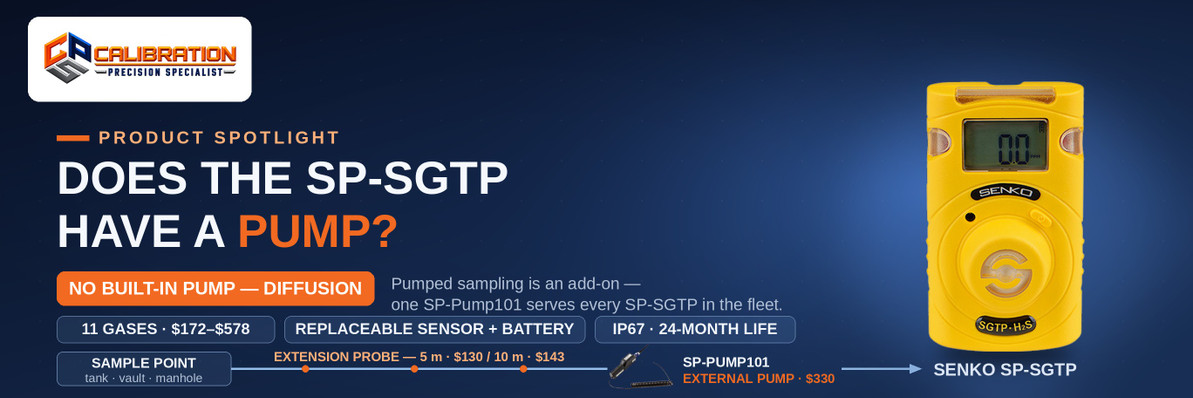
The SENKO SP-SGTP is a maintainable single-gas detector — $172 for CO or H₂S, $177 for O₂, and up to $578 for HCN, HCl, or PH₃ — with a replaceable electrochemical sensor, a replaceable battery, IP67 protection, and a 24-month operating life. It does not have a built-in pump: it samples by diffusion, and pumped remote sampling comes from the add-on SENKO SP-Pump101 external sampling pump ($330), with 5 m ($130) and 10 m ($143) extension probes for checking a space before entry.
That's the whole answer, and it's worth stating plainly because the model name invites the assumption. Buyers search for the SP-SGTP expecting a pumped single-gas monitor. What SENKO actually built is something arguably more useful for most fleets: a diffusion detector you don't throw away, that can borrow a pump on the days the job calls for one. Here's what the instrument is, how the pumped setup works, and how it stacks up against its disposable sibling, the SP-SGT.
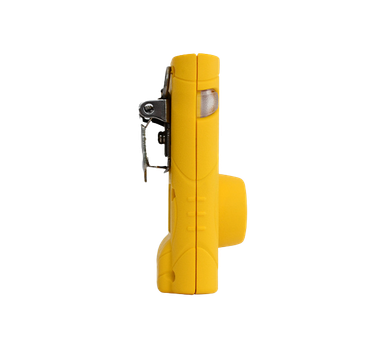
SENKO SP-SGTP Maintainable Single Gas Detector
Does the SENKO SP-SGTP have a pump? No built-in pump — it samples by diffusion. Add the SP-Pump101 ($330) and a 5 m or 10 m probe for remote sampling.
$172–$578 configured
See the SP-SGTPWhat Is the SENKO SP-SGTP?
The SENKO SP-SGTP is a compact personal detector that monitors one gas at a time with a dedicated electrochemical sensor. "Maintainable" is the key word in its name: unlike a disposable single-gas detector, both the sensor and the battery are replaceable, so when the sensor reaches end of life the instrument doesn't follow it into the bin — you service it and it stays in the fleet.
You choose the gas when you order, and the choice sets the price:
- O₂ (0–30% vol.) — $177
- CO (0–500 ppm) — $172
- H₂S (0–100 ppm) — $172
- H₂ (0–1,000 ppm) — $403
- SO₂ (0–50 ppm) — $403
- NH₃ (0–100 ppm) — $430
- NO₂ (0–20 ppm) — $430
- Cl₂ (0–20 ppm) — $430
- HCN (0–50 ppm) — $578
- HCl (0–20 ppm) — $578
- PH₃ (0–5 ppm) — $578
The rest of the spec sheet is built for daily industrial wear. The housing is rated IP67 — dust-tight and sealed against immersion — and measures just 1.93 × 3.35 × 1.57 in. (49 × 85 × 40 mm), at 3.28 oz (93 g) for the toxic-gas models and 3.67 oz (104 g) for the O₂ model. Alarms are audible (90 dB at 10 cm), visual (red flashing LEDs plus the LCD), and vibrating, because a detector that only beeps is useless next to running equipment. The unit logs the most recent 30 alarm events, has adjustable alarm settings, can be powered on and off as required (a disposable can't), and runs 24 months on its replaceable 3.6 V lithium primary battery based on 2 minutes of alarm per day — with fresh sensors and batteries extending service life beyond that first period. Operating temperature is −40°F to +122°F (−40°C to +50°C) for the CO, H₂S, H₂, NH₃, and NO₂ models, and −35°C to +50°C for O₂ and SO₂. Hazardous-location approvals include IECEx, ATEX, and CSA-UL (Ex ia IIC T4 Ga). In the box: the detector, a calibration cap, the manual, and a calibration and test certificate.
Does the SP-SGTP Have a Built-In Pump? No — and Here's Why That's Fine
The SP-SGTP is a diffusion instrument. Gas reaches the sensor by moving through the air around the detector — the same air the wearer is breathing. For personal monitoring, that's exactly what you want to measure: not the atmosphere across the room, but the atmosphere at the worker's chest, continuously, with nothing to prime, no hose to kink, and no pump to run down.
Diffusion's limit is reach. A diffusion detector can only tell you about the air it's sitting in. It cannot check the bottom of a tank from the top hatch, sample a vault from the sidewalk, or test a space before a worker enters it — because to sample the space, the detector (and usually the worker holding it) has to already be in it. That gap between "monitoring the worker" and "checking the space first" is the entire reason pumps exist.
How Do You Get Pumped Sampling From an SP-SGTP?
You add the pump. The SENKO SP-Pump101 ($330, part # AAA006000) is an external sampling pump made for SENKO's SGT, SGT-P, and MGT detectors. With the pump attached, the detector stops waiting for gas to wander to it and actively draws a sample from wherever the probe tip is. Pair it with the extension probes built for the job — the 5 m Extension Probe ($130) or the 10 m Extension Probe ($143) — and the sampling point moves 5 or 10 metres away from the worker holding the instrument.
That changes what the detector can do:
- Pre-entry checks. Lower the probe, draw a sample, and read the space before anyone commits to entering it — the classic confined-space sequence, done from outside.
- Remote and hard-to-reach points. Tank bottoms, sumps, vaults, ductwork, and the far side of a leak — anywhere the hazard is somewhere the worker shouldn't be standing yet.
- Leak investigation. Walk the probe along flanges, valves, and fittings and let the readings point at the source.
Two honest caveats. First, a pumped sample takes time to arrive: the gas has to travel the full length of the probe before the sensor sees it, so allow extra time per sampling point — and more for 10 m than for 5 m — before you trust a reading or move on. Second, a single-gas detector answers a single-gas question. An SP-SGTP on a probe tells you about its gas at the probe tip — nothing more. If your entry procedure calls for the standard multi-gas check, that's a pumped multi-gas job; our post on the SENKO SP-MGT and Docking Station II covers SENKO's 4-gas side of the family, and the pumped step-up in that line is the SP-MGTP.
The structural advantage of the add-on approach: the pump is shared equipment, not a per-detector feature. One SP-Pump101 and a set of probes can serve every SP-SGTP (and SP-SGT) in the fleet on the days remote sampling is needed, while the detectors themselves stay small, light, and cheap to carry every day.
Pumped or Diffusion: Which Sampling Does Your Job Need?
Choose the SP-SGTP on its own (diffusion) when:
- The detector's job is personal monitoring — worn on the worker, alarming on the air the worker is actually in.
- The work is continuous, all-shift wear, where 93 g on a belt clip beats any sampling hardware.
- Your spaces are checked by other means, or the task never requires sampling a point the worker hasn't reached.
Add the SP-Pump101 and probes (pumped) when:
- You check tanks, manholes, vaults, or other spaces before entry, from outside.
- The sampling point is physically separated from the worker — below grade, overhead, inside equipment, or across a barrier.
- You're hunting a leak and need the reading at a specific fitting, not in the general area.
Most fleets end up with both patterns in the same week: diffusion on every chest, every day — and one pumped kit in the truck for the entries and investigations. That's not indecision; that's the two sampling methods each doing the job they're for.
SP-SGTP vs. SP-SGT: Maintainable or Disposable?
The closest comparison isn't another brand — it's SENKO's own SP-SGT, the disposable version of the same idea. The two share the housing dimensions, the weight, the IP67 rating, the 90 dB / LED / vibration alarms, the 30-event logging, the operating-temperature ranges, and the 24-month design life. What differs is what happens at the end of that life, and how many gases you can choose from:
- End of life. The SP-SGT is sealed and disposable: CO and H₂S models are designed for maintenance-free operation across the two-year life, and when it's done, it's done. The SP-SGTP's sensor and battery are replaceable, so the instrument can be serviced and kept in service — and it can be switched off between jobs, where the disposable runs continuously.
- Gas choice. The SP-SGT offers 7 gases (O₂, CO, H₂S, H₂, SO₂, NH₃, NO₂). The SP-SGTP offers those 7 plus Cl₂, HCN, HCl, and PH₃ — 11 in all. If your hazard is one of the four extra toxics, the decision is already made.
- Price. The SP-SGT runs $163–$412 depending on gas; the SP-SGTP runs $172–$578. On the gases both models share, the maintainable version costs $9–$18 more per unit — CO is $163 vs. $172, O₂ is $165 vs. $177, NH₃ is $412 vs. $430. That small premium is the whole bet: pay a few dollars more now and never buy the instrument again, or pay less and replace the whole unit at end of life.
Both models work with the optional SENKO IR Link (configuration changes and event-log downloads) and with SENKO docking equipment — including, for the SP-SGTP, the pump: the SP-Pump101 fits both, so sampling method doesn't decide this choice. Maintainability and gas list do.
Bump Tests, Calibration, and the Dock
A single-gas fleet still lives or dies on its daily bump tests and periodic calibrations, and SENKO's answer is the same one we covered for the SGT family in our post on why bump tests fail: automate the routine. The SENKO SGT Docking Station II ($2,505, part # AAA072000) is listed as compatible with the SP-SGTP and handles bump testing and calibration for the SGT/SGTP fleet with a stored record of every test — the technique-proof version of the morning check.
However you test, keep the gas fresh and matched to the channel: a single-gas detector needs its own target gas at a concentration that clears its alarm points. Our calibration gas range covers the single-gas mixes these detectors use. And when a unit won't bump, won't calibrate, or comes back from the field with a story the event log only half-tells, ship it to our Rockwood lab or have us come to your facility — we calibrate every channel the instrument carries, and the as-found data goes on the certificate. Questions about which gas or range your application needs? Call us at 865-900-8844 before you order; on an 11-gas menu, one wrong selection is the most expensive mistake available.
The Bottom Line
The SENKO SP-SGTP doesn't have a pump, and it isn't trying to be a pumped instrument. It's a $172–$578 diffusion single-gas detector — 11 gases, IP67, 90 dB alarms, 30-event logging — whose sensor and battery you can replace instead of replacing the whole unit, and which pairs with the $330 SP-Pump101 and 5 m / 10 m probes on the days you need to sample a space before you step into it. Against the disposable SP-SGT, the premium on shared gases is $9–$18. Against buying a pumped instrument for every worker, the shared-pump math isn't close.
Ready to spec yours? Start with the SENKO SP-SGTP, add the SP-Pump101 and an extension probe if pre-entry sampling is in your procedures, and browse the full SENKO single-gas range for the rest of the family. Questions? Call us at 865-900-8844.
Frequently Asked Questions
Does the SENKO SP-SGTP have a built-in pump? No. The SP-SGTP is a diffusion detector — it monitors the air immediately around it. Pumped sampling is available as an add-on: the SENKO SP-Pump101 external sampling pump ($330) attaches to the detector, and optional extension probes put the sampling point 5 m ($130) or 10 m ($143) away for remote and pre-entry checks.
How much does the SENKO SP-SGTP cost? Price is set by the gas you choose: CO and H₂S are $172, O₂ is $177, H₂ and SO₂ are $403, NH₃, NO₂, and Cl₂ are $430, and HCN, HCl, and PH₃ are $578. The SP-Pump101 external pump is $330, and the SGT Docking Station II for automated bump tests and calibration is $2,505.
What's the difference between the SP-SGTP and the SP-SGT? The SP-SGT is disposable: sealed, maintenance-free for CO and H₂S, and replaced whole at the end of its 24-month life. The SP-SGTP is maintainable: its sensor and battery are replaceable, so it can be serviced and kept in service, and it can be powered off between uses. The SP-SGTP also offers 11 gases to the SP-SGT's 7, adding Cl₂, HCN, HCl, and PH₃. On the gases both offer, the SP-SGTP costs $9–$18 more per unit.
Which gases can the SP-SGTP detect? Eleven, one per instrument: O₂ (0–30% vol.), CO (0–500 ppm), H₂S (0–100 ppm), H₂ (0–1,000 ppm), SO₂ (0–50 ppm), NH₃ (0–100 ppm), NO₂ (0–20 ppm), Cl₂ (0–20 ppm), HCN (0–50 ppm), HCl (0–20 ppm), and PH₃ (0–5 ppm). You select the gas and range when you order — a single-gas detector can't be reconfigured to a different gas in the field.
How long does the SP-SGTP run before it needs service? The operating life is 24 months based on 2 minutes of alarm per day. Unlike a disposable, though, the end of that period isn't the end of the instrument: the battery is a replaceable 3.6 V lithium primary cell and the electrochemical sensor is replaceable, so a service restores the detector for another service period.
Can the SP-SGTP check a confined space before entry? With the SP-Pump101 and an extension probe, yes — for its one gas. You draw the sample from outside the space, allow extra time for the sample to travel the probe length, and read the result before anyone enters. Remember that a single-gas unit reports only its own gas: if your entry procedure requires checking multiple gases, you need a multi-gas instrument for that check.
Is the SP-SGTP waterproof? It's rated IP67: dust-tight and sealed against immersion. Rain, washdowns, and industrial dust are survivable events rather than replacement events — appropriate for an instrument that lives on a belt in industrial weather.
CPS Calibrations · 109 S. Front Street, Rockwood, TN 37854 · Portable Gas Detection · Calibration Gas · Calibration Services · Contact Us
Need a calibration you can file?
In-house calibration at CPS in Rockwood, Tennessee — $55 for single-gas instruments, $90 for 4- and 5-gas — every channel, as-found and as-left data, full certificate.
See Calibration Servicesor call 865-900-8844
Recent Posts
-

Can You Add a Pump to a SENKO SGT-P or MGT?
Yes — SENKO's SP-Pump101 external sampling pump ($330, part AAA006000) fits the SGT, SGT-P, and MGT, …Nov 12th 2026 -

What Refrigerant Detection Does a Grocery Store Need?
A grocery store needs refrigerant detection in three places: low-mounted carbon dioxide (R-744) sens …Nov 11th 2026 -

What Is LEL and UEL? The Explosive Range, Gas by Gas
The LEL is the lowest concentration of a gas in air that can explode, and the UEL is the highest: me …Nov 10th 2026