
What Does PPM Mean in Gas Detection?
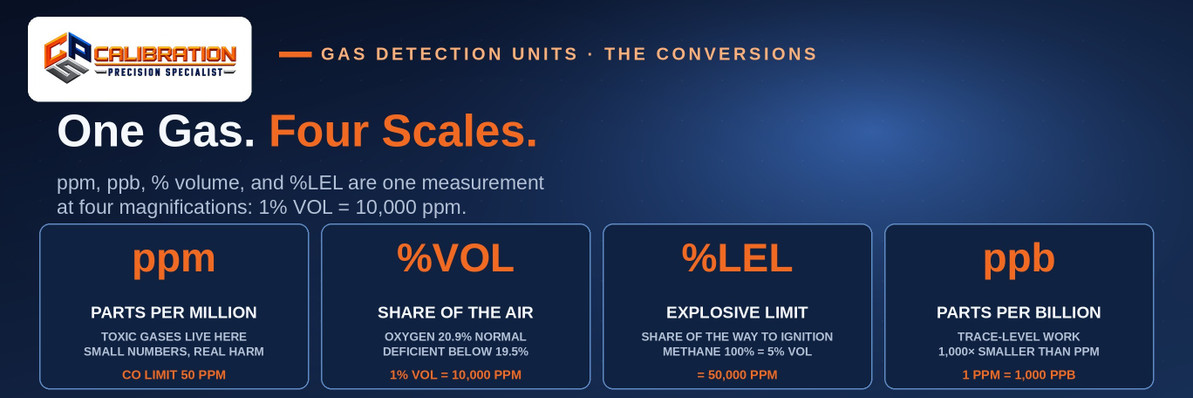
PPM means parts per million — the number of molecules of a gas in every million molecules of air — and the gas-detection scales convert directly: 1% by volume = 10,000 ppm = 10,000,000 ppb, so toxic gases with limits in the tens of ppm (carbon monoxide's OSHA limit is 50 ppm) are measured in ppm, oxygen is measured in % volume (normal air is 20.9%), and combustible gas is measured in %LEL (100% LEL methane = 5% volume = 50,000 ppm).
Every gas detector speaks in units, and the unit is not decoration — it tells you which hazard the number describes. A reading of 50 means something survivable in one unit, an emergency in another, and nothing at all in a third. This post is the plain-language map: what ppm actually counts, how ppm, ppb, %VOL, and %LEL convert into each other, and how to check any conversion yourself with one multiplication.
What Does "Parts Per Million" Actually Count?
It counts molecules by volume. One ppm of carbon monoxide means one molecule of CO in every million molecules of air — a concentration of 0.0001%. Gas detectors measure volume ratios, so ppm in gas detection is always a volume count (sometimes written ppmv), not a weight. The scale exists because toxic gases do their harm at concentrations far too small for percent to describe usefully: hydrogen sulfide is immediately dangerous at 100 ppm, which is 0.01% — a percent display would read 0.01 and invite exactly the wrong shrug. In ppm, the same air reads 100, a number with the weight the hazard deserves. Instruments like those in single-gas monitors and portable multi-gas monitors put each gas on the scale where its hazard lives.
How Do PPM, PPB, %VOL, and %LEL Convert?
By fixed steps, because three of the four scales are the same measurement at different magnifications:
| Unit | Meaning | Equals |
|---|---|---|
| 1% VOL (percent by volume) | 1 part in 100 | 10,000 ppm · 10,000,000 ppb |
| 1 ppm (parts per million) | 1 part in 1,000,000 | 0.0001% VOL · 1,000 ppb |
| 1 ppb (parts per billion) | 1 part in 1,000,000,000 | 0.001 ppm |
| 100% VOL | Pure gas | 1,000,000 ppm |
| Normal oxygen in air | 20.9% VOL | 209,000 ppm |
The two rules that generate the whole table: multiply %VOL by 10,000 to get ppm, and multiply ppm by 1,000 to get ppb. Reverse them to go the other way. %LEL is the odd one out — it is not a fixed magnification, because it is a percentage of a gas-specific limit, which is why %LEL vs. % volume gets its own post.
What Does a Worked Conversion Look Like?
Take methane, the most common combustible gas. Its lower explosive limit (LEL) is 5% by volume. Every scale applied to the same air:
| Methane reading | %LEL | %VOL | ppm |
|---|---|---|---|
| Low alarm territory | 10% LEL | 0.5% | 5,000 ppm |
| Halfway to explosive | 50% LEL | 2.5% | 25,000 ppm |
| The explosive limit itself | 100% LEL | 5% | 50,000 ppm |
Check the arithmetic once and it holds forever: 5% VOL × 10,000 = 50,000 ppm, and 10% of that limit is 0.5% VOL = 5,000 ppm. Run the same table for propane — LEL 2.1% VOL — and the numbers shrink: 100% LEL propane = 2.1% VOL = 21,000 ppm, and 10% LEL = 0.21% VOL = 2,100 ppm. Same %LEL, different ppm: that gap is the single most common conversion mistake in gas detection.
Why Do Toxic Gases Use PPM and Oxygen Use %VOL?
Because each hazard lives at a different size. Toxic gases harm at trace levels — carbon monoxide's OSHA permissible exposure limit is 50 ppm, hydrogen sulfide's ACGIH guideline is 1 ppm as an 8-hour average — so ppm (and, for the most sensitive instruments, ppb) gives those numbers room to be read precisely. Oxygen is the opposite problem: it is a fifth of all air, and the hazard is small percentage shifts — normal air is 20.9% VOL, and below 19.5% VOL is oxygen-deficient. In ppm that same line is 195,000 ppm, a number nobody can judge at a glance. Combustible gas sits between the two worlds, which is why it gets its own relative scale, %LEL: what matters is not the raw concentration but how close the air is to igniting, as %LEL vs. % volume explains. Exposure limits themselves — PELs, RELs, and TLVs — are defined in what is a PEL?
Which Unit Does Your Alarm Limit Use?
The one printed next to the limit — and mixing them up is dangerous in both directions. A CO alarm discussion in ppm (limit 50 ppm) becomes nonsense in %VOL (0.005%). An LEL alarm set at 10% LEL is 5,000 ppm for methane but 2,100 ppm for propane, so a ppm number copied from a methane procedure understates a propane hazard by more than half. And an oxygen alarm at 19.5% VOL cannot be set on a ppm channel at all. When a procedure, a permit, or an instrument disagrees about units, stop and convert — the conversions above are the whole toolkit. For the emergency end of the toxic scale, see what IDLH means.
Calibration is what keeps the units honest. A sensor that drifts reads the right unit and the wrong number — a CO channel reading 35 ppm in 50 ppm air converts perfectly and protects nobody. We calibrate every channel on the instruments above, through calibration services — in-house at our Rockwood, Tennessee shop, or shipped in from anywhere.
Frequently Asked Questions
What does ppm mean in gas detection?
PPM means parts per million: the number of molecules of a gas in every million molecules of air, measured by volume. 1 ppm = 0.0001% by volume, and 1% by volume = 10,000 ppm. Toxic gases are measured in ppm because they harm at very small concentrations — carbon monoxide's OSHA exposure limit is 50 ppm and hydrogen sulfide is immediately dangerous at 100 ppm (0.01%).
How many ppm is 1 percent gas?
10,000 ppm. Percent is parts per hundred and ppm is parts per million, so multiply percent by 10,000: 1% VOL = 10,000 ppm, 5% VOL = 50,000 ppm, and 100% VOL (pure gas) = 1,000,000 ppm. Going the other way, divide ppm by 10,000 to get percent volume — 50 ppm carbon monoxide = 0.005% VOL.
How do you convert ppm to percent volume?
Divide by 10,000. 50 ppm ÷ 10,000 = 0.005% VOL; 209,000 ppm ÷ 10,000 = 20.9% VOL, which is the normal oxygen content of air. To convert percent volume to ppm, multiply by 10,000 instead. The same fixed step works for every gas, because ppm and %VOL are the same measurement at different magnifications.
What is the difference between ppm and ppb?
Size: ppb is parts per billion, one thousand times smaller than ppm. 1 ppm = 1,000 ppb, and 1 ppb = 0.001 ppm. Everyday toxic-gas monitoring works in ppm — limits for gases like carbon monoxide (50 ppm) and hydrogen sulfide sit there — while ppb appears on high-sensitivity instruments measuring trace contaminants, where the concentrations of interest are below 1 ppm.
How many ppm is 100% LEL for methane?
50,000 ppm. Methane's lower explosive limit is 5% by volume, and 5% VOL × 10,000 = 50,000 ppm. So 100% LEL methane = 5% VOL = 50,000 ppm; 50% LEL = 2.5% VOL = 25,000 ppm; and a common 10% LEL low alarm = 0.5% VOL = 5,000 ppm. The ppm figure changes with the gas: 100% LEL propane is 21,000 ppm, because propane's LEL is 2.1% VOL.
Why is oxygen measured in percent instead of ppm?
Because oxygen is about a fifth of all air and its hazard is a small percentage shift. Normal air is 20.9% oxygen by volume and below 19.5% is oxygen-deficient. In ppm those are 209,000 ppm and 195,000 ppm — numbers too large to judge at a glance. Percent volume puts the safe band and the danger line within two digits of each other, which is why every oxygen channel reads %VOL.
What does 50 ppm carbon monoxide mean?
It means 50 molecules of carbon monoxide in every million molecules of air — 0.005% by volume. It is also a regulatory landmark: 50 ppm is OSHA's permissible exposure limit for CO as an 8-hour time-weighted average. NIOSH recommends a lower 35 ppm average with a 200 ppm ceiling, and ACGIH's guideline is 25 ppm — the three systems are compared in what is a PEL? and in carbon monoxide exposure limits: OSHA, NIOSH, and ACGIH.
How do you convert %LEL to ppm?
Multiply the %LEL reading by the gas's LEL in %VOL, then by 100. For methane (LEL 5% VOL): 10% LEL × 5 × 100 = 5,000 ppm. For propane (LEL 2.1% VOL): 10% LEL × 2.1 × 100 = 2,100 ppm. You must know which gas the %LEL refers to — %LEL alone cannot be converted, because each gas's explosive limit is a different concentration.
Is a higher ppm always more dangerous?
No — danger depends on the gas, not the raw number. 100 ppm of hydrogen sulfide is immediately dangerous to life or health, while 100 ppm of carbon monoxide is above the 50 ppm OSHA average limit but far below CO's 1,200 ppm IDLH. And 5,000 ppm of methane is only 10% of its explosive limit. Compare every reading to that gas's own limit, in that limit's own unit.
How much does it cost to calibrate a gas detector?
At CPS Calibrations, in-house calibration is $55 for a single-gas instrument and $90 for a 4- or 5-gas instrument; ship-in calibration is billed at the same rates. On-site work at your facility is quoted in writing and costs more than bench work. Calibration matters to this topic because a drifting sensor displays the right unit with the wrong number — ppm, %VOL, and %LEL are only as true as the calibration behind them.
The Bottom Line
PPM counts molecules per million: 1% VOL = 10,000 ppm = 10,000,000 ppb, oxygen lives in %VOL (20.9% normal, deficient below 19.5%), toxics live in ppm (CO limit 50 ppm, H2S IDLH 100 ppm), and %LEL is a percentage of a gas-specific explosive limit — 100% LEL methane = 5% VOL = 50,000 ppm. Learn the one multiplication — %VOL × 10,000 = ppm — and every detector display becomes readable.
Questions about what your monitors are really telling you? Call CPS Calibrations at 865-900-8844 — calibration, monitors, and the CPS Calibration Program behind them, from Rockwood, Tennessee.
CPS Calibrations · 109 S. Front Street, Rockwood, TN 37854 · Calibration Services · The CPS Calibration Program
Need a calibration you can file?
In-house calibration at CPS in Rockwood, Tennessee — $55 for single-gas instruments, $90 for 4- and 5-gas — every channel, as-found and as-left data, full certificate.
See Calibration Servicesor call 865-900-8844
Recent Posts
-

Can You Add a Pump to a SENKO SGT-P or MGT?
Yes — SENKO's SP-Pump101 external sampling pump ($330, part AAA006000) fits the SGT, SGT-P, and MGT, …Nov 12th 2026 -

What Refrigerant Detection Does a Grocery Store Need?
A grocery store needs refrigerant detection in three places: low-mounted carbon dioxide (R-744) sens …Nov 11th 2026 -

What Is LEL and UEL? The Explosive Range, Gas by Gas
The LEL is the lowest concentration of a gas in air that can explode, and the UEL is the highest: me …Nov 10th 2026