
What Does a 4-Gas Monitor Detect?
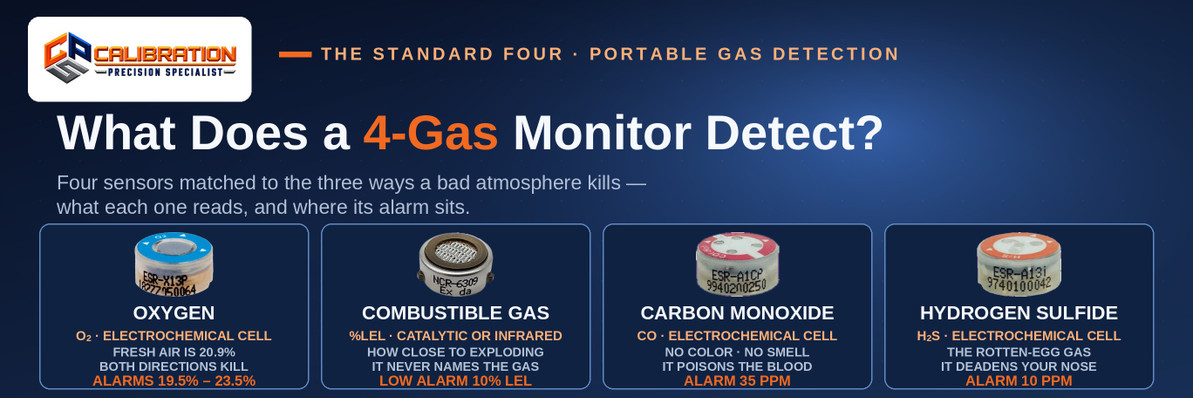
A 4-gas monitor detects oxygen (O₂), combustible gas measured as a percentage of the lower explosive limit (%LEL), carbon monoxide (CO), and hydrogen sulfide (H₂S) — the "standard four," chosen because together they cover the three ways a bad atmosphere kills: too little oxygen to breathe, enough fuel in the air to explode, and toxic gas that poisons. Typical factory alarm setpoints are oxygen at 19.5% (low) and 23.5% (high), combustible gas at 10% and 20% LEL, carbon monoxide at 35 ppm, and hydrogen sulfide at 10 ppm.
Ask for a "4-gas monitor" at any safety counter in the country and you will be handed an instrument with those same four sensors inside, whether it says RKI, SENKO, or another brand on the case. That is not an accident or a marketing habit. The standard four is the settled answer to a specific question — what has to be measured before a worker steps into a tank, a vault, a sewer, or any other space where the air itself is the hazard — and each of the four earned its slot by covering a failure mode the other three cannot see. This post works through each gas in turn: what it is, what sensor reads it, what range it measures over, and where its alarm is set. It also covers the honest limits of the configuration, because the standard four does not detect carbon dioxide, VOCs, ammonia, chlorine, or sulfur dioxide — and knowing what your monitor cannot see is worth as much as knowing what it can. For the testing sequence these four readings feed into, see our guide to how to test a confined space before entry.
Why These Four? The Three Ways an Atmosphere Kills
A hazardous atmosphere hurts people three ways. It can fail to contain enough oxygen, and the worker suffocates — often in a few breaths, without any feeling of choking, because the urge to breathe is driven by carbon dioxide buildup, not by oxygen shortage. It can contain enough fuel to burn or explode the moment it finds an ignition source. Or it can contain a toxic gas that poisons the body directly, at concentrations far too low to affect oxygen or flammability at all. Four sensors cover those three failure modes: the oxygen sensor stands guard over breathing, the combustible (LEL) sensor stands guard over explosion, and two electrochemical sensors stand guard over the two toxic gases that show up most often in industrial spaces — carbon monoxide, the product of every engine, heater, and incomplete fire, and hydrogen sulfide, the product of decaying organic matter in sewers, tanks, and sour processes. A monitor missing any one of the four has a hole in the coverage: a space can read perfectly normal on three channels and be lethal on the fourth.
Oxygen (O₂): The Breathing Check
Fresh air is 20.9% oxygen, and the oxygen sensor — an electrochemical (galvanic) cell that generates a small current from the oxygen that diffuses into it — reads the percentage directly. On the RKI GX-3R it measures 0–40.0% by volume; most portable 4-gas monitors read a similar span. Oxygen gets two alarms because both directions are dangerous. The low alarm, typically set at 19.5%, marks the OSHA line for an oxygen-deficient atmosphere: below it, judgment and coordination go first, then consciousness. The high alarm, typically 23.5%, marks oxygen enrichment — air with too much oxygen makes everything in it burn faster and more violently, including materials that barely burn in normal air. Oxygen is also tested first in the entry sequence for a practical reason: the reading explains the others. A low oxygen reading tells you something else has displaced the air, and a catalytic LEL sensor cannot be trusted in an atmosphere too oxygen-poor to burn — which is the next sensor's story.
Combustible Gas (%LEL): The Explosion Check
The combustible channel does not identify a gas. It reads how close the air is to exploding, expressed as a percentage of the lower explosive limit — the minimum concentration of a fuel in air that will burn. (If the %LEL scale itself is new, our post on what LEL means works through it.) A reading of 10% LEL means the atmosphere holds one-tenth of the fuel needed to ignite; 100% LEL is the ignition threshold itself. Typical factory alarms are 10% LEL (low) and 20% LEL (high) — deliberately far below the threshold, so the alarm is a command to stop work and ventilate, not a countdown. Two sensor technologies do this job. A catalytic bead (pellistor) sensor burns a trace of the gas on a heated element and measures the heat; it is the long-standing standard, but it needs oxygen in the sample to work and can be poisoned by silicones and sulfur compounds. An infrared (NDIR) combustible sensor reads how much infrared light the gas absorbs instead — it needs no oxygen, cannot be poisoned the same way, and sips power. The SENKO SP-MGT is sold both ways: catalytic (SP-MGT-P) variants start at $514 and run about 25 hours per charge, while the NDIR (SP-MGT-N) variants start at $660 and stretch battery life to as much as 60 days under specified conditions. Either way the channel reads 0–100% LEL in 1% increments.
Carbon Monoxide (CO): The Poison With No Warning
Carbon monoxide is what incomplete combustion makes — every forklift, generator, heater, vehicle, and fire produces it — and it is colorless and odorless, so the sensor is the only warning there is. CO kills by chemistry: it binds to hemoglobin roughly 240 times more readily than oxygen, so the blood progressively loses the ability to carry oxygen even while the air's oxygen reading stays a healthy 20.9%. That is why CO needs its own sensor even though the oxygen sensor is right there in the same instrument. The CO channel is an electrochemical cell measuring in parts per million — 0–2,000 ppm on the GX-3R — with a typical factory alarm at 35 ppm, the NIOSH recommended exposure limit as a time-weighted average. RKI also offers an H₂-compensated CO sensor option on the GX-3R for applications where hydrogen is present, because plain CO cells can cross-respond to hydrogen and report CO that isn't there. Headache and dizziness at moderate levels, collapse and death at high ones — and because the symptoms feel like fatigue or flu, workers routinely walk deeper into CO instead of out of it. The 35 ppm alarm exists to make that decision for them, early.
Hydrogen Sulfide (H₂S): The Poison That Deadens Your Nose
Hydrogen sulfide is the sewer, tank, and sour-gas poison: a colorless gas produced by decaying organic matter and many petroleum processes, famous for its rotten-egg smell at low concentrations — and infamous for what happens next. H₂S fatigues the sense of smell quickly, so the odor fades while the gas is still there and possibly rising; workers have died trusting a nose that had simply stopped reporting. Smell is therefore not a detection method, and the H₂S channel — another electrochemical cell, 0–200 ppm on the GX-3R — is. The typical factory alarm is 10 ppm, in line with the NIOSH recommended ceiling for short exposure; at concentrations around ten times that, H₂S is immediately dangerous, and a single breath at very high concentrations can cause immediate collapse. H₂S is also slightly heavier than air, so it pools in the low spots — pits, sumps, tank bottoms, vault floors — which is why it pairs with the confined-space work the 4-gas monitor exists for, a story we told in full in our post on why hydrogen sulfide is so dangerous in wastewater.
The Standard Four, Side by Side
| Gas | What it guards against | Sensor type | Range (RKI GX-3R) | Typical factory alarms |
|---|---|---|---|---|
| Oxygen (O₂) | Suffocation (deficiency) and violent burning (enrichment) | Electrochemical (galvanic) cell | 0–40.0% by volume | 19.5% low · 23.5% high |
| Combustible gas (%LEL) | Fire and explosion | Catalytic bead (pellistor) or infrared (NDIR) | 0–100% LEL | 10% LEL low · 20% LEL high |
| Carbon monoxide (CO) | Toxic poisoning — blood can't carry oxygen | Electrochemical cell | 0–2,000 ppm | 35 ppm |
| Hydrogen sulfide (H₂S) | Toxic poisoning — chemical asphyxiant | Electrochemical cell | 0–200 ppm | 10 ppm |
A note on the alarms column: those are the settings instruments commonly ship with, and they are starting points, not law. Sites routinely adjust setpoints to their own policy and to OSHA, NIOSH, or ACGIH guidance for the specific gas — what matters is that the numbers are chosen deliberately, not that they match a table on the internet. Ranges vary the same way; the GX-3R's are shown because it is the worked example throughout this post, and other 4-gas monitors publish similar spans.
What a 4-Gas Monitor Does NOT Detect
The standard four is a floor, not a ceiling, and treating it as complete protection is the most common 4-gas mistake we see. The gaps that matter most:
- Carbon dioxide (CO₂). The oxygen sensor does not cover CO₂ risk: CO₂ is toxic in its own right at concentrations (a few percent) that barely move the oxygen reading, and it pools in cellars, dry-ice storage, beverage plants, and fermentation spaces. CO₂ takes a dedicated infrared sensor — a fifth channel, or a dedicated monitor.
- VOCs (volatile organic compounds). Solvent and fuel vapors — benzene, toluene, gasoline vapor at toxic (not explosive) levels — are largely invisible to the standard four at the concentrations that matter for health. A photoionization detector (PID) is the tool, as a fifth/sixth sensor or a standalone instrument.
- Ammonia (NH₃), chlorine (Cl₂), sulfur dioxide (SO₂), and other specific toxics. Each needs its own electrochemical sensor, selected for the process: ammonia around refrigeration, chlorine at water treatment, SO₂ around combustion and pulp processes. None of them appears on a standard 4-gas display.
- A named combustible gas. The LEL channel reports %LEL of whatever combustible mixture reaches it, calibrated against one reference gas. It does not tell you which gas, and readings for gases other than the calibration gas run through correction factors.
None of this is a defect — it is the design. The 4-gas configuration covers the hazards that can appear in almost any confined space; process-specific hazards layer on top of it. Five- and six-gas instruments exist precisely to add those channels (a PID or a specific toxic sensor alongside the four), and our post on when the standard 4-gas isn't enough works through how to recognize when your space has outgrown the standard four. The rule is simple: the hazard assessment names the gases; the monitor gets built to match it — never the other way around.
Three Real 4-Gas Monitors
RKI GX-3R — $640 with VAC charger (configurations $590–$690). The smallest of the three: about 25 hours per charge, IP66/68 sealing, a 3-year warranty, and the ranges in the table above, worn in the breathing zone as a diffusion personal monitor. An optional clip-on pump converts it for remote sampling. This is the default answer for personal confined-space monitoring.
SENKO SP-MGT — from $514 (catalytic) / $660 (NDIR). The same standard four with a choice of combustible sensor: catalytic variants from $514, and the NDIR variants from $660 that trade a higher price for poison immunity, no oxygen requirement on the LEL channel, and battery life measured in weeks instead of hours. IP67, with 1- through 4-gas configurations on the same platform.
RKI GX-Force — from $794. The standard four with the pump built in: an internal sample pump drawing up to 100 feet, about 30 hours of runtime, and a leak-check mode alongside normal monitoring. This is the configuration for pre-entry testing — drawing a sample from the space and reading all four gases before anyone goes in — and for leak investigation around valves and piping.
All three are calibrated with the same idea: a quad-mix cylinder carrying all four gases at once, which is the subject of our post on what calibration gas you need for a 4-gas detector. The wider lineup lives in the portable gas detection range.
Frequently Asked Questions
What are the 4 gases in a 4-gas monitor? Oxygen (O₂), combustible gas read as %LEL, carbon monoxide (CO), and hydrogen sulfide (H₂S). That combination — the "standard four" — is used across brands because it covers oxygen deficiency and enrichment, explosion risk, and the two most common industrial toxic gases in one instrument.
What are the alarm setpoints on a 4-gas monitor? The settings instruments commonly ship with are oxygen 19.5% (low) and 23.5% (high), combustible gas 10% LEL (low) and 20% LEL (high), carbon monoxide 35 ppm, and hydrogen sulfide 10 ppm. They are typical factory defaults, not universal law — sites adjust them to their own safety policy and applicable exposure guidance.
Does a 4-gas monitor detect carbon dioxide? No. A standard 4-gas monitor has no CO₂ sensor, and its oxygen sensor does not substitute for one: carbon dioxide is toxic at a few percent concentration, a level that barely changes the oxygen reading. CO₂ requires a dedicated infrared sensor — either a fifth channel on a larger instrument or a dedicated CO₂ monitor.
Can a 4-gas monitor detect VOCs? Not in any useful way. The LEL channel responds to combustible vapors only as they approach explosive concentrations, and the toxic sensors are gas-specific — none of them measures volatile organic compounds at the ppm levels that matter for health. VOCs require a photoionization detector (PID), available as an added sensor on 5- and 6-gas instruments or as a standalone PID.
Does a 4-gas monitor tell you which combustible gas is present? No. The combustible channel reports a single number — %LEL — for whatever combustible gas or mixture reaches the sensor, relative to the gas it was calibrated with. It cannot distinguish methane from propane from solvent vapor, and readings for gases other than the calibration gas are adjusted with correction factors.
Why does a 4-gas monitor test oxygen first? Because the oxygen reading frames all the others. Low oxygen means some other gas has displaced the air, and a catalytic LEL sensor cannot burn gas properly — so cannot be trusted — in an atmosphere too oxygen-poor. Confined-space procedure therefore reads oxygen first, then flammables, then toxics.
Can you add a fifth gas to a 4-gas monitor? Generally not to the same instrument — the four sensor positions are fixed, so a "4-gas" unit cannot grow a CO₂ or PID channel later. The step up is a 5- or 6-gas platform built with the extra positions from the start. This is why the hazard assessment comes first: buy the instrument that matches the gases your spaces actually contain.
What gas do you use to calibrate a 4-gas monitor? A single quad-mix cylinder containing all four gases at once — the standard RKI-equivalent blend is H₂S 25 ppm, CO 50 ppm, methane 50% LEL, and oxygen 12% in a nitrogen balance. One cylinder span-calibrates every channel in one routine, which is part of why the standard four is configured the way it is.
How much does a 4-gas monitor cost? At CPS, the RKI GX-3R is $640 with the VAC charger (configurations run $590–$690), the SENKO SP-MGT starts at $514 with a catalytic LEL sensor or $660 with the infrared version, and the pumped RKI GX-Force starts at $794. Sensor choice and sampling (diffusion vs. pumped) move the price more than the brand does.
Do all 4-gas monitors detect the same gases? Almost always the same standard four — O₂, %LEL, CO, and H₂S — but not invariably. Some platforms offer alternate toxic sensors in place of one channel, and SENKO's SP-MGT, for example, is sold in 1-, 2-, and 3-gas configurations on the same platform. Always confirm the installed configuration on the instrument in hand rather than assuming "4-gas" describes it.
The Bottom Line
A 4-gas monitor detects oxygen, combustible gas (%LEL), carbon monoxide, and hydrogen sulfide — four sensors matched to the three ways an atmosphere kills: it starves you of oxygen, it explodes, or it poisons you. The oxygen channel watches both suffocation and enrichment, the LEL channel keeps you at a tenth or a fifth of the explosive threshold, and the CO and H₂S channels catch the two common poisons your senses cannot be trusted with — CO has no smell at all, and H₂S switches yours off. What the standard four does not do is equally definite: no carbon dioxide, no VOCs, no ammonia or chlorine, and no naming of the combustible it reads. Buy the standard four for the spaces it was designed for, add channels when your hazard assessment names more gases, and calibrate the whole set with one quad mix — that is the complete picture of what a 4-gas monitor detects, and what it doesn't.
Not sure whether the standard four covers your space? Bring us the hazard list and we'll match the instrument to it — call 865-900-8844 or reach us through Contact Us. Browse the monitors in Portable Gas Detection, and keep them honest with the right Calibration Gas.
CPS Calibrations · 109 S. Front Street, Rockwood, TN 37854 · Calibration Gas · Calibration Services · Contact Us
Recent Posts
-

What Is a Confined Space? OSHA's Definition, the 3 Tests, and When It Becomes Permit-Required
A confined space is a space that passes all three of OSHA's tests at the same time: it is large enou …Oct 21st 2026 -
PID vs. LEL for VOC Detection: Which Sensor Do You Actually Need?
Use a PID to detect VOCs and an LEL sensor to detect explosive atmospheres — they measure different …Oct 21st 2026 -

Semiconductor (MOS) Gas Sensors: Where They Work and Where They Lie
A semiconductor (MOS) gas sensor measures gas with a heated film of metal oxide — usually tin dioxid …Oct 21st 2026