
Why Do You Need a Dedicated CO₂ Monitor? The SENKO iGas CO₂ Explained
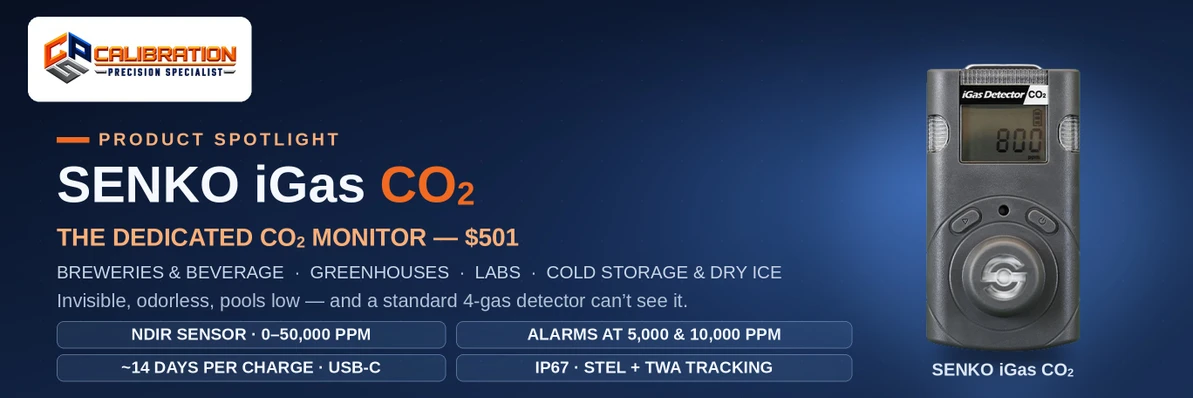
The SENKO iGas CO₂ is a dedicated single-gas carbon dioxide monitor ($501) built around an NDIR infrared sensor that measures CO₂ from 0 to 50,000 ppm (0–5.0% by volume) — the channel a standard 4-gas detector doesn't have. It runs up to about 14 days per USB-C charge, is rated IP67, tracks STEL and TWA exposure, and its factory alarms are set at 5,000 ppm (low) and 10,000 ppm (high), so a worker in a brewery, greenhouse, lab, or cold-storage space gets warned about an invisible buildup before it becomes an emergency.
That's the short answer. The rest of this post is why CO₂ needs a dedicated channel in the first place, where it accumulates, what the iGas CO₂ does with it all shift, and how to decide between a dedicated CO₂ monitor and a multi-gas instrument that carries CO₂ as one of its channels.
What Is the SENKO iGas CO₂, and Who Is It For?
The SENKO iGas CO₂ is a portable, diffusion-type personal monitor that does one job: continuous carbon dioxide monitoring on the worker wearing it. It is a single-gas instrument by design, not a cut-down multi-gas — every part of it, from the sensor to the alarm points to the 0–50,000 ppm range, is specified for CO₂.
The headline specifications, from the product listing:
- Sensor: NDIR (non-dispersive infrared), the standard technology for CO₂ measurement
- Range: 0–5.0% Vol (0–50,000 ppm), displayed in either % Vol or ppm, at 100 ppm (0.01% Vol) resolution
- Factory alarms: low at 0.5% Vol (5,000 ppm), high at 1.0% Vol (10,000 ppm) — setpoints are configurable
- Alarms: audible (90 dB at 10 cm), visual (red flashing LEDs and LCD indication), and vibration
- Battery: rechargeable Li-ion polymer, up to approximately 14 days of operation per charge in measuring mode without alarm, about 100 minutes from empty to full over USB-C with the supplied adapter
- Protection: IP67 — dust-tight, and sealed against immersion
- Size and weight: 2.13 × 3.92 × 1.53 in. (54 × 99.5 × 38.8 mm), 4.76 oz (135 g)
- Operating range: -4°F to +122°F (-20°C to +50°C), 5%–95% RH non-condensing
- In the box: calibration cap, manual, calibration & test certificate, USB-C charge cable & adapter
It's for the facilities where CO₂ is part of the process rather than a by-product someone remembered later: breweries and beverage plants, greenhouses, laboratories, and cold-storage and dry-ice operations — plus any confined-space or workplace program whose hazard assessment names CO₂ specifically. SENKO's full portable range is on our SENKO Instruments page.
Why Doesn't a Standard 4-Gas Detector See CO₂?
Because it was never built to. A standard 4-gas configuration is LEL, O₂, CO, and H₂S — four channels, four sensors, and carbon dioxide is none of them. There is no menu setting, firmware option, or alarm trick that adds a gas the instrument has no sensor for. A worker can be standing in rising CO₂ wearing a perfectly calibrated, freshly bump-tested 4-gas detector, and every channel on it will read normal.
This is the same trap we covered in our post on specialty gas mixes, and when standard 4-gas isn't enough: the standard configuration covers the standard hazards, and everything outside that list — CO₂ included — needs its own channel, its own sensor, and its own calibration gas.
CO₂ gets a dedicated infrared channel for a physical reason. It isn't measured well by the electrochemical cells that handle CO and H₂S, so CO₂ instruments use NDIR sensing: infrared light passes through the sample, and the instrument measures how much of it the CO₂ absorbs. No combustion and no consumed sensing element in normal use — the same infrared principle that, in a multi-gas instrument, is an added-cost option is simply the whole instrument here.
Why Is CO₂ an Invisible Hazard?
Three properties combine badly:
- You can't detect it yourself. CO₂ is colorless and odorless. Unlike H₂S, it gives no smell warning at any concentration; the first signs are the physiological ones — headache, drowsiness, shortness of breath — which are easy to misread as fatigue until they're not.
- It pools where people bend and enter. CO₂ is heavier than air, so it collects low: in cellars and fermentation rooms, inside tanks and pits, at the bottom of cold-storage spaces, and around dry ice as it sublimates. The air at head height in the doorway is not the air at floor level inside.
- It's often there on purpose. Greenhouses enrich CO₂ deliberately to feed plants. Breweries generate it in fermentation and add it back in carbonation. Beverage plants store it in bulk. Labs keep it in cylinders. Cold storage and shipping use dry ice, which is CO₂ waiting to become gas. A hazard that is part of the process doesn't announce itself as an accident in progress — it just builds, quietly, when ventilation, a regulator, or a relief path doesn't do its job.
That combination is exactly what personal monitoring exists for. The instrument travels with the worker into the low spots and the enclosed rooms, instead of assuming the doorway reading speaks for the whole space.
Where Does CO₂ Build Up? Four Places This Monitor Earns Its Keep
- Breweries and beverage production. Fermentation produces CO₂ in volume, and cellars, bright tanks, and bottling and carbonation areas are where it gathers — low, enclosed, and routinely entered for cleaning and checks. A personal monitor goes in with the worker; a doorway check doesn't.
- Greenhouses. Enrichment systems hold CO₂ above outdoor levels on purpose, and workers spend whole shifts inside that atmosphere. The question stops being "is CO₂ present?" and becomes "is it where it's supposed to be?" — which is a TWA and STEL question, and the iGas CO₂ tracks both.
- Laboratories. Cylinder CO₂, incubators, and dry ice in freezers and shipping containers all concentrate the gas in small, often poorly ventilated rooms. A leaking fitting in a small lab changes the air faster than the same leak in a warehouse.
- Cold storage and dry-ice handling. Dry ice sublimates continuously, including inside sealed or lightly ventilated cold rooms, vehicles, and insulated boxes. The hazard arrives with the product, peaks when ventilation is lowest, and sits at floor level where cases get stacked and picked.
What Does the iGas CO₂ Do All Shift?
A dedicated monitor only helps if it stays on the worker and keeps its own records. The iGas CO₂ is built around that routine:
- Triple alarms, set for CO₂. Audible (90 dB at 10 cm), visual, and vibration alarms, with factory setpoints at 5,000 ppm low and 10,000 ppm high — and configurable setpoints if your site's procedures call for different thresholds.
- STEL and TWA monitoring. Instantaneous readings protect the moment; short-term exposure limit and time-weighted average values protect the shift. The display shows CO₂ in ppm or % Vol, whichever your program works in.
- Records in the instrument. It stores the most recent 30 alarm events and approximately 64,000 data logs at one-minute intervals. When someone asks what a worker was actually exposed to last Tuesday, the answer is in the log, not in a recollection. PC software connectivity over the supplied USB-C cable handles configuration, calibration, and data-log downloads.
- Reminders that keep it honest. Calibration, bump-test, and self-test due warnings can be configured, and it runs a self-test so a fault announces itself before the instrument goes to work.
- Two weeks between charges. Up to approximately 14 days of operation per charge means charging is a weekly-or-so habit, not a nightly fleet ritual — and a monitor that's charged is a monitor that gets worn. When it does need power, it's about 100 minutes from empty to full over USB-C.
For areas that need a sample drawn before entry rather than read on the worker, the listing also notes compatibility with the optional SENKO SP-Pump101 sampling pump and 5 m / 10 m extension probes — diffusion on the person for personal monitoring, pumped sampling when the space has to be checked before anyone goes in.
Dedicated CO₂ Monitor, or a Multi-Gas with a CO₂ Channel — Which Do You Choose?
Both are legitimate instruments. The hazard assessment decides:
Choose a dedicated CO₂ monitor when:
- CO₂ is the named hazard and the other standard channels aren't part of the risk — a greenhouse, a carbonation line, a dry-ice store
- The monitor needs to live on specific workers all shift, every shift, at a price that lets you issue one per person — the iGas CO₂ is $501
- You want alarm points, range (0–50,000 ppm), and records specified entirely around CO₂, with nothing else competing for the display
- Simplicity matters: one gas, one sensor to bump and calibrate, one reading to train people on
Choose a multi-gas instrument with a CO₂ channel when:
- Workers face CO₂ and the standard hazards together — confined-space entry where LEL, O₂, CO, and H₂S are all in the assessment, for example
- One instrument per worker has to cover a changing mix of hazards across different jobs and sites
- Your program already runs a multi-gas fleet and its docks, records, and training — SENKO's pumped multi-gas family is the step-up we covered alongside the SENKO SP-MGT and Docking Station II
What doesn't work is the middle assumption: that a standard 4-gas unit covers CO₂ by implication. It doesn't, and the gap is silent — the instrument won't warn you about a channel it doesn't have.
How Is the iGas CO₂ Calibrated?
With CO₂ gas, at the concentration the listing specifies: the standard span calibration is 20,000 ppm (2.0% Vol) CO₂, applied at a 0.2 LPM calibration flow rate, through the calibration cap included in the box. Our CO₂ 2.0% calibration gas — nitrogen balance ($110) is the matching span gas, and the wider range of CO₂ concentrations is on the calibration gas page.
Two bench notes. First, a 4-gas cylinder cannot bump or calibrate this instrument — it contains no CO₂. That's the specialty-gas point again, from the gas side: every channel needs gas that actually contains its target. Second, the instrument's configurable calibration and bump-test reminders only help if the gas on hand is in date — an expired cylinder turns a passed bump test into a guess.
And when the monitor comes to us — shipped to our Rockwood lab or serviced on-site at your facility — we calibrate every channel it carries and return it with as-found and as-left data. If the NDIR sensor itself reaches end of life, the replacement CO₂ IR sensor for the iGas CO₂ is a listed part, and the calibration cap is replaceable on its own — small parts, priced like parts, instead of a new instrument.
The Bottom Line
A standard 4-gas detector does not detect carbon dioxide — full stop. Where CO₂ is fermented, injected, stored, or shipped as dry ice, it needs its own channel, and the SENKO iGas CO₂ is that channel as a complete instrument: NDIR sensing across 0–50,000 ppm, factory alarms at 5,000 and 10,000 ppm, STEL and TWA tracking, roughly 64,000 logged readings, IP67 sealing, and up to about 14 days per charge, for $501.
Ready to close the CO₂ gap? Start with the SENKO iGas CO₂, pair it with the matching 2.0% CO₂ span gas, and browse the rest of our portable gas detection lineup to see where it sits in your fleet. Not sure whether your application calls for a dedicated monitor or a multi-gas with a CO₂ channel? Call us at 865-900-8844 — we'll talk through the hazard assessment, not just the catalog.
Frequently Asked Questions
How much does the SENKO iGas CO₂ cost? $501 on our store. It's a single configuration — one dedicated CO₂ instrument, part # AAA077025 — with the calibration cap, manual, calibration & test certificate, and USB-C charge cable & adapter included. The matching 2.0% CO₂ span gas is $110.
What CO₂ range does the iGas CO₂ measure? 0–5.0% Vol, equivalent to 0–50,000 ppm, with a resolution of 0.01% Vol (100 ppm). Readings can be displayed in either % Vol or ppm. The NDIR infrared sensor covers that full range — the same span that takes in normal workplace monitoring at the low end and serious buildups in cellars, tanks, and cold rooms at the high end.
Will my standard 4-gas detector warn me about CO₂? No. A standard 4-gas detector monitors LEL, O₂, CO, and H₂S — it has no CO₂ sensor, so it cannot respond to carbon dioxide at any concentration. If your hazard assessment names CO₂, it needs an instrument with a CO₂ channel: a dedicated monitor like the iGas CO₂, or a multi-gas instrument specified with CO₂ as one of its channels.
What are the iGas CO₂ alarm setpoints? As shipped from the factory, the low alarm is 0.5% Vol (5,000 ppm) and the high alarm is 1.0% Vol (10,000 ppm), with audible (90 dB at 10 cm), visual LED, and vibration notification. The setpoints are configurable — the product documentation notes they should be selected in accordance with applicable workplace requirements and site safety procedures.
How long does the battery last, and how does it charge? Up to approximately 14 days of operation per charge in measuring mode without alarm, from its built-in rechargeable Li-ion polymer battery. It charges over USB-C with the supplied cable and adapter, in approximately 100 minutes from empty to full when powered off.
Is the iGas CO₂ waterproof? It's rated IP67 — dust-tight, and sealed against water immersion — in a 4.76 oz (135 g) case that runs from -4°F to +122°F (-20°C to +50°C). Rain, washdown areas, greenhouse humidity, and cold-room condensation are working conditions for this instrument, not warranty conversations.
How do you calibrate the iGas CO₂? With CO₂ span gas at the documented standard concentration — 20,000 ppm (2.0% Vol) — applied at 0.2 LPM through the included calibration cap. A standard 4-gas cylinder can't do it, because it contains no CO₂. The instrument can be configured with calibration and bump-test due reminders, and it connects to PC software over USB-C for configuration, calibration, and downloading its data logs (approximately 64,000 readings at one-minute intervals, plus the most recent 30 alarm events).
Dedicated CO₂ monitor or multi-gas with CO₂ — which is right for a brewery? It follows the hazard assessment. If cellar and carbonation-area workers face CO₂ as the named hazard, a dedicated monitor per worker — worn all shift, alarming at CO₂-specific setpoints, tracking TWA and STEL — is the direct answer at $501 a unit. If the same workers also enter spaces where combustible gas, oxygen deficiency, CO, or H₂S are assessed risks, they need a multi-gas instrument with a CO₂ channel for that work. Many breweries end up with both, issued by task.
CPS Calibrations · 109 S. Front Street, Rockwood, TN 37854 · Portable Gas Detection · Calibration Gas · Calibration Services · Contact Us
Recent Posts
-
Flame Detector vs. Gas Detector: What's the Difference — and Do You Need Both?
A gas detector and a flame detector guard opposite ends of the same incident: a gas detector reads l …Oct 21st 2026 -

How Do You Test a Flame Detector? Self-Tests, Test Lamps, and NFPA 72
You test a flame detector with light, not gas — there is no span gas, no zero gas, and never an open …Oct 21st 2026 -

Why Does a Flame Detector False Alarm — and Which Type Won't?
A flame detector false alarms because something that is not a fire is producing the signal it watche …Oct 21st 2026