
How Much Does Gas Detector Calibration Cost?
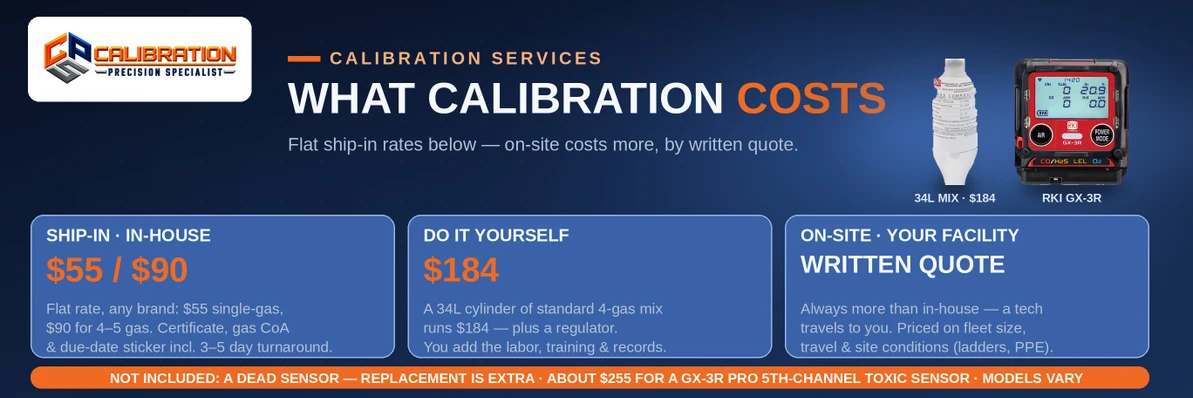
Gas detector calibration costs $55 for a single-gas instrument and $90 for a 4- or 5-gas instrument when you ship the instrument to a calibration lab — those are CPS Calibrations' flat in-house rates for any brand, with a 3–5 business-day turnaround. On-site calibration, where a technician comes to your facility, costs more and is priced by written quote based on fleet size, location, and site conditions. A replacement sensor is never included in a calibration price; if an instrument needs one (about $255 for an RKI GX-3R Pro fifth-channel toxic sensor, for example), that part is charged separately.
Notice what that answer does not do: it doesn't quote one number for every situation. Calibration pricing depends on where the work happens and what the instrument needs, and any shop that gives you a single flat figure for all of it is leaving something out. Here is the full breakdown.
The Short Answer: Calibration Prices at a Glance
- In-house (ship-in) calibration: $55 single-gas / $90 for 4–5 gas instruments, flat, any brand — 3–5 business-day turnaround
- On-site calibration: priced by written quote; always more than in-house, because a technician travels to you
- Calibration by a national online seller: at least one charges $99 per instrument for the same ship-in service
- Do-it-yourself: a 34L cylinder of 4-gas calibration gas runs $184, plus a regulator — but you supply the labor, the training, and the records
What's Included in the Price of a Calibration?
At CPS, the $55/$90 in-house price includes the complete job, not a bump-test-and-go:
- As-found and as-left readings on the certificate — what the instrument read when it arrived, and what it reads after calibration
- NIST-traceable calibration gas, with the gas lot's Certificate of Analysis listed right on your certificate
- A due-date sticker on the instrument and a QR sticker that pulls up the live certificate and the unit's full service history
- Enrollment in the CPS Calibration Program, free: a reminder email 30 days before the next calibration falls due, and updates at every step while your instrument is with us
When you compare prices between shops, compare what's included. A cheaper calibration that hands back a pass/fail sticker with no readings and no traceability documentation is a different product — and it's the one that gets uncomfortable in an audit.
Why Do Calibration Prices Vary So Much Between Shops?
Four things move the number:
- What's on the certificate. Full as-found/as-left data with traceable gas documentation takes more time than a pass/fail check. Some shops charge extra for the full breakdown; we include it in the flat rate, because charging more for ten seconds of extra work is wrong.
- How many gases. A single-gas instrument (an O₂ or H₂S single-gas unit, for example) is faster to calibrate than a 4- or 5-gas instrument with a PID channel. That's the whole reason for the $55 vs. $90 split.
- Where the work happens. Ship-in work is done on a bench, back-to-back, with every gas and fixture at arm's reach. On-site work carries travel and setup in every price — see the next section.
- What's actually wrong with the instrument. Calibration assumes working sensors. A depleted sensor is a parts replacement, not a calibration, and no honest calibration quote includes it.
How Much Does On-Site Gas Detector Calibration Cost?
More than in-house — always. The in-house rates above do not apply when a technician comes to you, and a shop that implies otherwise is setting up an argument on your dock.
On-site calibration at CPS is quoted in writing per job. The quote is built from:
- Fleet size — on-site service is for fleets of 10 or more instruments
- Location and travel — where your facility is relative to our Rockwood, Tennessee base
- Site conditions — this is the one people forget. Calibrations performed off ladders, in respirators or other PPE, or in difficult-access locations take longer and carry more risk than bench work, and the price reflects that
In exchange, your fleet never leaves the building: no packing, no shipping, no instruments out of service waiting on a return box. For a fleet that can't be down, that trade is usually worth it — but it is a trade, and it's priced like one. Details and quote requests are on our on-site calibration page.
What Makes Gas Detector Calibration Cost More?
- A dead or drifting sensor. The most common surprise. Electrochemical sensors deplete with use — typically every 1–2 years for O₂ — and a sensor that can't be brought into tolerance has to be replaced before the instrument can be calibrated. That part (about $255 for an RKI GX-3R Pro fifth-channel toxic sensor; prices vary by model) is on top of the calibration charge.
- Site conditions on on-site work. Ladders, respirators and other PPE, permit-required spaces — all of it adds time and cost, as covered above.
- Shipping on ship-in work. The calibration price doesn't include freight. You ship the instrument to us; the return shipment is arranged on the RMA form, on your UPS account or prepaid.
- Neglect. An instrument that has gone years past due, been stored with a dead battery, or taken a physical beating takes longer to evaluate and is more likely to need parts. Regular calibration is cheaper than rescue calibration.
How Often Do You Pay for Gas Detector Calibration?
Most manufacturers recommend a full calibration every six months, plus a bump test before each day's use to confirm the sensors respond. At in-house rates, that makes the real annual cost per instrument easy to figure:
- Single-gas instrument: $55 × 2 = $110 per year
- 4- or 5-gas instrument: $90 × 2 = $180 per year
That's the number to budget — and to compare against the cost of a citation, a failed audit, or an instrument that reads wrong when it matters. Our Calibration Program tracks the due dates and reminds you 30 days ahead, so the six-month cycle doesn't depend on somebody's spreadsheet.
Is It Cheaper to Calibrate Your Own Gas Detectors?
Sometimes — and it's worth doing the honest math. Doing it yourself means buying calibration gas (a 34L cylinder of standard 4-gas mix is $184), a regulator, and fittings, and then supplying three things money doesn't buy off the shelf: a trained person, the time to do it right, and calibration records that hold up in an audit.
DIY tends to win when you run a large fleet on a tight cycle and already have safety staff who can own it. It loses when calibrations are occasional, when nobody truly owns the records, or when the "savings" quietly become skipped calibrations. Plenty of our customers do both: routine calibrations in-house, and instruments shipped to us when a sensor misbehaves or an audit is coming. If you're setting up your own bench, start with the right gas — our calibration gas catalog lists every mix with its shelf life, and each cylinder carries QR codes for its SDS and Certificate of Analysis.
Frequently Asked Questions
How much does it cost to calibrate a 4-gas detector? In-house calibration of a 4-gas detector costs $90 at CPS Calibrations — flat, any brand, with a 3–5 business-day turnaround. The price includes a certificate with as-found and as-left readings, NIST-traceable gas documentation, and a due-date reminder service. On-site calibration of a 4-gas fleet costs more and is quoted in writing.
How much does it cost to calibrate a single-gas detector? A single-gas instrument — O₂, H₂S, CO, and similar — costs $55 to calibrate in-house at CPS. Single-gas units are faster to calibrate than multi-gas instruments, which is why they carry the lower flat rate.
Why is on-site calibration more expensive than ship-in calibration? Because a technician travels to your facility and works in your environment instead of on a bench. Travel, setup, fleet size, and site conditions all go into an on-site quote — work that requires ladders, respirators or other PPE, or difficult access costs more than a straightforward calibration. The $55/$90 in-house rates never apply to on-site work.
Is a replacement sensor included in the calibration price? No. Calibration adjusts and verifies the sensors already in the instrument. If a sensor has depleted or failed — common for O₂ sensors after 1–2 years — it must be replaced before the instrument can pass, and the part is charged separately (about $255 for an RKI GX-3R Pro fifth-channel toxic sensor; other models vary).
How often should a gas detector be calibrated? Most manufacturers recommend calibration every six months, with a bump test before each day's use. At in-house rates, budget $110 per year for a single-gas instrument and $180 per year for a 4- or 5-gas instrument.
What does a calibration certificate include? A proper certificate shows as-found and as-left readings for every sensor, the calibration date and next due date, and the traceability of the gas used. CPS certificates list the calibration gas Certificate of Analysis and are backed by a QR sticker on the instrument that pulls up the live certificate and full service history.
How long does calibration take? In-house turnaround at CPS is 3–5 business days from the day your instruments arrive at our Rockwood, Tennessee lab. On-site calibrations are completed during the scheduled visit.
Which brands of gas detectors can be calibrated? We calibrate and service most major brands, including RKI, Honeywell (BW and RAE), MSA, Industrial Scientific, Dräger, SENSIT, Senko, GMI, Gas Clip Technologies, and Teledyne. The flat in-house rates apply regardless of brand.
Do I have to pay for shipping when I send a detector in for calibration? Yes — shipping is not included in the calibration price. You ship the instrument to our lab, and the return shipment is arranged on the RMA form, either on your UPS account or prepaid.
The Bottom Line
Budget $55 per single-gas instrument and $90 per 4- or 5-gas instrument, twice a year, for ship-in calibration with full documentation — and expect on-site service to cost more, quoted honestly around your fleet, your location, and your site conditions. The expensive calibration is the one that was skipped: an overdue instrument is a liability every day it stays in service.
Ready to send instruments in? Start with our calibration services page or call CPS Calibrations at 865-900-8844. Sending a fleet? Ask about on-site service — we'll put the quote in writing.
CPS Calibrations · 109 S. Front Street, Rockwood, TN 37854 · Portable Gas Detection · Calibration Gas · Calibration Services · Contact Us
Recent Posts
-

What Is a Confined Space? OSHA's Definition, the 3 Tests, and When It Becomes Permit-Required
A confined space is a space that passes all three of OSHA's tests at the same time: it is large enou …Oct 21st 2026 -

PID vs. LEL for VOC Detection: Which Sensor Do You Actually Need?
Use a PID to detect VOCs and an LEL sensor to detect explosive atmospheres — they measure different …Oct 21st 2026 -

Semiconductor (MOS) Gas Sensors: Where They Work and Where They Lie
A semiconductor (MOS) gas sensor measures gas with a heated film of metal oxide — usually tin dioxid …Oct 21st 2026