
Gas Detection for Hot Work: What Does a Fire Watch Need to Monitor?
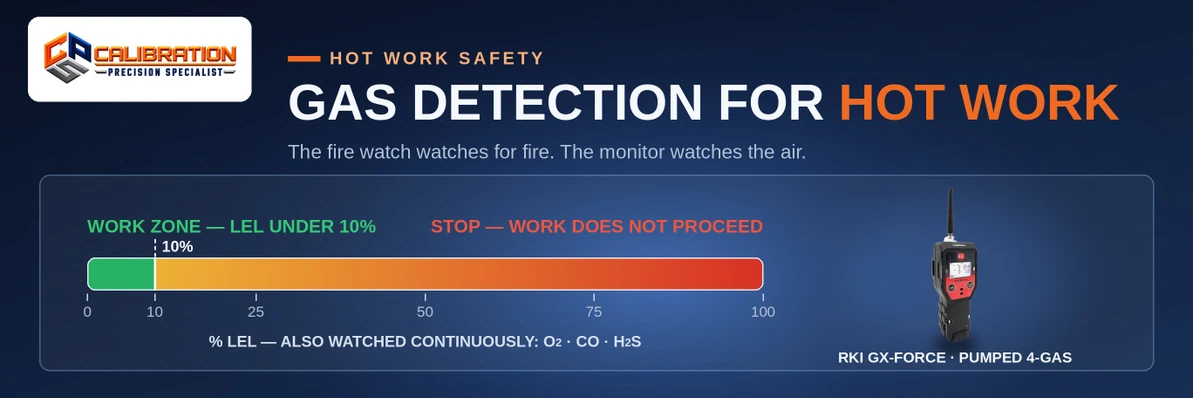
A fire watch monitors fire — but the atmosphere has to be proven safe before hot work starts and watched while it burns, and that is a gas detector's measurement, not an eye's. The monitoring is the standard confined-space four: combustible gas held below 10% of the lower explosive limit, oxygen in the safe band, and carbon monoxide and hydrogen sulfide in range when the work sits next to a process area, tank, sewer or pit. A pumped multi-gas monitor tests the space before anyone strikes an arc; a dedicated fire watch — kept at least 30 minutes after the work under OSHA, 60 minutes under NFPA 51B (2019 and later) — watches for the fires the sparks started after the welder left.
Hot work — welding, cutting, grinding, brazing, soldering, torch-applied roofing — is how a spark gets into a building that spent decades keeping sparks out. The permit system exists to make sure the space is safe before the work begins; gas detection is how the permit's atmospheric precautions are actually proved and maintained. This guide covers what the permit rules require, what the monitor should read, and where the honest boundaries are.
What Does the Hot Work Permit Actually Require?
In general industry, OSHA's welding standard (29 CFR 1910.252) doesn't start with the torch — it starts with the area. Before hot work begins, the person authorizing the work must inspect the area, designate the precautions to be taken, and set them down "preferably" in the form of a written permit. Where hot work can ignite something, the rule sets hard geometry: combustibles within 35 feet of the work must be moved, or if they can't be moved — wall studs, fixed racks, structural steel — protected with fire-resistant blankets or barriers, with floor and wall openings inside that radius covered so sparks can't reach what's behind them.
A fire watch is required where appreciable combustibles are within that 35-foot radius and can't be cleared or shielded, where openings expose combustibles in adjacent areas, or where combustibles on the far side of a metal partition could ignite by conduction or radiation. And the watch has one job — in OSHA's words, to "watch for fires in all exposed areas," with extinguishing equipment ready and the alarm within reach. Not to help the welder. Not to run for tools. To watch.
NFPA 51B, Standard for Fire Prevention During Welding, Cutting, and Other Hot Work, runs the permit system many insurers, fire codes and customer contracts actually enforce: a designated permit-authorizing individual inspects, issues a documented permit, and sets its conditions. A permit is also mandatory under OSHA's process safety management rule for hot work on or near covered processes. Name the authority behind every requirement you quote — the three (OSHA general industry, OSHA construction, NFPA 51B) do not always agree.
What Gases Does a Fire Watch Need to Monitor?
The atmosphere is tested the way a confined space is tested — because it often is one, and because the same instruments do the job. The four channels and their hot-work jobs:
| Channel | What it's looking for in hot work | The working line |
|---|---|---|
| LEL (combustibles) | Fuel that could meet the spark: solvent vapors, gas-line leaks, dust-cloud territory, residual fuels in tanks and piping | Below 10% of LEL before and during work |
| Oxygen (O₂) | Depletion in tanks and pits; enrichment from leaking oxygen lines or cylinders, which makes ordinary combustibles ignite far more readily | The normal band — roughly 20.9% vol; the work stops outside it |
| Carbon monoxide (CO) | Combustion byproducts and engine exhaust wherever vehicles or heaters run near the work | In range per the permit; the monitor's alarms decide |
| Hydrogen sulfide (H₂S) | Sewers, pits, wastewater and process areas adjoining the work | In range per the permit; the monitor's alarms decide |
LEL is the gate: fuel above the line means the work doesn't start, and a rising trend during the work means it stops. Oxygen is the two-way hazard — depletion below the band asphyxiates, but for hot work the enrichment direction is the fire multiplier, which is why O₂ gets its own channel instead of being assumed. CO and H₂S earn their places the moment the work is adjacent to anything but clean air: a pit, a sewer, a tank battery, a boiler room.
Why Is 10% LEL the Line?
Because 10% of the lower flammable limit is where the regulations draw the boundary between "atmosphere with fuel in it" and "hazardous atmosphere." OSHA's confined-space rule defines a hazardous atmosphere to include flammable gas or vapor in excess of 10% of its lower flammable limit — and hot-work practice has carried that same line into the permit world: pre-work testing must show the space below 10% LEL, and the alarm on the monitor doing the watching sits there too. Below the line, the atmosphere is not a fuel problem; above it, work does not proceed, period. The number is not a suggestion from the instrument — it is the threshold the permits are written around, so it is the threshold the detector is set to.
Test Before, Monitor During — and Why the Test Is Pumped
A diffusion monitor on a lanyard reads the air where the worker stands. Hot work needs the air where the work happens — and where the sparks go. That means a pumped test: draw the sample through a hose to the monitor, which stays with the tester outside the hazard, before anyone enters or strikes an arc. The instrument we fit for this is the RKI GX-Force: a built-in pump drawing 0.5 L/min through up to 100 ft of hose, reading the standard four (LEL, O₂, CO, H₂S) with a second Leak Check mode for hunting combustible leaks in ppm — from $794, in an IP67, intrinsically safe package. Our GX-Force spotlight covers why a built-in pump beats a clip-on for pre-entry work.
Then comes the duration question: continuous or periodic? The honest answer is that it follows the atmosphere, not the schedule. Continuous monitoring while work is underway is the practice where the atmosphere can change — adjacent processes still running, tanks and piping being opened, sludge or scale being disturbed, or a space whose history is unknown. Periodic spot checks are defensible only where the permit's competent person has judged the atmosphere stable and the permit allows it. If the reading moves, the work stops and the permit is re-tested; a drifting number at 8% LEL is information, not permission to finish the bead.
When hot work happens inside a permit-required confined space, the two permits stack: the space gets the full pre-entry and continuous testing sequence from our confined space testing guide, and the hot work permit adds its own conditions on top — same instruments, one coherent procedure.
The Fire Watch Watches Fire — Who Watches the Air?
The roles separate cleanly, and the separation is the point:
- The fire watch watches for fire. Posted during the work and for the post-work period, extinguishing equipment at hand, trained in its use, familiar with the alarm. Their watch is the 35-foot radius: exposed areas, the opposite side of walls, concealed spaces, everything a spark could reach.
- The monitor watches the air. Either the attendant keeps the pumped four-gas running, or a monitor sits at the work zone on continuous alarm — its job is the one the eyes can't do: LEL, O₂, CO and H₂S in numbers.
- The post-work watch has a number. OSHA general industry: a fire watch "shall be maintained for at least a half hour after completion of welding or cutting operations to detect and extinguish possible smoldering fires" — 29 CFR 1910.252(a)(2)(iii)(B). NFPA 51B (2019 and later editions): 60 minutes of fire watch, with the permit authorizing individual able to extend it and fire monitoring for up to 3 additional hours where warranted. Where your permit cites matters more than which number you like.
What Are the Honest Limits?
- A chest-worn monitor reads the chest zone. The monitor on the welder measures the air the welder breathes. It says nothing about the far side of the partition the sparks flew over, the wall cavity they dropped into, or the trench below the grate — which are exactly the places the fire watch exists to cover. Test and position for the spark's path, not the worker's body.
- Catalytic LEL sensors need oxygen and an atmosphere they can survive. Below roughly 10% O₂ a catalytic bead can't combust the gas properly and reads low — potentially showing safe when it isn't; in inerted or oxygen-deficient atmospheres, infrared or % volume measurement is the answer (our comparison of catalytic bead vs. infrared LEL sensors covers the physics). Heavy dust, poisons and over-range exposures blunt catalytic sensors too.
- An unbumped detector is a rumor. A dead sensor reads zero forever. The pre-shift bump test — the fast functional check before the permit's atmospheric section is signed — is what turns the monitor's numbers into evidence. Gas for it comes from the same calibration gas program as everything else we service.
- The permit is only as good as its conditions. A signed permit with a tested atmosphere is a procedure; an unsigned permit with a guessed atmosphere is paperwork. The gas test results belong on the permit, with the time, the instrument and the name of the person who tested.
Frequently Asked Questions
What does a fire watch need to monitor? Two things: visible fire and sparks — their sole duty — and, alongside them, the atmosphere: combustible gas below 10% of LEL, oxygen in the safe band, and CO and H₂S in range where the work adjoins process areas, sewers, tanks or pits. The fire watch handles the first; a pumped multi-gas monitor handles the second. One person doing both jobs is doing neither properly.
Does OSHA require gas testing before hot work? OSHA 1910.252 requires the area to be inspected and precautions designated before work begins — "preferably" in a written permit — and where flammable atmospheres are possible, atmospheric testing is how that inspection is done. NFPA 51B's permit procedure and OSHA's permit-space rules both require documented atmospheric testing; your permit, not a blog post, is what states the requirement for your job.
What LEL reading is acceptable for hot work? Below 10% of the LEL, with the monitor's alarm set at 10%. That threshold is the same 10%-of-LFL line OSHA uses to define a hazardous atmosphere — above it the atmosphere is a fuel problem and the work does not proceed. Below it is not a license to ignore the trend: a climbing reading at 8% is the signal to stop and re-test.
Should gas monitoring during hot work be continuous or periodic? Continuous, unless the permit says otherwise — and the permit should only say otherwise where the atmosphere is judged stable. Hot work is active disturbance: tanks opened, scale knocked loose, adjacent operations running. Any atmosphere that can change while the torch is lit should be watched while the torch is lit; periodic checks belong to stable, well-characterized spaces.
How long does the fire watch have to stay after hot work ends? It depends on the authority behind the permit. OSHA general industry (29 CFR 1910.252) requires at least 30 minutes after the work. NFPA 51B, 2019 edition and later, requires 60 minutes, with fire monitoring for up to 3 more hours where the permit authorizing individual determines it is warranted. Always quote the duration with the authority that sets it — they disagree, and yours governs.
What is the 35-foot rule for hot work? Combustibles within 35 feet of the hot work — floor distance included, and sparks travel vertically too — must be moved, or protected with fire-resistant barriers if they can't be moved (structural elements, fixed racks). Floor and wall openings inside that radius get covered. It's the zone the fire watch is responsible for, and the zone the pre-work inspection documents.
Should pre-entry testing for hot work use a pumped or diffusion monitor? Pumped. The tester needs the atmosphere of the space — a tank, pit, or the far side of a partition — while standing outside it, which means drawing the sample through a hose. The RKI GX-Force does exactly this: a built-in 0.5 L/min pump through up to 100 ft of hose, from $794. A diffusion monitor reads the worker's own zone; it cannot pre-test a space from outside it.
Can the welder serve as their own fire watch? No. The fire watch's sole responsibility is to watch for fires in all exposed areas — a separate person, with no other duties, whose attention stays on the watch zone during the work and the entire post-work period. A welder focused on the weld cannot also watch the far side of the wall.
Why monitor oxygen during hot work — isn't the risk fuel? Fuel is the entry risk; oxygen is the two-way risk. Depletion below the safe band is the asphyxiation hazard in tanks and pits, but for fire the dangerous direction is up: a leaking oxygen line or cylinder makes ordinary combustibles ignite far more readily, and nothing in the work's own fuel inventory warns you it is happening. The O₂ channel is what catches it.
What if the hot work is inside a confined space? Then two permit systems apply at once: the permit-required confined space entry rules (pre-entry testing in the OSHA sequence, continuous monitoring, attendant, rescue plan — our confined space testing guide lays out the order) plus the hot work permit with its 35-foot inspection, fire watch and post-work timing. Same instruments, same readings, one combined procedure — and the atmosphere that would stop an entry stops the hot work too.
CPS Calibrations · 109 S. Front Street, Rockwood, TN 37854 · GX-Force · GX-Force Spotlight · Confined Space Testing · Catalytic vs. Infrared LEL · Calibration Gas · Contact Us
Recent Posts
-

What Is a Confined Space? OSHA's Definition, the 3 Tests, and When It Becomes Permit-Required
A confined space is a space that passes all three of OSHA's tests at the same time: it is large enou …Oct 21st 2026 -
PID vs. LEL for VOC Detection: Which Sensor Do You Actually Need?
Use a PID to detect VOCs and an LEL sensor to detect explosive atmospheres — they measure different …Oct 21st 2026 -

Semiconductor (MOS) Gas Sensors: Where They Work and Where They Lie
A semiconductor (MOS) gas sensor measures gas with a heated film of metal oxide — usually tin dioxid …Oct 21st 2026