
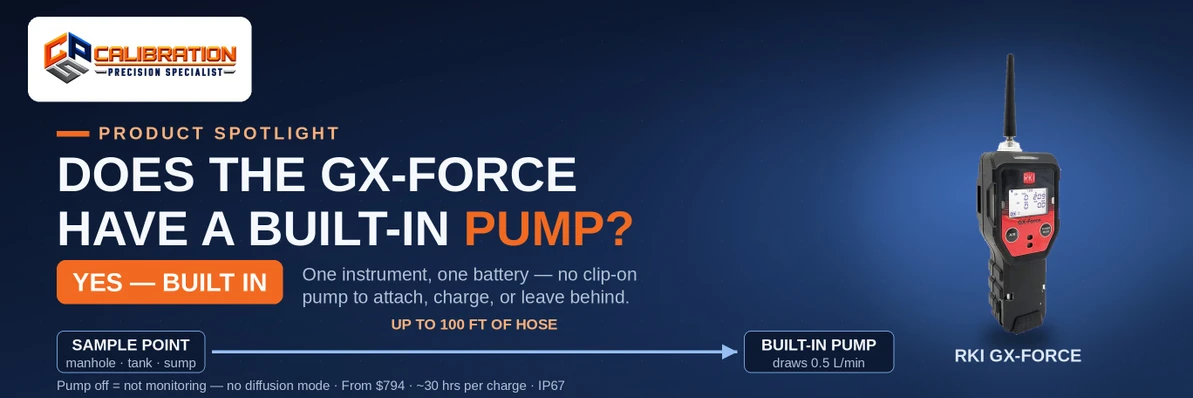
Does the RKI GX-Force Have a Built-In Pump?
Yes — the RKI GX-Force has a built-in internal sample pump that draws 0.5 L/min nominal (0.35 L/min minimum suction) through up to 100 ft of sample hose, so it can test a confined space before anyone enters it. It monitors the standard four gases — combustible gas (LEL), oxygen (O₂), carbon monoxide (CO), and hydrogen sulfide (H₂S) — for about 30 hours per charge in an IP67, intrinsically safe package weighing 9.87 oz, starts at $794, and carries a 3-year warranty that includes the sensors.
That built-in pump is not an accessory decision on this instrument — it is the instrument. RKI took the micro-sensor technology it shares with the GX-3R family and built the sample draw into the body, which makes the GX-Force the dedicated pre-entry and remote-sampling tool in RKI's portable line. Here's what it is, who it's for, why the built-in pump matters, and where its limits honestly sit.
What Is the RKI GX-Force, and Who Is It For?
The RKI GX-Force is a pumped (sample-draw) 4-gas monitor for combustible gas (LEL, 0–100% LEL), oxygen (0–40.0% vol.), carbon monoxide (0–2,000 ppm), and hydrogen sulfide (0–200.0 ppm), read simultaneously on a large auto-backlit LCD with audible (about 90 dB), visual, and vibration alarms. It runs in two modes: Normal Mode for confined-space and general safety monitoring, and Leak Check Mode, which follows combustible gas in the ppm range for investigating leaks at valves, piping, and fittings.
It's built for the person standing outside the space:
- Confined-space attendants and entrants who test top, middle, and bottom from outside before entry — the sequence our post on how to test a confined space before entry walks through step by step.
- Utilities, water and wastewater, and fire services crews working manholes, vaults, wet wells, and lift stations.
- Refinery, petrochemical, oil and gas, and construction teams who sample tanks, sumps, and process areas before a worker goes in.
- Leak investigation work, where Leak Check Mode turns the same instrument into a ppm-range combustible leak hunter.
The hardware is sized to be carried all day while it does that: 2.52 × 6.81 × 1.85 in., 9.87 oz, belt clip, two-button operation, an impact-resistant IP67 enclosure (dust-tight, sealed against immersion), intrinsically safe certifications (ATEX, IECEx, and QPS C/US), and an operating range of −4°F to +122°F (−20°C to +50°C) at up to 95% RH non-condensing. Browse the wider RKI lineup and the pumped monitors range for where it sits.
Why Does a Built-In Pump Beat Diffusion Plus a Clip-On Pump for Pre-Entry Work?
A diffusion monitor samples the air around the person wearing it — the right tool once a worker is inside, and the wrong tool for finding out whether the worker should go in at all. Pumped sampling moves the measurement to the end of a hose while the operator stays in clean air. Our pumped vs. diffusion post covers that decision in full; the GX-Force question is narrower: if you need a pump, should it be built in, or clipped onto a diffusion monitor like the RP-3R pump on a GX-3R?
Built-in wins the pre-entry job on logistics:
- One instrument, one battery, one charge. The GX-Force's pump runs off the same rechargeable lithium-ion battery as the monitor — about 30 hours in Normal Mode. A clip-on pump is a second device with its own charge state to verify at 6 a.m.
- Nothing to attach, align, or leave behind. The pump, its hydrophobic inlet filter, and its low-flow fault alarm are part of the unit. The monitor continuously self-checks sensor connections, low battery, circuit trouble, low flow, and calibration errors — a blocked or kinked line announces itself instead of quietly feeding the sensors stale air.
- It costs less than the two-piece route. A GX-3R ($640) plus an RP-3R clip-on pump ($369) totals $1,009. The GX-Force starts at $794 — and even fully configured with charger and a 20 ft hose and probe, the most expensive build on our listing is $975.
The honest counterpoint: if your fleet already runs GX-3Rs, the RP-3R route keeps one monitor family and lets each unit go back to diffusion duty when the pump comes off. The GX-Force is a dedicated pumped instrument — that dedication is exactly what a crew that tests spaces every day wants, and exactly what a crew that samples twice a year may not need. Both draw to the same 100 ft; our portable multi-gas monitors page carries the full range.
The Specs, Explained by What They Do to the Job
| Specification | GX-Force | What it means in the field |
|---|---|---|
| Pump flow | 0.5 L/min nominal, 0.35 L/min minimum suction | Sets both the 100 ft draw and how fast a remote sample arrives |
| Maximum sampling range | 100 ft | Deep vessels and long runs from one access point |
| Gases and ranges | LEL 0–100%, O₂ 0–40.0% vol., CO 0–2,000 ppm, H₂S 0–200.0 ppm | The standard confined-space quartet, with headroom on CO and O₂ |
| Response time | T90 within 30 s (CH₄/O₂/CO/H₂S); within 40 s (HC combustibles) | The sensor half of the wait for a remote reading |
| Battery | Rechargeable lithium-ion, USB-C; ~30 hrs Normal Mode, ~20 hrs Leak Check; ~8 hrs to charge | Two to three shifts per charge — but charge it the night before, not at breakfast |
| Build | IP67, intrinsically safe, 9.87 oz, 2.52 × 6.81 × 1.85 in. | Rain, washdowns, and hazardous locations are working conditions |
| Alarms and records | Audible (~90 dB), visual, vibration; STEL/TWA/peak; data logging to 3,600 items | Exposure math and the paper trail ride along automatically |
| Warranty | 3 years, materials and workmanship, sensors included | The consumable half of the instrument is covered as long as the instrument |
Two specs deserve a second look. The O₂ range runs to 40.0% vol., not the 25% ceiling on many 4-gas monitors — useful in oxygen-enriched or purged atmospheres where a standard cell over-ranges and tells you nothing. And the sensors are the same micro-sensor family used across the GX-3R, GX-3R Pro, 04 Series, and GasWatch 3, so a fleet already running those instruments shares sensor stock with the GX-Force — the replacement cells on our shelves are literally the same products.
The Honest Limits
- It is a pumped instrument, full stop. The pump can be switched off to save the battery between uses, but RKI's manual is blunt: the GX-Force is not a gas monitoring device while the pump is off. There is no diffusion mode hiding in it. Crews who want a wear-and-forget personal monitor should buy one — the diffusion GX-3R at 3.70 oz is that instrument (see diffusion monitors).
- Remote readings are delayed readings. The sample has to travel the hose before the sensors can respond: at 100 ft, budget about 1¼ to 2 minutes per sampling point before the number represents the far end. We deliberately don't re-teach that math here — our post on how far a pumped gas detector can draw a sample, and how long until it reads works the delay formula, the wait-time table, and the field rules in depth.
- Four gases, and only those four. There is no PID channel, no fifth toxic slot, no infrared CO₂ option. If the hazard assessment names a gas past LEL/O₂/CO/H₂S, the GX-Force is the wrong purchase — that job belongs to a configurable pumped instrument such as the SENKO SP-MGTP (from $850, up to six gases).
- 100 ft is a ceiling, not a starting point. Past the rated draw, flow sags toward the 0.35 L/min floor, delay stretches, and low-flow faults follow. Deeper spaces need a different sampling plan, not more hose.
- The pump path is upkeep. Filters clog, probes crack, and pumps wear. The running costs are small and known — they're itemized in the upkeep section below — but they are not zero, and a neglected inlet filter quietly taxes every reading the pump pulls.
GX-Force vs. the Alternatives, Side by Side
| Route | Price | Pump | Draw | Gases |
|---|---|---|---|---|
| RKI GX-Force | From $794 (configured $835–$975) | Built in | 100 ft | 4 (LEL/O₂/CO/H₂S) |
| RKI GX-3R ($640) + RP-3R pump ($369) | $1,009 combined | Clip-on | 100 ft of hose | 4 (same quartet) |
| SENKO SP-MGTP | From $850 | Built in, 250–300 cc/min | 98 ft (30 m) | 4 to 6, incl. PID/CO₂/specialty toxics |
Read the table by the question you're actually asking. Same four gases, pumped, one instrument, lowest total: GX-Force. A diffusion fleet that occasionally needs a pump: GX-3R + RP-3R. Pumped work where the hazard list runs past four gases: SP-MGTP — its extra channels, not its pump, are the reason to pay for it.
Choose the GX-Force When… / Look Elsewhere When…
Choose the GX-Force when:
- Pre-entry and remote testing is a routine part of the job — confined spaces, tanks, manholes, sumps — and the hazard list is the standard four gases.
- One dedicated pumped instrument should live with the entry kit, charged and ready, instead of being assembled from a monitor plus a clip-on pump each time.
- You want the pump path supervised: built-in low-flow fault alarms, user-adjustable bump and calibration reminders, and a 3-year warranty that includes the sensors.
Look elsewhere when:
- The job is personal monitoring on the worker with no remote draw — a diffusion monitor is smaller, cheaper, and always sampling the breathing zone.
- The assessment names a fifth or sixth gas, a PID/VOC channel, or % volume measurement — the GX-Force has no channel for any of them.
- Your sampling points sit beyond 100 ft, or the space needs continuous fixed detection rather than a portable test before entry.
Upkeep: Sensors, Filters, Pump, and the SDM-Force Dock
The GX-Force is built to be maintained, not replaced: sensors and filters are field-replaceable, and because its cells are shared with the GX-3R family, the spares are standard shelf items. Current prices on our store:
- Replacement sensors: LEL, O₂, CO, and H₂S cells at $160 each; the dual CO/H₂S combo sensor at $255. Replacement sensors carry their own 3-year warranty.
- Filters: wire mesh disk filters $16 for 10, Teflon filter disks $26 for 10, and the CO/H₂S scrubber disk filters $28 for 5 — the cheapest insurance in the whole sampling path.
- Pump and probe: a replacement pump is $147, and a probe with hydrophobic and dust filters is $37.
- Calibration rhythm: the instrument ships with a factory-set calibration interval of 90 days and a bump-test interval of 30 days, both user-adjustable, with reminders that can be set to alarm or lock out an overdue unit. Bump test before the day's use, calibrate on interval with a standard 4-gas mix from our calibration gas range — and when a bump fails, our post on why bump tests fail explains why the fault is so often delivery, not the sensor.
For crews running several GX-Forces, the SDM-Force calibration station (from $1,645) is the model's own docking station — single- or dual-solenoid configurations, with or without demand-flow regulators, up to complete kits with a 4-gas cylinder and holder at $2,430. And whether a unit lives on a dock or not, when it comes to us — shipped to our Rockwood lab or serviced on-site at your facility — we calibrate every channel and report as-found and as-left data.
The Bottom Line
Yes, the GX-Force has a built-in pump — 0.5 L/min of draw over up to 100 ft of hose, wrapped around the standard four gases, in the smallest pumped package RKI makes: 9.87 oz, IP67, intrinsically safe, about 30 hours per charge, a Leak Check mode for ppm-level leak hunting, and a 3-year warranty that includes the sensors, from $794. It is not a diffusion monitor, it has no fifth channel, and its remote readings arrive on pump time rather than instantly — but for the attendant testing a space before anyone goes in, those are the terms of the job, and this is the instrument built on exactly those terms.
Ready to spec one? Start with the RKI GX-Force configuration list — charger choice plus hose-and-probe lengths from 5 to 20 ft — and compare it against the rest of our portable gas detection range. Not sure whether built-in or clip-on fits your fleet? Call us at 865-900-8844 and describe the spaces you're testing; the draw distance and the gas list settle the question in about a minute.
Frequently Asked Questions
Does the RKI GX-Force have a built-in pump? Yes. The GX-Force has an internal sample pump built into the instrument — no clip-on or external pump is needed. It draws 0.5 L/min nominal (0.35 L/min minimum suction) through up to 100 ft of sample hose, with a hydrophobic inlet filter and a low-flow fault alarm that trips if the sampling path blocks.
How far can the RKI GX-Force draw a sample? Up to 100 ft — its maximum rated sampling range. The pump sustains 0.5 L/min nominal flow against that length of hose. Beyond 100 ft the flow sags, the reading delay stretches, and the low-flow protection starts treating the line as blocked, so 100 ft should be treated as a hard ceiling, not a guideline.
How long does it take for a GX-Force reading at the end of a hose to be valid? Budget about 1¼ to 2 minutes at the full 100 ft. The sample itself takes roughly 46 seconds to travel 100 ft of typical sample hose at the GX-Force's 0.5 L/min flow, and the sensors then need their response time — T90 within 30 seconds for CH₄, O₂, CO, and H₂S — before the display represents the air at the probe tip. Shorter hoses settle faster: about a minute at 50 ft and about 40 seconds at 10 ft.
How much does the RKI GX-Force cost? It starts at $794 at CPS Calibrations. Configurations with a charger and hose-and-probe package run $835 to $975: $835 with an AC or DC charger and no hose, $905–$920 with a 5–20 ft hose and probe on a single charger, and up to $975 with both AC and DC chargers and the 20 ft hose and probe.
What gases does the RKI GX-Force measure? Four gases simultaneously: combustible gas (LEL) from 0–100% LEL, oxygen (O₂) from 0–40.0% vol., carbon monoxide (CO) from 0–2,000 ppm, and hydrogen sulfide (H₂S) from 0–200.0 ppm. It has no PID channel and no fifth-gas option — VOC screening or a specialty toxic requires a different instrument, such as the SENKO SP-MGTP.
How long does the RKI GX-Force battery last? About 30 hours per charge in Normal Mode and about 20 hours in Leak Check Mode, at 25°C under non-alarm operation, from its rechargeable lithium-ion battery. Charging is by USB-C and takes approximately 8 hours, so the routine is an overnight charge rather than a top-up between jobs.
Can the RKI GX-Force be used as a personal monitor? It can be carried for personal monitoring with the pump running — personal monitoring is one of its listed applications, and it has a belt clip — but it is not a diffusion monitor. RKI's manual states the GX-Force is not a gas monitoring device while its pump is off (the pump-off setting exists to save the battery between uses), and at 9.87 oz it is nearly three times the weight of the 3.70 oz diffusion GX-3R. If nobody on the crew ever samples remotely, the GX-3R is the better personal instrument.
What's the difference between the RKI GX-Force and the GX-3R? The sampling method and the mission. The GX-3R ($640) is a 3.70 oz diffusion monitor that samples the air around the wearer and needs the $369 RP-3R clip-on pump — $1,009 combined — to sample remotely. The GX-Force (from $794) builds the pump in, draws to 100 ft on its own, and adds a Leak Check mode, at the cost of size (9.87 oz) and a longer charge time (~8 hours vs. ~3 hours). They share the same sensor family, ranges, T90 response class, and 3-year warranty.
How much do GX-Force replacement sensors and pump parts cost? Replacement sensors are $160 each for the LEL, O₂, CO, and H₂S cells and $255 for the dual CO/H₂S combo sensor, and they are field-replaceable and warranted for 3 years. The wear items in the pump path are inexpensive: filter disks run $16–$28 per multi-pack, a replacement probe with hydrophobic and dust filters is $37, and a replacement pump is $147.
How often does the RKI GX-Force need calibration, and what gas does it take? Bump test before use and fully calibrate on the instrument's calibration interval — factory-set at 90 days and user-adjustable from 1 to 1,000 days, with a factory-set 30-day bump-test interval and reminders that can lock out an overdue unit. It calibrates with a standard 4-gas mix containing all four channels (LEL, O₂, CO, H₂S); a gas that omits a channel cannot verify that channel. The SDM-Force docking station (from $1,645) automates bump tests and calibration for fleets.
CPS Calibrations · 109 S. Front Street, Rockwood, TN 37854 · Portable Gas Detection · Calibration Gas · Calibration Services · Contact Us
Recent Posts
-

What Is a Confined Space? OSHA's Definition, the 3 Tests, and When It Becomes Permit-Required
A confined space is a space that passes all three of OSHA's tests at the same time: it is large enou …Oct 21st 2026 -
PID vs. LEL for VOC Detection: Which Sensor Do You Actually Need?
Use a PID to detect VOCs and an LEL sensor to detect explosive atmospheres — they measure different …Oct 21st 2026 -

Semiconductor (MOS) Gas Sensors: Where They Work and Where They Lie
A semiconductor (MOS) gas sensor measures gas with a heated film of metal oxide — usually tin dioxid …Oct 21st 2026