
What Is the SENKO SI-H100? A Sample-Draw Fixed Gas Detector Explained
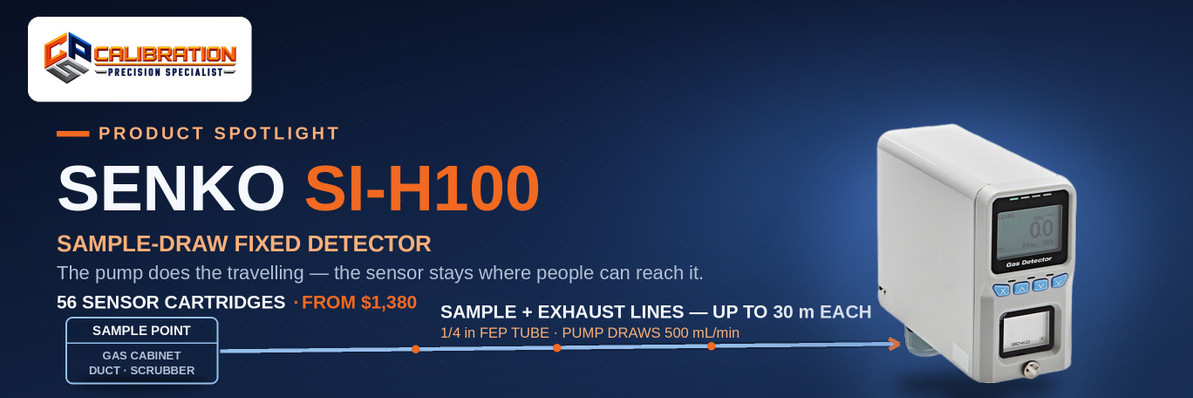
The SENKO SI-H100 is a fixed, wall-mounted sample-draw gas detector head — $1,380 to $1,840 at CPS depending on the sensor fitted — whose built-in pump pulls a gas sample at 500 mL/min through up to 30 m (about 100 ft) of tubing to a replaceable sensor cartridge inside the unit, so one gas can be monitored continuously at a point nobody can stand next to. The cartridge is chosen from 56 orderable options dominated by semiconductor specialty gases — arsine (0–400 ppb), phosphine (0–1.2 ppm), silane (0–15 ppm), NF₃, ClF₃, HF, hydrogen, and a 10.6 eV PID for VOCs — and the unit runs stand-alone on its own display, buzzer, and relays, or integrates by 4-20 mA, RS-485 Modbus, and Ethernet.
That is the short version. The longer one starts with the name, because the name misleads: despite "H100," this is not a hydrogen-only detector. Hydrogen is two cartridges on a menu of 56. What the SI-H100 actually is — and why a sample-draw head exists at all — is the subject of this spotlight.
What Is the SI-H100, and Who Is It For?
The SENKO SI-H100 is a fixed sampling-type detector head: a compact wall-mounted unit, 123 × 65 × 155 mm and about 2 kg, built from a case, a replaceable sensor cartridge, and a sampling assembly with an internal pump. SENKO's manual describes its job plainly — it measures sample gas drawn in remotely, in real time, to help prevent gas accidents including suffocation, intoxication, fire, explosion, and corrosion in semiconductor and industrial sites.
It monitors one gas at one point, continuously. The end of its tubing run sits at the point that matters; the unit itself mounts where people can read its graphic LCD (concentration, sample flow, alarm and fault status), hear its 90 dB buzzer, and reach its sensor cartridge. If your hazard list is the standard four gases in ordinary industrial space, a conventional fixed head is simpler. The SI-H100 earns its place when the gas is a specialty toxic at parts-per-billion levels, or the point is somewhere a diffusion sensor cannot be mounted and serviced — the same problem space as the RKI GD-70D sample-draw transmitter we spotlighted earlier, answered with a different sensor menu and a published line-length specification.
Why Sample-Draw? The Sensor Stays Where People Can Reach It
A diffusion fixed detector measures the air that reaches the head — so the head has to be mounted where the gas will be: inside the gas cabinet, up the duct, over the scrubber, inside the enclosure. Every one of those locations makes calibration and sensor replacement a shutdown, a lift, or a confined-space conversation, which is the tension our post on where fixed gas detectors should be placed works through.
Sample-draw splits the system in two. The sample point — the open end of a 1/4-inch FEP tube — goes where the gas is. The detector mounts at working height, where its display, alarms, and cartridge are reachable on an ordinary Tuesday. The pump does the travelling; people don't have to. The exhaust side is tubed too (also up to 30 m), so the drawn sample — which may itself be toxic — can be routed away rather than vented at the unit.
The trade is the one every pumped system makes: the sample travels before it is measured, so readings trail the point by the line's travel time, and the line becomes part of the instrument. Our post on how far a pumped gas detector can draw a sample — and how long until it reads covers that physics in full; the SI-H100's numbers are below.
What Gases Can the SI-H100 Detect?
One gas per unit — the cartridge you choose when you order. The menu is the story: 56 orderable cartridges across four sensing principles (electrochemical, infrared, catalytic, and PID), and most of it is gases that standard fixed catalogs don't carry at all.
| Family | Representative cartridges (range) | Why it matters |
|---|---|---|
| Semiconductor hydrides | Arsine AsH₃ 0–400 ppb · Diborane B₂H₆ 0–400 ppb · Phosphine PH₃ 0–1.2 ppm · Silane SiH₄ 0–15 ppm · Germane GeH₄ 0–800 ppb | Toxic at parts-per-billion levels — arsine's factory alarm defaults are 25 and 50 ppb. This is dedicated, single-purpose detection. |
| Etch and acid gases | NF₃ 0–40 ppm · ClF₃ 0–1 ppm · HF 0–6 ppm · HCl 0–6 ppm · WF₆ 0–6 ppm · BF₃ 0–8 ppm · BCl₃ 0–10 ppm · F₂ 0–3 ppm · Cl₂ 0–3 ppm · HBr 0–6 ppm | The corrosive half of a fab's gas list, monitored at the cabinet or tool rather than just in the room. |
| Process precursors | TMA 0–20 ppm · TEOS 0–30 ppm · HMDS 0–400 ppm · plus a long tail of precursor-specific cartridges | Gases most detector catalogs have never heard of. If your process uses it, there is likely a cartridge. |
| Hydrogen and combustibles | H₂ 0–1,000 ppm (electrochemical) · H₂ 0–100% LEL (catalytic) · CH₄ 0–100% LEL (catalytic or IR) · other fuels to 100% LEL | Hydrogen gets both a ppm leak range and an LEL range — the two questions hydrogen monitoring actually asks. |
| Common gases and VOCs | CO 0–100 ppm · H₂S 0–100 ppm · NH₃ 0–100 ppm · O₂ 0–30% vol. · CO₂ 0–5,000 ppm (IR) · VOCs 0–2,000 ppm (10.6 eV PID) | The familiar list is here too — the SI-H100 is a platform, not only a fab instrument. |
An optional pyrolyzer module pairs with the unit for gases that must be thermally decomposed before they can be sensed — SENKO rates the combined draw at 12 W against the base unit's roughly 5 W. If your gas is on the menu but you are unsure which cartridge or whether the pyrolyzer applies, that is a spec'ing conversation, not a guess: call us and we will confirm the configuration with SENKO before you order.
How Far Can It Draw — and How Long Until It Reads?
SENKO publishes the numbers many sample-draw makers leave vague: the sample line can run up to 30 m (about 100 ft) from the point to the unit, and the exhaust line up to 30 m beyond it, both in 1/4-inch FEP tubing. The pump draws 500 mL/min nominal (up to 900), and the unit continuously displays its sample flow — a falling or failed flow shows as a fault condition, not as a silently wrong reading.
Distance still costs time. The sample has to physically travel the tubing before the cartridge sees it, so every reading trails the sample point by the line's travel time, and the delay grows with every metre of line. Reactive, "sticky" gases also interact with long tubing runs. Treat 30 m as a ceiling, not a target: mount the unit as close to the point as the layout allows, keep the run clean and unkinked, and reserve the full 30 m for points that genuinely cannot be reached any other way. For the underlying math of draw distance versus delay, see our pumped sampling distance and delay post.
Outputs and Integration: Stand-Alone or System Component?
Both, as delivered. Stand-alone, the SI-H100 is a complete detector: graphic LCD (160 × 100) showing concentration, flow, alarm, and fault status; a 90 dB buzzer; and dry-contact relay outputs for first-stage alarm, second-stage alarm, and device fault. Settings are made from the four front buttons, or remotely over RS-485 or Ethernet.
For integration, the standard signal set is 4-20 mA plus RS-485 Modbus (the manual publishes the full Modbus address map) and TCP Ethernet. Power is unusually flexible for a fixed head: 24 V DC ±10%, or Power over Ethernet (36–57 V, typically 48 V) — on a PoE build, one cable carries both power and data. Total consumption is about 5 W. The whole fixed range it belongs to is in our fixed systems category.
SENKO SI-H100 vs. RKI GD-70D: Which Sample-Draw Detector Fits?
These are the two sample-draw transmitters in our catalog aimed at specialty gases, and they sit in the same price class — so the honest comparison is about configuration, not quality.
| SENKO SI-H100 | RKI GD-70D | |
|---|---|---|
| Price | $1,380–$1,840 by sensor cartridge ($1,518 headline) | $1,595 |
| Draw specification | 500 mL/min (max 900); sample line up to 30 m published | 0.5 L/min, self-adjusting; no published maximum — RKI directs installers to keep the line as short as possible |
| Sensor system | Replaceable cartridge; 56 configurations, four sensing principles, optional pyrolyzer | Plug-in smart sensor units in four families; replacements listed at $415–$945; sensors carry their own calibration data for off-unit calibration and hot swaps |
| Outputs and power | 4-20 mA, relays, RS-485 Modbus, TCP Ethernet; 24 V DC or PoE | 4-20 mA and relays standard (PoE/LonWorks on the GD-70D-EA version); 24 V DC |
| Calibration rhythm | Built-in zero/span menu and bump-test function at the unit; SENKO publishes no fixed interval | RKI recommends calibration every six months |
Choose the SI-H100 when you want a published 30 m line specification, native Modbus/Ethernet with a PoE power option, or a fab-specific gas that lives on its wider cartridge menu. Choose the GD-70D when off-unit sensor calibration and hot swaps fit your service model, or your plant already standardizes on RKI. The full GD-70D walk-through is our post on what the RKI GD-70D is. Either way, the arithmetic is identical: one gas, one point, per unit.
Installation and Upkeep: Power, Tubing, and Calibrating in Place
Installation is a wall mount, a power run, and two tube runs. The unit takes 24 V DC ±10% (14 AWG wiring) or PoE, draws about 5 W, and works in a 0–40 °C environment — a fab, plant room, or equipment enclosure specification. Sample and exhaust lines are 1/4-inch FEP (Teflon) tube, each up to 30 m. Because the exhaust carries the sampled gas away from the unit, where that exhaust terminates is part of the design, not an afterthought.
Calibration happens in place, at the unit, with bottled gas — nobody removes the head or breaks the sample line. The front-button menu provides:
- Zero and span calibration, with the span-gas concentration settable to match the cylinder in hand.
- Flow calibration, which sets the pump to its 500 cc/min working flow.
- A bump-test function that applies test gas to check reading accuracy and alarm/fault operation.
- 4 mA / 20 mA output calibration, so the analog loop reads true at the PLC.
Which cylinder to reach for depends on the cartridge: a catalytic %LEL cartridge needs oxygen in its span gas, an electrochemical toxic cartridge calibrates in either balance — our guide to air balance vs. nitrogen balance settles that by sensor type, and the full gas range is in our calibration gas category. The sensor cartridge is the consumable: it is replaceable, CPS's listing carries a two-year warranty on the unit and one year on the sensor, and cartridges are priced with the instrument configuration rather than listed separately — confirm replacement pricing for your gas when you spec the unit, because ppb-level specialty cartridges are the premium end of any detector's running costs.
The Honest Limits
- One unit, one gas, one point. Each SI-H100 holds a single cartridge and draws from a single sample point. Three gases at one cabinet is three units. There is no multi-gas version.
- 30 m is a ceiling with a delay attached. Readings trail the point by line travel time, and the tubing run — moisture, kinks, adsorption — is a permanent maintenance item. Sample-draw buys access, not instant response.
- The environment window is indoor-instrument. 0–40 °C, and you will not find an IP rating in SENKO's published specifications for this unit — treat it as a fab and plant-room instrument, not a washdown or outdoor one.
- The sensor is a consumable with a real price. A specialty point is a standing commitment to specialty cartridges. Budget for replacement at spec time, not at failure time.
- It does not replace personal monitoring. A fixed point watches a location. People moving through the area still need their own instruments for the air they actually breathe.
SENKO SI-H100 Specifications
| Sampling | Built-in pump, 500 mL/min (max 900 mL/min) |
|---|---|
| Sample line | Up to 30 m inlet and 30 m exhaust, 1/4-inch FEP (Teflon) tube |
| Sensor | Replaceable cartridge — electrochemical, IR, catalytic, or PID; one gas per unit; 56 configurations |
| Display | Graphic LCD 160 × 100 — concentration, flow, alarm, fault |
| Alarms | 90 dB buzzer; dry-contact relays for 1st alarm, 2nd alarm, and fault |
| Outputs | 4-20 mA · RS-485 Modbus · TCP Ethernet |
| Power | 24 V DC ±10% or PoE 36–57 V; approx. 5 W (12 W with optional pyrolyzer) |
| Size and weight | 123 × 65 × 155 mm · 2 kg |
| Operating temperature | 0–40 °C |
| Certification | CE, RoHS2 |
| Warranty | 2 years (unit) · 1 year (sensor), per CPS listing |
| Price | $1,380–$1,840 depending on sensor cartridge ($1,518 headline) |
The Bottom Line
The SENKO SI-H100 ($1,380–$1,840 by sensor) is a sample-draw detector head for the gases and the points that defeat ordinary fixed detectors: a 500 mL/min pump pulls the sample up to 30 m from a cabinet, duct, or enclosure to a wall-mounted unit at working height; the sensor is a replaceable cartridge chosen from 56 options that run from arsine at parts per billion to a 10.6 eV PID; and the unit stands alone on its own display, buzzer, and relays or integrates by 4-20 mA, Modbus, or Ethernet, powered by 24 V DC or PoE. Its limits are equally clear: one gas and one point per unit, a sample line that is part of the measurement, and specialty cartridges as a standing running cost.
Spec'ing a specialty-gas point? Start with the SENKO SI-H100 listing, tell us the gas, the range, and where the sample point sits, and we will confirm the sensor configuration before you order — call 865-900-8844 or reach us through Contact Us.
Frequently Asked Questions
How much does the SENKO SI-H100 cost? At CPS Calibrations the SI-H100 runs $1,380 to $1,840 depending on the sensor cartridge fitted — most configurations are $1,380, the listing's headline price is $1,518, and the 10.6 eV PID VOC version tops the range at $1,840. The price follows the sensor: common electrochemical and catalytic cartridges sit at the low end, specialty and PID cartridges at the high end. The ongoing cost is the replacement sensor cartridge when the fitted one reaches end of life.
What gases does the SENKO SI-H100 detect? One gas per unit, chosen from 56 orderable sensor cartridges: semiconductor hydrides (arsine 0–400 ppb, diborane 0–400 ppb, phosphine 0–1.2 ppm, silane 0–15 ppm, germane 0–800 ppb), etch and acid gases (NF₃ 0–40 ppm, ClF₃ 0–1 ppm, HF and HCl 0–6 ppm, WF₆ 0–6 ppm, BF₃, BCl₃, F₂, Cl₂), process precursors such as TMA, TEOS, and HMDS, hydrogen (0–1,000 ppm or 0–100% LEL), methane and other combustibles to 100% LEL, CO₂ by infrared (0–5,000 ppm), VOCs by PID (0–2,000 ppm), and common gases including CO, H₂S, NH₃, and O₂. You pick the cartridge when you order.
Is the SI-H100 a hydrogen detector? It can be — hydrogen is two of its cartridges, at 0–1,000 ppm (electrochemical) and 0–100% LEL (catalytic) — but despite the model name it is not a hydrogen-only instrument. The SI-H100 is a sample-draw platform whose 56-cartridge menu is dominated by semiconductor specialty gases; hydrogen is one choice among many, in both a ppm leak range and an LEL range.
How far can the SI-H100 draw a sample? Up to 30 m — about 100 ft — from the sample point to the unit on 1/4-inch FEP tubing, and the exhaust line can run up to 30 m as well; both figures are SENKO's published specifications. The built-in pump draws 500 mL/min nominal (900 maximum). Treat 30 m as a ceiling rather than a target: shorter lines respond faster and are kinder to reactive gases.
How long does an SI-H100 take to respond through a long sample line? Longer than the sensor alone would suggest. The sample must travel the tubing at 500 mL/min before it reaches the cartridge, so every reading trails the sample point by the line's travel time, and that delay grows with line length. SENKO publishes the 30 m maximum but no per-length response table; as a rule, keep the unit as close to the point as the layout allows for alarm duty, and accept the delay only where the monitoring is trend-style or the point is otherwise unreachable.
Does the SI-H100 need a controller or PLC? No. The SI-H100 is a complete stand-alone detector with a graphic LCD showing concentration and sample flow, a 90 dB buzzer, and relay contacts for first-stage alarm, second-stage alarm, and fault. If you do integrate it, it outputs 4-20 mA and communicates by RS-485 Modbus and TCP Ethernet, and it can be powered by 24 V DC or by Power over Ethernet.
How do you calibrate an SI-H100? In place, at the unit, with bottled calibration gas — the head and sample line are not removed. The front-button CAL menu runs zero and span calibration with the span-gas concentration set to match your cylinder, a flow-calibration step that holds the pump at 500 cc/min, and a bump-test function that applies test gas to check reading accuracy and alarm operation. Which balance gas the span cylinder needs depends on the cartridge fitted; catalytic %LEL cartridges need oxygen in the gas, electrochemical toxics calibrate in either balance.
What does it cost to keep an SI-H100 running? The consumable is the sensor cartridge: it is replaceable, and CPS's listing carries a one-year warranty on the sensor (two years on the unit). Cartridges are not listed as separate store items, so confirm replacement pricing for your specific gas when you spec the unit — ppb-level specialty cartridges are the premium end. Beyond the sensor, upkeep is calibration gas for zero/span checks, the FEP tubing run, and about 5 W of 24 V power; there is no battery to maintain.
SENKO SI-H100 vs. RKI GD-70D — which sample-draw detector should I buy? They do the same job in the same price class (GD-70D $1,595; SI-H100 $1,380–$1,840 by cartridge). Choose the SI-H100 for its published 30 m sample-line specification, native Modbus and Ethernet with a PoE power option, or a fab-specific gas on its wider cartridge menu. Choose the GD-70D if you want plug-in sensors that carry their own calibration data for off-unit calibration and hot swaps, and RKI's published six-month calibration rhythm. Either way, each unit monitors one gas at one point.
Can one SI-H100 monitor several gases or sample points? No. Each SI-H100 holds one sensor cartridge and draws from one sample point, so it monitors one gas at one location continuously. Watching three gases at one cabinet means three units — they can share the same output architecture (4-20 mA, Modbus, Ethernet), but sample-draw does not multiplex. Multi-gas or multi-point coverage is always multiple detectors.
CPS Calibrations · 109 S. Front Street, Rockwood, TN 37854 · Fixed Systems · Calibration Gas · Calibration Services · Contact Us
Recent Posts
-
Flame Detector vs. Gas Detector: What's the Difference — and Do You Need Both?
A gas detector and a flame detector guard opposite ends of the same incident: a gas detector reads l …Oct 21st 2026 -

How Do You Test a Flame Detector? Self-Tests, Test Lamps, and NFPA 72
You test a flame detector with light, not gas — there is no span gas, no zero gas, and never an open …Oct 21st 2026 -

Why Does a Flame Detector False Alarm — and Which Type Won't?
A flame detector false alarms because something that is not a fire is producing the signal it watche …Oct 21st 2026