
RKI 04 Series: Which Single-Gas Monitor Do You Need?
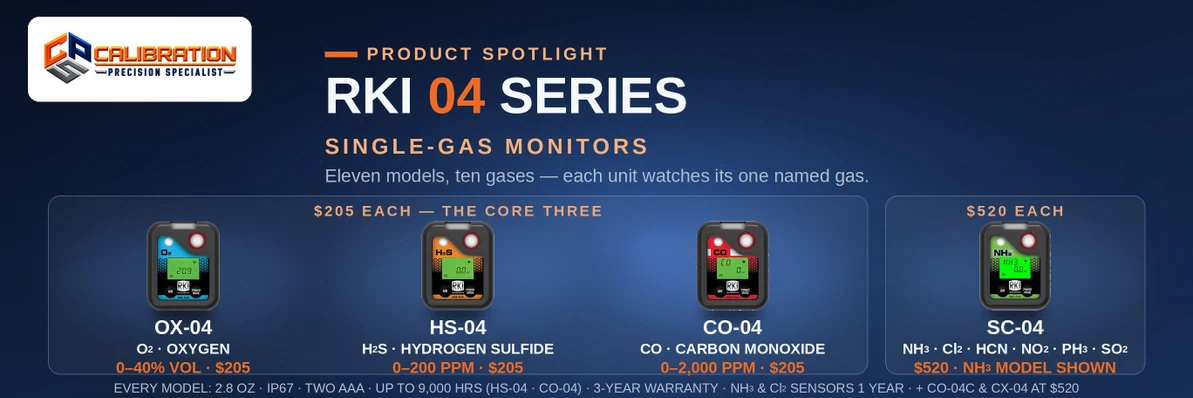
The RKI 04 Series is a family of pocket-size personal gas monitors built on one shared platform — 2.1 × 2.64 × 0.94 in., 2.8 oz, IP67, powered by two AAA alkaline batteries — with a model matched to each gas: the OX-04 for oxygen (O₂), the HS-04 for hydrogen sulfide (H₂S), and the CO-04 for carbon monoxide (CO) at $205 each, plus the hydrogen-compensated CO-04C, the dual-gas CX-04 (CO + O₂), and six SC-04 specialty-toxic models (NH₃, Cl₂, HCN, NO₂, PH₃, SO₂) at $520 each. Every model is serviceable rather than disposable — sensors and filters are field-replaceable, RKI rates sensor life expectancy at over 3 years under a 3-year warranty (1 year for ammonia and chlorine sensors), and the HS-04 and CO-04 run up to 9,000 hours of continuous operation on one set of batteries.
That is the whole idea of the series in one paragraph: one instrument your crew already knows how to wear, bump, and calibrate, issued in whichever gas version the hazard assessment names. This post walks the lineup model by model — what each one detects, why it exists, what the two price tiers actually buy — and closes with the honest limit of the format: a single-gas monitor sees its one gas and nothing else.
What Is the RKI 04 Series, and Who Is It For?
The RKI 04 Series is RKI's personal single-gas line: diffusion monitors that clip to a worker and continuously watch one named gas (two, in the CX-04's case). Every model shares the same operating picture:
- Pocket format. 2.1 in. W × 2.64 in. H × 0.94 in. D, 2.8 oz, with a replaceable rubber boot and a 360° rotating alligator clip — small enough that "forgot it in the truck" is a discipline problem, not a comfort problem.
- Diffusion sampling with a T90 response of 30 seconds. The monitor samples the air around the wearer and reaches 90% of the final reading within half a minute of the gas arriving.
- Three user-adjustable alarm set points, plus OVER, STEL, and TWA alarms, announced by flashing LEDs, an intermittent buzzer, and vibration — and trouble alarms for sensor connection, low battery, circuit failure, and calibration range error.
- Built-in datalogging. The instrument records alarms, alarm trends, gas readings, and its calibration and bump-test history — the paper trail a safety program needs, kept by the unit itself.
- IP67 enclosure and intrinsically safe approvals — ATEX/IECEx, and QPS classified C/US for Class I, Division 1, Groups A, B, C, and D — with an operating range of −4°F to +122°F (−20°C to +50°C).
It is built for plants whose hazard assessments name gases one worker at a time: the wastewater operator whose exposure is H₂S, the refrigeration mechanic whose exposure is ammonia, the boiler crew whose exposure is CO. Instead of a different brand and a different routine for each, one platform covers the roster — same clip, same two-button operation, same bump and calibration routine, same docking station — and only the sensor and the faceplate color change. Browse the wider single-gas monitors range for how the 04 Series sits alongside the other personal monitors we carry, or the full RKI lineup for the multi-gas side of the family.
The Lineup, Model by Model
| Model | Gas detected | Detection range | Continuous operation (2 AAA alkaline) | Price |
|---|---|---|---|---|
| OX-04 | Oxygen (O₂) | 0–40% Vol. | Up to 3,000 hours | $205 |
| HS-04 | Hydrogen sulfide (H₂S) | 0–200 ppm | Up to 9,000 hours | $205 |
| CO-04 | Carbon monoxide (CO) | 0–2,000 ppm | Up to 9,000 hours | $205 |
| CO-04C | Carbon monoxide, H₂-compensated | 0–2,000 ppm | Up to 6,200 hours | $520 |
| CX-04 | Carbon monoxide + oxygen | CO 0–2,000 ppm · O₂ 0–25% Vol. | Up to 4,600 hours | $520 |
| SC-04 (NH₃) | Ammonia | 0–400 ppm | 2 AAA alkaline | $520 |
| SC-04 (Cl₂) | Chlorine | 0–20 ppm | 2 AAA alkaline | $520 |
| SC-04 (HCN) | Hydrogen cyanide | 0–30 ppm | 2 AAA alkaline | $520 |
| SC-04 (NO₂) | Nitrogen dioxide | 0–20 ppm | 2 AAA alkaline | $520 |
| SC-04 (PH₃) | Phosphine | 0–20 ppm | 2 AAA alkaline | $520 |
| SC-04 (SO₂) | Sulfur dioxide | 0–100 ppm | 2 AAA alkaline | $520 |
OX-04 — oxygen ($205, part # 72-0018). Oxygen is the one gas on the list that alarms in both directions: the factory set points are 19.5% Vol. and 18.0% Vol. on the way down (deficiency) and 23.5% Vol. on the way up (enrichment, where fire risk climbs). The OX-04 reads 0–40% Vol. in 0.1% increments, and it is the shortest-lived model on batteries — up to 3,000 hours — which is still roughly 125 days of continuous running. It is the dedicated O₂ unit for confined-space-adjacent work, inerting and purging jobs, and anywhere a program wants an oxygen reading on a worker who is not carrying a full multi-gas instrument.
HS-04 — hydrogen sulfide ($205, part # 73-0063). The wastewater and oil-and-gas model: 0–200 ppm in fine 0.1 ppm increments, with factory alarms at 5, 30, and 100 ppm and a TWA of 1.0 ppm — a scale built for a gas whose exposure limits sit at the very bottom of its range. We covered why this gas earns a dedicated monitor in our post on why hydrogen sulfide is so dangerous in wastewater: it pools in wet wells and lift stations and disables the sense of smell at its 100 ppm IDLH level. Up to 9,000 hours of continuous operation means an HS-04 issued today is not a battery-management task this year.
CO-04 — carbon monoxide ($205, part # 73-0065). The general-purpose toxic: 0–2,000 ppm in 1 ppm increments, factory alarms at 25, 50, and 1,200 ppm, TWA 25 ppm and STEL 200 ppm, up to 9,000 hours per battery set. Furnaces, boilers, engine exhaust, warehouses with propane forklifts, parking structures — wherever combustion happens near people, this is the $205 answer, and the starting point the rest of the CO family builds on.
CO-04C — CO with hydrogen compensation ($520, part # 73-0067). Same 0–2,000 ppm CO range, different sensor — and the difference is the reason it exists. A standard electrochemical CO sensor also responds to hydrogen, so in an atmosphere that contains H₂, a plain CO-04 reads some of that hydrogen as if it were carbon monoxide: the number on the screen overstates the CO that is actually there. The CO-04C's hydrogen-compensated sensor is designed to reduce that H₂ interference, so the CO reading stays a CO reading around battery-charging rooms, hydrogen-using processes, and refining and steel applications where hydrogen is part of the atmosphere. Battery life is up to 6,200 hours — the compensation costs some run time, which is the honest trade you are paying $520 for.
CX-04 — CO + O₂ dual gas ($520, part # 73-0069). The one two-gas unit in the series, built for the pair of hazards that travel together: carbon monoxide from combustion, and the oxygen displacement or enrichment that can come with the same work. One dual sensor reads CO 0–2,000 ppm and O₂ 0–25% Vol., so a worker who would otherwise clip on two single-gas units carries one. Continuous operation is up to 4,600 hours. The CX-04 is also the series' built-in reminder of its own boundary — the moment your hazard list reaches three or four gases, the right answer stops being a single-gas platform at all (see the honest limits below).
SC-04 — the specialty toxic family ($520 each). Six dedicated models for the gases a standard lineup never carries, each in the same housing with the same routine:
- Ammonia (NH₃), 0–400 ppm (part # 73-0077) — the refrigeration and food-and-beverage-processing model, for the mechanic whose named hazard is the refrigerant itself.
- Chlorine (Cl₂), 0–20 ppm (part # 73-0075) — water and wastewater treatment, chemical processing, anywhere chlorine is stored, fed, or changed out in cylinders.
- Hydrogen cyanide (HCN), 0–30 ppm (part # 73-0071) — a low range matched to a gas with low exposure limits, for the processes and response work that name HCN specifically.
- Nitrogen dioxide (NO₂), 0–20 ppm (part # 73-0073) — diesel exhaust areas, welding and combustion byproducts, ice rinks and indoor equipment fleets.
- Phosphine (PH₃), 0–20 ppm (part # 73-0079) — fumigation work, where PH₃ is applied deliberately and the monitor proves the space has cleared.
- Sulfur dioxide (SO₂), 0–100 ppm (part # 73-0081) — the widest range in the SC-04 family, for pulp, chemical, and combustion-process areas.
One warranty note that applies to two of them: the ammonia and chlorine SC-04 sensors carry a 1-year warranty where every other sensor in the series carries 3 years — worth knowing before you standardize a chlorine fleet on them, and it is printed on the listings rather than buried.
Why Two Price Tiers? $205 vs. $520
The pricing is not trim levels; each $520 model buys one specific thing the $205 models do not have:
- The $205 tier (OX-04, HS-04, CO-04) is the three core personal gases, each with a standard sensor. High-volume, straightforward, and — at 3,000 to 9,000 hours per battery set — cheap to keep.
- The CO-04C ($520) buys the hydrogen-compensated CO sensor: you are paying for a reading you can trust in a hydrogen-bearing atmosphere.
- The CX-04 ($520) buys a second gas channel: CO and O₂ in one unit instead of two.
- The SC-04 family ($520 each) buys a specialty toxic sensor — gases with smaller production runs and, in the NH₃ and Cl₂ cases, a shorter 1-year sensor warranty.
If your hazard is plain CO with no hydrogen in the picture, the CO-04 at $205 is not the "cheap" choice — it is the correct one, and the extra $315 buys you a feature with nothing to do. The tiers reward reading your own hazard assessment, not a trim chart.
The Honest Limits of a Single-Gas Monitor
- One unit, one gas. An HS-04 says nothing about oxygen, and a CO-04 says nothing about H₂S. The CX-04 is the only exception, at two gases. If a worker's space can plausibly hold two or more hazards at once — and most confined spaces can — that worker belongs on a multi-gas instrument. Our portable multi-gas monitors range is the step up, and our post on single-gas vs. multi-gas detectors works through the choice in full.
- There is no LEL channel in the series. No 04 Series model detects combustible gas. A fleet built only on 04 Series units has no flammability coverage at all.
- Diffusion only. These monitors sample the air that reaches the wearer. They cannot test a space before entry from outside — that takes a pumped instrument, which is a different product class entirely.
- The sensor is a consumable. Life expectancy is over 3 years, not forever, and a unit that starts failing calibration is telling you the cell is done — RKI builds a calibration range error trouble alarm in for exactly that moment. Budget the replacement sensor, not a replacement instrument.
Upkeep: Replaceable Sensors, and the SDM-04 Dock
The 04 Series is designed to be kept, not thrown away. Sensors and filters are field-replaceable, and RKI's replacement sensors are interchangeable with the GX-3R, GX-3R Pro, and GasWatch 3 — a plant already running those RKI instruments is stocking one sensor family, not two. On our store, the CO replacement sensor and H₂S replacement sensor listed for the 04 Series models are $160 each, and the H₂-compensated CO sensor is $255 — real numbers to plan a fleet budget around, against a $205 or $520 instrument you do not replace.
For the bump-and-calibrate routine itself, the series has its own docking station: the SDM-04 calibration station, starting at $1,675. Drop the monitor in, and the station runs the bump test or the calibration against its connected cylinder, shows pass/fail, and copies the records to a USB flash drive. Our listing carries 15 configurations — 1- or 2-solenoid stations, with or without demand-flow regulators and gas cylinders, plus dedicated SC versions for the SC-04's super-toxic gases — running to $2,330 at the top end. A fleet of 04 Series units with an SDM-04 on the charger bench is a program: every unit bumped the same way, every result recorded the same way.
However the fleet is maintained, the gas has to match the sensor: a CO unit calibrates with CO span gas, an SC-04 with its own toxic. Our calibration gas range carries the mixes and single-gas cylinders these models need, and our post on why bump tests fail shows how often a "failed sensor" is actually a gas-delivery problem. When an 04 Series unit comes to CPS — shipped to our Rockwood lab or serviced on site — we calibrate every channel the unit carries.
Choose an 04 Series Monitor When…
- Your hazard assessment names one gas per worker — H₂S in the collection system, CO at the boiler, NH₃ at the refrigeration plant — and you want that worker monitored continuously, in the breathing zone, all shift.
- You are equipping a fleet and want one platform to train, bump, calibrate, and stock sensors for, with per-gas models instead of per-gas brands.
- The atmosphere contains hydrogen and CO readings have to stay honest — that is the CO-04C's whole reason to exist.
- Two hazards travel together — CO and O₂ — and one dual unit beats two clips: the CX-04.
- A named specialty toxic (NH₃, Cl₂, HCN, NO₂, PH₃, SO₂) needs a dedicated personal monitor that a standard 4-gas has no channel for: the SC-04 family.
And choose something else when the space can hold three or four hazards at once, when combustible gas is on the list, or when the space must be tested before anyone enters — those jobs belong to portable multi-gas monitors, including pumped models.
The Bottom Line
The RKI 04 Series is one pocket platform — 2.8 oz, IP67, two AAA batteries, field-replaceable sensors with a life expectancy over 3 years — issued per gas: OX-04, HS-04, and CO-04 at $205 for the core hazards; CO-04C, CX-04, and the six SC-04 specialty toxics at $520 where the application buys hydrogen compensation, a second channel, or a specialty sensor. It does one job per unit and says so, it is built to be serviced for years rather than replaced, and the SDM-04 dock turns a drawer of them into a documented program.
Ready to spec a fleet? Start with the single-gas monitors range, match each model to the gas on your hazard assessment, and keep the calibration gas matched to every sensor you issue. Not sure whether a job belongs on a single-gas unit or a multi-gas? Call us at 865-900-8844 and describe the space — that one conversation is the difference between a $205 monitor that covers the hazard and one that covers only part of it. Browse the full portable gas detection lineup for the wider picture.
Frequently Asked Questions
What gases does the RKI 04 Series detect? Eleven models cover ten gases. The core models detect oxygen (OX-04, 0–40% Vol.), hydrogen sulfide (HS-04, 0–200 ppm), and carbon monoxide (CO-04, 0–2,000 ppm). The CO-04C detects carbon monoxide (0–2,000 ppm) with hydrogen compensation, and the CX-04 detects carbon monoxide (0–2,000 ppm) and oxygen (0–25% Vol.) together. The SC-04 family detects ammonia (0–400 ppm), chlorine (0–20 ppm), hydrogen cyanide (0–30 ppm), nitrogen dioxide (0–20 ppm), phosphine (0–20 ppm), or sulfur dioxide (0–100 ppm). No 04 Series model detects combustible gas (LEL).
How much does an RKI 04 Series monitor cost? The OX-04, HS-04, and CO-04 cost $205 each. The CO-04C (hydrogen-compensated CO), the CX-04 (CO + O₂ dual gas), and each of the six SC-04 specialty-toxic models cost $520. The SDM-04 calibration station for the series starts at $1,675, with 15 configurations listed up to $2,330.
How long does the battery last in an RKI 04 Series monitor? Every model runs on two AAA alkaline batteries, and continuous operation varies by sensor: up to 9,000 hours for the HS-04 and CO-04 (over a year of continuous running), up to 6,200 hours for the CO-04C, up to 4,600 hours for the CX-04, and up to 3,000 hours for the OX-04. There is no charging routine — when the batteries run down, you swap in two fresh AAAs.
Are RKI 04 Series monitors disposable or serviceable? Serviceable. RKI designed the 04 Series to operate for many years with field-replaceable sensors and filters — when a sensor reaches end of life, you replace the sensor, not the instrument. The housing, rubber boot, and alligator clip are likewise replaceable, and the series has its own docking station (the SDM-04) for fleets that keep units in service long-term.
How long do RKI 04 Series sensors last, and what does a replacement cost? RKI rates sensor life expectancy at over 3 years, backed by a 3-year warranty — except the ammonia and chlorine SC-04 sensors, which carry a 1-year warranty. On the CPS store, the replacement CO sensor and replacement H₂S sensor listed for the 04 Series models cost $160 each, and the hydrogen-compensated CO replacement sensor costs $255. A sensor that repeatedly fails calibration is at end of life; the instrument flags that condition with a calibration range error trouble alarm.
What does the CO-04C's hydrogen compensation do? It keeps hydrogen from inflating the carbon monoxide reading. A standard CO sensor also responds to hydrogen, so in a hydrogen-bearing atmosphere — battery-charging rooms, hydrogen process areas, some refining and steel work — a plain CO monitor reads part of the hydrogen as if it were CO. The CO-04C's compensated sensor is designed to reduce that hydrogen interference, so the displayed number reflects the carbon monoxide actually present. The CO-04C reads CO 0–2,000 ppm and runs up to 6,200 hours, and it costs $520 versus $205 for the standard CO-04.
What is the difference between the RKI CO-04 and the CX-04? The CO-04 ($205) monitors carbon monoxide only, 0–2,000 ppm, for up to 9,000 hours per battery set. The CX-04 ($520) monitors two gases through one dual sensor — carbon monoxide 0–2,000 ppm plus oxygen 0–25% Vol. — for up to 4,600 hours. Choose the CX-04 when oxygen deficiency or enrichment is a plausible companion hazard to the CO; choose the CO-04 when carbon monoxide is the only named hazard.
How often does an RKI 04 Series monitor need calibration? Bump test before each day's use, and fully calibrate at the interval set by your site's gas detection program and the RKI operator's manual — and immediately after a failed bump test or a calibration range error alarm. Each unit datalogs its bump-test and calibration history, and the SDM-04 docking station automates both the bump test and the calibration and stores the results. Calibration gas must match the sensor: a specialty SC-04 model needs span gas containing its own toxic gas.
What warranty does the RKI 04 Series carry? Three years on material and workmanship, including the sensors — with one exception: the ammonia and chlorine sensors carry a 1-year warranty. The instruments are also intrinsically safe for hazardous locations (ATEX/IECEx, and QPS classified C/US for Class I, Division 1, Groups A, B, C, and D) and carry an IP67 impact-, dust-, and water-resistant rating.
Is there a docking station for the RKI 04 Series? Yes — the SDM-04 calibration station, starting at $1,675. It performs bump tests and calibrations on a docked 04 Series monitor, displays pass/fail results, and copies stored data to a USB flash drive. The CPS listing offers 15 configurations: 1- or 2-solenoid versions, with or without demand-flow regulators and calibration gas cylinders, plus dedicated SC versions built for the SC-04 specialty-toxic models.
CPS Calibrations · 109 S. Front Street, Rockwood, TN 37854 · Portable Gas Detection · Calibration Gas · Calibration Services · Contact Us
Recent Posts
-
Flame Detector vs. Gas Detector: What's the Difference — and Do You Need Both?
A gas detector and a flame detector guard opposite ends of the same incident: a gas detector reads l …Oct 21st 2026 -

How Do You Test a Flame Detector? Self-Tests, Test Lamps, and NFPA 72
You test a flame detector with light, not gas — there is no span gas, no zero gas, and never an open …Oct 21st 2026 -

Why Does a Flame Detector False Alarm — and Which Type Won't?
A flame detector false alarms because something that is not a fire is producing the signal it watche …Oct 21st 2026