
Permit-Required vs. Non-Permit Confined Spaces: What's the Difference?
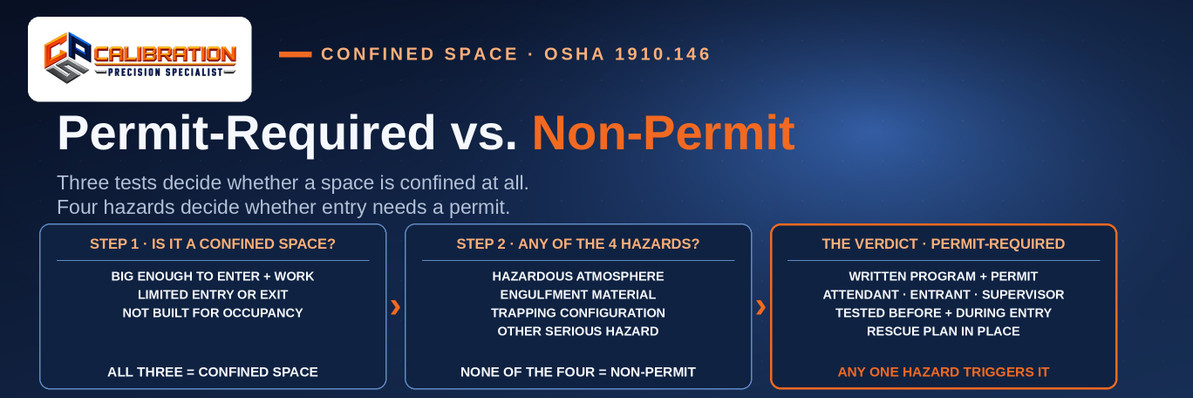
The difference is a second decision. Under OSHA 29 CFR 1910.146, a space is a confined space when it passes three tests — it is large enough for an employee to bodily enter and perform work, it has limited or restricted means of entry or exit, and it is not designed for continuous employee occupancy. It becomes a permit-required confined space when it also has at least one of four characteristics: it contains or has the potential to contain a hazardous atmosphere, it contains material that could engulf an entrant, its internal shape could trap or asphyxiate an entrant, or it holds any other recognized serious safety or health hazard. A non-permit confined space passes the first three tests and none of the four — and that single distinction decides whether entry runs on a written permit program with an attendant, an entry supervisor, and atmospheric testing, or on none of that machinery at all.
Most facilities can point at their tanks, vaults, and pits and say "confined space" without hesitating. Where they get hurt — in audits and in accidents — is the second classification, because permit-required is not a description of the space's size or shape; it is a description of what can kill someone inside it. This post walks through OSHA's actual decision flow: the three tests, the four triggers with the regulation's own numbers, what the permit program adds, and the two ways a permit space's requirements legitimately change — alternate procedures and reclassification.
Step One: Is It a Confined Space at All? The Three Tests
OSHA's definition at 1910.146(b) is three conditions joined by "and" — a space has to meet all three before it is a confined space under the standard:
- It is large enough and so configured that an employee can bodily enter and perform assigned work. A space a worker can only reach into, or inspect from outside, fails this test.
- It has limited or restricted means for entry or exit. The regulation's own examples of spaces that may have limited entry are tanks, vessels, silos, storage bins, hoppers, vaults, and pits — openings you climb through, up, or down, rather than doors you walk through.
- It is not designed for continuous employee occupancy. Nobody's workstation is inside it. People go in to do a task and come back out.
Fail any one test and the space is not a confined space under 1910.146 at all — a mechanical room with a full-size door that technicians occupy all shift fails tests two and three, and a sump too small to bodily enter fails test one. Pass all three and you have a confined space. That is only the first decision, and by itself it triggers no permit, no attendant, and no entry program. Those arrive only if the space also fails the second decision.
Step Two: Does It Have One of the Four Hazards?
A permit-required confined space is a confined space with one or more of four characteristics, again from 1910.146(b). One "yes" is enough:
1. It contains — or has the potential to contain — a hazardous atmosphere. This is the trigger that catches the most spaces, and OSHA defines the term precisely. A hazardous atmosphere is one that may expose employees to death, incapacitation, inability to self-rescue, injury, or acute illness from: flammable gas, vapor, or mist above 10 percent of its lower flammable limit (LFL); airborne combustible dust at or above its LFL; oxygen below 19.5 percent or above 23.5 percent; any substance with a published OSHA dose or permissible exposure limit at a concentration that could push exposure over that limit; or any other atmospheric condition that is immediately dangerous to life or health (IDLH). Note the words "potential to contain": a tank that is clean today but held solvent last month, or a sewer whose atmosphere changes with the weather, is judged on what it can become, not what a meter reads on a good morning.
2. It contains a material that has the potential for engulfing an entrant. Engulfment is the surrounding and capture of a person by a liquid or a finely divided, flowable solid — grain, sand, water, sludge — that can fill or plug the respiratory system or exert enough force to cause death by strangulation, constriction, or crushing. Silos, grain bins, and hoppers are the classic picture.
3. Its internal configuration could trap or asphyxiate an entrant. The regulation describes walls that converge inward, or a floor that slopes downward and tapers to a smaller cross-section — the hopper bottom, the cone, the funnel shape that funnels a fallen worker into a space too small to escape from.
4. It contains any other recognized serious safety or health hazard. The catch-all: unguarded rotating equipment, exposed energized parts, extreme temperatures, falling-object hazards — anything recognized as capable of causing death or serious physical harm.
A confined space with none of the four is, in OSHA's own definition, a non-permit confined space: a confined space that "does not contain or, with respect to atmospheric hazards, have the potential to contain any hazard capable of causing death or serious physical harm." Most classification arguments live in trigger one — the word potential — and trigger four, where "recognized" means hazards the employer knows or should know about.
Permit-Required vs. Non-Permit, Head to Head
| Non-permit confined space | Permit-required confined space | |
|---|---|---|
| The space itself | Meets all three confined-space tests | Meets all three confined-space tests |
| Hazards | None of the four triggers — and no potential for a hazardous atmosphere | At least one: hazardous atmosphere (actual or potential), engulfment material, trapping configuration, or another recognized serious hazard |
| Written program | Not required by 1910.146 | Required: a written permit space program, available to employees |
| Entry permit | None | Required for every entry — space, purpose, duration, hazards, controls, test results, rescue arrangements, and the entrants, attendant, and entry supervisor by name |
| Named roles | None assigned by the standard | Authorized entrant, attendant stationed outside, and entry supervisor who authorizes and can terminate entry |
| Atmospheric testing | Not required by the standard | Required — tested before entry and monitored as necessary during it, in the order: oxygen, then flammable gases and vapors, then toxics |
| Rescue planning | Not specified by the standard | Required: procedures for summoning rescue, non-entry retrieval where feasible, and preventing unauthorized rescue attempts |
| Signage | Not required | Required: exposed employees must be informed of permit spaces — the regulation's example sign reads "DANGER—PERMIT-REQUIRED CONFINED SPACE, DO NOT ENTER" |
| Record review | None | Canceled permits kept at least 1 year; the program reviewed annually using them |
What the Permit Program Actually Adds
The permit is the visible tip of a system. Paragraph (d) of 1910.146 requires the employer to evaluate each space's hazards before entry, specify acceptable entry conditions, isolate the space, and control atmospheric hazards by purging, inerting, flushing, or ventilating. It requires the equipment — testing and monitoring instruments, ventilation, communications, PPE, lighting, ladders, rescue gear — provided at no cost to employees. It requires at least one attendant outside the space for the entire entry, designated roles with training for each, and procedures for summoning rescue and emergency services and for stopping unauthorized personnel from attempting a rescue themselves.
The entry permit itself, under paragraphs (e) and (f), is signed by the entry supervisor before entry begins, posted at the entry portal, and good only for the time needed to complete the task named on it. It records who is inside by name, who is attendant, who supervises, what the hazards are, what controls are in place, the acceptable entry conditions, the results of the initial and periodic atmospheric tests with the tester's name and the time, and how rescue is summoned. When the job ends — or a condition the permit doesn't allow shows up — the supervisor terminates entry and cancels the permit, and the canceled permit is retained for at least a year so the annual program review can learn from it. That paper trail is not bureaucracy for its own sake; it is how a facility proves, to itself before OSHA ever asks, that each entry was actually thought through.
Where the Meter Comes In: Atmospheric Testing
Because the hazardous-atmosphere trigger is the most common reason a space lands in the permit column, testing is where this classification system meets gas detection. For permit entries, 1910.146(d)(5) requires the space to be tested before entry is authorized, monitored as necessary while work goes on, and tested in a fixed order — oxygen first, then combustible gases and vapors, then toxic gases and vapors — with the entrants given the results and the chance to observe the testing. Our post on how to test a confined space before entry walks that sequence end to end, and our companion piece on how long you test a confined space before entry works through the sampling-time side — why a reading taken too fast is a guess. The instrument for the job is a pumped multi-gas monitor that can sample the space before anyone breaks the plane of the opening — see our portable multi-gas and pumped monitor categories.
One honest boundary: the standard imposes no testing requirement on a genuinely non-permit space. What it does require, at (c)(1), is that the employer evaluate the workplace to determine which spaces are permit spaces — and a classification decision with no evaluation behind it is a guess wearing a label. Conditions also change: the day a "non-permit" pit gets a leaking valve or a solvent washdown, its classification has to be revisited.
The Middle Path: Alternate Procedures for Ventilation-Controlled Spaces
Paragraph (c)(5) of 1910.146 offers a narrow middle path that many facilities don't know exists. If the employer can demonstrate two things — that the only hazard the space poses is an actual or potential hazardous atmosphere, and that continuous forced-air ventilation alone is sufficient to keep the space safe for entry — entry may proceed under alternate procedures without the permit system, the attendant, and most of the program machinery in paragraphs (d) through (k). The catch is that testing and ventilation become non-negotiable: the atmosphere is tested before entry with a calibrated direct-reading instrument, there may be no hazardous atmosphere while anyone is inside, the ventilation runs continuously and is aimed where the employees actually are, and the atmosphere is retested periodically to prove it is holding. If a hazardous atmosphere is detected during entry, everyone leaves immediately and the space is re-evaluated. The demonstrations and the monitoring data behind them must be documented and available to the entrants — this is a paperwork-light path, not a paperwork-free one, and it evaporates the moment the space has any hazard beyond the atmosphere.
How a Permit Space Becomes Non-Permit: Reclassification
The other direction is paragraph (c)(7). A permit space may be reclassified as non-permit when all hazards in it are eliminated. If that can be done without entering — draining, cleaning, and isolating a tank from outside — the space is reclassified for as long as the hazards stay eliminated. If entry is needed to eliminate the hazards, that entry is made under the full permit rules first, and only when testing and inspection during it demonstrate the hazards are gone does the space convert. Either way, the employer must document the basis for the determination in a certification containing the date, the location of the space, and the signature of the person making it, and that certification must be available to every employee who enters. Two traps deserve emphasis. First, the regulation's own note: controlling an atmospheric hazard with forced-air ventilation is not eliminating it — a ventilated space is a (c)(5) space or a permit space, never a reclassified one. Second, reclassification is conditional, not permanent: if hazards arise in a declassified space, every employee exits, and the employer reevaluates whether it is a permit space again. A cleaned tank that goes back into solvent service was never truly reclassified — it was borrowed.
Why the Paperwork Exists: The Rescuer Statistic
If the permit system reads like a lot of machinery for climbing into a tank, the fatality pattern behind it explains the weight. In its investigation of confined-space deaths, NIOSH found that roughly 60 percent of the fatalities were would-be rescuers — people, often coworkers and sometimes supervisors, who saw someone down inside a space and went in after them, unprotected, into the same invisible atmosphere. The BLS counted 1,030 worker deaths involving confined spaces from 2011 through 2018. The permit program's structure maps directly onto that pattern: the attendant exists to be the person who does not go in; the retrieval system exists so rescue can happen from outside; the testing exists so the atmosphere that felled the first entrant is a reading on a screen instead of a second and third victim. Almost none of that machinery applies to a non-permit space — which is exactly why calling a space "non-permit" is a determination that has to be right.
Frequently Asked Questions
What is the difference between a permit-required and a non-permit confined space? Both meet OSHA's three confined-space tests: large enough to bodily enter and work, limited or restricted entry or exit, and not designed for continuous occupancy. The difference is hazards. A permit-required space has at least one of four characteristics — a hazardous atmosphere or the potential for one, engulfment material, a trapping internal configuration, or another recognized serious hazard — and entry runs under a written permit program. A non-permit space has none of the four, and 1910.146's permit machinery does not apply to it.
What are the three criteria for a confined space under OSHA? Under 29 CFR 1910.146(b), a confined space is a space that (1) is large enough and so configured that an employee can bodily enter and perform assigned work, (2) has limited or restricted means for entry or exit, and (3) is not designed for continuous employee occupancy. All three must be true. OSHA's examples of spaces with limited entry include tanks, vessels, silos, storage bins, hoppers, vaults, and pits.
What makes a confined space permit-required? Any one of four characteristics: it contains or has the potential to contain a hazardous atmosphere; it contains a material that has the potential for engulfing an entrant; it has an internal configuration — inwardly converging walls, or a floor sloping down to a smaller cross-section — that could trap or asphyxiate an entrant; or it contains any other recognized serious safety or health hazard. One characteristic is enough, and the atmosphere trigger counts potential, not just a bad reading today.
What counts as a hazardous atmosphere under OSHA 1910.146? An atmosphere that may expose employees to death, incapacitation, inability to self-rescue, injury, or acute illness from one of these causes: flammable gas, vapor, or mist above 10 percent of its lower flammable limit; airborne combustible dust at or above its lower flammable limit; oxygen below 19.5 percent or above 23.5 percent; a substance above its OSHA permissible exposure limit; or any other condition immediately dangerous to life or health (IDLH).
Does a non-permit confined space require atmospheric testing? Not under 1910.146 — the standard's testing requirements attach to permit spaces, to entries under the (c)(5) alternate procedures, and to reclassification entries. What the standard does require for every space is an evaluation: the employer must evaluate the workplace to determine which spaces are permit-required. A "non-permit" label with no evaluation behind it is undefended, and if conditions in the space change — a new chemical, a leak, a different process — the classification has to be re-evaluated.
Can a permit-required confined space be reclassified as non-permit? Yes, under paragraph (c)(7), when all hazards in the space have been eliminated. If entry is required to eliminate them, that entry is made under the full permit program, and reclassification follows only when testing and inspection demonstrate the hazards are gone. The employer must document the basis in a signed certification showing the date and the space's location, available to everyone entering. Ventilation alone does not qualify — controlling an atmospheric hazard is not eliminating it — and if hazards return, the space goes back up for reclassification as a permit space.
What are the alternate procedures in 1910.146(c)(5)? They are a streamlined entry path for a narrow case: the employer can demonstrate that the only hazard is an actual or potential hazardous atmosphere, and that continuous forced-air ventilation alone keeps the space safe for entry. Entries under (c)(5) skip the entry permit, attendant, and most program requirements — but the atmosphere must be tested before entry, no hazardous atmosphere may exist while anyone is inside, ventilation runs continuously, the air is retested periodically, and the supporting demonstrations and data must be documented and available to entrants.
What do the attendant, entrant, and entry supervisor each do? The authorized entrant is the employee approved to enter and work in the space. The attendant is stationed outside the space for the duration of entry — monitoring the entrants, maintaining communication, and performing the non-entry rescue and rescue-summoning duties in the program rather than entering. The entry supervisor determines whether acceptable entry conditions exist, authorizes entry by signing the permit, oversees the operation, and terminates entry and cancels the permit when the job is done or a prohibited condition appears.
How long do you keep confined space entry permits? Canceled entry permits must be retained for at least 1 year. That retention serves the paragraph (d)(14) review: the employer must review the program within 1 year after each entry, using the canceled permits, and revise it where the entries showed problems. Problems encountered during an entry are supposed to be noted on the permit itself so the review can act on them.
Why are so many confined space deaths would-be rescuers? Because the hazards are invisible and the impulse is immediate. NIOSH's investigation of confined-space fatalities found that about 60 percent of those killed were would-be rescuers — people who saw a coworker collapse and entered without testing, ventilation, or breathing protection, meeting the same oxygen-deficient or toxic atmosphere. The attendant, the retrieval system, and the pre-entry test in the OSHA standard are aimed at that exact sequence: the attendant stays out, rescue happens by retrieval line where feasible, and the atmosphere is a known number before anyone goes in.
The Bottom Line
Permit-required versus non-permit is not two kinds of space; it is one space, passed through two decisions. Pass the three entry tests and the space is confined. Trip any one of the four hazards — hazardous atmosphere or its potential, engulfment, a trapping shape, or any other recognized serious hazard — and it is permit-required, with the written program, signed permit, attendant, supervisor, testing, and rescue plan that follow. Trip none, and the standard steps back. The classification that matters most is the honest one, because everything the permit system builds exists to interrupt the oldest pattern in confined-space deaths: the second person through the opening. When in doubt, test the atmosphere and treat the space as what the readings say it is — the meter does not care what the sign on the hatch says.
Classifying spaces or setting up the testing program behind a permit? The atmospheric half of that program runs on a calibrated, bump-tested multi-gas monitor — call 865-900-8844 or reach us through Contact Us. Browse the instruments in the portable multi-gas monitors category, and see our Calibration Services for the calibration program that keeps the readings defensible.
CPS Calibrations · 109 S. Front Street, Rockwood, TN 37854 · Calibration Gas · Calibration Services · Contact Us
Recent Posts
-

What Is a Confined Space? OSHA's Definition, the 3 Tests, and When It Becomes Permit-Required
A confined space is a space that passes all three of OSHA's tests at the same time: it is large enou …Oct 21st 2026 -

PID vs. LEL for VOC Detection: Which Sensor Do You Actually Need?
Use a PID to detect VOCs and an LEL sensor to detect explosive atmospheres — they measure different …Oct 21st 2026 -

Semiconductor (MOS) Gas Sensors: Where They Work and Where They Lie
A semiconductor (MOS) gas sensor measures gas with a heated film of metal oxide — usually tin dioxid …Oct 21st 2026