
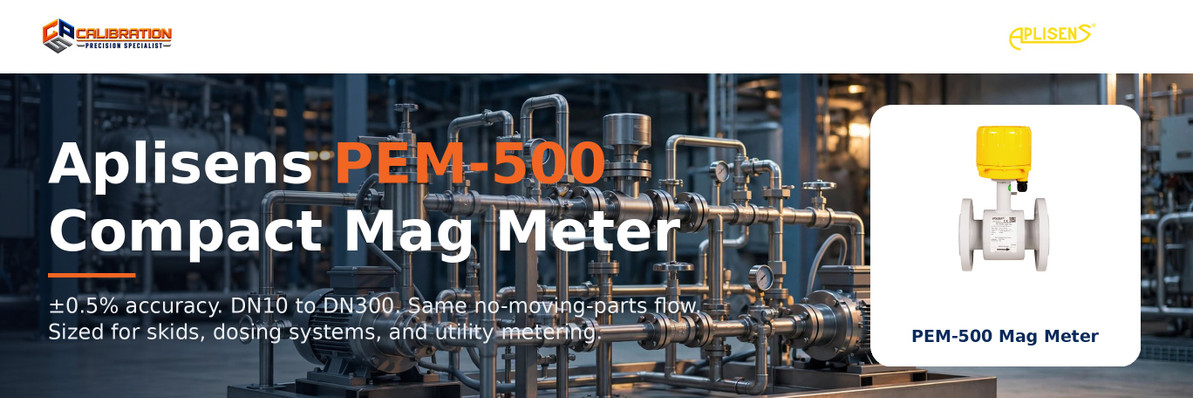
Aplisens PEM-500 Mag Meter: Compact Flow Measurement for Skids and Dosing Lines
Ask a plant engineer what kills flow meters, and you'll hear the same story: the turbine that seized after six months of slurry, the paddle wheel chewed up by chemical dosing, the meter that "reads fine" until the batch comes out wrong. Mechanical flow measurement has moving parts, and moving parts in process service are a maintenance contract you never signed.
The Aplisens PEM-500 sidesteps the whole problem. It's a mag meter — no rotor, no paddle, no bearings. Nothing touches the process except a smooth lined tube and two electrodes. Here's why that matters, and why this particular meter earns its place on skids and dosing lines.
How a Mag Meter Actually Works
Faraday's law of magnetic induction: move a conductor through a magnetic field and you induce a voltage. In a mag meter, the flowing liquid is the conductor. Coils in the meter body generate the field, two electrodes pick up the induced voltage, and the voltage is directly proportional to flow velocity. Multiply by the pipe's cross-section and you have volumetric flow.
Three consequences fall out of that physics:
- No wear. Nothing moves, so there's nothing to wear out. A mag meter's accuracy on day 2,000 is the same as day 1.
- No pressure drop. The tube is the same bore as your pipe. You're not paying pump energy to push liquid past a rotor.
- It handles the ugly stuff. Pastes, slurries, acids, caustics — anything conductive (≥ 5 µS/cm, which covers nearly all water-based processes) meters the same way. Try that with a turbine.
Why the PEM-500, Specifically
Aplisens makes two mag meters. The PEM-1000 covers DN10 to DN1000 for the big lines. The PEM-500 covers DN10 to DN300 (½" to 12") — the range where most skids, dosing systems, and utility lines actually live — in a compact, economical package. Same measurement principle, sized and priced for the job.
What makes it more than a commodity meter:
- ±0.5% of reading. Not of full scale — of reading. At low flows, that distinction is worth real money in chemical dosing, where overdosing 5% of an expensive chemical, every batch, for years, dwarfs the meter's purchase price.
- Bidirectional. One meter reads fill and drain, forward and reverse. If your process ever back-flushes, you don't need two meters or creative plumbing.
- Empty-pipe detection. This one saves pumps. The PEM-500 knows when the pipe runs dry and can alarm on it, before your pump cavitates itself to death.
- Liner and electrode choices that match your chemistry. Hard rubber for water and wastewater, PTFE or PFA for aggressive chemicals; 316L electrodes standard, Hastelloy or Tantalum when the process eats stainless.
- Modbus RTU on board. 4–20 mA and pulse/frequency for the loop, Modbus over RS-485 for the control system — configuration, diagnostics, and totals without extra hardware.
- IP67 standard, IP68 optional. Washdown, flooding, buried vaults — the meter survives the environment instead of dictating it.
Mag vs. The Alternatives
Turbine meters are accurate when new and need long straight pipe runs — and their bearings are a wear item in anything but clean service. Clamp-on ultrasonic avoids cutting the pipe but struggles on small lines. Orifice plates and DP are cheap to buy and expensive to own: permanent pressure loss, impulse lines to maintain, and accuracy that degrades as the plate edge wears.
A mag meter costs more up front than an orifice plate and less over five years than a turbine you're rebuilding. For conductive liquids, it's the default right answer — the question is only which size and liner.
Getting the Installation Right
Two rules make or break any mag meter: the pipe must stay full, and the meter needs proper grounding. Mount it in a vertical run with upward flow or at the low point of the system, ground it per the manual (grounding rings if your pipe is non-conductive), and keep it away from strong electromagnetic interference.
The Bottom Line
The PEM-500 is the meter we recommend when the line is ½" to 12" and the process is anything but clean water: ±0.5% of reading, no moving parts, bidirectional, Modbus on board, and wetted materials matched to your chemistry — at a price that fits skid budgets. Need bigger lines? Step up to the PEM-1000.
Sizing questions or liner selection for your process? Call CPS Calibrations at 865-900-8844 — we'll spec it with you, and we can calibrate it when it's due.
Recent Posts
-

Electrochemical Toxic Sensors: Cross-Sensitivities That Fool Your Readings
Your carbon monoxide alarm goes off in the battery room. You sweep the area — there's no CO source a …Oct 8th 2026 -

Why Oxygen Sensors Die — and How to Make Them Last
Every 4-gas monitor has an oxygen channel, and it's the only channel with a built-in expiration date …Oct 7th 2026 -

Catalytic Bead vs. Infrared LEL Sensors: When Each Wins
Most gas detectors read %LEL the same way on the display. What's happening behind that number is any …Oct 6th 2026