
What GfG Portable Gas Detectors Are There? Every Model Explained
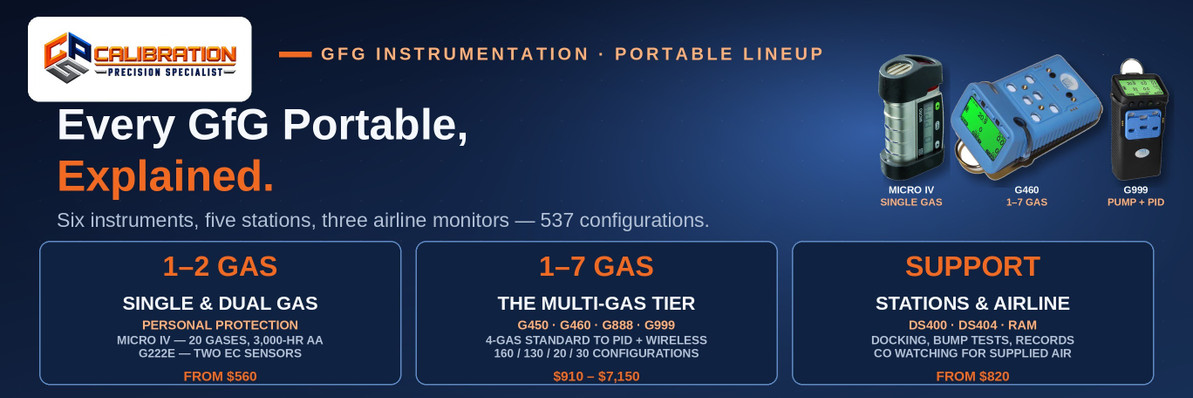
GfG’s portable line at CPS is 14 products built around six instruments: the Micro IV single-gas detector (42 configurations, $560–$1,820), the G222E 1–2 gas detector (73 configurations, $780–$2,625), the G450 4-gas detector (160 configurations, $910–$3,405), and three 1–7 gas instruments — the G460 ($1,590–$6,385), the wireless G888 ($1,920–$3,980), and the pumped G999 ($2,765–$7,150) — backed by five docking and test stations and three RAM monitors that watch carbon monoxide in supplied breathing air.
The GfG portable range is organized by one decision: how many gases the instrument has to measure at once. Everything else — pump or diffusion, PID or not, wireless or not — is a configuration inside that decision. That is why the configuration counts below matter more than the model count: a “configuration” is a factory build (sensor set, battery, pump, and kit), and the spread between the lowest and highest configuration is the real price of the model. Every price in this post is the live configured range on the CPS store, pulled across every variant of every product. The full GfG range, fixed systems included, is on the GfG Instrumentation brand page.
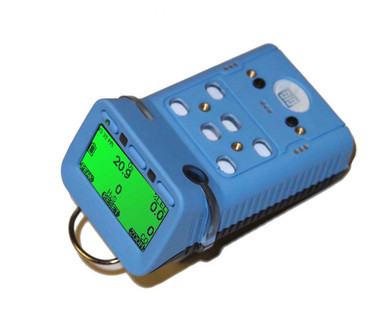
GfG G460 Multi-Gas Detector (1-7 Gas)
The configurable center of the portable line: 1–7 gases with PID, NDIR CO2, and dual-sensor options across 130 factory builds.
$1,590–$6,385 configured
See the G460The Six Portable Instruments
Six instruments cover everything from a single known gas to seven gases with a pump and a PID. They sit in three tiers: single- and dual-gas personal monitors, the standard 4-gas tier, and the 1–7 gas tier where sensor menus, pumps, and wireless open up.
Micro IV — the single-gas detector
The Micro IV measures one gas with a smart sensor, and the sensor menu is the story: 20 gases, including CO, H2S, O2, NH3, Cl2, HCN, HF, PH3, SO2, and SiH4. Its 42 configurations are the gas-and-range choices — ammonia at 0–200 or 0–500 ppm, CO at 0–300 ppm, and so on — each offered as the instrument alone or in a Value Kit. It runs up to 3,000 hours on one AA alkaline battery, works with one button, calibrates with AutoCal, and carries a lifetime warranty on non-consumables. 42 configurations — $560–$1,820.
G222E — one or two gases
The G222E is the smallest and lightest 1–2 gas detector in GfG’s Micro 5 series. Two electrochemical sensor slots take single-gas builds or dual pairings drawn from 22 gases — CO with HCN, CO with H2S, CO with O2 — and the two slots can even carry a redundant pair of the same sensor. The 73 configurations run 2,160 hours on alkaline batteries, with smart sensors, AutoCal, and full event and data logging. 73 configurations — $780–$2,625.
G450 — the standard 4-gas detector
The G450 is the line’s confined-space workhorse: 1–4 gases drawn from LEL, O2, CO, and H2S, in the widest configuration list of any GfG portable. The 160 builds combine sensor subsets with NiMH or alkaline battery packs, an optional motorized smart pump for sample-draw work, MSHA-approved versions, and Value Kits. Battery life runs up to 24 hours, the housing is IP67, and the three-color backlight plus 360-degree flashing LEDs make alarm state readable at a glance. 160 configurations — $910–$3,405.
G460 — 1–7 gases, the configurable one
The G460 measures up to seven gases at once, and its 130 configurations reach well past the standard four: catalytic or infrared LEL, O2, CO, H2S, a COSH dual CO/H2S sensor that frees a slot, NDIR CO2, toxic sensors such as Cl2, HCN, NH3, NO2, PH3, and SO2 — and a PID for VOCs at 0–2,000 ppm, which appears in 30 of the 130 builds. A detachable, self-powered smart pump converts it between diffusion and sample-draw use, battery packs run up to 24 hours, and sensors carry a 3-year warranty (5 years on O2). 130 configurations — $1,590–$6,385.
G888 — 1–7 gases with wireless
The G888 is the diffusion member of the 1–7 gas tier, built around team visibility: a 915 MHz ISM radio with a 300 m range and a man-down alarm, a top-mounted display that changes color in alarm, and a 103 dB audible alarm with vibration. Its 20 configurations are four-gas builds (O2, catalytic LEL, CO, H2S) with or without an infrared CO2 channel, wireless or standard, as the instrument or in Value and ecoBump kits, with the charging cradle included. Runtime is 23 hours, and the instrument and electronics carry a lifetime warranty. 20 configurations — $1,920–$3,980.
G999 — 1–7 gases with the pump built in
The G999 integrates a motorized pump with a 100 m sample draw and still runs in diffusion mode when the pump is not needed. The 30 configurations fall in three families: the G999C four-gas builds (catalytic LEL, CO, H2S, lead-free O2), the G999P builds with infrared LEL and an optional PID at 0–2,000 ppm (including hydrogen-range builds), and the G999S triple-range methane builds that read LEL, % volume, and ppm on one channel. Wireless versions add the 915 MHz radio and man-down alarm. Runtime runs up to 47 hours on the G999C and 24 hours on the G999P. 30 configurations — $2,765–$7,150.
The Docking and Test Stations
A portable fleet is only as good as its bump tests and calibrations, and GfG’s station line is built to take the human out of both: drop the instrument in, and the station runs the test, calibrates, charges, and keeps the record.
DS400 Docking Station — one gas inlet, full automation
The DS400 is a single-inlet docking station that runs a full functional test — fresh-air calibration, bump test, sensor tests, and alarm tests — then AutoCal-calibrates and charges the instrument. Its software prints official calibration and bump certificates, keeps simple pass/fail records (memory for up to 2,000,000 records), needs no computer, and stations can be cascaded. The 13 configurations cover single- and double-cradle stations, versions for the G222 and for the G888/G999, multi-unit DS401, DS402, and DS406 systems, and versions with a demand flow regulator included. 13 configurations — $2,895–$9,640.
DS404 Multi-Inlet Docking Station — four gas inlets
The DS404 runs the same drop-in test, calibration, and record-keeping as the DS400, but with four test-gas inlets, so a multi-gas instrument is tested against each of its gases without switching cylinders — one demand flow regulator per cylinder. The 15 configurations cover the G888/G999, the dual-gas G222, and instrument-and-pump cradles, with one to four regulators included. 15 configurations — $4,690–$9,810.
TS400 Test Station — bump testing only
The TS400 does one job: the daily bump test. Its push-button regulator sharply reduces gas consumption, and test records are stored for retrieval and report generation. Four configurations cover single- and double-cradle versions, with and without charging. 4 configurations — $1,060–$1,410.
TX400 Test Station — the G888/G999 test station
The TX400 is the test station built for the G888 and G999 portable detectors, in two configurations — standard, or with the charging function added. 2 configurations — $995–$1,160.
DI220 Docking Station — the Micro IV station
The DI220 is the calibration and data-download station for a single Micro IV; the cable and software are included, and it works with a fixed-flow regulator with an on/off knob and tubing. 1 configuration — $820.
The RAM Airline Monitors: Watching Supplied Breathing Air
OSHA 29 CFR 1910.134 requires carbon monoxide monitoring on supplied breathing air, and the RAM line is GfG’s answer: continuous CO monitoring that mounts with the filtration system instead of relying on sample lines that can block or crimp.
RAM 744 — inline CO monitoring
The RAM 744 continuously monitors CO in Grade D and Grade E (SCBA) breathing air over a 0–99 ppm range, with AutoCal automatic calibration and a long-life electrochemical sensor; a low-hydrogen-interference CO-H sensor is available where hydrogen is present. The 16 configurations pair the instrument with three-stage filter panels at 25, 50, or 100 CFM — wall-mount or portable air case, serving up to 8 users — or the 744-XP version in a watertight suitcase. 16 configurations — $1,265–$5,210.
RAM 4021 AutoCal — CO, O2, and dew point
The RAM 4021 series monitors CO, O2, and/or dew point in breathing air from a NEMA 4X housing, with user-adjustable alarm points, alarm relay contacts, a low-flow alarm indicator, and dry contacts for a remote horn and lights. The 29 configurations include medical DPX variants with dryer control relays that comply with NFPA 99, and optional three-stage filtration for up to 8 users. 29 configurations — $2,060–$6,020.
RAM 4035 — the CO transmitter
The RAM 4035 strips the airline monitor down to a transmitter: CO at 0–300 ppm on a linear 4–20 mA output, in a corrosion-resistant, dust-tight aluminum housing, for plants that already have a panel to land the signal on. Two configurations cover the standard unit and the 4035-RF version with increased RF resistance. 2 configurations — $1,220–$1,290.
Every GfG Portable at a Glance
| Model | What it is | Configurations | Configured price |
|---|---|---|---|
| Micro IV | Single-gas detector, smart sensors for 20 gases | 42 | $560–$1,820 |
| G222E | 1–2 gas detector, two electrochemical sensors | 73 | $780–$2,625 |
| G450 | 1–4 gas detector (LEL, O2, CO, H2S) | 160 | $910–$3,405 |
| G460 | 1–7 gas detector with PID and CO2 options | 130 | $1,590–$6,385 |
| G888 | 1–7 gas wireless detector with man-down alarm | 20 | $1,920–$3,980 |
| G999 | 1–7 gas detector, integrated pump, wireless options | 30 | $2,765–$7,150 |
| DS400 | Docking station, single gas inlet | 13 | $2,895–$9,640 |
| DS404 | Docking station, four gas inlets | 15 | $4,690–$9,810 |
| TS400 | Bump-test station | 4 | $1,060–$1,410 |
| TX400 | Test station for G888 / G999 | 2 | $995–$1,160 |
| DI220 | Micro IV calibration and download station | 1 | $820 |
| RAM 744 | Inline CO monitor for supplied breathing air | 16 | $1,265–$5,210 |
| RAM 4021 | AutoCal CO / O2 / dew point airline monitor | 29 | $2,060–$6,020 |
| RAM 4035 | CO transmitter for supplied breathing air | 2 | $1,220–$1,290 |
How the Line Fits Together
Read the range as a ladder. The single-gas tier (Micro IV, G222E) covers one known hazard per worker at the lowest cost per instrument. The multi-gas tier starts with the G450 for the standard four gases and opens into the G460, G888, and G999 when the job adds gases, a pump, a PID, or wireless. The stations and the RAM monitors are not accessories to that ladder — they are what keep the instruments on it compliant and the supplied-air crews legal.
Frequently Asked Questions
How many gases can a GfG portable detector measure at once?
Up to seven. The G460, G888, and G999 are 1–7 gas instruments; below them, the G450 measures up to four gases (LEL, O2, CO, H2S), the G222E one or two, and the Micro IV one.
Which GfG portable detectors have a PID for VOCs?
The G460 and the G999P. The G460 offers a PID at 0–2,000 ppm in 30 of its 130 configurations, and the G999P builds the same 0–2,000 ppm PID into a pumped, optionally wireless instrument. The G888’s store configurations do not include a PID.
Which GfG portable gas detector has a built-in pump?
The G999, with an integrated motorized pump rated for a 100 m sample draw that can also run in diffusion mode. The G450 and G460 instead take detachable smart pumps — the G460’s is self-powered — so the same instrument works diffusion or sample-draw.
What is the cheapest GfG portable gas detector?
The Micro IV, starting at $560 configured. It is a single-gas detector with smart sensors for 20 gases and up to 3,000 hours of operation on one AA alkaline battery.
How much does the GfG G450 cost?
$910–$3,405 depending on configuration. The G450 has 160 configurations — sensor subsets of LEL, O2, CO, and H2S, NiMH or alkaline battery packs, an optional smart pump, MSHA-approved versions, and Value Kits — and the build you pick sets the price.
Does GfG make a wireless portable gas detector?
Yes. The G888 and the wireless G999 versions carry a 915 MHz ISM radio with a 300 m range and a man-down alarm, so a worker’s alarm state is visible to the team instead of only sounding on the instrument.
What docking station do the G888 and G999 use?
The DS400 (single gas inlet) and DS404 (four gas inlets) docking stations are built for them, and the TX400 is their bump-test station. The DS400 and DS404 run the full functional test, AutoCal calibration, and charging automatically and print the certificates.
How long does a Micro IV battery last?
Up to 3,000 hours of operation on one AA alkaline battery — the longest battery story in the GfG portable line, and a large part of why the Micro IV is the low-cost way to cover a single known gas.
What monitors carbon monoxide in supplied breathing air?
The RAM line: the RAM 744 inline CO monitor (0–99 ppm), the RAM 4021 AutoCal monitors for CO, O2, and dew point, and the RAM 4035 CO transmitter (0–300 ppm, 4–20 mA). They exist to meet OSHA 29 CFR 1910.134 CO monitoring requirements for Grade D breathing air.
Does CPS calibrate GfG portable detectors?
Yes. CPS calibrates the GfG portable line in-house in Rockwood, Tennessee, with as-found and as-left data and a full certificate — see calibration services. Fleets that would rather calibrate in-house can do it with the DS400 or DS404 docking stations above.
The Bottom Line
GfG’s portable line is one ladder, not fourteen unrelated products: Micro IV and G222E for one or two known gases, G450 for the standard four, and G460, G888, and G999 when the job grows to seven gases, a pump, a PID, or a radio — with DS and TX stations to keep the fleet tested and RAM monitors to keep supplied-air work inside OSHA’s CO rule. Pick your rung by gas count first, then configure inside it; the configuration count on each model is where the real choice, and the real price, lives.
Need a calibration you can file?
In-house calibration at CPS in Rockwood, Tennessee — $55 for single-gas instruments, $90 for 4- and 5-gas — every channel, as-found and as-left data, full certificate.
See Calibration Servicesor call 865-900-8844
Recent Posts
-

Which GfG Portable Gas Detector Is Best for You?
The right GfG portable is decided by three questions — how many gases, pumped or diffusion, and PID …Nov 24th 2026 -
What GfG Fixed Gas Detection Systems Are There? Every Transmitter and Controller Explained
GfG’s fixed gas detection line at CPS is 39 products in two layers: 23 transmitters and detection sy …Nov 24th 2026 -
What GfG Portable Gas Detectors Are There? Every Model Explained
GfG’s portable line at CPS is 14 products built around six instruments: the Micro IV single-gas dete …Nov 24th 2026