
What GfG Fixed Gas Detection Systems Are There? Every Transmitter and Controller Explained
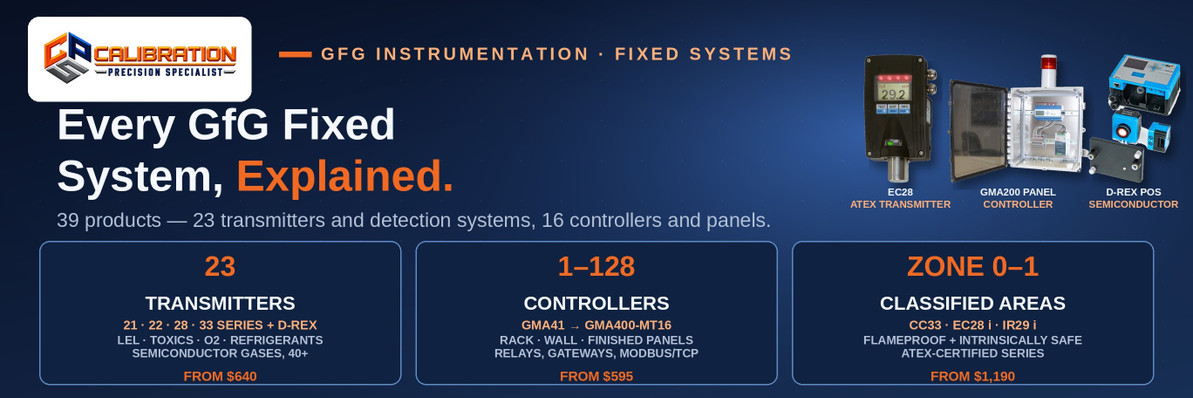
GfG’s fixed gas detection line at CPS is 39 products in two layers: 23 transmitters and detection systems — the 21-series, 22-series, 28-series, and flameproof CC33 transmitters, the stand-alone Dynagard 25 oxygen system, and the D-ReX semiconductor family — and 16 controllers, panels, and system components that scale from a single measuring point on a GMA41 ($595) to 128 measuring points on a GMA400-MT16 (up to $26,570 configured).
A fixed system is a chain: a transmitter senses the gas and sends a 4–20 mA or Modbus signal, and a controller powers it, displays it, alarms on it, and drives the relays that start fans and sound horns. GfG builds both ends of that chain, and this post walks the whole CPS lineup — every transmitter family, every controller including the panel packages, what each one is for, how many configurations it carries, and what it costs configured. Every price is the live configured range on the store, pulled across every variant page. (The portable half of the GfG line is covered in the GfG portable roundup.)
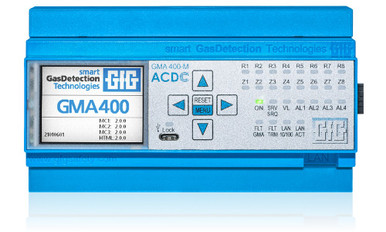
GfG GMA400-MT16 Gas Detection Controller
The top of the GfG controller range: one controller for 4 to 128 measuring points, compatible with every GfG transmitter, with Ethernet data and Modbus/TCP options.
$2,305–$26,570 configured
See the GMA400-MT16The 21 Series: Economical Transmitters
Three transmitters, one job each, no display-driven complexity — the lowest-cost way to put a GfG sensor on a wall and land its signal on a controller.
CI21 — ammonia, without the false alarms
The CI21 uses a charge carrier injection (CI) sensor developed specifically for ammonia refrigeration detection. Unlike metal-oxide (MOS) sensors, its sensor life is not limited by ammonia exposure, high concentrations do not harm it, and it runs down to −40 °F — the combination that eliminates the false alarms ammonia plants associate with MOS detection. Ranges run from 0–200 ppm to 0–10,000 ppm (0–1.00% vol). 3 configurations — $935.
EC21 — simple electrochemical toxics
The EC21 is a loop-powered electrochemical transmitter for CO (0–500 and 0–2,000 ppm), NH3 (five ranges to 1,000 ppm), and NO2 (0–20 ppm), with other electrochemical gases on request. Two-wire 4–20 mA, reverse-wire protected, quick-disconnect power connector, in a corrosion-resistant, dust-tight housing. 9 configurations — $885–$2,455.
ZD21 — fast zirconia oxygen
The ZD21 is an intelligent oxygen transmitter on a zirconium-dioxide sensor with a T90 under 2 seconds and a typical sensor life of 5 years. Range is 0–25% vol, with a 10–1,000 ppm version also available; recovery from pressure, humidity, and temperature changes is fast, with minimal signal loss. 3 configurations — $640–$2,325.
The 22 Series: Display or Blind, 4–20 mA or Modbus
The 22 series is the general-purpose transmitter family: one housing style, six sensor technologies, each available with or without a display and on 4–20 mA or RS485 Modbus. Most are also sold as a base unit with no sensor, so the sensor can be specified or replaced separately.
CC22 — catalytic LEL for 33 gases
A catalytic combustible transmitter with a proprietary high-performance sensor rated for over 5 years of life, linearized and temperature-compensated, with a display that turns red in alarm. The 132 configurations are 33 combustible gases at 0–100% LEL — methane, propane, hydrogen, solvents, and more — crossed with display/blind and 4–20 mA/Modbus. 132 configurations — $1,000–$1,500.
CS22 — chemosorption for refrigerants and ammonia
The CS22’s chemosorption sensor is highly sensitive where refrigeration plants need it: ammonia (to 3,000 ppm and 1% vol) and a long refrigerant list — R-22, R-32, R-134a, R-404A, R-407C, R-410A, R-448A, R-449A, R-454B, R-1234yf, R-1234ze, and others, mostly at 0–1,000 or 0–2,000 ppm — plus ethylene and LEL-range ethanol and n-hexane. Response is under 14 seconds and sensor life exceeds 5 years in continuous operation. 124 configurations — $660–$1,485.
EC22 and EC22 O — electrochemical toxics and oxygen
The EC22 covers 16 electrochemical gases — NH3, CO, Cl2, ClO2, F2, H2, HCl, HCN, H2S, NO, NO2, O3, SiH4, SO2 among them — with a menu-driven display for calibration. The EC22 O is its oxygen sibling, a partial-pressure O2 transmitter (0–25% vol) designed for low-molecular-weight gas environments such as helium, in semiconductor, laboratory, and research work. EC22: 72 configurations — $660–$2,155. EC22 O: 8 configurations — $660–$1,600.
IR22 — infrared CO2 and hydrocarbons
The IR22 measures CO2 at 0–1, 5, 10, 25, or 50% vol, and methane, propane, and R32 at 0–100% LEL, on infrared sensors that do not consume themselves the way electrochemical cells do. Display or blind, 4–20 mA or Modbus. 36 configurations — $660–$2,315.
ZD22 — zirconia oxygen, wide ranges
The ZD22 extends the zirconia O2 idea across four ranges — 0–25% vol, 0–2% vol, 0–1,000 ppm, and 0–96% vol — with sensor life over 5 years and a display that turns red and sounds in alarm. 20 configurations — $660–$2,400.
The 28 Series and CC33: Certified for Classified Areas
Where the area classification demands certified hardware, the 28 series brings ATEX-certified transmitters with smart plug-in sensors that swap in seconds and non-intrusive calibration, and the CC33 brings a flameproof enclosure for Zone 1.
CC28 — ATEX catalytic LEL
An ATEX-certified catalytic combustible transmitter for 30 combustible gases at 0–100% LEL, with an integrated explosion-proof buzzer, bright alarm LEDs, touch-key adjustment or RC2 remote control for one-person calibration, and IP64 protection. 99 configurations — $795–$2,060.
EC28 and EC28 i — ATEX electrochemical, standard and intrinsically safe
The EC28 is the ATEX electrochemical transmitter for 18 gases, in seven configuration families (blind, display, display + alarm, display + alarm + relay, and Modbus versions). The EC28 i is the intrinsically safe version — ATEX II 1G — which needs a safety barrier but no Ex conduit, in blind or display versions for 17 gases. EC28: 171 configurations — $1,585–$3,460. EC28 i: 44 configurations — $1,455–$2,950.
IR29 e and IR29 i — infrared that ignores poisons
Infrared LEL detection needs no oxygen and is immune to sensor poisons, and the IR29 pair brings it to classified areas: the IR29 e in an increased-safety (Ex e) stainless housing, and the IR29 i as an intrinsically safe, patented 4-beam NDIR transmitter installable in Ex Zone 0, whose sensor head can be replaced while energized. Both carry continuous self-monitoring with temperature, moisture, and pressure compensation. IR29 e: 26 configurations — $4,205–$4,950. IR29 i: 12 configurations — $3,555–$4,175.
CC33 — flameproof for Zone 1
The CC33 is a flameproof, encapsulated catalytic LEL transmitter certified Ex d for Zone 1, gas group IIC, with gas-optimized sensors for 30 combustible gases, one of the fastest response times in its class, and three magnetic switches behind the glass for non-intrusive AutoCal calibration. The 63 variants combine four sensor choices (including a base unit) with 16 housing and output combinations — aluminum or stainless, 4–20 mA or RS 485, relays and explosion-proof horn optional. 63 configurations — $1,190–$2,700.
Dynagard 25 — a complete oxygen system in one product
The Dynagard 25 is the exception to the transmitter-plus-controller chain: a stand-alone oxygen monitoring system pairing a ZD21 or ZD22 zirconia sensor with a GMA 41B single-channel controller, local display, horn and strobe, and four voltage-free relays (three alarms plus fault), each alarm separately adjustable. It is the one-box answer for oxygen depletion monitoring at 0–25% vol. 3 configurations — $2,330–$2,805.
D-ReX: Semiconductor Gas Detection
Semiconductor fabs run toxic and corrosive gases that ordinary industrial transmitters are not built around. The D-ReX family covers more than 40 of those gases — arsine, diborane, germane, hydrazine, phosphine, silane, TEOS, and the everyday toxics besides — with Bluetooth access, full-color plain-text displays, five relays, and Power-over-Ethernet Modbus/TCP communication. The family splits by where the gas is measured.
D-ReX PoU — at the point of use
Diffusion detection with an internal sensor, at the point of use. 57 configurations — $2,095–$3,995.
D-ReX PoI — sensor at the point of installation
Remote diffusion: the external sensor cartridge mounts up to 100 feet away, directly on pipe systems and gas cabinets, while the detector stays at eye level for access and inspection. Also sold as a NEMA 4X enclosure package with power supply and stack light/horn. PoI: $2,435. PoI with enclosure: $4,755.
D-ReX PoS — sample draw, with integrity options
Extraction detection: a built-in pump draws the sample from up to 100 feet away. The PoS with LIM adds Line Integrity Monitoring, which watches the sampling hose’s pressure signature and reports it if the hose starts drawing in air; the PoS enclosure package puts the PoS in a NEMA 4X enclosure with power supply and stack light/horn. PoS: 57 configurations — $2,490–$4,390. PoS with LIM: 57 configurations — $3,235–$5,130. PoS with enclosure: 57 configurations — $4,910–$6,810.
Py-ReX — for the gases sensors cannot see directly
The Py-ReX pyrolyzer module widens a D-ReX PoS to fluorinated gases that need pyrolysis first: NF3 (0–50 ppm), SF6 (0–0.5% vol), fluoromethane, hexafluorobutadiene, and octafluorocyclopentene. It requires a D-ReX PoS transmitter. $3,695.
The Controllers
Controllers are where the GfG fixed line scales. The same transmitter can land on a $595 single-channel controller or on a 128-point GMA400 — what changes is how many points, how many relays, and how the data leaves the building.
GMA41 / GMA44 — one or four channels
The entry controllers: the GMA41 monitors a single channel and the GMA44 four, for combustible, O2, toxic gases, and vapors via any connected GfG transmitter. Every alarm is individually adjustable (with delay, hysteresis, and latching options), and four voltage-free relays — three alarms plus fault — drive external horns, lights, and ventilation. 2 configurations — $595–$1,660.
GMA22-MW — the small wall-mount controller
A self-contained wall controller for 1–4 transmitters in any combination, with integrated audible and LED alarms, four relays, and a backlit graphic LCD that changes color in alarm. Transmitters can sit up to 3/4 of a mile away depending on type. 8 configurations — $1,370–$2,225.
GMA200 Rack Controller (MT6 / MT16) — the flexible core
GfG’s most flexible controller: a DIN-rail module that controls up to 16 individual transmitters in any combination (MT6 for 2–6 points, MT16 for 7–16), with 16 analog inputs, 8 relays (6 fully programmable), micro SD logging of values, means, alarms, and faults, and RS485 buses for external relay modules and data transfer. SIL-certified and expandable module by module. 15 configurations — $1,440–$5,620.
GMA200-MW4 and GMA200-MW16 — GMA200 on the wall
The GMA200 in self-contained IP65 wall housings: the MW4 for 2–4 transmitters with integral audible and LED alarms and 6 relays, and the MW16 for 2–16 transmitters with the rack unit’s input and bus structure and optional gateway modules. MW4: 3 configurations — $2,035–$2,575. MW16: 15 configurations — $2,385–$6,390.
GMA400-MT16 — up to 128 measuring points
The top of the range: one controller for 4, 8, 12, 16, 24, 32, 40, 48, 64, 80, 96, 112, or 128 measuring points, compatible with every GfG transmitter and gas type, with values displayed centrally, safety measures managed on the controller, and data available over Ethernet. 13 configurations — $2,305–$26,570.
Relay modules, gateways, and upgrades
Three component products extend the two controller families. The GMA200 Relay Modules (RT / RTD) add 16 freely configurable relays per module — up to four modules, 64 additional relays — positioned locally over a digital connection to cut cabling cost ($875–$1,045). The GMA200 System Components cover the 19-inch racks, Modbus TCP and Profibus DP gateways, 8- and 15-inch touchscreens with visualization software, wifi interface, and power and UPS options (14 configurations, $265–$7,985). For the GMA400, the GMA400-RT adds 16 changeover relays per module, up to 128 additional relays ($880), and GMA400 Options & Upgrades adds the Modbus/TCP Ethernet module, the AT24 module with 24 analog inlets, and measuring-point upgrades of +4, +8, or +16 points (6 configurations, $990–$5,630).
GMA200-MGSS — the sample draw system
The MGSS is a compact wall-mount sample draw system that pulls gas from up to six sample points to as many as three sensors at once (one catalytic, two electrochemical or infrared), with an electronically controlled pump, condensate trap, water filter, flame arrestor, microSD storage, and six programmable alarm relays. Its sensor menu spans NH3, CO2, CO, hydrocarbons, H2, HCl, HCN, H2S, CH4, NO2, O2, C3H8, and SO2. 23 configurations — $555–$8,435.
The Panel Packages
Panels are controllers delivered as finished packages — NEMA 4X or metal enclosures, power supply sized to the channel count, terminal blocks, local display, horn, and strobe — so the system arrives as one installable unit instead of a parts list.
25 Series — 1 or 4 channels, complete
Single-channel or one-to-four-channel panels complete with controller, local display, horn, and strobe; three user-adjustable alarm points plus adjustable hysteresis; four relays (three alarm, one fault); metal housing or polycarbonate NEMA 4X enclosure. 8 configurations — $1,095–$3,145.
4000 Series — 1–16 channels from GMA41/GMA44 modules
Panels built from up to four GMA40 mini controllers (GMA41 single-channel and GMA44 four-channel in any combination), each configured to its transmitter, with a combination horn and strobe on each panel (84 dbA at 10 feet) and power supplies from 2 to 10 A by size. 28 configurations — $1,365–$6,545.
5000 Series — 2–6 channels on the GMA200
Complete GMA200-based packages in 2, 4, or 6 channel configurations, in a key-locked steel enclosure with graphical LCD, local horn and strobe, and room to extend with up to four relay modules. 12 configurations — $2,520–$4,240.
GMA200 Control Panels and GMA400 Control Panels
The panel versions of the two big controllers: GMA200 panels in 2–16 channel NEMA 4X packages with stack light horn and power supply included (17 configurations, $1,540–$8,235), and GMA400 panels in 4–128 channel packages with internal data storage, an integrated network interface for Modbus TCP and web access, and up to 128 addable relays (27 configurations, $1,540–$29,055).
Every GfG Fixed Product at a Glance
| Product | Role | Configurations | Configured price |
|---|---|---|---|
| CI21 | Ammonia transmitter, charge-injection sensor | 3 | $935 |
| EC21 | Electrochemical toxic transmitter (CO, NH3, NO2) | 9 | $885–$2,455 |
| ZD21 | Zirconia oxygen transmitter | 3 | $640–$2,325 |
| CC22 | Catalytic LEL transmitter, 33 gases | 132 | $1,000–$1,500 |
| CS22 | Chemosorption transmitter — refrigerants, NH3 | 124 | $660–$1,485 |
| EC22 | Electrochemical transmitter, 16 gases | 72 | $660–$2,155 |
| EC22 O | Oxygen transmitter for helium environments | 8 | $660–$1,600 |
| IR22 | Infrared transmitter — CO2, CH4, C3H8, R32 | 36 | $660–$2,315 |
| ZD22 | Zirconia oxygen transmitter, wide ranges | 20 | $660–$2,400 |
| CC28 | ATEX catalytic LEL transmitter | 99 | $795–$2,060 |
| EC28 | ATEX electrochemical transmitter, 18 gases | 171 | $1,585–$3,460 |
| EC28 i | Intrinsically safe electrochemical transmitter | 44 | $1,455–$2,950 |
| IR29 e | Infrared LEL transmitter, Ex e | 26 | $4,205–$4,950 |
| IR29 i | Intrinsically safe infrared transmitter, Zone 0 | 12 | $3,555–$4,175 |
| CC33 | Flameproof catalytic LEL transmitter, Zone 1 | 63 | $1,190–$2,700 |
| Dynagard 25 | Stand-alone oxygen monitoring system | 3 | $2,330–$2,805 |
| D-ReX PoU | Semiconductor transmitter, point of use | 57 | $2,095–$3,995 |
| D-ReX PoI | Semiconductor transmitter, remote sensor | 1 | $2,435 |
| D-ReX PoI with Enclosure | PoI package in NEMA 4X enclosure | 1 | $4,755 |
| D-ReX PoS | Semiconductor transmitter, sample draw | 57 | $2,490–$4,390 |
| D-ReX PoS with LIM | PoS with line integrity monitoring | 57 | $3,235–$5,130 |
| D-ReX PoS with Enclosure | PoS package in NEMA 4X enclosure | 57 | $4,910–$6,810 |
| Py-ReX | Pyrolyzer module for D-ReX PoS | 1 | $3,695 |
| GMA41 / GMA44 | Controller, 1 or 4 channels | 2 | $595–$1,660 |
| GMA200 Rack (MT6 / MT16) | DIN-rail controller, up to 16 points per module | 15 | $1,440–$5,620 |
| GMA200 Relay Modules | +16 relays per module (RT / RTD) | 2 | $875–$1,045 |
| GMA200 System Components | Gateways, touchscreens, UPS, power | 14 | $265–$7,985 |
| GMA400-MT16 | Controller, 4–128 measuring points | 13 | $2,305–$26,570 |
| GMA400 Options & Upgrades | Modbus/TCP, AT24 analog module, point upgrades | 6 | $990–$5,630 |
| GMA400-RT | Relay module, 16 relays | 1 | $880 |
| GMA22-MW | Wall-mount controller, 1–4 points | 8 | $1,370–$2,225 |
| GMA200-MW4 | Wall-mount controller, 2–4 points, IP65 | 3 | $2,035–$2,575 |
| GMA200-MW16 | Wall-mount controller, 2–16 points, IP65 | 15 | $2,385–$6,390 |
| GMA200 Control Panels | NEMA 4X panels, 2–16 channels | 17 | $1,540–$8,235 |
| GMA400 Control Panels | NEMA 4X panels, 4–128 channels | 27 | $1,540–$29,055 |
| 25 Series | Control panels, 1 or 4 channels | 8 | $1,095–$3,145 |
| 4000 Series | Control panels, 1–16 channels (GMA41/GMA44 based) | 28 | $1,365–$6,545 |
| 5000 Series | Control panels, 2–6 channels (GMA200 based) | 12 | $2,520–$4,240 |
| GMA200-MGSS | Sample draw system, up to 6 points / 3 gases | 23 | $555–$8,435 |
How a GfG Fixed System Goes Together
Pick the transmitter by the gas and the area classification — a 22-series for general areas, a 28-series or CC33 where certification is demanded, a D-ReX where the gases are semiconductor-grade nasty — then size the controller by measuring points: GMA41/GMA44 or a 25 Series panel for a point or four, GMA200 in rack, wall, or 5000 Series form up to 16, and GMA400 when the count runs toward 128. The relay modules and gateways are how the system stops being a display and starts starting fans, closing valves, and reporting into the plant network — the layer covered in our remote monitoring explainer. CPS also installs fixed systems end to end; see fixed system installation.
Frequently Asked Questions
What is the difference between a gas transmitter and a controller?
The transmitter senses the gas at the point of risk and sends the reading out as a 4–20 mA or Modbus signal; it does not run the building’s response. The controller receives those signals, displays the values, sets the alarms, and drives relays for horns, strobes, fans, and shutdowns. A GfG fixed system needs both ends — except stand-alone systems like the Dynagard 25, which package a sensor and a single-channel controller together.
How many transmitters can a GfG controller handle?
From one to 128. The GMA41 handles a single channel and the GMA44 four; the GMA200 family handles up to 16 per module or wall unit; and the GMA400-MT16 scales through fixed sizes — 4, 8, 12, 16, 24, 32, 40, 48, 64, 80, 96, 112 — to 128 measuring points on one controller.
Which GfG transmitter is made for ammonia refrigeration?
The CI21. Its charge carrier injection sensor was developed for ammonia detection: it is not consumed by ammonia exposure, is unaffected by high concentrations, operates down to −40 °F, and avoids the false alarms associated with metal-oxide sensors. The CS22 (ammonia to 3,000 ppm) and EC22 (ammonia to 1,500 ppm) are the other ammonia-capable transmitters in the line.
What GfG transmitters work in classified or explosion-proof areas?
The CC33 is flameproof (Ex d) for Zone 1; the EC28 i and IR29 i are intrinsically safe, with the IR29 i rated for Zone 0; and the CC28, EC28, and IR29 e carry ATEX certification for their area classes. Intrinsically safe versions need a safety barrier but no Ex conduit.
Can GfG fixed transmitters communicate over Modbus?
Yes. The 22 series offers RS485 Modbus versions alongside 4–20 mA, the CC33 offers RS 485, the D-ReX family communicates over Power-over-Ethernet Modbus/TCP, and the GMA400 takes an optional Modbus/TCP module; GMA200 systems bridge to plant networks through their gateway modules, including Modbus TCP and Profibus DP.
What is the cheapest way to monitor one fixed gas point?
One transmitter landed on a GMA41 single-channel controller at $595 — the transmitter itself starts at $640 (ZD21). Where the single point is oxygen, the Dynagard 25 packages the sensor, controller, horn, strobe, and relays into one stand-alone system at $2,330–$2,805.
What is the GfG D-ReX used for?
Semiconductor and high-tech gas monitoring. The D-ReX family detects more than 40 toxic, combustible, and corrosive gases — including arsine, diborane, germane, hydrazine, phosphine, and silane — at the point of use (PoU), at a remote point of installation (PoI), or by sample draw (PoS), with Bluetooth access and Power-over-Ethernet communication.
How do you detect a gas like NF3 that sensors cannot measure directly?
With a pyrolyzer. The Py-ReX module breaks fluorinated gases down so a D-ReX PoS can measure them: NF3 at 0–50 ppm, SF6 at 0–0.5% vol, plus fluoromethane, hexafluorobutadiene, and octafluorocyclopentene. The Py-ReX requires a D-ReX PoS transmitter.
Do GfG controllers have relays for fans, horns, and shutdowns?
Yes. The GMA41/GMA44 carry four voltage-free relays (three alarms plus fault). The GMA200 has 8 relays built in and takes RT/RTD modules of 16 relays each, up to 64 additional; the GMA400 starts with 8 and takes GMA400-RT modules up to 128 additional relays.
Can CPS install and calibrate a GfG fixed system?
Yes. CPS sells, installs, and calibrates fixed gas detection systems — see fixed system installation for the install side and calibration services for the ongoing calibration that keeps a fixed system’s readings defensible.
The Bottom Line
GfG’s fixed line is a complete chain from one vendor: transmitters for general areas (21 and 22 series), certified transmitters for classified areas (28 series and CC33), a semiconductor family (D-ReX and Py-ReX) for gases most lines never touch, and controllers that scale from a $595 single channel to a 128-point GMA400 — with panels that deliver any of it as a finished, wired package. Size the transmitter by gas and classification, size the controller by points, and the rest of the system is configuration.
Need a calibration you can file?
In-house calibration at CPS in Rockwood, Tennessee — $55 for single-gas instruments, $90 for 4- and 5-gas — every channel, as-found and as-left data, full certificate.
See Calibration Servicesor call 865-900-8844
Recent Posts
-

Which GfG Portable Gas Detector Is Best for You?
The right GfG portable is decided by three questions — how many gases, pumped or diffusion, and PID …Nov 24th 2026 -
What GfG Fixed Gas Detection Systems Are There? Every Transmitter and Controller Explained
GfG’s fixed gas detection line at CPS is 39 products in two layers: 23 transmitters and detection sy …Nov 24th 2026 -
What GfG Portable Gas Detectors Are There? Every Model Explained
GfG’s portable line at CPS is 14 products built around six instruments: the Micro IV single-gas dete …Nov 24th 2026