
Which GfG Portable Gas Detector Is Best for You?
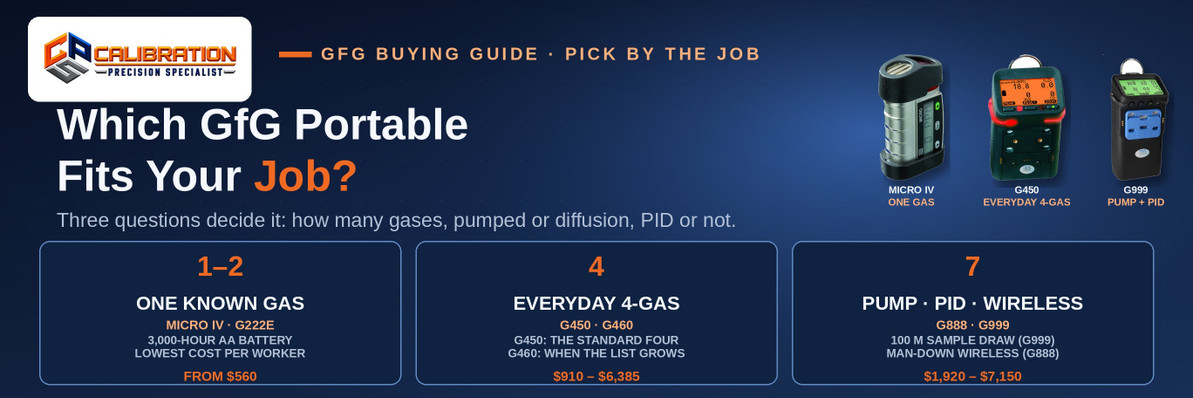
The right GfG portable is decided by three questions — how many gases, pumped or diffusion, and PID or not. One gas on a budget points to the Micro IV ($560–$1,820) or the two-slot G222E ($780–$2,625); standard 4-gas confined-space work splits between the G450 ($910–$3,405) and the 1–7 gas G460 ($1,590–$6,385); and VOC or team-visibility work lands on the wireless G888 ($1,920–$3,980) or the pumped, PID-capable G999 ($2,765–$7,150).
Do not start with the catalog. Start with the job: the gas list the work actually produces, whether the instrument has to pull a sample from somewhere the worker is not standing, and whether anybody besides the wearer needs to see the alarm. Answer those three and the GfG portable line narrows itself — this guide walks each answer to its pick, with the deciding fact and the live configured price for each. For the full model-by-model lineup behind these picks, see every GfG portable explained.
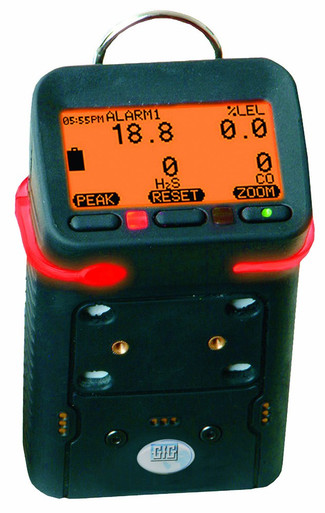
GfG G450 4-Gas Detector
The everyday pick: the standard four gases in 160 configurations, with MSHA-approved versions and an optional smart pump.
$910–$3,405 configured
See the G450If the Job Is One Known Gas: Micro IV or G222E
Who it’s for: plants where each worker’s hazard is a single known gas — one toxic to watch, all shift, on the lowest budget that still buys a real instrument.
The pick is the Micro IV. The deciding facts: smart sensors for 20 gases, up to 3,000 hours on one AA alkaline battery (the lowest running cost in the line), one-button operation, and a lifetime warranty on non-consumables — at $560–$1,820 across 42 gas-and-range configurations. Step up to the G222E ($780–$2,625, 73 configurations) when two gases travel together — CO with H2S is the classic pair — because its two electrochemical slots carry both in the smallest body GfG makes, and can even run a redundant pair of the same sensor. Buying a 4-gas instrument for a one-gas job spends the difference on sensors that will never alarm.
If the Job Is Everyday 4-Gas Confined-Space Work: G450 or G460
Who it’s for: crews doing routine confined-space entry and plant rounds against the standard four gases — LEL, O2, CO, H2S.
The default pick is the G450 at $910–$3,405. The deciding facts: those four gases are all it does, across 160 configurations that let you match battery (NiMH or alkaline), add the optional motorized smart pump for pre-entry sampling, and choose MSHA-approved versions where mining rules apply — in an IP67 housing with up to 24 hours of battery. The G460 at $1,590–$6,385 earns its premium on one deciding fact: the gas list can grow. It measures up to seven gases, and its sensor menu adds NDIR CO2, a COSH dual CO/H2S sensor, toxics like Cl2 and HCN, and a PID — so the crew whose work might add a fifth or sixth gas next year buys the G460 once instead of replacing the fleet. If the four standard gases are the whole job for the instrument’s life, the G450 is the honest buy.
If the Job Needs VOCs, a Real Pump, or Team Visibility: G888 or G999
Who it’s for: VOC survey and leak work, pre-entry sampling from outside the space, and lone-worker or team jobs where an alarm has to reach somebody besides the wearer.
The split here is the pump. The G888 ($1,920–$3,980) is a diffusion instrument: its deciding facts are the 915 MHz wireless radio with 300 m range and man-down alarm, a 23-hour runtime, and a lifetime warranty on the instrument and electronics. Buy it when the instrument stays on the worker and the team needs to see the alarm — do not buy it to sample a space before entry, because diffusion cannot pull a sample. That job belongs to the G999 ($2,765–$7,150): an integrated motorized pump with a 100 m sample draw that still runs diffusion on the worker, up to 47 hours of runtime on the four-gas G999C, and — in the G999P builds — a PID at 0–2,000 ppm for VOC work. If VOCs are the job but the instrument never has to sample remotely, the G460’s PID configurations are the lighter spend.
If the Job Is Specialty or High-Gas-Count Work
Who it’s for: chemical, utility, and specialty crews whose gas list runs past the standard four — chlorine, hydrogen cyanide, ammonia, nitrogen dioxide, phosphine, sulfur dioxide — or who need several of them on one instrument.
Both picks live in the 1–7 gas tier, and the deciding fact is the sensor menu, not the badge. The G460’s 130 configurations include those toxics alongside catalytic or infrared LEL, O2, CO2, and PID — and its COSH dual sensor reads CO and H2S in one slot, which is how a seven-channel build stays seven channels. The G999 adds the pumped and wireless versions of the same idea, plus two specialty families: G999P builds with hydrogen ranges (0–2,000 ppm or 0–4%) beside the PID, and G999S builds whose methane channel reads LEL, % volume, and ppm in one triple range — the build for gas-utility style work where one channel has to cover leak, purge, and percent-gas readings.
If the Job Is Supplied Air: The RAM Pick
Who it’s for: any crew breathing supplied air — OSHA 29 CFR 1910.134 requires the CO in that air to be monitored continuously, and a personal gas detector on the worker is not the instrument that does it.
The RAM 744 ($1,265–$5,210) is the pick when the job is CO only: it mounts inline with the filtration system, and its configurations bundle three-stage filter panels at 25, 50, or 100 CFM for up to 8 users. The RAM 4021 ($2,060–$6,020) earns the step up when the air system also has to prove O2 or dew point, or drive remote alarms — it adds relay contacts, dry contacts for a horn and lights, and medical DPX variants for NFPA 99 work. And where a plant panel already exists, the RAM 4035 ($1,220–$1,290) is simply the CO transmitter that feeds it a 4–20 mA signal. When the supplied-air points multiply and move indoors permanently, that is where the GfG fixed line takes over.
The Support Decision: How the Fleet Gets Tested
Who it’s for: anyone buying more than a couple of instruments. The detector decision is half the purchase; the other half is how a fleet gets bump tested every day and calibrated on schedule without eating a technician’s mornings.
The deciding fact is gas inlets. The DS400 ($2,895–$9,640) runs the full functional test, AutoCal calibration, and charging through one gas inlet and prints the certificates; the DS404 ($4,690–$9,810) adds three more inlets so multi-gas instruments test against every gas without cylinder switching — the right buy once the fleet is mostly 4-gas and up. Where the daily discipline is bump-only, the TS400 ($1,060–$1,410) and the G888/G999’s TX400 ($995–$1,160) cut the cost to the test itself, and Micro IV fleets get their own answer in the DI220 ($820). Fleets that would rather not own the station question at all can send the instruments in — CPS calibrates the line in-house.
The Picks at a Glance
| The job | The pick | The deciding fact | Configured price |
|---|---|---|---|
| One known gas, tight budget | Micro IV | One smart sensor, 3,000-hour AA battery | $560–$1,820 |
| Two gases travel together (CO + H2S) | G222E | Two electrochemical sensors, smallest body | $780–$2,625 |
| Standard 4-gas confined space | G450 | LEL/O2/CO/H2S in 160 builds, MSHA versions | $910–$3,405 |
| 4-gas today, more gases tomorrow | G460 | 1–7 gases; PID, CO2, and COSH sensor menu | $1,590–$6,385 |
| Wireless team monitoring | G888 | 915 MHz radio, man-down alarm, diffusion | $1,920–$3,980 |
| Pumped sampling and PID work | G999 | Integrated pump, 100 m draw, PID 0–2,000 ppm (G999P) | $2,765–$7,150 |
| Supplied breathing air | RAM 744 / 4021 | OSHA 1910.134 CO monitoring, filter panels to 8 users | $1,265–$6,020 |
| Fleet bump testing and calibration | DS400 / DS404 | 1 vs. 4 gas inlets; automatic tests, records, certificates | $2,895–$9,810 |
Frequently Asked Questions
Which GfG detector should I buy for confined space entry?
For standard confined-space entry against LEL, O2, CO, and H2S, the G450 ($910–$3,405) is the pick — add its smart pump configuration for pre-entry sampling. Move to the G460 ($1,590–$6,385) when the space’s gas list runs past the standard four or may grow, because it measures up to seven gases with PID and CO2 options.
Is the G460 worth the extra money over the G450?
Only when the gas list justifies it. The G450 covers the standard four gases completely, in 160 configurations from $910. The G460’s premium buys headroom: up to seven gases, NDIR CO2, a COSH dual CO/H2S sensor, toxic sensors, and a PID. If none of those will ever be fitted, the G450 is the better spend.
Which GfG portable is best on a small budget?
The Micro IV, from $560. It is a true single-gas instrument — smart sensors for 20 gases, up to 3,000 hours on one AA battery, lifetime warranty on non-consumables — so the low price does not buy a stripped-down detector, just a focused one.
Do I need a pumped or a diffusion gas detector?
Diffusion is for gas that reaches the worker — personal monitoring while working in the space. A pump is for gas that has to be pulled to the instrument: pre-entry testing from outside, leak checking, and sampling remote points. In the GfG line that means the G999’s integrated pump (100 m draw), or a G450/G460 configuration with its smart pump fitted.
Which GfG detector measures VOCs?
The PID configurations: the G460 offers a PID at 0–2,000 ppm in 30 of its 130 configurations, and the G999P builds the same PID range into a pumped, optionally wireless instrument. The G888’s configurations do not include a PID.
What is the difference between the G888 and the G999?
The pump, and everything that follows from it. The G888 is diffusion-only, wireless, and built for team visibility with a man-down alarm and 23-hour runtime. The G999 adds an integrated motorized pump with a 100 m sample draw, PID builds (G999P), triple-range methane builds (G999S), and up to 47 hours of runtime on the four-gas version.
Can one GfG sensor read CO and H2S at the same time?
Yes — the COSH dual sensor reads CO (0–500 ppm) and H2S (0–100 ppm) in a single slot. It appears in G460 configurations and in G999P builds, and it is how a high-gas-count build keeps a slot free for another gas.
What do I need to bump test and calibrate a GfG fleet?
A station matched to the fleet: the DS400 (one gas inlet) or DS404 (four inlets) for automatic full tests, AutoCal calibration, charging, and printed certificates; the TS400 or TX400 where the daily requirement is bump testing only; and the DI220 for Micro IV fleets. The inlet count is the deciding fact — four-gas fleets test fastest on the DS404.
Which GfG monitor is for supplied breathing air?
The RAM line, built for OSHA 29 CFR 1910.134 CO monitoring: the RAM 744 for inline CO with filter panels up to 8 users, the RAM 4021 where O2 or dew point and alarm relays are also needed, and the RAM 4035 where the CO reading only has to reach an existing panel as a 4–20 mA signal.
Why does the same GfG model cost so much more in one configuration than another?
Because a configuration is a factory build, not a trim level. On the G450, the $910–$3,405 spread is sensor count, battery type, the smart pump, MSHA approval, and kit contents; on the G460, PID and CO2 sensors move the price most. Price the build your job needs — the cheapest configuration of the right model beats the wrong model at any price.
The Bottom Line
Three questions pick the instrument: how many gases (Micro IV/G222E for one or two, G450 for the standard four, the 1–7 tier beyond that), pumped or diffusion (G999’s integrated pump or a smart-pump build when the sample has to travel), and PID or not (G460 or G999P configurations). Answer them from the job, then spend the rest of the decision on the two things buyers forget: the station that keeps the fleet tested, and the RAM monitor that keeps supplied-air work legal.
Need a calibration you can file?
In-house calibration at CPS in Rockwood, Tennessee — $55 for single-gas instruments, $90 for 4- and 5-gas — every channel, as-found and as-left data, full certificate.
See Calibration Servicesor call 865-900-8844
Recent Posts
-

Which GfG Portable Gas Detector Is Best for You?
The right GfG portable is decided by three questions — how many gases, pumped or diffusion, and PID …Nov 24th 2026 -

What GfG Fixed Gas Detection Systems Are There? Every Transmitter and Controller Explained
GfG’s fixed gas detection line at CPS is 39 products in two layers: 23 transmitters and detection sy …Nov 24th 2026 -
What GfG Portable Gas Detectors Are There? Every Model Explained
GfG’s portable line at CPS is 14 products built around six instruments: the Micro IV single-gas dete …Nov 24th 2026