
Crowcon
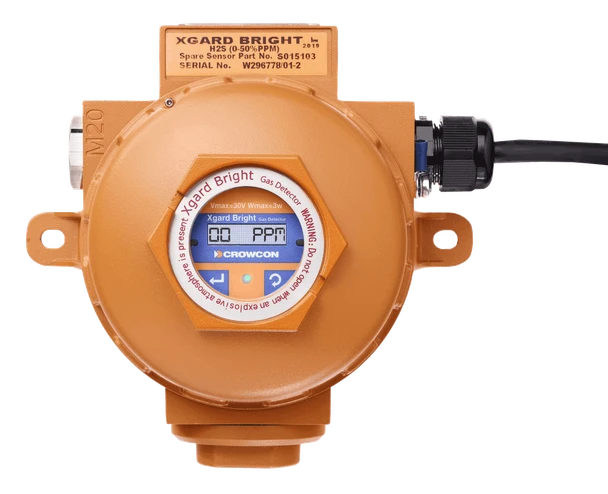
Crowcon XSafe Fixed Gas Detector (Safe Area)
- SKU:
- CROWCON-XSAFE
- Availability:
- Usually ships in 3 business days

Description
The Crowcon XSafe is the safe-area member of the Xgard fixed detector family — the same robust junction-box design as the hazardous-area Xgard types, built for areas that are not classified as hazardous, so it carries no hazardous-area certification. This page lists two XSafe builds in one dropdown.
The X Safe Bright (XSB) configurations bring the Xgard Bright platform to safe areas, with a bright OLED display, non-intrusive calibration with a magnetic wand, 4-20mA and RS-485 Modbus RTU outputs, alarm and fault relays and optional HART, plus long-life sensor options including MPS, infrared and PID across toxic gases, carbon dioxide and volatile organics. The classic XSafe configurations are the original safe-area flammable-gas detector for methane or propane at 0-100% LEL, using a catalytic bead (pellistor) sensor with a choice of 3-wire 4-20mA (mA) or 3-wire mV bridge (mV) output for a control panel, and every classic configuration is NON CERT, exactly as stated in the dropdown. Every configuration on this page is a safe-area build, so none of them may be installed in a classified hazardous location.
How to read the configuration code: XSB codes are X Safe Bright builds — housing (A1 = aluminium M20, A3 = aluminium M20(1/2), S1 = stainless steel M20, S2 = stainless steel 1/2" NPT), the 03 safe-area block, then comms (HA/HB/HC = HART fitted, ZA/ZB/ZC = no HART), R = relays fitted, and the gas code. Classic codes (C011xxx / C019xx) are the original XSafe — mA or mV output, methane or propane, M20 or 1/2" NPT — and are NON CERT. Every configuration in the dropdown also spells out its build, gas and range in full.
Common Applications:
Battery & Energy Storage • Warehousing • Water & Wastewater • Chemical Plants • Manufacturing • Commercial Buildings
Need help selecting the right configuration? Call CPS Calibrations at (865) 900-8844 — every configuration on this page is a factory Crowcon build, and we calibrate what we sell.
- Safe-area, non-certified design — for areas that are not classified as hazardous; no ATEX, UL or CSA hazardous-location approval applies to any configuration on this page
- Two builds in one product: X Safe Bright (XSB) display transmitters and classic XSafe mA / mV detectors
- XSB: bright OLED display with non-intrusive calibration and setup via magnetic wand — no need to open the housing and no hot-work permit
- XSB: 3-wire 4-20mA (sink or source) and RS-485 Modbus RTU outputs, with alarm and fault relays as standard and HART 7 on the configurations that state it
- XSB: long-life sensor options — MPS and infrared flammable sensors (10+ years) and PID for volatile organics — minimise sensor replacements
- XSB: electrochemical sensors for toxic gases including hydrogen sulfide, chlorine, chlorine dioxide, ammonia, nitrogen dioxide, nitric oxide, sulfur dioxide, hydrogen cyanide, hydrogen peroxide and ozone
- Classic XSafe: catalytic bead (pellistor) sensor for methane or propane, 0-100% LEL
- Classic XSafe: 3-wire 4-20mA (mA) or 3-wire mV bridge (mV) output to suit the control panel
- Universal Xgard junction box — sensors and sinters are plug-in, so replacement takes minutes, and many spares are common across the Xgard family
- Wall or ceiling mounting with no additional brackets; accessories available for duct mounting, sampling and remote gassing
| Gases & Ranges (listed configurations) | Hydrogen sulfide: 0–10 ppm; Chlorine dioxide: 0–1 ppm; Hydrogen peroxide: 0–5 ppm; Ozone: 0–1 ppm; Chlorine: 0–5 ppm, 0–10 ppm; Ammonia: 0–50 ppm, 0–100 ppm; Nitrogen dioxide: 0–5 ppm; Sulfur dioxide: 0–10 ppm; Hydrogen cyanide: 0–25 ppm; VOC (PID): 0–1000 ppm; Carbon dioxide: 0–5% vol; Nitric oxide: 0–50 ppm; Flammable gas (MPS): 0–100% LEL; Methane: 0–100% LEL; Propane: 0–100% LEL |
| Configuration builds | X Safe Bright (XSB) display transmitter; Classic XSafe with mA or mV output — build stated in every configuration |
| Size — X Safe Bright (XSB) | Aluminium: 156 x 166 x 109 mm (6.1 x 6.5 x 4.3 in); Stainless steel: 165 x 166 x 105 mm (6.1 x 6.5 x 4.1 in) |
| Size — Classic XSafe | 156 x 166 x 111 mm (6.1 x 6.5 x 4.3 in) |
| Weight | Aluminium: 1 kg (2.2 lbs); 316 stainless steel: 3.1 kg (6.8 lbs) |
| Enclosure material | XSB: ADC 12 aluminium alloy or 316 stainless steel (per configuration); Classic: aluminium |
| Ingress protection | XSB: IP65/66 (EN 60529); Classic: IP65 |
| Cable entries | XSB: 2x M20 or 2x 1/2" NPT per housing code (stopping plug fitted to left-side entry); Classic: 1x M20 or 1/2" NPT on right side |
| Operating voltage | XSB: 10-30 V dc; Classic mA: 10-30 V dc; Classic mV: 2.0 V dc (bridge) |
| Power | XSB: 3 W max; Classic mA: 50 mA at 24 V dc (1.2 W); Classic mV: 300 mA (typical) |
| Electrical output — XSB | 3-wire 4-20mA (sink or source); RS-485 Modbus RTU; HART 7 optional (fitted on configurations that state HART) |
| Electrical output — Classic | mA: 3-wire 4-20mA (current sink or source); mV: 3-wire mV bridge, typical signal 12-15 mV/%LEL CH4 |
| Relay output — XSB | Alarm 1, Alarm 2, Fault — SPDT contacts rated 1A, 24 V dc |
| Sensor types | XSB: electrochemical, infrared, MPS and PID, per configuration; Classic: catalytic bead (pellistor) |
| Operating temperature | Sensor dependent — see the datasheet gas tables; Classic: mV -40 to +80 °C, mA -40 to +55 °C |
| Humidity | 0-95% RH non-condensing (XSB); 0-99% RH non-condensing (Classic) |
| Repeatability / zero drift | XSB: +/-2% FSD repeatability, +/-2% FSD per year zero drift max; Classic: <2% FSD typical, <2% FSD per month typical |
| Approvals | NONE — safe-area product. XSB configurations are the non-certified safe-area (03) build; classic XSafe is NON CERT and is listed in the Xgard datasheet as not certified for use in a hazardous environment. Do not install in classified hazardous locations |
Product Documents & Resources
- XSafe Datasheet (PDF)
Document files are being added to this page. Need one now? Email info@cpscalibrations.com and we'll send it straight over.