
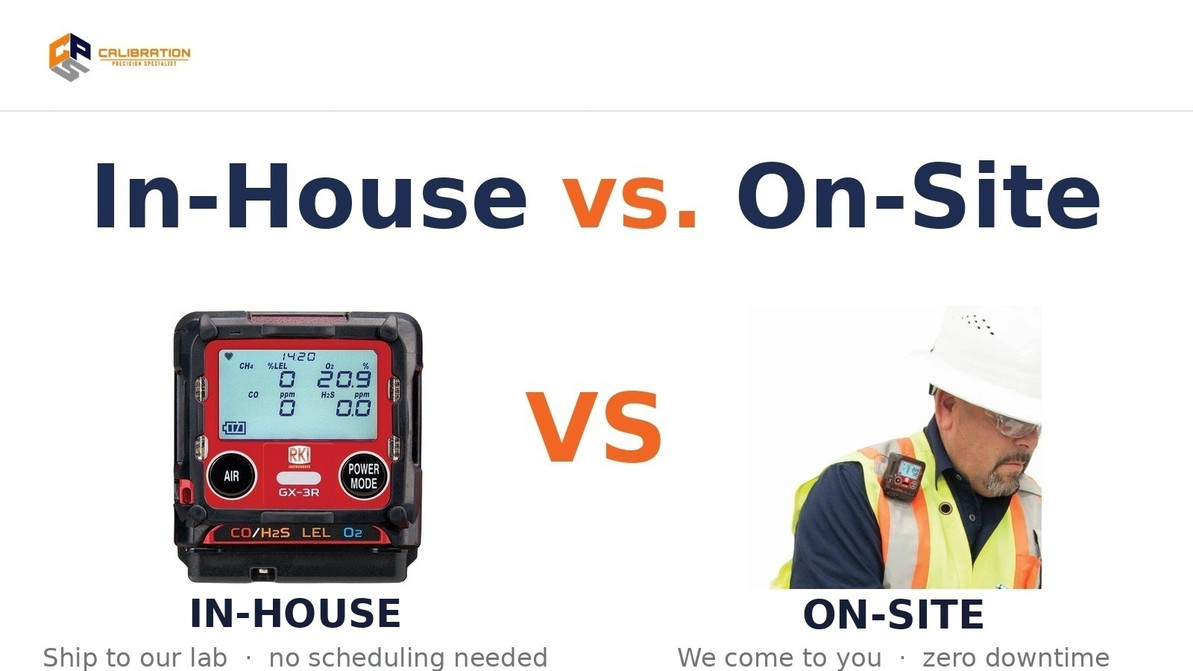
In-House vs. On-Site Calibration: Which One Does Your Facility Need?
Every safety manager with a fleet of gas detectors eventually faces the same decision: box up the instruments and ship them to a calibration lab, or have the calibration technician come to you. Both keep you compliant. Both end with certified instruments. But they differ in convenience, downtime, and hassle — and picking the wrong one wastes time in both directions.
Here's the straight version, from a company that does both every week.
The Short Answer
- Fewer than ~10 instruments: ship them in (or drop them off). No visit to schedule, no minimum — just box them up when it's convenient.
- ~10 or more instruments at one location: have us come to you. Zero downtime, the whole fleet done in a day, one stack of certificates.
- Either way: the calibration itself is identical — same traceable gas, same full certificate, same thorough job.
What In-House (Ship-In) Calibration Is — and When It Wins
In-house calibration means your instruments come to us instead of us coming to you. You box up your detectors, write the RMA number on the box, and send them to our lab in Rockwood, Tennessee. If you're local, you can just drop them off in person.
Why it wins for smaller fleets:
- Fast turnaround. 3–5 business days of bench time, and your instruments come home calibrated, certified, and stickered with fresh due dates.
- Repairs are easier here. A bad sensor, weak pump, or cracked case gets diagnosed on the bench. We call you with repair options before doing anything extra — you'll never pay for work you didn't approve.
- No scheduling. Ship on your timeline — there's no visit to coordinate and no minimum.
- Two minutes to start. Our online RMA form takes about two minutes. Your RMA number arrives by email with packing instructions.
When ship-in is the clear winner: you have a handful of instruments, a few spares to cover the downtime, or units that need repair work alongside calibration. It's also the natural choice if your instruments live in different locations — shipping them to one lab beats coordinating a site visit around scattered equipment.
What On-Site Calibration Is — and When It Wins
On-site calibration flips it around: our technician comes to your facility with everything needed to calibrate your fleet right there on the spot. All you need is a table near an outlet and the instruments gathered in one place.
Why it wins for larger fleets:
- Zero downtime. Calibrations happen during your workday. Nobody's waiting on a UPS truck to bring their meter back, and nobody works a shift without one.
- No shipping, no risk. No packing, no freight damage, no instruments sitting in a warehouse for a week. They never leave your site.
- Whole fleet, one day. Everything that's due gets done in a single visit — half a day to a full day, depending on fleet size. Your safety manager gets one stack of certificates, all dated the same.
- One visit, one stack of certificates. Everything calibrated the same day, all dated the same — your compliance records stay simple.
When on-site is the clear winner: ten or more instruments at one location, crews that can't be without their meters for a week, or a compliance calendar where having everything calibrated on the same date simplifies your records. Fire departments, utilities, and plants running multi-shift operations feel this difference the most.
Which One Fits Your Operation?
Forget the spreadsheet for a minute. The real question is which option disrupts your operation less.
Ship-in is less hassle when: you have a handful of instruments, a few spares to cover the gap, and no need to coordinate schedules. Box them up, send them off, and get back to work — 3–5 business days of bench time and they're home calibrated, certified, and stickered.
On-site is less hassle when: you have ten or more instruments in one place and crews that can't be without their meters. No packing, no tracking a box, no week of loaners — just gather the fleet at a table and our technician knocks it out in half a day to a full day.
Neither option is "basic" or "premium" — they're different logistics for different situations. The right answer is whichever one keeps your operation running smoothest.
What Doesn't Change: The Calibration Itself
This is the part that matters most, and it's the part some providers get wrong. With us, there is no "light" version of calibration for on-site visits. Every instrument gets the full job, either way:
- Every sensor bump-tested, calibrated, and verified — we calibrate every channel
- Alarm and function testing
- Pump and flow checks, filter inspection
- Fresh-air/zero adjustment with NIST-traceable calibration gas (lot numbers recorded)
- As-found and as-left readings on every channel
- Measurement uncertainty and pass/fail against manufacturer specs
- A detailed, audit-ready certificate — emailed as PDF with a QR code that pulls up the live certificate for auditors
- A fresh due-date sticker on the unit, and free automatic reminders before the next cycle
Our own calibration software runs both workflows, so your records look the same whether the instrument came to us or we came to it. And our no-surprise promise travels with the technician: if something needs a repair during an on-site visit, we tell you on the spot and quote it before touching anything.
Special Cases Worth Knowing
You also run process instruments. Many plants calibrate gas detectors and process instruments on different schedules — pressure transmitters, flow meters, temperature — but there's real value in asking whether a service visit can cover more than one instrument type. One trip, one quote, one set of records.
Wall-mounted fixed systems. Fixed gas detection is screwed to the wall — and for those, sending a technician out is usually not the answer. A site visit just to service something bolted to a wall rarely makes sense, and the farther out you are, the worse that math gets. The better options: pull the unit off the wall and ship it to us, or buy the calibration gas and equipment and we'll teach you to calibrate it yourself over the phone. Either way beats paying for a truck roll to unscrew something from a wall.
Audit season. If an audit is coming and you need a stack of current certificates with matching dates, an on-site visit gets your whole fleet recertified in one day. One date on every certificate makes an auditor's job easy, and an easy audit is a good audit.
The mixed fleet. Got twenty instruments but six are spread across satellite locations? Ship the stragglers in, bring the tech out for the main plant. We'll help you work out the split — call us and we'll do the math with you.
FAQ
When does on-site calibration start making sense?
There's no hard minimum, but around 10 instruments at one location is the rule of thumb. Below that, boxing them up is usually less hassle than scheduling a visit. Above that, gathering the fleet at one table for a day beats packing, shipping, and tracking a box for a week. Not sure where you land? Call us and we'll help you decide.
Is on-site calibration as accurate as lab calibration?
Yes. The calibration uses the same NIST-traceable calibration gas, the same procedures, and the same software — and produces the same detailed certificate with as-found/as-left readings, measurement uncertainty, and CoA links. The only difference is the location.
What if an instrument needs repair during an on-site visit?
We tell you on the spot and quote the repair before doing anything. You'll never get a surprise on the invoice — that's the same promise we make in the lab.
Can I just drop off my detectors instead of shipping them?
Yes — bring them to our lab at 109 S. Front Street, Rockwood, TN during business hours. Get your RMA number online first and we'll check you in fast.
Do I get calibration certificates with on-site service?
Yes — detailed certificates for every instrument: as-found/as-left readings, the traceable gas lots used, Certificate of Analysis links, measurement uncertainty, and pass/fail. Same audit-ready documentation as our lab service.
How long does an on-site visit take?
It depends on your fleet — most visits run from half a day to a full day. When you request a quote, we give you a straight estimate so you can plan the day.
The Bottom Line
Ship in when your fleet is small and you have the time. Bring us out when your fleet is big and you don't. Either way, the calibration — the part that keeps your crew safe and your auditors happy — is exactly the same.
Fewer than ~10 instruments? Start an RMA — two minutes, and your box is on its way.
Ten or more? Request an on-site quote — one custom quote, whole fleet, one day.
Or just call 865-900-8844 and tell us what you've got. We'll help you pick whichever option is less hassle for your operation.
Recent Posts
-

Electrochemical Toxic Sensors: Cross-Sensitivities That Fool Your Readings
Your carbon monoxide alarm goes off in the battery room. You sweep the area — there's no CO source a …Oct 8th 2026 -

Why Oxygen Sensors Die — and How to Make Them Last
Every 4-gas monitor has an oxygen channel, and it's the only channel with a built-in expiration date …Oct 7th 2026 -

Catalytic Bead vs. Infrared LEL Sensors: When Each Wins
Most gas detectors read %LEL the same way on the display. What's happening behind that number is any …Oct 6th 2026