
Zero vs. Span Calibration: What's the Difference?
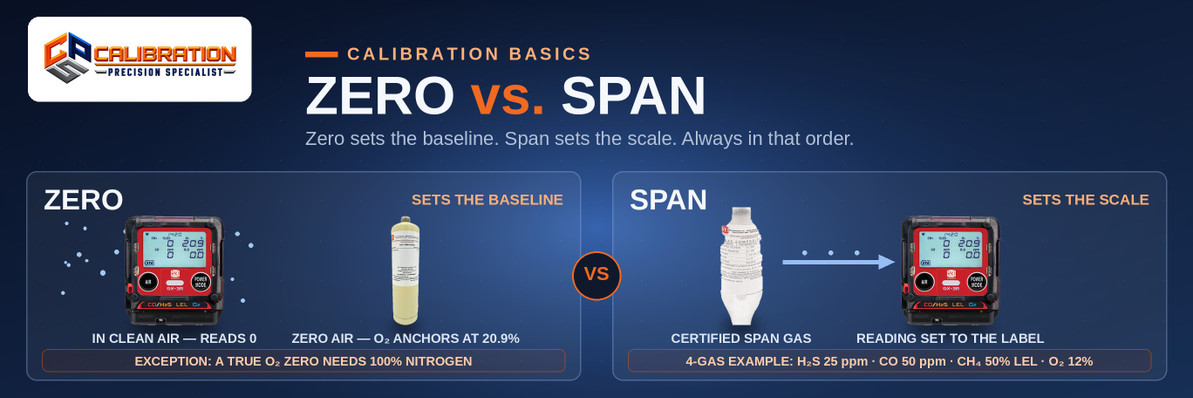
Zero calibration sets a gas detector's baseline — it tells the instrument what "no gas" reads like, using clean fresh air, a zero-air cylinder (20.9% oxygen in nitrogen), or pure nitrogen for the oxygen channel — while span calibration sets its accuracy at the top of the scale, exposing the sensors to a certified gas of known concentration and adjusting the reading to match it. A full calibration always does both, zero first: zero without span leaves the instrument's slope unverified, and span without a true zero builds every reading on a shifted baseline.
Two adjustments, two different gases, two different failure modes. Most calibration confusion — and most bad readings that "passed calibration" — comes from treating them as one step. This post separates them: what each one physically does inside the instrument, which gas each one needs, and the specific ways readings go wrong when one is skipped or done badly. For the balance-gas half of the story — why the nitrogen or air behind the target gases matters — see air balance vs. nitrogen balance.
What Does Zero Calibration Actually Do?
Zero calibration fixes the instrument's reference point. OSHA's calibration bulletin puts it in one line: an operator zeroes an instrument to reset its reference point, and in some cases a cylinder of "zero air" gas is needed to do it. After a proper zero:
- Toxic and LEL channels read zero in gas-free air.
- The oxygen channel reads 20.9% — because fresh air is not "zero oxygen," and the zero step is where the instrument anchors itself to that fact. BW's MicroClip procedure shows the pattern clearly: its auto-zero step zeroes the toxic and combustible sensors and calibrates the oxygen sensor against the ambient air in one motion.
Where the zero happens matters as much as how. Zero in genuinely clean air, or don't zero at all: if the "fresh air" around the instrument carries even a few ppm of the target gas, the instrument learns that contamination as its baseline, and every later reading is offset by that amount — the mechanism behind the classic negative-reading complaint, where a monitor zeroed near an idling forklift reads −5 ppm CO in clean air.
What Does Span Calibration Actually Do?
Span calibration fixes the instrument's slope — the conversion from sensor signal to displayed concentration. The sensors are exposed to a certified gas whose concentration is known and traceable (OSHA: calibration gas should always be certified using a standard traceable to NIST), and the instrument adjusts its reading to coincide with that value. One point, set exactly: if the cylinder says 50 ppm CO, after a span the instrument reads 50 ppm CO in that gas.
Because it is a single-point adjustment at a working concentration, span is where accuracy at alarm levels is won or lost. The span value has to match the cylinder in hand, and the instrument has to be told the same number — Honeywell's support guidance for its MicroClip line is explicit that the calibration-gas values set in the instrument must match the values on the gas cylinder. A cylinder swapped for a different concentration without updating the instrument's span setting produces a confident, precise, wrong calibration.
Zero vs. Span at a Glance
| Zero calibration | Span calibration | |
|---|---|---|
| What it sets | The baseline — what "no gas" reads like | The slope — what a known concentration reads like |
| Gas used | Clean fresh air, zero air (20.9% O₂ / balance N₂), or N₂ for O₂ and CO₂ channels | Certified span gas at a known concentration, NIST-traceable |
| Typical value | 0 ppm toxics/LEL; O₂ anchored at 20.9% | The cylinder's label value — e.g., H₂S 25 ppm, CO 50 ppm, 50% LEL |
| Order | Always first | Always second, built on the zero |
| If it's wrong | Every reading is offset by a fixed amount, everywhere | Readings are right near zero and increasingly wrong as concentration climbs |
| How often | Before span, and whenever the baseline drifts | On the calibration schedule, and after any failed bump or calibration check |
Why Does the Order Matter — Zero First, Then Span?
Because span is arithmetic performed on top of zero. The instrument measures the sensor's signal in the span gas, subtracts the baseline it recorded at zero, and scales the difference to the certified concentration. If the baseline it subtracted was wrong — zeroed in dirty air, or zeroed before the sensor had stabilised — the scaling is computed from a false starting point, and the "calibrated" instrument carries a built-in offset at every concentration. That is why every manufacturer's procedure runs the same way: the MicroClip zeroes all of its sensors first and only then displays APPLY GAS; RKI's instruments take their fresh-air adjustment before the span gas is applied. The sequence is not a preference; it is how the maths works.
What Goes Wrong When Only One Is Done?
Zero only. The instrument reads a clean, convincing zero — and nothing else is verified. Sensor output falls as sensors age, so an instrument that is only ever zeroed quietly under-reads real gas: at an actual 100 ppm it may display 70, and at alarm concentrations it alarms late or not at all. Zeroing proves the baseline; it says nothing about whether the top of the scale still exists.
Span only. A span performed over a drifted or contaminated baseline locks the offset in and scales it. The instrument now reads the span gas correctly by construction — it was forced to — while its zero sits wherever the bad baseline put it, and readings at low concentrations, where exposure limits live, are shifted by the error. Worse, a span over a badly poisoned sensor may not take at all: OSHA notes that after certain exposures, an instrument being calibrated will display a failure message or refuse to let the operator fully adjust the reading — at which point the answer is a sensor, not another attempt.
Zero in the wrong place. The most common single error in the field. Zeroing in air that isn't clean doesn't just fail to help — it manufactures the offset, and because the instrument now trusts that baseline, the error survives until the next proper zero. Auto-zero-on-startup features make this effortless to do wrong: power up in the work area instead of in clean air and the instrument baselines itself to the workplace.
Which Gas Does Each Channel Zero With?
Fresh air covers most channels most of the time — but three channels have their own rules:
- Oxygen. You cannot zero an oxygen sensor in air; air at the sensor is the 20.9% anchor. A true O₂ zero — used in O₂ calibration routines that call for it — requires oxygen-free gas: 100% nitrogen. (This is also why the standard quad mix can carry a reduced oxygen content for span purposes while the instrument's everyday O₂ reference stays 20.9%.)
- CO₂ (infrared). An IR CO₂ sensor cannot be zeroed in ordinary air either, because ordinary air already contains CO₂. BW's Micro 5 manual states it directly: nitrogen must be used to zero the CO₂ sensor.
- LEL (catalytic). The zero itself is unremarkable — but the span gas for a catalytic bead must contain oxygen, because the bead measures by burning the target gas. This is the balance-gas question, and it is why quad mixes for LEL duty are built the way they are; air balance vs. nitrogen balance works through it sensor by sensor.
For bottled zero duty, zero air is a defined product: a synthetic blend of 20.9% oxygen in nitrogen, hydrocarbon-free — our zero air listing runs $45–$325 depending on cylinder size. Span gas is the certified mix matched to the instrument — the standard 4-gas blend starts at $184 in our calibration gas range.
The Bottom Line
Zero and span are not two names for calibration; they are its two halves. Zero fixes the baseline in air — or gas — that is known to be clean; span fixes the slope against a certified concentration, and only means anything when it is built on a true zero. Skip the span and the instrument's accuracy at working concentrations is a rumour. Skip or botch the zero and every reading inherits the offset. Do both, in that order, with the right gas for each — that is a calibration.
Zero air, span gas, or a bench calibration that does both halves properly — CPS stocks the gases and calibrates every channel. Call 865-900-8844 or reach us through Contact Us.
Frequently Asked Questions
What is the difference between zero and span calibration? Zero calibration sets the instrument's baseline — it tells the detector what "no gas" reads like, using clean fresh air, a zero-air cylinder (20.9% oxygen in nitrogen), or nitrogen for the oxygen and CO₂ channels. Span calibration sets the instrument's accuracy at a working concentration: the sensors are exposed to a certified gas of known concentration and the reading is adjusted to match it. Zero fixes where the scale starts; span fixes how the scale climbs. A full calibration always does both, zero first.
Which comes first, zero or span calibration? Zero, always. Span calibration is arithmetic built on the baseline: the instrument takes the sensor's signal in the span gas, subtracts the recorded zero, and scales the difference to the cylinder's certified concentration. A wrong zero therefore corrupts the span calculation itself. Manufacturers build the order into their procedures — BW's MicroClip, for example, zeroes all of its sensors and calibrates the oxygen channel first, and only then prompts APPLY GAS for the span step.
What gas do you use for zero calibration? For most channels, clean fresh air is the zero medium: toxic and LEL sensors are zeroed in air free of their target gases, and the oxygen channel anchors to fresh air's 20.9%. Where the air can't be trusted, a zero-air cylinder — a synthetic 20.9% oxygen / nitrogen blend — provides a controlled baseline ($45–$325 by cylinder size at CPS). Two channels cannot be zeroed in air at all: an oxygen sensor's true zero needs 100% nitrogen, and an infrared CO₂ sensor must be zeroed with nitrogen because ordinary air already contains CO₂.
What happens if you only zero a gas detector and never span it? The instrument reads a perfect zero and unverified everything else. Sensor output declines as sensors age, so with no span adjustment the detector progressively under-reads real gas: it can display 70 ppm in an actual 100 ppm atmosphere and reach its alarm setpoints late. Zeroing proves the baseline is clean; only the span step proves the instrument still measures accurately at the concentrations that trigger alarms and exposure limits.
What happens if you span a gas detector without zeroing it first? The span adjustment is calculated from whatever baseline the instrument happens to hold — including a drifted or contaminated one — so the offset is baked into the calibration and carried to every reading. The instrument will read the span gas correctly because it was forced to, while low-level readings, where exposure limits are judged, stay shifted by the baseline error. If the baseline problem is a dying sensor, the span may fail outright: OSHA notes such instruments display a failure message or refuse the full adjustment, which is the signal to replace the sensor.
Why does my gas detector read 20.9% after a zero calibration? Because the oxygen channel is supposed to. Zeroing anchors the oxygen sensor to fresh air, which is 20.9% oxygen — the zero step for an O₂ sensor is a calibration to 20.9%, not to zero. BW's MicroClip procedure does exactly this: its auto-zero step zeroes the toxic and combustible sensors while calibrating the oxygen sensor against the ambient air. A true oxygen zero — reading 0.0% — is only possible in oxygen-free gas such as 100% nitrogen, and is used only where a procedure specifically calls for it.
Can you zero a gas detector in any air? No — the zero is only as good as the air it's taken in. If the surrounding air carries even a few ppm of the target gas, the instrument adopts that contamination as its baseline, and the error reappears in clean air as an offset reading — classically, a small negative reading on the affected channel. Zero where the air is verifiably clean, away from engines, welding, and process vents, or use a zero-air cylinder and remove the guesswork.
How often should zero and span calibration be done? The span belongs to the full-calibration schedule — the interval your manufacturer sets (BW's standing recommendation for its portables, for example, is a calibration at least once every 180 days) — and to any event that calls accuracy into question, such as a failed bump test. The zero is done as part of every full calibration, before the span, and on its own whenever the baseline visibly drifts in known-clean air. The daily check in between remains the bump test, which verifies function without adjusting either setting.
Does zero calibration use the same gas as span calibration? No — they are different products bought for different jobs. Zero gas is a baseline medium: fresh air, bottled zero air (20.9% O₂ in nitrogen), or pure nitrogen for the channels that need an oxygen-free zero. Span gas is a certified mixture at the exact concentrations the instrument will be set to — a standard 4-gas blend, for example, carries H₂S 25 ppm, CO 50 ppm, CH₄ 50% LEL, and O₂ 12% in nitrogen, with a certificate of analysis behind it. The instrument's span settings must match the cylinder's label values exactly.
Why won't my gas detector hold a zero? A baseline that won't stay put is diagnostic information. The common causes are a contaminated zero (the air wasn't clean), a sensor still stabilising after power-up or after a big temperature or humidity change, and a sensor at end of life whose output wanders faster than calibration can correct. Work them in that order: re-zero in verified clean air after full warm-up, then bump test and run a full zero-and-span calibration. A sensor that still won't hold its baseline after a correct full calibration is telling you it is finished — replacement, not another recalibration, is the fix.
CPS Calibrations · 109 S. Front Street, Rockwood, TN 37854 · Calibration Gas · Calibration Services · Contact Us
Recent Posts
-

Why Does Gas Detector Data Logging Matter? The Paper Trail Your Incidents Need
Gas detector data logging matters because it is the only objective record of an incident: a data-log …Oct 22nd 2026 -

What Is a Confined Space? OSHA's Definition, the 3 Tests, and When It Becomes Permit-Required
A confined space is a space that passes all three of OSHA's tests at the same time: it is large enou …Oct 21st 2026 -
PID vs. LEL for VOC Detection: Which Sensor Do You Actually Need?
Use a PID to detect VOCs and an LEL sensor to detect explosive atmospheres — they measure different …Oct 21st 2026