
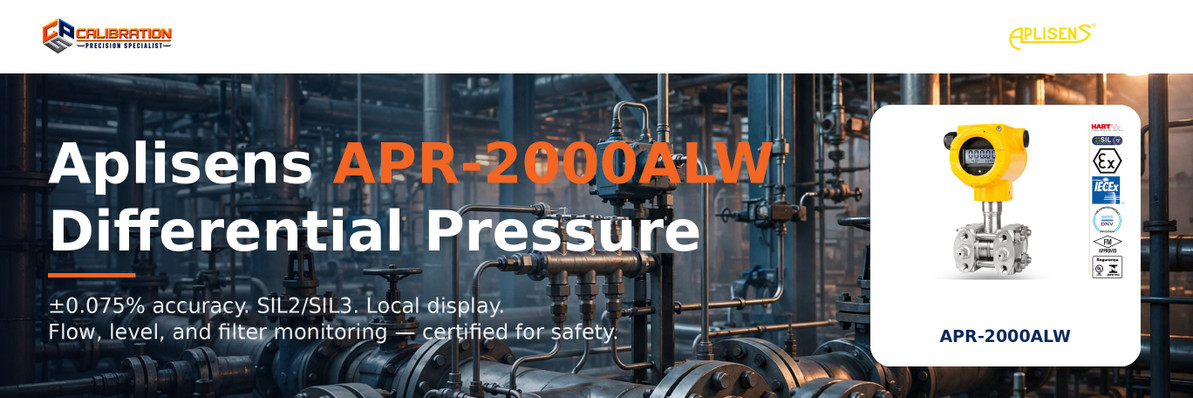
Aplisens APR-2000ALW: Smart Differential Pressure Transmitter with SIL2
Differential pressure is the hardest-working measurement in the plant. It meters flow through orifice plates and pitot tubes, watches filters load up, measures tank level from the bottom up, and derives density. And it's the measurement most people under-specify — because a DP error doesn't just add, it multiplies.
Here's why: flow from differential pressure follows a square-root relationship. A 1% error in DP becomes roughly a 0.5% error in flow — but more importantly, at low flows the math punishes you. Accuracy in a DP transmitter isn't a luxury spec; it's the foundation every derived measurement stands on. The Aplisens APR-2000ALW starts at ±0.075% — with ±0.05%, ±0.04%, even ±0.025% available — because Aplisens understands what that number has to carry.
What SIL2/SIL3 Certification Really Means
Anyone can print "suitable for safety applications" on a datasheet. SIL certification means an independent body verified the failure rates, the diagnostics, and the systematic capability — and that the transmitter belongs in a safety-instrumented function up to SIL2 (or SIL3 in redundant architectures). If your HAZOP calls for a certified DP measurement on a shutdown function, this is the paperwork that lets you install it and sleep at night. The APR-2000ALW has it.
Designed to Survive Its Own Process
DP transmitters live between two process connections, and processes surge. The APR-2000ALW's sensing element is built to withstand pressure spikes and overloads up to hundreds of bar without shifting calibration — because a transmitter that needs recalibration after every water hammer isn't a transmitter, it's a hobby.
The sensor is fully welded, which matters more than it sounds: the oil-filled sensing system stays sealed for years. Cheap DP transmitters lose fill fluid slowly through seals, and the symptom is a mysterious drift nobody can explain until someone replaces the unit. Welded construction eliminates that failure mode.
And the static pressure rating — up to 420 bar, with 1000 bar options — means the transmitter handles high line pressure with the DP signal riding on top of it. High-pressure steam, hydraulics, wellhead service: the line pressure doesn't faze it.
The Display You'll Actually Use
The ALW in the name means a backlit local display, rotatable 0–340° with the housing, plus configuration keys. That sounds like a convenience feature until you're commissioning at 2 AM: zero, span, damping, units, and characteristic — set at the instrument, no HART communicator required. It turns two-person commissioning into one-person commissioning and makes troubleshooting a walk-up job instead of a control-room phone call.
HART 5/7 is still there for remote configuration, diagnostics, and multidrop — you get both worlds.
When the Process Fights Back
Some processes can't be piped to a transmitter with impulse lines: viscous fluids that won't transmit pressure through a small tube, corrosive media that eat standard diaphragms, sanitary applications that can't tolerate dead legs. That's what the diaphragm-seal versions are for — the seal mounts at the process, the capillary transmits the pressure, and wetted parts in 316L, Hastelloy C276, Tantalum, or gold plate handle the chemistry. One transmitter platform, from clean water to the nastiest stream in the plant.
The Bottom Line
The APR-2000ALW is what a DP transmitter looks like when nothing is value-engineered out: ±0.075% accuracy, SIL2/SIL3 certification, a welded sensor that stays sealed, static pressure to 420 bar, hazardous-area and marine approvals, and a display you can configure in the field. It's priced for real projects, not just the ones with unlimited budgets.
Spec'ing a DP application — flow, level, or filter monitoring? Call CPS Calibrations at 865-900-8844. We'll help with ranges, seals, and mounting, and we'll keep it calibrated for as long as it runs.
Recent Posts
-

Electrochemical Toxic Sensors: Cross-Sensitivities That Fool Your Readings
Your carbon monoxide alarm goes off in the battery room. You sweep the area — there's no CO source a …Oct 8th 2026 -

Why Oxygen Sensors Die — and How to Make Them Last
Every 4-gas monitor has an oxygen channel, and it's the only channel with a built-in expiration date …Oct 7th 2026 -
Catalytic Bead vs. Infrared LEL Sensors: When Each Wins
Most gas detectors read %LEL the same way on the display. What's happening behind that number is any …Oct 6th 2026