
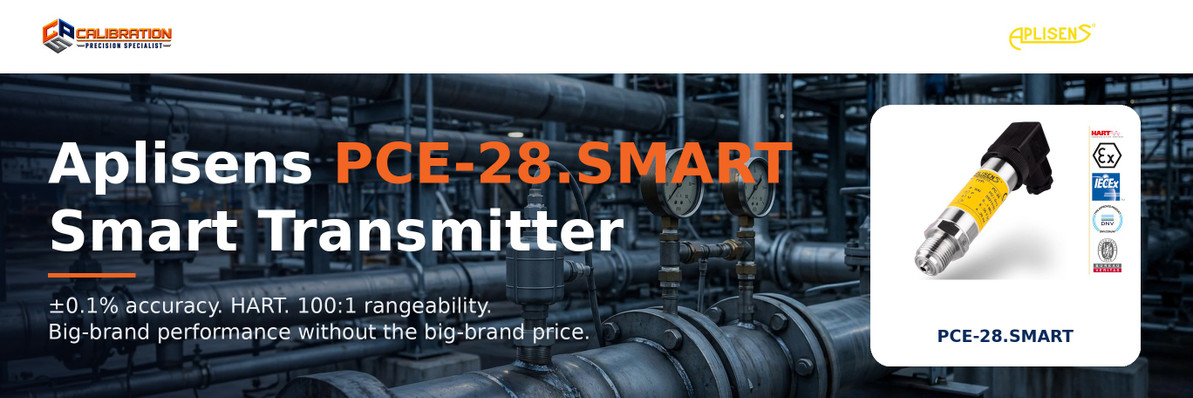
Aplisens PCE-28.SMART: ±0.1% Smart Pressure Transmitter with HART
Pressure is the most measured variable in the plant — and the most taken for granted. A pressure transmitter that's "close enough" drives a control valve that's always hunting, a batch that's always slightly off, or a safety system working with numbers it can't trust. The Aplisens PCE-28.SMART exists for the engineer who's done accepting "close enough."
What ±0.1% Actually Means
On a 10 bar range, ±0.1% is ±10 millibar — about the pressure of a strong breath. That level of accuracy matters in three places: tight process control (where measurement error becomes control error), custody-adjacent measurements (where small errors compound into real money), and safety functions (where you need margin you can prove).
But the number that matters more is 100:1 rangeability. One PCE-28.SMART can be calibrated to any span within -1 to +1380 bar. Practically, that means:
- One spare covers many applications. Instead of stocking transmitters in six ranges, you stock one and configure it. For maintenance departments, that's real inventory money.
- You can re-range without re-buying. Process change? Reconfigure the span over HART instead of ordering a new instrument and waiting three weeks.
- Better accuracy at your actual operating point. A 100:1 transmitter calibrated to a narrow span around your real process pressure performs far better than a wide-range gauge used at 10% of scale.
Why HART Changes the Job
The "SMART" in the name is the HART protocol riding on the 4–20 mA loop — and it's the difference between 1990s maintenance and modern maintenance. From the control room or a handheld, you can re-range the transmitter, change damping, switch engineering units, apply a custom characteristic curve, and read diagnostics — without climbing to the instrument, breaking the loop, or shutting anything down.
You can even calibrate it yourself against a reference standard with a HART modem and free software. (And when it's due for its accredited calibration, that's what we do at CPS — 865-900-8844.)
Built for Where It'll Actually Live
Spec sheets are written in offices; transmitters live in plants. The PCE-28.SMART is built for the second one:
- Wetted parts in 316L standard, with Hastelloy C276 or gold plating when the process is corrosive or hydrogen permeation is a concern. The diaphragm material is a 10-year decision — get it right once.
- -40 to +85 °C ambient, -40 to +120 °C medium. It doesn't need a heated enclosure to survive winter or a standoff to survive the process.
- IP65 to IP68 housings. Washdown, dust, submersion — pick the housing for the location.
- Stability inside its accuracy spec for 3 years. That's fewer calibrations, less downtime, and lower cost of ownership than a transmitter that drifts.
The Certifications Are the Point
A transmitter without the right certifications can't be installed where you need it, no matter how accurate it is. The PCE-28.SMART carries ATEX and IECEx (intrinsic safety and explosion-proof) for hazardous areas, DNV and BV marine approvals for ships and offshore, NACE MR-01-75 compliance for sour service, and SIL readiness for safety-instrumented systems. There's also an oxygen-washed version for O2 service — because a standard transmitter in oxygen service is a fire waiting for an excuse.
The Bottom Line
The PCE-28.SMART is the pressure transmitter we recommend when a customer wants big-brand performance without the big-brand price: ±0.1%, HART, 100:1 rangeability, hazardous-area and marine certifications, and three-year stability — in one unit, configurable from your desk.
Need help picking a range, wetted material, or certification package? Call CPS Calibrations at 865-900-8844 — we spec these every week.
Recent Posts
-

Electrochemical Toxic Sensors: Cross-Sensitivities That Fool Your Readings
Your carbon monoxide alarm goes off in the battery room. You sweep the area — there's no CO source a …Oct 8th 2026 -

Why Oxygen Sensors Die — and How to Make Them Last
Every 4-gas monitor has an oxygen channel, and it's the only channel with a built-in expiration date …Oct 7th 2026 -
Catalytic Bead vs. Infrared LEL Sensors: When Each Wins
Most gas detectors read %LEL the same way on the display. What's happening behind that number is any …Oct 6th 2026