
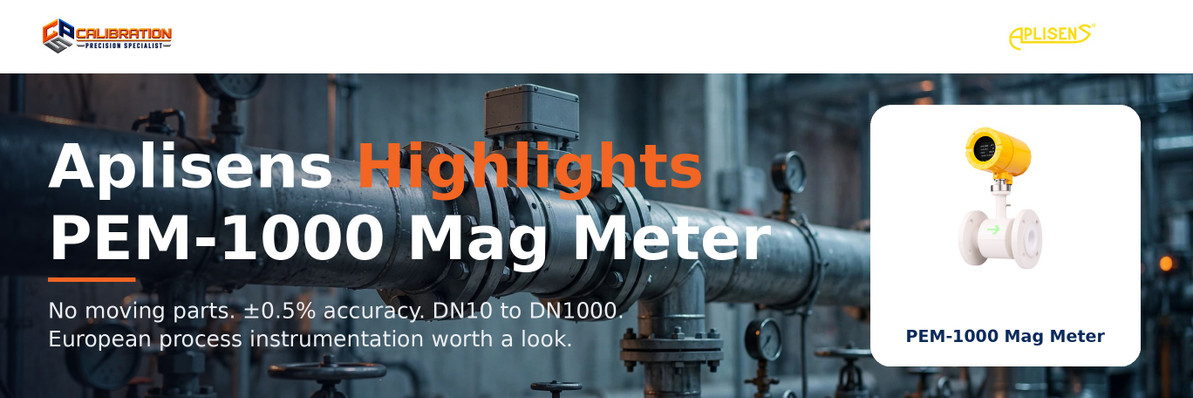
Aplisens Product Highlights: The PEM-1000 Mag Meter and More
Aplisens S.A. is one of Europe's leading manufacturers of process instrumentation — pressure, flow, level, and temperature measurement built in Warsaw, Poland, and trusted in plants around the world. At CPS Calibrations we stock their line, and one instrument gets asked about more than the rest: the PEM-1000 electromagnetic flowmeter — the mag meter.
Here's what makes it worth a look, plus the other Aplisens highlights we carry.
The Star: PEM-1000 Electromagnetic Flowmeter (Mag Meter)
A mag meter measures flow with no moving parts at all. Following Faraday's law of magnetic induction, the flowing liquid itself becomes the conductor moving through a magnetic field — the voltage induced is proportional to flow velocity, picked up by two electrodes, and converted to a flow reading using the pipe's cross-section. Nothing to wear out, nothing to clog, nothing for pastes and slurries to destroy.
The PEM-1000 is Aplisens' flagship mag meter, and the spec sheet reads like a wish list:
- Size range: DN10 to DN1000 (ANSI ½" to 40") — from small dosing lines to municipal water mains
- Accuracy: ±0.5% of reading (±0.2% optional) — serious precision for a competitive price
- Bidirectional measurement of any conductive liquid ≥ 5 µS/cm: water, wastewater, acids, alkalis, paints, pastes
- No straight-pipe version available — installs where other meters can't fit
- Outputs: 4–20 mA, pulse or frequency (uni- or bidirectional), plus Modbus RTU over RS-485
- Liner options: hard rubber, neoprene, PTFE, or PFA — match the liner to your chemistry
- Electrodes: 316L stainless, Hastelloy, or Tantalum for aggressive media
- Protection: IP66/IP67 standard, IP68 optional
- Smart extras: empty-pipe detection, adjustable low-flow cut-off, wireless setup via smartphone or tablet
- Versions: compact (transmitter on the sensor, PEM-1000ALW) or remote (transmitter separate, PEM-1000NW) — convertible in the field
Where it earns its keep: water and wastewater treatment, chemical dosing, food and beverage, pulp and paper — anywhere you need reliable flow measurement on liquids that would punish a mechanical meter.
PEM-500: The Compact Sibling
Need the same mag-meter technology in smaller lines? The PEM-500 covers DN10 to DN300 (ANSI ½" to 12") at ±0.5% accuracy, with 4–20 mA, pulse/frequency outputs, and Modbus RTU — in a compact, economical package. Same no-moving-parts reliability, sized for skids, dosing systems, and utility metering.
Pressure Transmitters: PCE-28 Family
Aplisens built its name on pressure. The highlights:
- PCE-28.SMART — smart pressure transmitter with digital configuration, the workhorse for general process pressure.
- PCE-28 — the economical analog version, plus a Modbus variant for digital networks.
- APC-2000ALW — smart transmitter with local display for applications where you want a reading at the instrument.
Differential Pressure: APR-2000 Series
For flow via DP, filter monitoring, and level: the APR-2000ALW smart differential pressure transmitter, the PRE-28 Smart, and sealed-diaphragm versions like the APR-2000ALW/SB with direct diaphragm seals for corrosive or viscous media.
Why Aplisens?
Three reasons we recommend them: the price-to-performance ratio is hard to beat against the big-name brands, the range is deep enough to standardize a plant on one manufacturer (flow, pressure, differential pressure, level), and the build quality holds up — these are instruments designed for real process conditions, not catalog specs.
The Bottom Line
If you're metering conductive liquids — water, wastewater, chemicals, slurries — the PEM-1000 mag meter deserves a spot on your short list: ±0.5% accuracy, DN10 to DN1000, no moving parts, Modbus on board, and a price that won't blow up the project budget. And when you need pressure or DP to go with it, the PCE-28 and APR-2000 families are right there.
Questions on sizing a mag meter or matching a liner to your process? Call CPS Calibrations at 865-900-8844 — we'll spec it with you. Browse the PEM-1000, the PEM-500, and our full Aplisens lineup.
Recent Posts
-

Electrochemical Toxic Sensors: Cross-Sensitivities That Fool Your Readings
Your carbon monoxide alarm goes off in the battery room. You sweep the area — there's no CO source a …Oct 8th 2026 -

Why Oxygen Sensors Die — and How to Make Them Last
Every 4-gas monitor has an oxygen channel, and it's the only channel with a built-in expiration date …Oct 7th 2026 -

Catalytic Bead vs. Infrared LEL Sensors: When Each Wins
Most gas detectors read %LEL the same way on the display. What's happening behind that number is any …Oct 6th 2026