
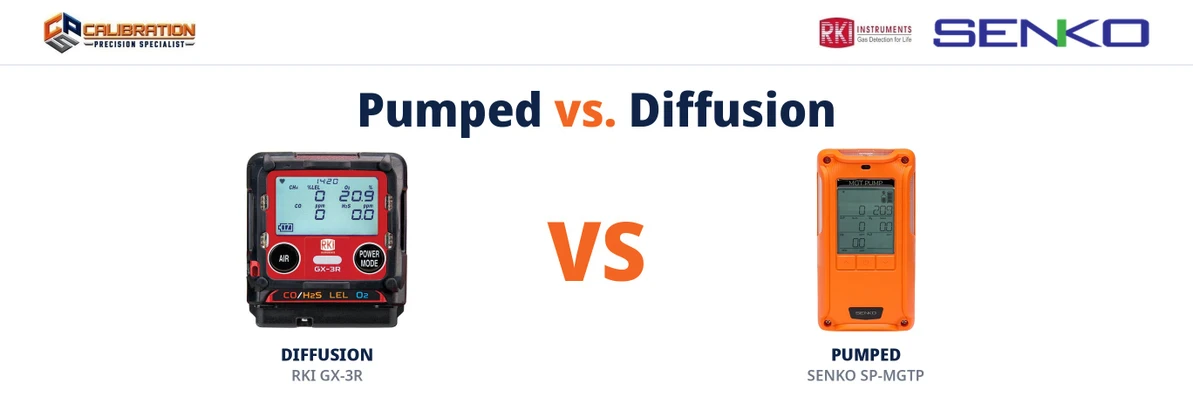
Pumped vs. Diffusion Gas Detectors: Which One Do You Actually Need?
If you're shopping for a gas detector, you'll run into two words fast: pumped and diffusion. They describe how air gets to the sensors — and that one difference decides whether a detector is right for your job or dangerously wrong for it.
Here's the straight version, with no spec-sheet talk.
The Short Answer
- Diffusion: the detector sits in the air it's measuring, and gas drifts to the sensors on its own. Best for personal, breathing-zone monitoring.
- Pumped (sample-draw): a pump pulls air through tubing from somewhere else to the sensors. Best for confined-space pre-entry testing and anywhere you can't — or shouldn't — put the detector itself.
- The rule of thumb: if the question is "what am I breathing right now," diffusion. If the question is "what's in there before I go in," pumped.
How Diffusion Works
A diffusion detector has no moving parts in the sampling path. Its sensors sit behind a membrane or ported housing, and gas molecules migrate to them naturally. Wherever the detector is, that's the air it reads.
That's why nearly every personal 4-gas monitor works this way — you clip it to your chest and it continuously reads your breathing zone. Simple, rugged, and honest: it tells you about the air you're actually in.
Where diffusion wins:
- Personal monitoring. Refinery rounds, wastewater plants, construction, utilities — the detector rides with the worker and reads what the worker breathes.
- Simplicity. No pump to maintain, no tubing to kink, no filters to clog. Fewer failure points.
- Battery life and weight. No pump motor draining the battery, so diffusion units run longer and weigh less.
- Cost. Less hardware, lower price.
Where diffusion falls short: it can only tell you about the air where the detector physically is. It can't check a tank, vault, or pit before you climb in — and in still air or stratified pockets, it takes longer for gas to reach the sensors.
How Pumped (Sample-Draw) Works
A pumped detector adds one thing: a pump that continuously pulls air through a probe and tubing to the sensors. The detector can sit in your hands — or on a wall — while the sample comes from somewhere else entirely.
Portable pumped units like the RKI GX-Force draw through a probe for pre-entry checks. Fixed sample-draw systems like the PureAire AirCheck O2 Sample Draw or the RKI GD-70D pull from a remote point 24/7, often through filters that protect the sensors from dust and moisture.
Where pumped wins:
- Confined-space pre-entry testing — no contest. OSHA 1910.146 requires the atmosphere of a permit space to be tested before anyone enters. You do that from outside, with a pump and probe, testing the top, middle, and bottom because gases stratify. A diffusion unit on your chest tells you nothing about that space until you're already inside it.
- Unreachable or hostile locations. Ducts, sumps, tanks, ceiling voids — anywhere the detector itself shouldn't go.
- Stratified atmospheres. Lower a probe to each level instead of guessing.
- Sensor protection. Inline filters keep dust, water, and grime off the sensors in dirty environments.
The trade-offs: the pump drains the battery faster and needs maintenance — filters, tubing inspections, pump rebuilds eventually. And there's transport lag: the longer the sample line, the slower the reading. Response time is roughly the tubing volume divided by the pump's flow rate, so keep sample lines as short as the job allows. A kinked, cracked, or over-long tube dilutes the sample and lies to you — which is worse than no reading at all.
Head to Head: Which Job Gets Which
- Confined space entry: pumped. Test before entry from outside, then keep monitoring while the entrant is inside.
- Daily personal monitoring: diffusion. Lighter, longer runtime, reads the actual breathing zone. The RKI GX-3R is the classic example — 4 gases, diffusion, clips on and goes.
- Fixed area monitoring: either. Diffusion heads where air circulates freely; sample-draw where the sampling point is remote, dirty, or needs conditioning.
- Response time: diffusion wins at the sensor itself; pumped adds tubing lag.
- Oxygen deficiency in a storage room: a fixed diffusion head works — or a remote-sensor head on a cable like the PureAire Oxygen Deficiency Monitor with Remote Sensor, which splits the difference: sensor where the hazard is, display where your people are.
Does a Pump Make It More Accurate?
No — and this is the misconception to kill. Accuracy comes from the sensors and calibration, not the pump. The pump changes where the sample comes from, not how well it's measured. A pumped detector with a leaking sample line is less trustworthy than a diffusion detector sitting in clean air. The hardware only helps if the sampling path is sound: intact tubing, clean filters, sensible line length.
FAQ
Can I use a diffusion detector for confined space entry?
For continuous monitoring of the entrant while inside, yes. For the required pre-entry atmospheric testing, no — that demands a pumped sample drawn from outside the space, tested at multiple levels.
How long can sample tubing be?
As short as the job allows. Longer tubing means slower response and more joints that can leak and dilute the sample. Follow the manufacturer's guidance for maximum draw distance.
Can I convert a diffusion detector to pumped?
Don't jury-rig tubing onto a diffusion unit. Buy the pumped version — manufacturers build them as siblings for exactly this reason (the GX-Force is the pumped counterpart to RKI's diffusion portables).
Do pumped detectors cost more to own?
Up front, usually yes. Over time, budget for filters, tubing replacement, and eventual pump service — plus the shorter battery runtime on portables.
Which gases work with sample-draw?
Most common ones, including O2, LEL, CO, H2S, and many toxics. Highly reactive gases can be a poor fit for long sample lines — check with the manufacturer for your specific gas.
The Bottom Line
Diffusion and pumped aren't good/better/best — they're answers to different questions. Diffusion asks "what am I breathing?" Pumped asks "what's in there?" Buy the one that matches the question your job actually asks, keep the sampling path honest, and calibrate either one on schedule.
Not sure which fits your application? Call CPS Calibrations at 865-900-8844 and tell us the job — confined space, personal monitoring, or fixed area. We'll match you to the right instrument instead of the most expensive one.
Recent Posts
-

Electrochemical Toxic Sensors: Cross-Sensitivities That Fool Your Readings
Your carbon monoxide alarm goes off in the battery room. You sweep the area — there's no CO source a …Oct 8th 2026 -

Why Oxygen Sensors Die — and How to Make Them Last
Every 4-gas monitor has an oxygen channel, and it's the only channel with a built-in expiration date …Oct 7th 2026 -

Catalytic Bead vs. Infrared LEL Sensors: When Each Wins
Most gas detectors read %LEL the same way on the display. What's happening behind that number is any …Oct 6th 2026