
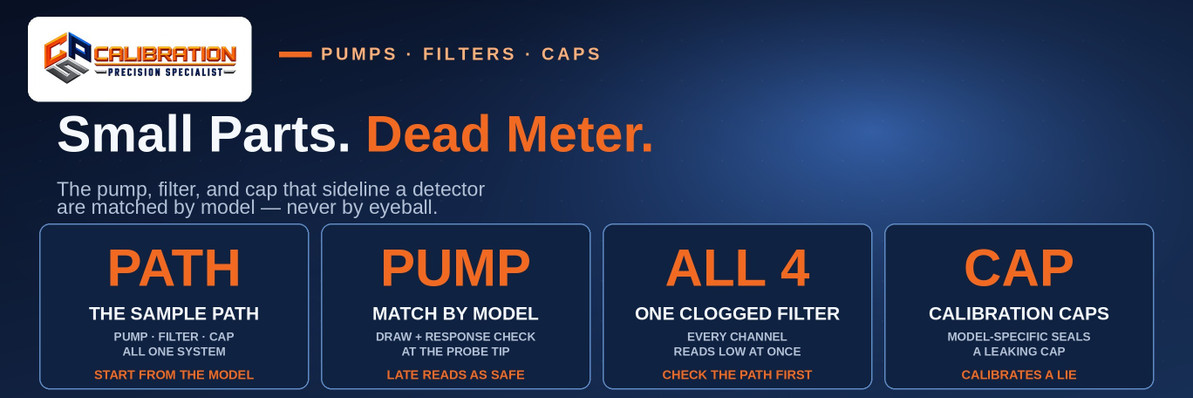
Finding the Right Pump, Filter, and Cap for Your Detector
The parts that sideline gas detectors are rarely the sensors — they are the pump that no longer draws, the filter nobody replaced until every channel read low, and the calibration cap that almost fits. None of the three is universal: pumps, filters, and caps are matched to the instrument model, so the right way to find each one is to start from the detector you own — its sampling method, its filter stack, and the cap or adapter its maker specifies — not from a bin of parts that look close.
Think of the sample path as part of the instrument, because the sensors do. A diffusion detector breathes through its filter; a pumped detector drinks through a hose, a pump, and a filter stack; and every calibration you have ever done passed through a cap or adapter that either sealed or quietly lied. When readings go strange, experienced technicians check this path before they condemn a sensor — a starved sensor and a dead sensor produce the same low reading, and only one of them costs real money. The catalog on our store is organized the same way: start from portable multi-gas monitors or your model's own page, and let the model dictate the parts.
Diffusion or Pumped — Which Sampling Does Your Detector Use?
Everything downstream depends on the answer. A diffusion detector — the standard configuration of most personal monitors, the RKI GX-3R included — samples the air that reaches it naturally, which is why it must ride in the breathing zone and why its filters matter so much. A pumped detector pulls a sample from somewhere else: down a hose, into a space before entry, across a leak. Browse the two families separately — pumped monitors and diffusion monitors — because their parts do not cross over.
Some diffusion instruments take an accessory pump: the GX-3R, for example, offers an optional clip-on motorized sampling pump that turns the personal monitor into a remote sampler for pre-entry checks. That is the correct way to add a pump — the manufacturer's own accessory, matched to the model — rather than improvising draw through a diffusion instrument that was never meant to pull against hose resistance.
How Do You Match a Pump to Your Detector?
By model, by draw, and by the sample path as a whole. The pump must be the one specified for the instrument or its listed accessory; the hose must be the length and material the sampling setup assumes — every extra foot is response time and, with reactive gases, sample lost to the hose walls; and the probe and filters in the line are part of the match, not decorations. A pump that draws too weakly against a long hose delivers yesterday's air to the sensors; the reading is real, it is just late, and in a pre-entry test late reads as safe.
Judge a pump setup the way the bench does: draw check plus response check. If known gas at the probe tip takes visibly longer to register than it used to, or the pump sounds strained, or low-flow warnings appear, the path — pump, hose, filter, fittings — gets inspected as one system before any sensor is blamed.
Why Does One Clogged Filter Lie to Every Channel at Once?
Because all the sensors breathe through it. Dust, moisture, and process grime load a filter gradually, so the failure is gradual too: response slows, readings sag, bump tests get marginal — across LEL, O₂, CO, and H₂S together. Simultaneous drift on every channel is the signature of a sample-path problem; sensors age independently, but a filter fails them all at once. Instruments like the GX-3R are built with field-replaceable filters for exactly this reason — the filter is a consumable with a job, not a lifetime part.
The discipline is simple: inspect filters on a schedule, replace them when they are loaded or water-damaged rather than when the meter finally complains, and keep spares with the instrument. A pumped setup adds its own filter stack — including the hydrophobic element that keeps water out of the pump — and each element is matched to the model. When in doubt, the model's page and manual name what belongs in the path; a filter that fits physically but restricts flow differently is the wrong filter.
Why Isn't a Calibration Cap Just a Calibration Cap?
Because a calibration is only as true as the seal delivering the gas. The cap or adapter for your model — the GX-3R, for instance, ships with its own calibration adapter in the box — routes span gas across the sensors at the intended flow and keeps room air out. A cap borrowed from another model may sit on the housing and feel fitted while leaking at one corner; the meter then calibrates against diluted gas and leaves reading low by exactly the leak you never saw. The same failure hides in cracked caps, perished seals, and adapters forced onto pumps they were not made for.
Match the cap to the model, inspect its seal like you inspect the filter, and store it with the calibration gas kit it serves. If a calibration behaves oddly — slow to span, unstable, different from last time — suspect the cap and the path before you suspect four sensors at once. And if your fleet's parts situation has become guesswork, a bench visit sorts it: CPS calibrates in-house ($55 single-gas, $90 for 4- and 5-gas instruments) and sees the sample path as part of the instrument — see calibration services.
Frequently Asked Questions
How do I find the right pump for my gas detector?
Start from the instrument model, not the pump shelf. Check whether your detector is a pumped model, a diffusion model with a manufacturer accessory pump (the RKI GX-3R offers a clip-on motorized pump, for example), or diffusion-only. Fit only the pump specified for that model, with the hose and probe the setup assumes — and verify with a draw and response check at the probe tip.
Can I use another model's calibration cap if it fits?
It may sit on the housing and still leak — and a leaking cap dilutes the span gas with room air, so the meter calibrates low and reads low afterward. Caps and adapters are model-specific sealing parts. Use the cap or adapter made for your instrument, inspect its seal, and treat an odd calibration as a cap problem before treating it as four bad sensors.
What are the signs a detector filter needs replacing?
Slow response, sagging readings, marginal bump tests — especially when several channels degrade together. Sensors age independently; a loaded or water-damaged filter starves all of them at once. Inspect filters on schedule and replace them when loaded, wet, or damaged rather than waiting for a failed bump. Keep spares with the instrument.
Why do all four channels read low at the same time?
Most often, the sample path: a clogged filter, a weak pump, a cracked hose, or a leaking fitting starves every sensor of sample simultaneously. Check the path as one system — filter, hose, pump draw, seals — before condemning sensors. Simultaneous failure of four independent sensors is rare; one shared restriction is common.
Does a diffusion detector need a pump?
Not for personal monitoring — diffusion is the standard sampling method for most personal monitors, worn in the breathing zone. A pump is for remote sampling: pre-entry testing and drawing from a distance. Some diffusion instruments accept the manufacturer's clip-on pump accessory for that job; never improvise draw through an instrument not built for it.
How long a sample hose can I use?
Only as long as your instrument and pump are specified for — hose length is response time, and with reactive gases it is also sample loss to the hose walls. The model's documentation sets the limit; this post deliberately gives no universal footage, because there isn't one. Verify any setup with known gas at the probe tip and time the response.
What parts should I keep as spares for each detector?
The consumables of the sample path: the correct filters for the model, its calibration cap or adapter in good sealing condition, and for pumped setups the hose, probe, and filter stack elements. Add the model's charger and a note of its exact configuration. Spares matched by model turn a sidelined meter into a ten-minute fix.
Can a wrong filter damage readings without damaging the sensor?
Yes — that is precisely the failure. A filter that restricts flow, or a hydrophobic element that has taken on water, changes what reaches the sensor and how fast. The sensor may be perfectly healthy behind a starved path. Replace the filter and re-test before pricing a sensor.
Where do I order parts if I don't know the part number?
By model. Call CPS Calibrations at 865-900-8844 and name the instrument and what you need — pump, filter, or cap — and the part gets matched to that detector. This post keeps part numbers out on purpose: a number copied from the wrong model's page is worse than no number at all.
Should the pump and hose go in with a mailed-in calibration?
Yes, if you sample with them. The combination you carry is the combination that should leave checked: CPS inspects the sample path as part of a bench visit, because a weak pump or clogged filter changes what every sensor sees. Our calibration services page covers rates — $55 single-gas, $90 for 4- and 5-gas instruments, in-house.
The Bottom Line
Pumps, filters, and caps are not accessories — they are the sample path your sensors live behind, and every one of them is matched by model. Order by the detector you own, keep the consumables in spares, and check the path before you ever condemn a sensor: the cheapest part in the kit is the one that most often makes a good meter look dead.
Not sure which part fits your detector? Call CPS Calibrations at 865-900-8844 and name the model — or send the instrument in and let the bench sort the path: 109 S. Front Street, Rockwood, TN 37854.
--- CPS Calibrations · 109 S. Front Street, Rockwood, TN 37854 · Portable Multi-Gas Monitors · Calibration Gas · Calibration Services
Need a calibration you can file?
In-house calibration at CPS in Rockwood, Tennessee — $55 for single-gas instruments, $90 for 4- and 5-gas — every channel, as-found and as-left data, full certificate.
See Calibration Servicesor call 865-900-8844
Recent Posts
-

What Is Remote Monitoring for Fixed Gas Detection?
Remote monitoring for fixed gas detection means a fixed system's live readings, trends, and alarm hi …Nov 23rd 2026 -

What Are the Key Differences Between the GX-6000 and GX-6100?
The RKI GX-6100 is the current replacement for the discontinued GX-6000: both are pumped 6-gas monit …Nov 22nd 2026 -

How to Read a PID Correction Factor Chart
To read a PID correction factor chart, find your vapor’s row, take the factor under your own lamp en …Nov 21st 2026