
How Do You Calibrate a BW MicroClip XL?
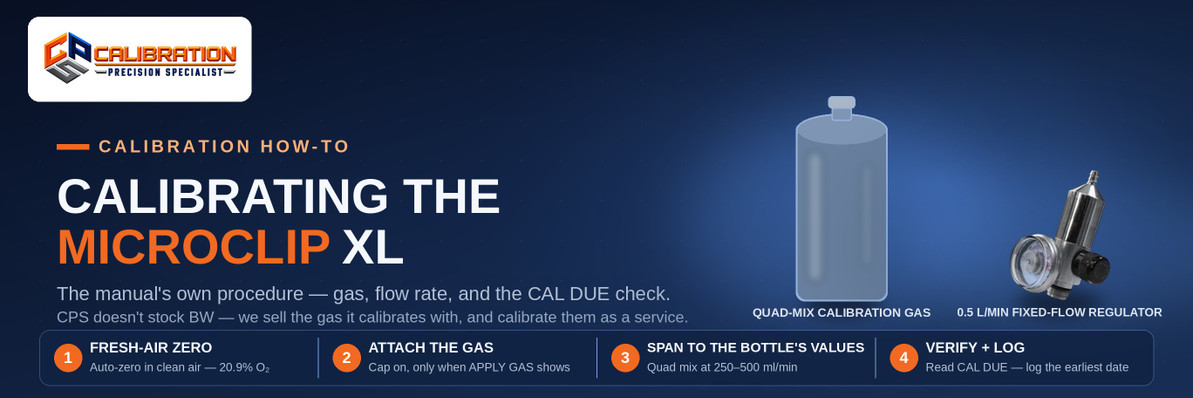
To calibrate a BW GasAlert MicroClip XL, take it to a safe area with a normal 20.9% oxygen atmosphere, hold the button through the OFF countdown and keep holding through the CAL countdown to enter calibration, let the detector auto-zero all of its sensors and calibrate the oxygen sensor, then — only when APPLY GAS is displayed — fit the calibration cap and apply the BW quad mix (CH₄ 2.5% / 50% LEL, O₂ 18.0%, H₂S 25 ppm, CO 100 ppm, balance nitrogen) at a flow of 250 to 500 ml/min until the detector beeps (about 30 seconds) and completes the span. BW recommends calibrating the MicroClip at least once every 180 days, and bump testing before each day's use.
That is the manufacturer's procedure, from the GasAlertMicroClip operator's manual, and this post follows it step by step — including the parts that get skipped in the field and quietly ruin the calibration. A note on who we are in this story: CPS does not stock BW instruments. We sell the calibration gas and regulators the MicroClip uses, and we calibrate these detectors as a service for the plants that run them — which is why this post exists. The general method behind it, for any 4-gas instrument, is in bump test vs. calibration.
What Do You Need Before You Start?
| Item | The manual's requirement |
|---|---|
| Calibration gas | BW quad mix: CH₄ 2.5% vol (50% LEL), O₂ 18.0%, H₂S 25 ppm, CO 100 ppm, balance N₂ — BW's own cylinders are CG-Q34-4 (34 L) and CG-Q58-4 (58 L). CPS's BW-equivalent 4-gas mix matches it component for component: $184; 34 L cylinder $195, 60 L $245, 120 L $295 |
| Regulator | Fixed-flow, set to deliver 250–500 ml/min for calibration — the 0.5 L/min size is the standard choice (BW's REG-0.5). CPS's C-10 fixed-flow regulator in the 0.5 LPM version (R-05) is $130; the CGA-600 version is the same $130 — match the connection to your cylinder. A demand-flow regulator is for use with a MicroDock II dock instead |
| Calibration cap + hose | The cap supplied with the detector. The manual: only use the calibration cap during the calibration span process and for bump tests |
| The right setting values | The calibration-gas concentrations configured in the detector (via Fleet Manager II) must match the values on the cylinder in hand — Honeywell's support guidance is explicit on this point |
| The right place | A safe area, free of hazardous gas, in an atmosphere of 20.9% oxygen — the manual's caution, verbatim in substance |
| Timing | Not during charging, and not immediately after charging is complete — the manual prohibits both. Wind currents can also cause false readings and poor calibrations, so work out of the draft |
One warning before the steps: do not substitute the RKI-spec quad mix (CO 50 ppm, O₂ 12%) that sits next to the BW mix on most shelves. The MicroClip's configured span values are CO 100 ppm and O₂ 18.0%. Span it against the wrong cylinder without changing the settings and the detector will dutifully calibrate itself to numbers that aren't in the bottle.
The Calibration Procedure, Step by Step
Step 1 — Enter calibration mode. With the detector in the safe area, press and hold the button as the detector performs its OFF countdown. Continue holding while the LCD briefly deactivates; the LCD reactivates and performs a CAL countdown. Keep holding until the CAL countdown completes — you are now in calibration.
Step 2 — Let the auto-zero finish. The detector flashes its zero indication while it zeroes all of the sensors and calibrates the oxygen sensor against the ambient 20.9% air. Two rules live in this step: the manual cautions that if a sensor fails to auto-zero, it cannot be calibrated — that sensor needs attention, not a workaround — and you must not apply gas early. Honeywell's user manual is explicit: do not apply calibration gas until APPLY GAS displays, otherwise the auto-zero function will fail.
Step 3 — Fit the cap and apply the gas. When APPLY GAS is displayed, attach the calibration cap to the detector, open the regulator, and apply the quad gas at a flow rate of 250 to 500 ml/min.
Step 4 — Wait for the beep. After a sufficient amount of gas has been detected — approximately 30 seconds — the detector beeps and its calibration indicator flashes while it completes the calibration. Don't rush this step or break the flow early; the span is being set on what the sensors actually saw.
Step 5 — Read the CAL DUE screens. The LCD displays CAL DUE, then a screen showing the number of days remaining before calibration is due for each sensor, and finally the earliest calibration due date — because, as the manual notes, some sensors require more frequent calibration than others. Note the earliest date; that is your fleet's real deadline for this instrument.
Step 6 — Remove the cap and verify. Cap off, regulator closed, and let the readings settle in clean air: toxics and LEL at zero, oxygen back at 20.9%. The instrument is now calibrated — and a bump test before its next day's use remains the daily proof, exactly as BW recommends.
How Often Does a MicroClip XL Need Calibration?
BW's manual gives two numbers, and they do different jobs:
- Calibration: at least once every 180 days (6 months). "BW recommends calibrating at least once every 180 days" is the manual's standing instruction, along with calibrating before first-time use and more often where use and exposure to poisons and contaminants demand it.
- Bump test: before each day's use. BW recommends bump testing the sensors before each day's use, exposing the detector to a gas concentration that exceeds the alarm setpoints and manually verifying the audible and visual alarms; calibrate if the readings are not within the specified limits. The manual's bump procedure uses the same cap and a 0.5 L/min regulator (a demand-flow regulator when the bump runs on a MicroDock II), and its gas rules mirror the calibration rules: premium-grade NIST-traceable gas, never past its expiration date.
Also calibrate — don't just bump — after the events the manual lists: exposure to sensor contaminants or poisons such as sulfur compounds, silicon vapours, or halogenated compounds, and after any alarm driven by a high concentration of combustible gas. If the LEL sensor has been stressed by an explosive-range exposure, the manual goes one step further: calibrate the detector, and if necessary, replace the sensor.
What Goes Wrong Most Often?
- Gas applied before APPLY GAS. The auto-zero fails or anchors to span gas — the calibration is wrong from the first second, and it looks like a detector fault.
- The wrong mix. A quad cylinder with RKI or Dräger values (CO 50, O₂ 12% or 17%) spanned into a detector configured for BW values, without updating the settings in Fleet Manager II. The detector accepts it. The readings are wrong by the difference.
- Wrong flow. A 1.0 L/min regulator "because it was on the other cylinder" sits outside the manual's 250–500 ml/min window and can pressure-feed the sensors into a span that clean diffusion would never reproduce.
- Calibrating in the work atmosphere. The manual's safe-area rule exists because the auto-zero anchors everything: zero a MicroClip where CO or combustibles linger and you have built the offset into every channel — the same dirty-zero mechanism behind negative readings everywhere else.
- A sensor that fails auto-zero, calibrated anyway. It can't be. The manual is absolute: a sensor that fails to auto-zero cannot be calibrated — it needs replacement, and BW's manual gives the sensor-swap procedures and the standing order that follows them: new sensors should be calibrated before the instrument returns to service.
Don't Want to Run It Yourself?
That's a legitimate choice, and it's most of what our bench does. CPS calibrates MicroClip XLs — and the other brands we don't stock — as a service: we calibrate every channel, against the correct BW-spec gas, and the instrument comes back with a calibration certificate and its next due date set. If you'd rather run your own, the two purchases that make it a manual-true calibration are the BW-equivalent quad mix and the 0.5 L/min fixed-flow regulator — both in our calibration gas range.
The Bottom Line
Calibrating a MicroClip XL is a five-minute, button-and-cap procedure — but it is an exact one. Clean 20.9% air for the auto-zero; no gas until APPLY GAS; the BW quad mix (CO 100, H₂S 25, CH₄ 50% LEL, O₂ 18.0%) at 250–500 ml/min; the CAL DUE screen read before you walk away; and the whole thing repeated at least every 180 days, with bump tests on the days in between. Every field failure of this calibration traces to one of those specifics being improvised.
Questions about a MicroClip that won't calibrate, or want it on our bench? Call 865-900-8844 or reach us through Contact Us — and see Calibration Services for how the service works.
Frequently Asked Questions
How do you calibrate a BW MicroClip XL? Per the GasAlertMicroClip operator's manual: in a safe area with a 20.9% oxygen atmosphere, press and hold the button through the OFF countdown and the following CAL countdown to enter calibration. The detector auto-zeroes all sensors and calibrates the oxygen sensor; when APPLY GAS displays, fit the calibration cap and apply the quad gas at 250 to 500 ml/min. After about 30 seconds the detector beeps and completes the span, then displays CAL DUE and the days remaining before each sensor's next calibration.
What calibration gas does a MicroClip XL use? BW's quad mix: methane 2.5% by volume (50% LEL), oxygen 18.0%, hydrogen sulfide 25 ppm, and carbon monoxide 100 ppm, balance nitrogen — sold by BW as CG-Q34-4 (34 L) and CG-Q58-4 (58 L). The combustible sensor is factory calibrated to 50% LEL methane, which is why methane is the LEL component. CPS stocks a BW-equivalent mix matching those values exactly ($184; 34 L $195) — do not substitute mixes built to other brands' values without changing the detector's configured span settings to match.
What flow rate do you use to calibrate a MicroClip XL? 250 to 500 ml/min, per the operator's manual — which is why the standard regulator for the job is a 0.5 L/min fixed-flow unit (BW's REG-0.5). CPS's fixed-flow regulators are $130 in the 0.5 LPM size for either cylinder connection (C-10 or CGA-600). The exception is docking: with a MicroDock II, the manual specifies a demand-flow regulator instead of the fixed-flow unit.
How often should a MicroClip XL be calibrated? At least once every 180 days — that is BW's standing recommendation in the operator's manual — and before first-time use. Calibrate sooner after exposure to sensor poisons or contaminants (sulfur compounds, silicon vapours, halogenated compounds), and after any high-concentration combustible-gas alarm; the manual advises checking the combustible sensor with a known concentration of gas after any such exposure. Separately, BW recommends a bump test before each day's use.
Why does my MicroClip XL fail auto-zero during calibration? Because a sensor could not establish its baseline in the air provided — the manual states that if a sensor fails to auto zero, it cannot be calibrated. Work the causes in order: the air wasn't clean (the procedure must run in a safe area at 20.9% oxygen, free of hazardous gas); gas was applied before APPLY GAS displayed, which Honeywell's manual says will fail the auto-zero; or the sensor itself is at end of life. Fix the air and the sequence first — a sensor that still fails auto-zero in verified clean air needs replacement.
Can you calibrate a MicroClip XL with a different brand's gas mix? Only if the detector's configured calibration-gas values are changed to match the cylinder, using Fleet Manager II — Honeywell's support guidance requires the values in the instrument to match the values on the gas cylinder. Spanning a BW-configured detector (CO 100 ppm, O₂ 18.0%) with a mix built to another brand's specification (for example CO 50 ppm, O₂ 12%) without updating those settings produces a calibration that completes, beeps, and is wrong by the difference between the two mixes.
What does CAL DUE mean on a MicroClip XL? It is the end-of-calibration report. After the span completes, the LCD displays CAL DUE, then the number of days remaining before calibration is due for each sensor individually, and finally the earliest due date among them — the manual notes some sensors require more frequent calibration than others. Read the earliest date as this instrument's real deadline; on a fleet, logging it per serial number is what keeps the 180-day rule from becoming a guess.
Do you need the calibration cap to calibrate a MicroClip XL? Yes. The manual directs that the calibration cap be used during the calibration span process and for bump tests — and only then ("Only use the calibration cap during calibration and bump check"). The cap seals the gas path over the sensor area so the applied gas, at its specified 250–500 ml/min, is what the sensors actually see; without it, wind currents — which the manual warns cause false readings and poor calibrations — and dilution make the span meaningless.
Can you calibrate a MicroClip XL right after charging it? No. The operator's manual states plainly: do not calibrate the detector during or immediately after charging is complete. Charge the detector after the workday as BW recommends, and schedule calibrations away from the charge cycle — a calibration squeezed in while the instrument sits on its charger is one the manufacturer has already told you not to trust.
Who can calibrate a MicroClip XL if we don't do it in-house? Any competent calibration service with the correct BW-spec gas — including CPS. We don't sell BW instruments, but we calibrate them as a service, alongside the brands we stock: every channel calibrated, a certificate issued, and the next due date set in the instrument. If a sensor fails its auto-zero or won't span, we'll tell you which one and what it means before any repair is authorised. Call 865-900-8844.
CPS Calibrations · 109 S. Front Street, Rockwood, TN 37854 · Calibration Gas · Calibration Services · Contact Us
Need a calibration you can file?
In-house calibration at CPS in Rockwood, Tennessee — $55 for single-gas instruments, $90 for 4- and 5-gas — every channel, as-found and as-left data, full certificate.
See Calibration Servicesor call 865-900-8844
Recent Posts
-

What Is Remote Monitoring for Fixed Gas Detection?
Remote monitoring for fixed gas detection means a fixed system's live readings, trends, and alarm hi …Nov 23rd 2026 -

What Are the Key Differences Between the GX-6000 and GX-6100?
The RKI GX-6100 is the current replacement for the discontinued GX-6000: both are pumped 6-gas monit …Nov 22nd 2026 -

How to Read a PID Correction Factor Chart
To read a PID correction factor chart, find your vapor’s row, take the factor under your own lamp en …Nov 21st 2026