
Replacing an Obsolete Fixed Gas Detection System: Where to Start
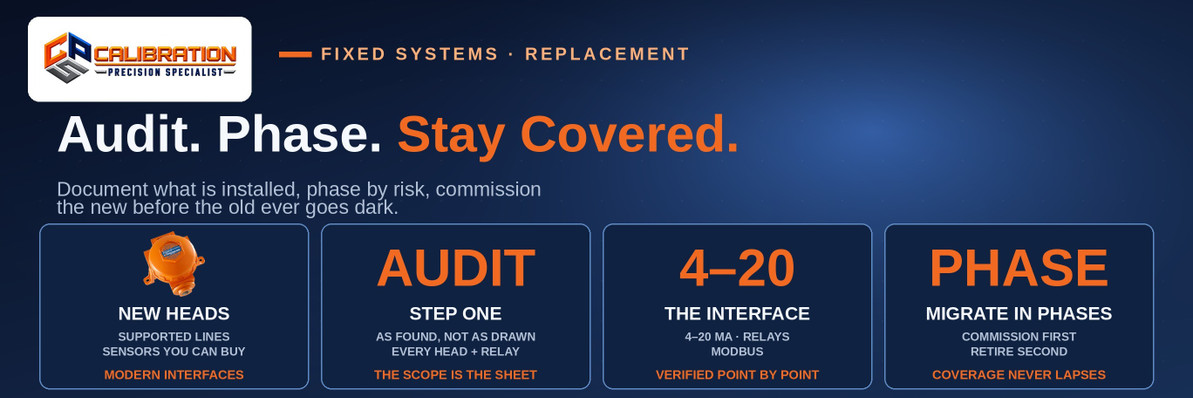
Replacing an obsolete fixed gas detection system starts with an audit, not a purchase order: document what is actually installed — every head, gas, range, cable run, and controller input, as found in the field rather than as drawn — because the usual death is already underway (sensors discontinued for heads that still 'work,' a controller no one supports), and the replacement that succeeds is phased around that reality: new detection commissioned area by area, so the plant is never left uncovered while its safety system is being swapped underneath it.
Fixed systems age in layers, and the layers fail at different speeds. Sensors are consumables on a few years' cycle; detector heads last longer; controllers and their configuration software can strand a plant overnight when a manufacturer ends a line. The moment to plan replacement is the first time a part becomes hard to get — not the first time an area goes dark. This post is the starting sequence we walk plants through: audit, compatibility, phasing, and the paperwork that makes the new system defensible from day one. The install side of the work is covered at fixed system installation.
Step One: Audit What Is Actually Installed
Walk the plant with a camera and a spreadsheet, and record the system as it exists: every detector's location, gas, range, and condition; the controller's make, inputs in use, relay actions, and what each alarm actually does today (ventilation? shutdown? a light nobody watches?); cable runs and junction points; and the calibration history, which tells you which heads are being nursed. Compare against drawings and expect differences — twenty years of maintenance leaves undocumented moves, swapped ranges, and at least one head watching a process that left in 2011.
Score each point honestly: supported and healthy; supported but tired; unsupported — no sensors, no parts, or no manufacturer behind it. That third column is your true scope. Plants are routinely surprised to find the system is not 'old but fine' but a patchwork where a third of the points are one sensor failure from being decorative.
The Two Obsolescence Problems: Heads and Controllers
The head problem is consumable starvation: the detector still powers, the display still reads, but its sensor is discontinued — so the next drift is permanent, and a 'working' system quietly becomes a set of uncalibratable displays. The controller problem is the opposite shape: heads may be standard, but the panel is unsupported, its configuration is locked in dead software, or its inputs cannot accept modern devices. Diagnosing which problem you actually have decides the money: a sensor-starved system needs heads (and gets to evaluate whether the controller deserves to survive them), while a controller-stranded system may keep serviceable heads and replace the brain.
Interfaces are the hinge. Fixed detection speaks a small set of standard languages — 4–20 mA analog, relay outputs, and digital buses like Modbus — and a modern head (the current generation of fixed detectors, SENKO's SI-200E among them, offers 4–20 mA plus RS-485 Modbus and relays as standard) can often report to a healthy existing controller. 'Often' is verified point by point in the audit, never assumed from a brochure: signal type, power, and hazardous-area ratings all have to match the installation as built.
Phased Migration: Coverage Never Lapses
The replacement plan that works is phased by area, in risk order: the unsupported, highest-hazard points first. Each phase follows the same rhythm — new detection installed, wired, commissioned, and calibrated beside the old; alarm actions proven end-to-end (this relay starts that fan, this signal reaches that panel); the old point retired only after the new one has carried the area through a proving period. Temporary portable coverage bridges any gap a phase genuinely cannot avoid: an area with a dead fixed point and a two-week install schedule gets portables and a watch rotation, not a shrug.
- Phase by risk: worst-supported, highest-hazard areas first; cosmetic completeness last.
- Commission before you retire: the new point proves itself — calibration, alarm action, signal at the panel — before the old one is switched off.
- Bridge with portables: any uncovered window is covered personally, on paper, with named responsibility.
- Document as you go: each phase closes with updated drawings, ranges, setpoints, and calibration records — the new system's audit trail starts clean.
Phasing costs a little more in mobilization and buys the only thing that matters: at no point in the project does an area rely on detection that has already died.
What 'Done' Looks Like
A finished migration is boring in the best way: every point supported by a living product line with sensors you can buy; a controller someone can still configure; alarm actions that were tested, not inherited; drawings that match the field because they were rebuilt from it; and a calibration program — schedule, records, due-date discipline — running from commissioning day, so the new system never drifts into the condition that forced the replacement. CPS installs and commissions fixed systems and calibrates what it installs; ongoing bench and service options are on calibration services.
If you are staring at a system you suspect is obsolete, the first move costs nothing but shoe leather: do the audit. Bring us the spreadsheet — what is installed, what is supported, what is already dark — and the phasing conversation starts from facts instead of fears. Call 865-900-8844.
Frequently Asked Questions
How do I know if my fixed gas detection system is obsolete?
By support, not by age: can you still buy sensors for every head, parts for the controller, and get the manufacturer (or a competent shop) to stand behind it? The moment any of those answers is no for a point, that point is obsolete on a timer — it will fail permanently at its next sensor or component failure, and its calibration is already living on borrowed time.
Where do I start a replacement project?
With a field audit: every head's location, gas, range, and condition; the controller's inputs, relay actions, and alarm destinations as they actually function today; cable runs; and calibration history. Score each point supported/healthy, supported/tired, or unsupported. That spreadsheet — not a catalog — is the scope document the whole project is priced and phased from.
Can new detectors work with my old controller?
Often, yes — fixed detection uses standard interfaces (4–20 mA analog, relay outputs, digital buses such as Modbus), and modern heads commonly offer several. But 'often' is verified point by point: signal type, loop power, wiring, and hazardous-area ratings must all match the installation as built. The audit answers it for your system; no brochure can.
Can I keep my old heads and just replace the controller?
If the heads are supported, healthy, and speak an interface the new controller accepts — that is a legitimate architecture, and it is the right one when the controller is the stranded layer. The reverse (new heads, surviving controller) is equally legitimate when sensors starved first. The audit's job is to identify which layer actually died.
How do we stay protected during the changeover?
By phasing: new points are installed, commissioned, calibrated, and proven — including their alarm actions — beside the old before the old are retired, area by area in risk order. Any window that genuinely cannot overlap gets bridged with portable monitors and a documented watch. An area should never spend a shift relying on detection that has already failed.
What does commissioning a new point include?
Calibration with documented gas, as-found/as-left records, and an end-to-end alarm proof: the head alarms, the signal arrives, the relay does its job (ventilation, shutdown, notification) in the real plant, not on a bench. A point that has not proven its alarm action is installed, not commissioned.
How long does a full replacement take?
It depends on the audit: point count, wiring condition, hazardous-area work, and how much can overlap with operations. Phasing deliberately trades a longer calendar for continuous coverage. Anyone who quotes a duration before auditing your installed base is guessing with your safety system — get the audit first, then a schedule built on it.
What paperwork should a replacement produce?
As-built drawings that match the field, a point list with gases/ranges/setpoints, commissioning and calibration certificates per point, and alarm-action test records. This is the new system's baseline: five years from now, its maintenance and its next audit start from these documents. A replacement that skips them recreates the archaeology problem you just paid to escape.
Is it worth calibrating an obsolete system in the meantime?
Calibrate every point that can still be calibrated — a drifted detector on a dying system is still worse than a true one, and areas stay covered until their phase arrives. Points whose sensors are discontinued and unobtainable are the exception: they cannot be made honest, which is exactly why they phase first and get portable bridging.
Who should do the replacement?
A gas-detection shop that installs, commissions, and calibrates as one discipline — CPS does fixed system installation and service (call 865-900-8844) and starts every engagement with the audit described here. Electrical and classified-area work proceeds under the plant's permits and standards; our side is the detection: selection, placement, commissioning, and the records.
The Bottom Line
An obsolete fixed system is replaced in this order: audit what is actually installed, identify which layer died — sensors, heads, or controller — verify interfaces point by point, and migrate in risk-ordered phases that commission the new before retiring the old, with portables bridging any gap. Do that, and the plant trades a dying system for a supported one without ever spending a shift uncovered.
Starting an audit, or staring at a system you already suspect? Call CPS Calibrations at 865-900-8844 — 109 S. Front Street, Rockwood, TN 37854.
--- CPS Calibrations · 109 S. Front Street, Rockwood, TN 37854 · Fixed System Installation · Calibration Services · Portable Gas Detection
Need a calibration you can file?
In-house calibration at CPS in Rockwood, Tennessee — $55 for single-gas instruments, $90 for 4- and 5-gas — every channel, as-found and as-left data, full certificate.
See Calibration Servicesor call 865-900-8844
Recent Posts
-

What Is Remote Monitoring for Fixed Gas Detection?
Remote monitoring for fixed gas detection means a fixed system's live readings, trends, and alarm hi …Nov 23rd 2026 -

What Are the Key Differences Between the GX-6000 and GX-6100?
The RKI GX-6100 is the current replacement for the discontinued GX-6000: both are pumped 6-gas monit …Nov 22nd 2026 -

How to Read a PID Correction Factor Chart
To read a PID correction factor chart, find your vapor’s row, take the factor under your own lamp en …Nov 21st 2026