
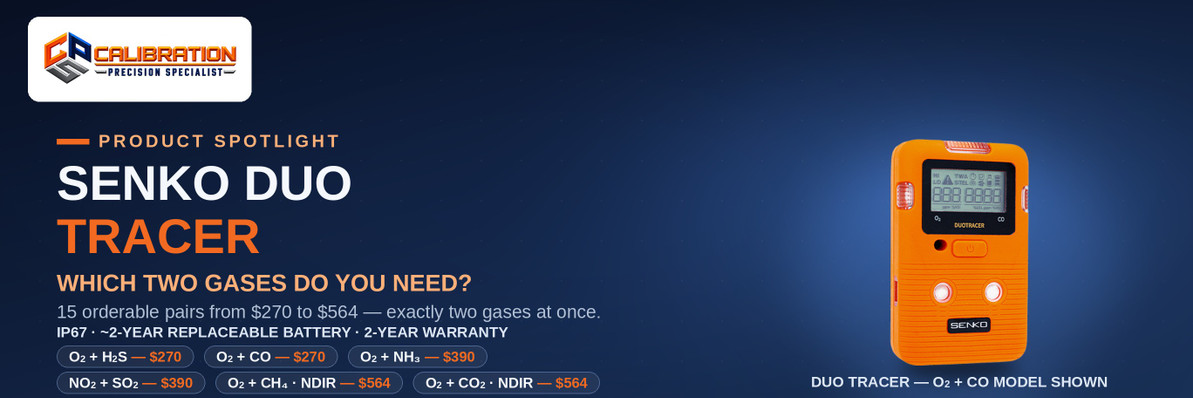
SENKO DUO TRACER: Which Two-Gas Combination Do You Actually Need?
The SENKO DUO TRACER is a diffusion dual-gas personal monitor that watches exactly two gases at once, in 15 configurations on our store priced from $270 to $564 — nine pair oxygen (O₂, 0–30% Vol.) with a second gas such as CO, H₂S, CH₄, or CO₂, and six pair two toxics with no oxygen channel, including NO₂+CO and SO₂+H₂S. Most configurations use electrochemical sensors (the CH₄ and CO₂ pairs use NDIR), carry an IP67 rating, run approximately 2 years on a replaceable 3.6V battery — approximately 3 months for the NDIR configurations — and are backed by a 2-year warranty.
That's the whole pitch, and it's a narrower one than a 4-gas monitor makes — deliberately. The DUO TRACER exists for the jobs where a hazard assessment names two gases, not four, and where carrying, charging, and calibrating two channels you don't need is cost without protection. Here's every combination you can actually order, what the sensor choices mean, and the honest line between "two gases is exactly right" and "step up to a 4-gas."

SENKO DUO TRACER Portable Dual Gas Detector
SENKO DUO TRACER dual-gas monitor: 15 two-gas pairs from $270, electrochemical & NDIR sensors, IP67, ~2-year battery, 2-year warranty. Which pair fits?
$270–$564 configured
See the DUO TRACERWhat Is the SENKO DUO TRACER — and Who Is It For?
The SENKO DUO TRACER is a compact, diffusion-type personal monitor: it samples the air immediately around the worker, displays both gas concentrations continuously on its LCD, and warns with audible, visual LED, and vibration alarms when a threshold is crossed. It runs on a single button, clips to clothing, a belt, or a helmet, stores the most recent 30 alarm events, and can be configured through optional wireless communication or the SENKO IR Link.
It's for crews whose hazard picture is stable and specific: the wastewater operator whose atmosphere is oxygen displacement plus hydrogen sulfide, the utility crew watching carbon monoxide alongside oxygen, the refrigeration tech whose pair is ammonia and carbon monoxide. If your assessment names the same two gases every shift, a dedicated two-gas instrument matches the risk without the extra channels. If your hazards change by job, or your work is standard confined-space entry, hold that thought — the 4-gas comparison below is for you.
Which Two-Gas Combinations Can You Actually Order?
This is where dual-gas monitors live or die, because a pair you can't order doesn't protect anyone. The store listing offers 15 configurations under one "Choose Sensor Layout" dropdown. Nine are anchored on oxygen:
- O₂ + CO (0–30% Vol. / 0–500 ppm) — $270
- O₂ + H₂S (0–30% Vol. / 0–100 ppm) — $270
- O₂ + SO₂ (0–30% Vol. / 0–20 ppm) — $333
- O₂ + H₂ (0–30% Vol. / 0–1,000 ppm) — $333
- O₂ + NO₂ (0–30% Vol. / 0–20 ppm) — $333
- O₂ + NH₃ (0–30% Vol. / 0–100 ppm) — $390
- O₂ + O₃ (0–30% Vol. / 0–5 ppm) — $410
- O₂ + CH₄ (0–30% Vol. / 0–100% LEL, NDIR) — $564
- O₂ + CO₂ (0–30% Vol. / 0–5% Vol., NDIR) — $564
Six more pair two toxics and drop the oxygen channel entirely — the right call where oxygen displacement isn't the hazard but two specific toxics are:
- NO₂ + CO (0–20 ppm / 0–500 ppm) — $390
- NO₂ + H₂S (0–20 ppm / 0–100 ppm) — $390
- SO₂ + H₂S (0–20 ppm / 0–100 ppm) — $390
- SO₂ + CO (0–20 ppm / 0–500 ppm) — $390
- NH₃ + CO (0–100 ppm / 0–500 ppm) — $390
- NO₂ + SO₂ (0–20 ppm / 0–20 ppm) — $390
One honest gap to know before you spec: CO and H₂S together is not one of the 15 pairs, and neither is a combustible (LEL) channel paired with a toxic. If your requirement is CO+H₂S — or the classic four-gas set — that's not a DUO TRACER job at all; it's the SENKO SP-MGT comparison below. Order the pair from the dropdown, not from a brochure's longer configuration list, and verify the combination before ordering — available combinations and hazardous-location approvals vary by configuration.
When Are Exactly Two Gases the Right Answer?
Two-gas monitoring is not a budget version of four-gas monitoring. It's a different answer to a different hazard assessment, and it's the right answer more often than the 4-gas default suggests:
- Wastewater and collections work lives on O₂ + H₂S: oxygen displacement and sewer gas are the pair that dominate, and it's the joint-cheapest configuration on the page at $270.
- Utility and boiler crews watching combustion byproducts pair O₂ + CO ($270) — carbon monoxide is the toxic that matters, and oxygen tells you about the space itself.
- Refrigeration is ammonia country: O₂ + NH₃ ($390) where the space matters too, or NH₃ + CO ($390) where it doesn't.
- Fermentation, brewing, and greenhouse work is the CO₂ case: O₂ + CO₂ ($564) watches the gas that accumulates and the oxygen it displaces, with an NDIR CO₂ sensor instead of an electrochemical cell.
- Combustion and flue-adjacent maintenance is where the dual-toxic pairs earn their keep — NO₂ + SO₂ ($390) covers the two acid gases that show up together around burners and engines, without paying for channels the assessment never named.
The pattern: the work is defined, the atmosphere is understood, and the same two hazards dominate every shift. What a two-gas instrument gives back is real — a lower purchase price, a smaller calibration job (two channels of gas, two channels of drift to manage), and, in most DUO TRACER configurations, a battery measured in years instead of hours. What it never gives you is coverage of a hazard you didn't spec. The assessment decides; the instrument just executes it.
Electrochemical or NDIR: Which Sensor Technology Is in Your Pair?
The DUO TRACER mixes two sensing technologies, and which pair you choose decides which one you get:
- Electrochemical covers oxygen and the toxics — CO, H₂S, SO₂, H₂, NO₂, NH₃, and O₃. The gas reacts in a cell and produces a current proportional to concentration. It's the proven, low-power technology for ppm-level toxics, and its low power draw is exactly why most DUO TRACER configurations run approximately 2 years on the replaceable 3.6V lithium primary cell (based on roughly 8 hours of daily use with wireless communication off).
- NDIR (non-dispersive infrared) covers the CH₄ and CO₂ pairs. Infrared measures gas by light absorption, with no electrochemical cell to consume — the right physics for methane at 0–100% LEL and carbon dioxide at 0–5% Vol. The trade is power: NDIR configurations run approximately 3 months on the same battery basis, not 2 years. That's still months of service with no charging routine — but if you're choosing between an electrochemical pair and an NDIR pair for the same job, the battery math belongs in the decision.
Note what isn't on the menu: there's no catalytic LEL option on the DUO TRACER. Combustible coverage means the O₂ + CH₄ NDIR pair at $564 — which is also exactly where the SP-MGT's infrared version starts to compete, as the head-to-head shows.
What Else Is on the Spec Sheet?
- Size and weight: 2.2 × 3.5 × 0.83 in. (56 × 89 × 21 mm), 7.05 oz (200 g), in a rubberized polycarbonate enclosure with a clothing/belt/helmet clip. It's a wear-it-and-forget-it personal monitor, not a belt anchor.
- Ingress protection: IP67 — dust-tight and sealed against immersion. Rain, washdowns, and wastewater humidity are working conditions for this class of instrument, not accidents.
- Operating range: −4°F to +122°F (−20°C to +50°C), 15–90% RH non-condensing.
- Alarms and display: audible buzzer, flashing LEDs, and vibration, with real-time readings plus maximum and minimum concentration information on the LCD.
- Records: the most recent 30 alarm events stored on board. That's an event log, not a full compliance archive — a point of contrast with the SP-MGT below.
- In the box: calibration cap, manual, and calibration & test certificate. Optional accessories are the SENKO IR Link and the Dock DUO, a multi-docking station that calibrates, bump-tests, and updates up to four DUO TRACER units at once.
- Warranty: 2 years from date of purchase.
DUO TRACER vs. SP-MGT: Two Gases or Four?
The SENKO SP-MGT is the DUO TRACER's 4-gas sibling — we covered it and its docking stations in depth in our SP-MGT and Docking Station II spotlight. Same manufacturer, same IP67 rating, same 2-year warranty, same diffusion sampling. Everything else is the decision:
- Channels and gas menu. The DUO TRACER monitors the two gases you spec, from a menu that includes specialty toxics the SP-MGT doesn't offer at all — SO₂, NO₂, NH₃, H₂, O₃, and CO₂. The SP-MGT monitors the classic four — LEL, O₂, CO, H₂S — simultaneously, including the CO+H₂S pairing and the full confined-space set that no DUO TRACER configuration can cover.
- Price. DUO TRACER: $270–$564 depending on pair. SP-MGT: starts at $485, with the standard 4-gas at $589 (catalytic LEL) or $735 (NDIR LEL). The SP-MGT is also sold in 1-, 2-, and 3-gas layouts — its 2-gas versions run $514–$685 — so for a pair both instruments offer, like O₂+CH₄, compare directly; for the DUO TRACER's specialty pairs, there is no SP-MGT equivalent.
- Battery philosophy. The DUO TRACER uses a replaceable primary cell: no charging routine at all, approximately 2 years per battery in most configurations, approximately 3 months in NDIR configurations. The SP-MGT uses a rechargeable 2,000 mAh lithium-ion battery over USB-C: approximately 25 hours per charge with the catalytic LEL sensor, up to approximately 60 days with the NDIR version. Replaceable-and-forgettable vs. rechargeable-and-managed — which one fits your fleet's habits is an honest question worth answering before you buy.
- Records. The DUO TRACER stores 30 alarm events. The SP-MGT stores 30 alarm events, 30 calibration records, and 30 bump-test records, plus roughly two months or more of data logging, and tracks TWA and STEL exposures. Fleets with audit exposure feel that difference.
- Docking. Both have a fleet answer: the optional Dock DUO handles up to four DUO TRACERs; the SP-MGT's Docking Station II handles up to four SP-MGTs with automated bump, calibration, and USB-logged records.
Choose the DUO TRACER When / Step Up to a 4-Gas When
Choose the DUO TRACER when:
- Your hazard assessment names exactly two gases, shift after shift — O₂+H₂S, O₂+CO, O₂+NH₃, O₂+CO₂, or a dual-toxic pair.
- You need a specialty toxic — SO₂, NO₂, NH₃, H₂, or O₃ — that standard 4-gas monitors don't carry.
- Charging discipline is your fleet's weak point and a replaceable battery that runs about 2 years removes the problem instead of managing it.
- The work is personal monitoring in a defined process area, not entry into unknown atmospheres.
Step up to a 4-gas monitor when:
- The job is standard confined-space entry, where LEL, O₂, CO, and H₂S are assessed together — no two-gas configuration covers that set, and a two-gas instrument is not a substitute.
- Your hazards change by site or by task, so the channel you need next month isn't the one you'd spec today.
- You need CO and H₂S on the same instrument, TWA/STEL tracking, or instrument-held calibration and bump records for audits.
- You need remote sampling before entry — that's pumped-instrument territory, a step beyond both of these diffusion monitors.
Bump Testing and Calibrating a Two-Gas Monitor
Two channels doesn't mean half a maintenance program — it means a smaller one, done completely. The DUO TRACER ships with its calibration cap, and both channels get bumped and calibrated with gas that actually covers the pair you own: an O₂+H₂S unit and an NO₂+SO₂ unit don't share a cylinder, and a calibration is only valid for the channels the gas challenged. Fresh, in-date gas for your configuration is on our calibration gas page, and the full SENKO lineup — DUO TRACER, SP-MGT, and the rest — is in our SENKO instruments category. For fleets, the Dock DUO automates bump tests and calibrations four units at a time.
When a DUO TRACER comes to us — shipped to our Rockwood lab or serviced on-site at your facility — we calibrate every channel and prove it channel by channel on the certificate, with as-found and as-left data. Not sure which pair your assessment actually calls for? Call us at 865-900-8844 before you order. On a two-gas instrument, choosing the pair is choosing the protection — it's worth a five-minute conversation.
The Bottom Line
The SENKO DUO TRACER is the right instrument when the hazard assessment names two gases: 15 orderable pairs from $270 to $564, specialty toxics no standard 4-gas offers, IP67 construction, a 2-year warranty, and — in most configurations — a replaceable battery that runs about 2 years with no charging routine at all. It is the wrong instrument when the job needs the classic four gases together, CO+H₂S on one unit, or audit-grade records on board. Spec the pair your work actually has, and a dual-gas monitor isn't a compromise — it's the exact fit.
Ready to spec a pair? Start with the SENKO DUO TRACER, compare it against the SENKO SP-MGT, and keep both fed with fresh calibration gas. Questions about which combination fits your assessment? Call us at 865-900-8844. Browse the rest of our portable gas detection lineup for the full picture.
Frequently Asked Questions
How much does the SENKO DUO TRACER cost? Price is set by the gas pair. O₂+CO and O₂+H₂S are $270; O₂+SO₂, O₂+H₂, and O₂+NO₂ are $333; O₂+NH₃ and all six dual-toxic pairs (NO₂+CO, NO₂+H₂S, SO₂+H₂S, SO₂+CO, NH₃+CO, NO₂+SO₂) are $390; O₂+O₃ is $410; and the two NDIR configurations, O₂+CH₄ and O₂+CO₂, are $564.
Which two-gas combinations does the DUO TRACER offer? Fifteen, in the store's "Choose Sensor Layout" dropdown: nine pair oxygen (0–30% Vol.) with CO, H₂S, SO₂, H₂, NO₂, NH₃, O₃, CH₄ (NDIR), or CO₂ (NDIR), and six pair two toxics without oxygen — NO₂+CO, NO₂+H₂S, SO₂+H₂S, SO₂+CO, NH₃+CO, and NO₂+SO₂. CO+H₂S together is not one of the 15; that pairing calls for a 4-gas monitor like the SP-MGT.
How long does the DUO TRACER battery last? Approximately 2 years for most configurations and approximately 3 months for the NDIR (CH₄ and CO₂) configurations, based on roughly 8 hours of daily use with wireless communication turned off. The battery is a replaceable 3.6V lithium primary cell (Li/SOCl₂) — there's no charging routine; when it runs down, you replace the cell.
Is a two-gas monitor enough for confined space entry? Only if your hazard assessment for that space names exactly the two gases the instrument carries. Standard confined-space practice assesses combustible gas (LEL), oxygen, carbon monoxide, and hydrogen sulfide together, and no DUO TRACER configuration covers that four-gas set — for that work you need a 4-gas monitor such as the SENKO SP-MGT. A two-gas instrument is the right tool for defined, stable two-hazard work, not a substitute for a 4-gas where four hazards are assessed.
What's the difference between the DUO TRACER and the SP-MGT? Channels, gas menu, and battery. The DUO TRACER watches two gases you choose from 15 pairs — including specialty toxics (SO₂, NO₂, NH₃, H₂, O₃, CO₂) the SP-MGT doesn't offer — on a replaceable battery, for $270–$564. The SP-MGT watches the classic four (LEL/O₂/CO/H₂S) simultaneously on a rechargeable USB-C battery (about 25 hours catalytic, up to about 60 days NDIR), adds TWA/STEL tracking and on-board calibration and bump records, and runs $589 for the 4-gas catalytic or $735 for the 4-gas NDIR. Both are IP67 diffusion monitors with a 2-year warranty.
Does the DUO TRACER log events, and can it be docked? Yes to both, within its class. It stores the most recent 30 alarm events on board, and settings can be changed via supported wireless communication or the optional SENKO IR Link. The optional Dock DUO station supports calibration, bump testing, and automatic updates for up to four DUO TRACER units simultaneously.
CPS Calibrations · 109 S. Front Street, Rockwood, TN 37854 · Portable Gas Detection · Calibration Gas · Calibration Services · Contact Us
Need a calibration you can file?
In-house calibration at CPS in Rockwood, Tennessee — $55 for single-gas instruments, $90 for 4- and 5-gas — every channel, as-found and as-left data, full certificate.
See Calibration Servicesor call 865-900-8844
Recent Posts
-

What Is Remote Monitoring for Fixed Gas Detection?
Remote monitoring for fixed gas detection means a fixed system's live readings, trends, and alarm hi …Nov 23rd 2026 -

What Are the Key Differences Between the GX-6000 and GX-6100?
The RKI GX-6100 is the current replacement for the discontinued GX-6000: both are pumped 6-gas monit …Nov 22nd 2026 -

How to Read a PID Correction Factor Chart
To read a PID correction factor chart, find your vapor’s row, take the factor under your own lamp en …Nov 21st 2026