
What Are Gas Detection Tubes and When Do You Use Them Instead of a Monitor?
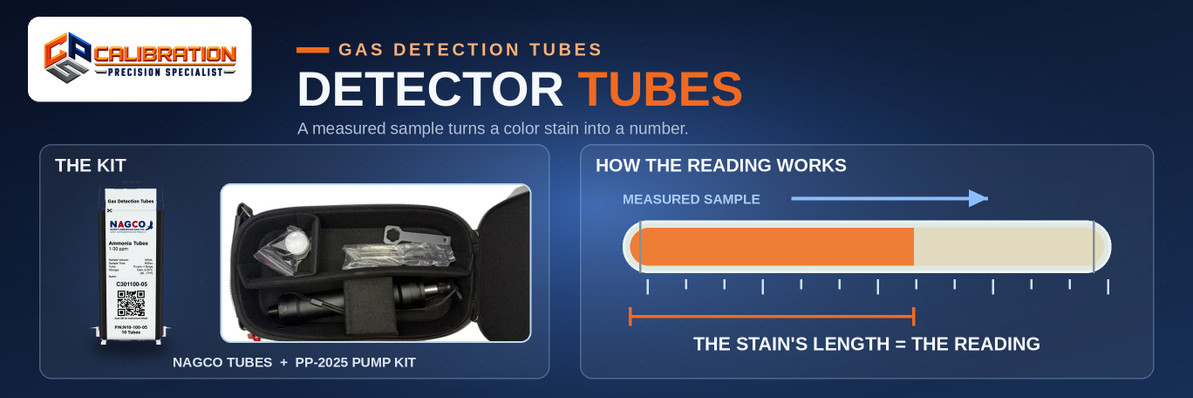
A gas detection tube is a sealed glass tube filled with a chemical reagent that changes color when a measured sample of air is drawn through it with a hand pump — the length of the resulting color stain, read against the scale printed on the tube, is the gas concentration. Each tube measures one gas, exactly once, with no battery, no calibration, and no electronics; at CPS the system is NAGCO's, with the PP-2025 hand pump kit at $395 and standard tube boxes at $49–$59.
Detector tubes are the oldest direct-reading instruments in gas detection — the format has been in practical use since the 1930s — and they survive because they answer a question electronic monitors answer badly: what is the concentration of this one specific gas, right here, right now, once? This post explains how a tube measurement actually works, which tubes CPS stocks, and the honest line between where tubes win and where only a monitor will do.
What Is Inside a Gas Detection Tube?
A detector tube is a narrow glass tube, sealed at both ends, filled with a granular chemical reagent chosen to react with one target gas. The outside carries a printed scale in the units the tube measures — ppm, percent by volume, mg/L, or, for natural-gas work, pounds of water per million cubic feet.
Because the reagent does the sensing, the tube is factory-calibrated by its printed scale: there is nothing to bump test and nothing to span. The measurement system is the tube plus the pump that pulls the sample, and the two are designed and calibrated together — which is why tube makers tell you not to mix one brand's tubes with another brand's pump.
The method is also intrinsically safe in the plainest sense: there is no electrical energy involved at all. A tube and a hand pump can go into a classified area without the hot-work and equipment-approval conversation an electronic instrument can trigger.
How Do You Take a Tube Measurement?
The procedure is the same across the NAGCO line we stock, and the PP-2025 pump is built around it:
- Leak-check the pump first. Seat an unbroken tube, pull the handle, and confirm the pump holds vacuum. A leaking pump under-draws the sample and under-reports the gas — this check takes a minute and is the single most skipped step.
- Break both tips of the tube using the pump's built-in tip breaker.
- Seat the tube in the pump, arrow pointing toward the pump.
- Pull the strokes the tube's instruction sheet specifies. The PP-2025 draws 50 mL on a half stroke or 100 mL on a full stroke, has an end-of-flow indicator for each stroke, and counts strokes for you. The standard ammonia measurement is one 100 mL stroke; the standard benzene measurement is three strokes (300 mL).
- Wait the specified sampling time, then read the stain. Find where the color change ends and read that point against the printed scale. NAGCO's ammonia tube changes purple to beige in about 1.5 minutes; its benzene tube changes white to brown over three 3-minute strokes.
- Apply the correction factor if you changed the stroke count. Drawing half a stroke and doubling the scale reading (NAGCO publishes a 2.4 factor for the ammonia tube's half-stroke range, not a flat 2.0) is how one tube covers several ranges — the factors are printed in each tube's instructions, and they are not always the round numbers you'd guess.
Used tubes are spent chemical reagents in broken glass; dispose of them under your site's rules and local regulations rather than in general trash.
Which Gas Detection Tubes Does CPS Carry?
Every tube on our shelf is NAGCO (North American Gas Co., Needville, Texas) — 31 tube products plus the pump and its accessories, all in our gas detection tubes category. A representative slice of the detection tubes range:
| Tube | Range | Strokes (standard range) | Price |
|---|---|---|---|
| Hydrogen sulfide (H₂S), N10-103-04 | 0.2–3 ppm | 1 × 100 mL | $49 |
| Carbon dioxide (CO₂), N10-104-30 | 300–5,000 ppm | 1 × 100 mL | $49 |
| Ammonia (NH₃), N10-100-05 | 1–30 ppm | 1 × 100 mL | $59 |
| Benzene specific, N10-101-01 | 0.5–10 ppm | 3 × 100 mL | $59 |
| Carbon monoxide selective, N10-102-18 | 5–100 ppm | per instructions | $59 |
| Sulfur dioxide (SO₂), N10-107-15 | 2–30 ppm | per instructions | $59 |
| Mercaptans, N10-129-20 | 5–120 ppm | per instructions | $59 |
| Amines, N10-132-10 | 0.5–10 ppm | per instructions | $59 |
| Water vapor, pipeline, N10-120-10 | 2–10 lbs/MMCF | per instructions | $49 |
| Benzene separation, N012-3022-010 | 0.1–1,000 ppm | temperature-dependent | $125 |
| Butadiene polymer, N012-3024-010 | 0.1–200 ppm | per instructions | $125 |
The H₂S family alone runs to eleven tubes, from 0.2–3 ppm up to 2–40% — tubes scale by range the way sensors can't, because the "sensor" is a fresh tube every time. The hardware around them is one-time money: the PP-2025 Hand Pump Kit at $395 (pump, zippered case, and rebuild kit, with a limited lifetime warranty on the pump), the PP-2025 Pump Rebuild Kit at $65, and a stainless steel sampling bulb at $95 for pipeline sampling points.
Gas Detection Tubes vs. Electronic Monitors: The Honest Comparison
| Detector tubes | Electronic monitor | |
|---|---|---|
| Reading | One measurement of one gas, at one moment | Continuous readings, one to six gases |
| Alarms | None — nobody is warned between measurements | Audible, visual, and vibrating alarms at setpoints |
| Power | None | Battery, charging, sensor warm-up |
| Stated precision | ≤±12% relative standard deviation on NAGCO tube spec sheets | Per sensor specification |
| Calibration | None — the scale is printed at the factory | Bump tests and periodic calibration required |
| Cost to start | $395 pump kit + $49–$59 per box of ten tubes | The instrument, plus sensors and calibration gas over its life |
| Cost per measurement | About $4.90–$5.90 a tube at standard box prices | Effectively zero per reading once owned |
| Shelf life | Finite — 1 to 3 years by tube type, printed on the box | Sensor life, typically tracked in months of service |
| Gas menu | Hundreds of compounds, including many with no practical sensor | Whatever sensors exist for the platform |
Read the table as a division of labor, not a contest. A monitor is a guard: it watches continuously and shouts. A tube is a witness: it testifies once, about one gas, in writing you can hold. Guards and witnesses are not interchangeable.
When Are Tubes the Right Tool?
- Infrequent checks at fixed points. A quarterly water-vapor check on a gas pipeline (the NAGCO pipeline tubes read directly in lbs/MMCF) never justifies a dedicated analyzer; a box of tubes and the pump do it for years.
- Gases with no practical electronic sensor. Benzene-specific measurement, amines, mercaptans, diesel and jet-fuel vapor, and polymer-plant tubes like the butadiene tube exist precisely because the sensor catalog runs out.
- Verifying a suspicious monitor reading. A tube is an independent chemical method. When a sensor's number and the situation disagree, a tube measurement is a cheap second opinion before anyone condemns or trusts the instrument.
- Industrial hygiene spot surveys. Screening a work area gas-by-gas to decide where continuous monitoring is actually warranted.
- Classified areas without an approved instrument on hand. No electrical energy, no approval gap.
When Are Tubes the Wrong Tool?
- Anywhere an alarm has to sound. A tube cannot warn anyone. If people will be exposed between measurements, the point needs a monitoring instrument, not a sampling method.
- Confined space occupancy. A tube reading is a snapshot of the moment it was drawn. Entry work calls for direct-reading instruments testing before entry and monitoring while people are inside — our walk-through of how to test a confined space before entry covers that sequence, and tubes are a supplement to it, never a substitute.
- Personal exposure monitoring while working. A tube measures where it is, when it is drawn — not the air a moving worker breathes across a shift.
- Outside the tube's stated conditions. Each tube's instructions carry its temperature and humidity envelope and its correction factors; some tubes carry outright humidity limits. A reading taken outside the envelope is a number, not a measurement.
The Honest Limits
- One gas, one moment, one tube. There is no trend, no data log, and no second reading from the same tube. If the answer matters, draw two tubes and average them — tube-class readings are generally quoted at ±20–25%, even though NAGCO's spec sheets state precision of ≤±12% RSD under controlled conditions.
- Tubes expire. NAGCO storage lives run 1 year (benzene specific), 2 years (ammonia), and 3 years (CO₂ and the benzene separation tube), stored in darkness at 5–25 °C with refrigeration preferred. An expired tube's reagent has already spent part of its reaction on the shelf. The benzene separation tube adds its own rule: once opened, use it within an hour.
- Interferences are printed, not hidden. Tube instruction sheets list cross-sensitivities; the benzene specific tube carries a pre-tube that strips interfering compounds before the sample reaches the indicating layer. Read the sheet for the gas mixture you actually have.
- The pump is half the instrument. Worn seals under-draw every sample. The PP-2025 is field-serviceable — that is what the $65 rebuild kit is for — and the leak check before each use is how you know whether it needs it.
The Bottom Line
Gas detection tubes are single-measurement chemical instruments: a hand pump draws a measured volume of air through a reagent, the stain length is the concentration, and the whole system at CPS is a $395 NAGCO pump kit plus boxes of ten tubes at $49–$59 for standard gases and $125 for specialty tubes. Use tubes for spot checks, odd gases, pipeline water vapor, and second opinions. Use monitors — portable or fixed — anywhere people need continuous warning. The two technologies have coexisted for ninety years because neither does the other's job.
Setting up a tube program, or not sure whether your check needs a tube or an instrument? Start with the gas detection tubes category, or call us at 865-900-8844 — tell us the gas, the range, and how often you measure, and we'll tell you plainly which side of the line it falls on. CPS also backs the instruments tubes can't replace: see our calibration services or reach us through Contact Us.
Frequently Asked Questions
What is a gas detection tube? A gas detection tube (colorimetric tube) is a sealed glass tube filled with a chemical reagent that changes color on contact with one specific gas. You break both tips, seat the tube in a hand pump, and draw a measured volume of air through it; the reagent stains in proportion to the amount of gas, and the length of the stain read against the scale printed on the tube is the concentration. Each tube makes one measurement of one gas and is then discarded.
How accurate are gas detection tubes? Good enough for spot checks and screening, not for custody-grade numbers. NAGCO's tube spec sheets state precision of ≤±12% relative standard deviation under controlled conditions, and detector-tube readings as a class are generally quoted at ±20–25%. Accuracy depends on following the instruction sheet: the specified stroke count and sampling time, the printed correction factors, and the tube's temperature and humidity envelope. When a reading decides something important, draw two tubes and average them.
How much do gas detection tubes cost? At CPS, standard NAGCO tube boxes are $49–$59 — hydrogen sulfide and carbon dioxide boxes at $49, ammonia, benzene specific, carbon monoxide, sulfur dioxide, mercaptan, and amine boxes at $59 — and specialty tubes (benzene separation, butadiene polymer) are $125. Boxes hold ten tubes, so a standard measurement costs about $4.90–$5.90 in consumables. The one-time hardware is the PP-2025 hand pump kit at $395.
How many measurements do you get from one detector tube? One. A detector tube is a single-use measurement: once the sample has been drawn and the reagent has reacted, that tube is spent, whether the stain reached the top of the scale or barely moved. Boxes hold ten tubes, so one box is ten measurements of the same gas and range. If you need the same point checked daily, that arithmetic — not the tube price alone — is what you compare against owning a monitor.
Do gas detection tubes expire? Yes. Every tube carries a finite storage life because the reagent slowly degrades even in a sealed tube. On the NAGCO line at CPS the stated lives run 1 year for the benzene specific tube, 2 years for the ammonia tube, and 3 years for the carbon dioxide and benzene separation tubes, stored in darkness at 5–25 °C (40–77 °F), with refrigeration preferred. Check the date printed on the box before trusting a reading, and note special rules — the benzene separation tube must be used within an hour once opened.
Do gas detection tubes need calibration? No. A detector tube is calibrated at the factory — its measuring scale is printed on the glass, and there is no adjustment to make or drift to correct. What does need attention is the pump: leak-check it with an unbroken tube before each use, because a pump that under-draws the sample makes every tube read low. The pump is field-serviceable (the PP-2025 rebuild kit is $65), and tubes and pump should be the matched system the tube maker specifies.
Can gas detection tubes replace a 4-gas monitor for confined space entry? No. A tube gives you one reading at the moment you draw it; it cannot alarm, cannot log, and cannot keep watching the space while people are inside it. Confined space entry calls for direct-reading instruments that test the atmosphere before entry and monitor it continuously during the work. Tubes have a legitimate supporting role — checking a specific gas a 4-gas sensor doesn't cover, such as benzene, before or during an entry — but the monitor is the entry instrument.
What gases can detector tubes measure that electronic sensors can't easily? The tube catalog runs to gases that have no practical portable sensor: benzene measured specifically in the presence of other hydrocarbons (0.5–10 ppm, or 0.1–1,000 ppm with the separation tube), water vapor in natural gas pipelines read directly in pounds per million cubic feet, amines, mercaptans, diesel and jet-fuel vapor, and polymer-plant gases such as butadiene. If a gas has a chemistry that changes color, there is very likely a tube for it — that breadth is the technology's reason to exist.
How long does a gas detection tube measurement take? Minutes, and the tube's instruction sheet sets the pace. NAGCO's standard ammonia measurement is one 100 mL pump stroke with about 1.5 minutes of sampling; the carbon dioxide tube takes about 2 minutes on one stroke; the benzene specific tube uses three strokes at 3 minutes each, so about 9 minutes of sampling. Ranges extended with extra strokes take proportionally longer. It is fast for a spot check and useless as surveillance — both halves of that sentence are the point.
Can you use one brand of tube in another brand's pump? You shouldn't. Detector tubes and their pumps are calibrated as a system — stroke volume, flow resistance, and the printed scale all assume the pump the tube was designed for. Tube manufacturers state plainly that their pumps and tubes are not interchangeable with other makers', and a mismatched pair can produce readings that are wrong by an unknown amount. Buy the pump your tubes specify; at CPS that pairing is NAGCO tubes with the PP-2025 pump.
CPS Calibrations · 109 S. Front Street, Rockwood, TN 37854 · Gas Detection Tubes · Calibration Gas · Calibration Services · Contact Us
Need a calibration you can file?
In-house calibration at CPS in Rockwood, Tennessee — $55 for single-gas instruments, $90 for 4- and 5-gas — every channel, as-found and as-left data, full certificate.
See Calibration Servicesor call 865-900-8844
Recent Posts
-

What Is Remote Monitoring for Fixed Gas Detection?
Remote monitoring for fixed gas detection means a fixed system's live readings, trends, and alarm hi …Nov 23rd 2026 -

What Are the Key Differences Between the GX-6000 and GX-6100?
The RKI GX-6100 is the current replacement for the discontinued GX-6000: both are pumped 6-gas monit …Nov 22nd 2026 -

How to Read a PID Correction Factor Chart
To read a PID correction factor chart, find your vapor’s row, take the factor under your own lamp en …Nov 21st 2026