
What Do IP Ratings and Intrinsic-Safety Marks on a Gas Detector Actually Mean?
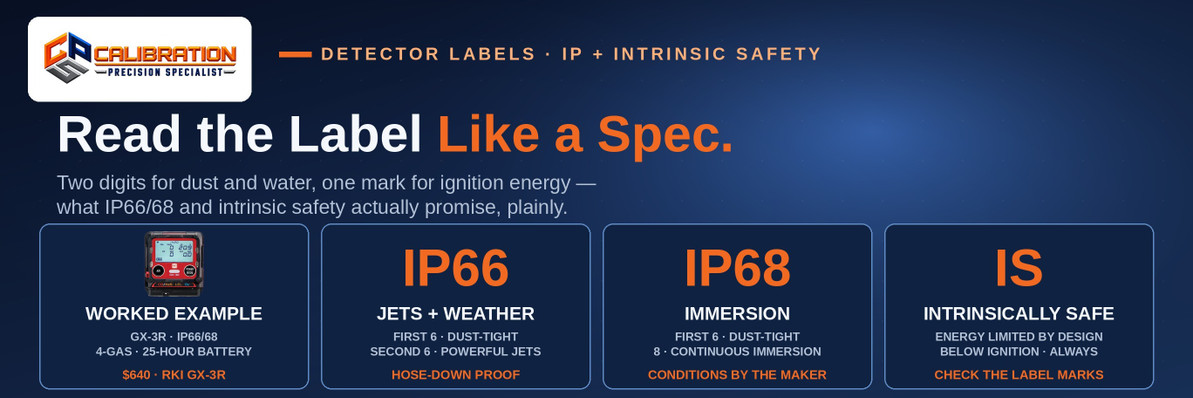
An IP rating tells you how well a gas detector's case keeps out dust and water — IP stands for Ingress Protection, the first digit rates solids (6, the highest, means dust-tight), and the second rates liquids (6 means powerful water jets, 7 temporary immersion, 8 continuous immersion under manufacturer-specified conditions) — while an intrinsic-safety mark makes a completely different promise: the instrument's electrical energy is limited so it cannot ignite a flammable atmosphere. The RKI GX-3R shows how the two combine on a real label: it carries IP66/68, meaning it is dust-tight and rated for both powerful jets and immersion.
Buyers compare gas detectors on sensors, battery, and price, then discover in the field that two other lines on the label controlled where the instrument was allowed to work and whether it survived the environment. Neither line is marketing. The IP code is a standardized designation with defined test levels, and intrinsic-safety and hazardous-location marks are certifications with legal weight — an instrument used in a classified area without the matching approval is a compliance failure no matter how well it detects gas. This post decodes both at the level a buyer, a safety manager, or a crew lead actually needs: what the digits mean, what they do not mean, and what to check on the label before an instrument is bought or carried into a classified space.
How Do You Read an IP Code?
Read it as IP plus two independent digits — the two digits do not average, and neither implies the other.
The first digit rates solids and dust, on a scale that tops out at 6. A rating of 6 means the enclosure is dust-tight: no dust ingress under test. For gas detectors this digit matters more than it looks — dust is what coats sensors, clogs diffusion paths, and works into charging contacts, and a dust-tight case is the difference between an instrument that lives on a plant floor and one that lives in a case.
The second digit rates water, and the levels a buyer will actually meet are these: 6 means the enclosure withstands powerful water jets — hose-down, driving rain, washdown conditions. 7 means it withstands temporary immersion. 8 means it withstands continuous immersion under conditions specified by the manufacturer — which is why an IP68 claim should always send you to the manual for the depth and duration the maker actually specifies, rather than a number assumed from the digit alone.
A dual rating like IP66/68 asserts both tests. This is the subtlety that trips up spec sheets: the immersion levels (7 and 8) and the jet level (6) are different tests, and passing immersion does not by itself promise the jet test was passed. A manufacturer that has run both marks both — which is exactly what a dual marking is telling you.
IP66 vs. IP67 vs. IP68: What Actually Changes?
All three start with the same first digit in most detector lineups — 6, dust-tight. The difference is entirely in the water digit, and it is about the kind of water exposure, not a simple ladder of better. IP66 is the washdown and weather rating: jets, spray, and rain, but not submersion. IP67 adds temporary immersion — the dropped-in-a-puddle, brief-submersion case — but a 7 does not by itself assert the powerful-jet performance of a 6. IP68 is immersion under manufacturer-specified conditions, typically more demanding than the IP67 test, with the exact conditions set by the maker rather than by a single universal depth. So "higher digit, better detector" is the wrong way to shop: match the rating to the exposure. A detector that gets hosed down daily needs the jet rating proven; a detector that works around open water and sumps needs immersion proven; a detector that does both needs both marks — or a dual rating that carries them.
The Worked Example: The RKI GX-3R's IP66/68
The RKI GX-3R — CPS's standard 4-gas instrument at a $640 display price, $590–$690 configured — carries IP66/68. Decoded with the rules above: the case is dust-tight (first digit 6); it is rated against powerful water jets (the 6 in the liquids position); and it is rated for continuous immersion under RKI's specified conditions (the 8). For a 4-gas monitor that works outdoors, in plants, in wet confined-space support roles, and in weather, that dual marking covers the two distinct ways water actually reaches an instrument — driven at it, and sat in it. The rest of the instrument behind that label: 0–100% LEL, 0–40% O2, 0–200 ppm H2S, and 0–2,000 ppm CO ranges, about a 25-hour battery, and a 3-year warranty. Keeping one calibrated is its own walkthrough: RKI GX-3R calibration service.
What IP Ratings Do NOT Tell You
An IP rating is a narrow, defined claim, and reading more into it causes real mistakes. It says nothing about impact resistance — a dust-tight case can still crack when dropped, and a cracked case no longer delivers the rating printed on it. It says nothing about chemical resistance — solvents and process chemicals attack seals and housings on their own terms. It does not mean the instrument operates underwater: the rating concerns ingress into the enclosure under test conditions, while the gas sensors still need the surrounding air to measure anything at all. And the rating describes the instrument as tested, with its covers and seals intact — a missing sensor cap, a perished gasket, or a case opened outside proper service can quietly retire a rating the label still advertises. Treat the IP code as one line of the specification, verified against your environment — not as a general toughness score.
What Does Intrinsic Safety Actually Mean?
Intrinsic safety is an ignition-protection concept, and it works by limitation rather than by armor. An intrinsically safe instrument is designed so that the electrical energy inside it — including under specified fault conditions, not just normal operation — is kept below the level that could ignite the flammable atmosphere it may be used in. There is no spark or hot surface available with enough energy to start a fire, because the design never lets that much energy exist in the first place. That is a fundamentally different approach from containing an explosion inside a heavy enclosure, and it is why intrinsically safe designs suit portable instruments: the protection travels with a device light enough to clip to a shirt. Two buyer consequences follow. First, intrinsic safety is a certified property of a specific instrument configuration — the mark applies to the instrument as certified, which is why battery packs, accessories, and repairs are not the place for improvisation. Second, the mark only helps if it matches the classification of the area the instrument enters — which is what the Class/Division and Zone systems describe.
Class/Division vs. Zone: Two Maps of the Same Hazard
Hazardous-location systems answer one question — how likely is a flammable atmosphere to be here, and how often — and two systems answer it in parallel. Class/Division is the traditional North American system. The Class names the kind of hazard; Class I is flammable gases and vapors. The Division grades the likelihood: Division 1 means the flammable atmosphere can be present under normal operating conditions; Division 2 means it is expected only under abnormal conditions, such as a leak or equipment failure. The Zone system, used internationally and alongside Class/Division in modern North American practice, grades gas atmospheres in three steps: Zone 0, where a flammable atmosphere is present continuously or for long periods; Zone 1, where it is likely occasionally in normal operation; and Zone 2, where it is unlikely and, if it occurs, persists only briefly. As a rough orientation, Division 1 spans the territory Zones 0 and 1 divide between them, and Division 2 corresponds broadly to Zone 2 — but "roughly" is the operative word: equipment approvals are granted against a specific system, class, division or zone, and often a gas group and temperature code as well. The buyer's rule is simple and non-negotiable: check the label for the exact marks the instrument carries, and match them to your area's classification — never assume a mark in one system substitutes for a mark in the other, and never let a salesperson's summary replace the printed certification.
How to Check a Detector Before You Buy or Deploy It
Work the label, in this order. First, the IP code: first digit 6 for dusty work, and a liquids digit that matches your real water exposure — jets, immersion, or both. Second, the hazardous-location marks: read the exact system (Class/Division or Zone), the class and division or zone, and any group and temperature code printed, and set them against the documented classification of the areas the instrument will enter; if the label's marks and the area's classification do not line up on paper, the instrument does not go in, whatever its sensor specs say. Third, the manual: IP68 conditions, approved batteries and accessories, and service instructions all live there, and the certification holds for the instrument as the manual describes it. If any of the three is unclear, that is a question to settle with the manufacturer or your dealer before purchase — CPS answers them for the instruments we sell at 865-900-8844 — rather than a detail to discover during an audit or an incident investigation.
Frequently Asked Questions
What does IP66 mean on a gas detector?
IP66 means the detector's enclosure is dust-tight and protected against powerful water jets. The first 6 is the top of the solids scale — no dust ingress under test. The second 6 means the case was tested against powerful jets, the hose-down and driving-rain case. It is a weather and washdown rating; it does not by itself claim the instrument can be immersed, which is what the 7 and 8 levels address.
What is the difference between IP66 and IP68?
The dust claim is the same — both start with 6, dust-tight. The water claim differs in kind: IP66 covers powerful water jets but not submersion, while IP68 covers continuous immersion under conditions the manufacturer specifies. Neither simply includes the other, which is why instruments tested for both carry a dual marking such as IP66/68 — the RKI GX-3R is one — rather than a single digit.
Is IP67 or IP68 better?
Neither is flatly better; they describe different exposures, and IP68's exact test conditions are set by the manufacturer. IP67 covers temporary immersion; IP68 covers continuous immersion under the maker's specified depth and duration, typically more demanding than the IP67 test — but you confirm that from the manual, not from the digit. Also note an immersion rating does not by itself assert the powerful-jet test of IP66. Buy the rating that matches how water actually reaches your instruments.
What does the first digit of an IP rating mean?
It rates protection against solid objects, ending with dust. The scale runs upward to 6, and 6 means dust-tight — no dust enters the enclosure under test. For gas detectors, that digit protects the things that make the instrument work: sensors, diffusion paths, and contacts, all of which suffer in dusty plants, grain and aggregate work, and construction environments. A first digit below 6 means some level of dust ingress is accepted by design.
What does the second digit of an IP rating mean?
It rates protection against water, and the levels most common on gas detectors are 6, 7, and 8. Six means powerful water jets — washdown and weather. Seven means temporary immersion. Eight means continuous immersion under conditions specified by the manufacturer, which is why an IP68 claim should always be checked against the manual for the depth and duration actually specified. The digits are separate tests: a higher immersion number does not automatically include the jet rating.
Does an IP68 gas detector work underwater?
No — and the distinction matters. The IP rating concerns water getting into the enclosure under test conditions; it is not a claim that the instrument functions submerged. A gas detector measures the air its sensors are exposed to, and a submerged sensor is not sampling your workplace atmosphere. IP68 means the instrument should survive immersion and keep working afterward — dropped in a sump, soaked in a pit — not that it measures gas while under water.
What does intrinsically safe mean for a gas detector?
It means the instrument is designed so its electrical and thermal energy — including under specified fault conditions — stays below the level that could ignite the flammable atmosphere around it. The protection is by energy limitation, not by containing an explosion, which is what makes it practical for lightweight portable instruments. Intrinsic safety is a certified property of the specific instrument and configuration, so approved batteries, accessories, and proper service are part of the certification, not optional details.
What is the difference between Class/Division and Zone ratings?
They are two systems for classifying hazardous locations and marking equipment for them. Class/Division, the traditional North American system, names the hazard type — Class I is flammable gases and vapors — and grades likelihood as Division 1 (hazard can be present in normal operation) or Division 2 (only under abnormal conditions). The Zone system grades gas atmospheres as Zone 0 (present continuously or for long periods), Zone 1 (likely occasionally in normal operation), or Zone 2 (unlikely and brief). Approvals are granted in a specific system, so match the instrument's printed marks to your area's classification rather than translating loosely between systems.
Does an IP rating mean a detector is explosion-proof or intrinsically safe?
No. IP ratings and ignition-protection marks answer entirely different questions. The IP code rates dust and water ingress into the case; intrinsic-safety and hazardous-location certifications concern whether the instrument can ignite a flammable atmosphere. A detector can carry a high IP rating and no hazardous-location approval at all — which makes it a weatherproof instrument that still does not belong in a classified area. Read both lines on the label, separately.
What rating does the RKI GX-3R carry, and what does it cost?
The RKI GX-3R carries IP66/68: dust-tight, rated against powerful water jets, and rated for continuous immersion under the manufacturer's specified conditions. It is a 4-gas monitor — 0–100% LEL, 0–40% O2, 0–200 ppm H2S, 0–2,000 ppm CO — with about a 25-hour battery and a 3-year warranty, at a $640 display price and $590–$690 configured on the CPS store. Its calibration is covered in RKI GX-3R calibration service, and the instrument itself is in portable multi-gas monitors.
The Bottom Line
IP ratings and intrinsic-safety marks are two separate promises printed on the same label: the IP code — first digit dust, second digit water — tells you whether the case keeps your environment out, worked plainly by the GX-3R's IP66/68; intrinsic safety tells you whether the instrument's energy is limited so it cannot ignite the atmosphere it works in, with Class/Division and Zone as the two classification systems that mark has to match. Read both lines exactly, check IP68 conditions and certification details in the manual, and never let a toughness rating substitute for a hazardous-location approval.
Decoding a label before a purchase or an entry? Call CPS Calibrations at 865-900-8844 — we will read the marks on the instruments we sell and calibrate with you, from 109 S. Front Street, Rockwood, TN 37854.
CPS Calibrations · 109 S. Front Street, Rockwood, TN 37854 · Calibration Services · RKI GX-3R · RKI GX-3R Calibration Service
Need a calibration you can file?
In-house calibration at CPS in Rockwood, Tennessee — $55 for single-gas instruments, $90 for 4- and 5-gas — every channel, as-found and as-left data, full certificate.
See Calibration Servicesor call 865-900-8844
Recent Posts
-

What Is Remote Monitoring for Fixed Gas Detection?
Remote monitoring for fixed gas detection means a fixed system's live readings, trends, and alarm hi …Nov 23rd 2026 -

What Are the Key Differences Between the GX-6000 and GX-6100?
The RKI GX-6100 is the current replacement for the discontinued GX-6000: both are pumped 6-gas monit …Nov 22nd 2026 -

How to Read a PID Correction Factor Chart
To read a PID correction factor chart, find your vapor’s row, take the factor under your own lamp en …Nov 21st 2026