
What Does Cold Weather Do to a Gas Detector? Batteries, Sensors, and Readings Below Freezing
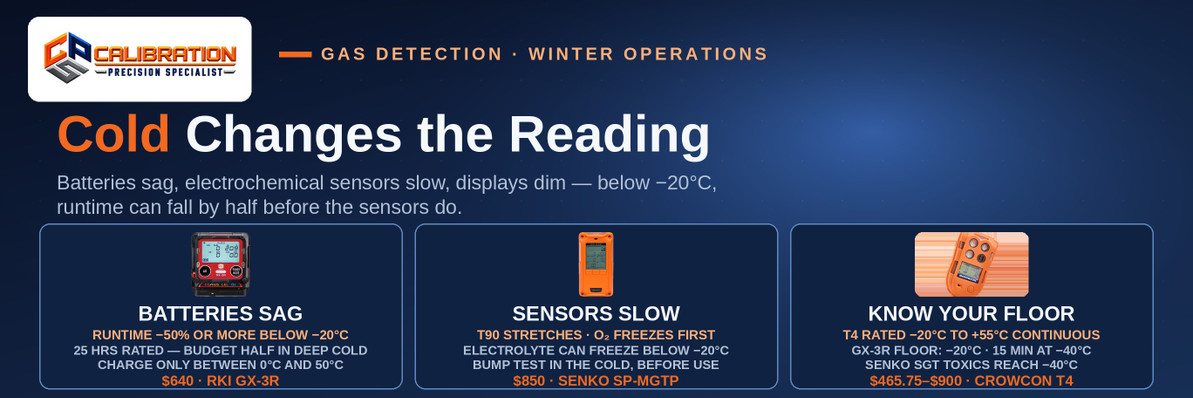
Cold weather attacks a gas detector in a set order: below −20°C (−4°F), battery runtime can fall by 50% or more, the electrochemical reactions that produce toxic and oxygen readings slow down so response time (T90) stretches past its room-temperature rating, and after extended exposure below −20°C the water-based electrolyte inside electrochemical sensors can freeze — the oxygen sensor usually first — while LCD displays turn sluggish or go blank even though the instrument may still detect gas and alarm. Most professional portables, including the RKI GX-3R ($640, continuous rating −20°C to +50°C / −4°F to +122°F) and the Crowcon T4 ($465.75–$900, rated −20°C to +55°C / −4°F to +131°F), are built to that −20°C floor; the disposable SENKO SGT is a deliberate exception, rated to −40°C (−40°F) for its toxic-gas versions.
Nothing about a detector fails dramatically at 31°F. That is what makes cold dangerous: the instrument powers on, passes a casual glance, and goes to work quietly degraded — answering slower, dying sooner, and reading through a sensor whose chemistry is running at half speed. This post walks through what actually changes, system by system, why the order matters, and the winter routine that keeps readings honest.
What Changes First: The Battery
Cold is a battery problem before it is a sensor problem. Low temperature raises the internal resistance of lithium-ion and alkaline cells and slows the chemistry that delivers their charge, so the pack delivers less of its rated capacity and sags under load:
- Runtime can fall by half or more. Manufacturer guidance for professional monitors puts the figure plainly: below −20°C (−4°F), battery run time may be reduced by 50% or more. A detector rated around 25 hours per charge at room temperature — the RKI GX-3R — should be budgeted at roughly half that in deep cold, and some manufacturers warn that operating time is already reduced at −10°C (14°F) and below.
- Alkaline packs suffer worst. Instruments that accept alkaline battery packs have a much shorter runtime in the cold than on rechargeable lithium-ion — carry spares, and carry them warm, in an inside pocket rather than the truck box.
- Charging is temperature-limited too. Recommended charging temperatures are typically 0°C to 50°C (32°F to 122°F). A detector that "won't charge" on a freezing loading dock is often protecting its battery, not failing — bring it inside and let it warm before concluding the charger or the pack is dead.
- Old batteries fail first. Capacity loss compounds age. A pack that barely finished a summer shift will not finish a winter one; check pack age before the season, not during it.
Plan the shift around the derated number, not the brochure number. A monitor that dies at hour five of an eight-hour turnaround is not a minor inconvenience — it is an unmonitored crew that may not notice the protection is gone.
What Changes Second: Sensor Speed and the Freezing Point
Electrochemical sensors — the cells that measure oxygen, CO, H₂S, and most other toxic gases — are small chemical reactors. Gas diffuses through a membrane and reacts at an electrode in a water-based (aqueous) electrolyte, producing a current proportional to concentration. Cold slows every step of that:
- Response time stretches. The reaction and diffusion rates fall with temperature, so the sensor still reaches the right answer — later. A T90 specified as "within 30 seconds" (the GX-3R's rating) is a room-condition specification; in deep cold the same sensor takes measurably longer to climb to 90% of the final reading. On a pumped pre-entry test, that means longer waits at each level — rush the reading and you have measured the hose, not the space.
- Sensitivity and zero shift. Sensor output is temperature-dependent, and manufacturers publish temperature-effect allowances for exactly this reason. Instruments compensate within their rated range, but compensation is not magic at the edges of it — expect more zero wander and more frequent fresh-air zeroing in the cold.
- Below −20°C, the electrolyte itself can freeze. Electrochemical sensors typically carry an aqueous electrolyte, which may freeze as temperatures drop below −20°C for extended periods. The oxygen sensor is usually the first to freeze. A frozen sensor does not produce a reliable reading — but it should return to normal function once it warms up and thaws. A detector that spent the night in a frozen truck needs to warm up and be bump tested before it is trusted, not just switched on.
- Sensor floors differ inside one instrument. Ratings are per-sensor, not per-box: on the SENKO SP-MGTP ($850), for example, the published operating ranges run −20°C to +50°C for oxygen but −30°C to +50°C for CO and H₂S. The instrument's real cold floor is its weakest fitted sensor.
Catalytic LEL sensors and infrared sensors are affected differently — a catalytic bead must stay hot to work and draws more power in cold air, while infrared optics have no electrolyte to freeze but can be blinded by condensation on the optics. No technology is immune; each just fails in its own order.
What Changes Third: Displays, Pumps, and Water Turning to Ice
- The display lies about the instrument's health. Below about −20°C the response of the instrument may appear sluggish and the LCD may dim or even go blank if it freezes. In that condition the monitor will likely still detect gas and still alarm — bump test it before each use to prove it responds, and warm it as soon as possible once back indoors. A blank screen is a reason to verify, not a reading of zero.
- Condensation is the winter failure nobody logs. Moving a warm detector into freezing air — or a frozen detector into a warm, humid building — condenses moisture onto sensor membranes, filters, and optics. That moisture can temporarily block the gas path, skew readings, and, in a pumped instrument's sample line or filter, freeze into a low-flow fault. Let instruments temperature-stabilize, keep filters clean and dry, and treat a pump fault on a cold morning as ice until proven otherwise.
- Dry winter air dries sensors out. Cold climates are often extremely dry, and dry air pulls moisture from electrochemical electrolytes over time. Storing and charging instruments in a humidified area — around 40–50% relative humidity — significantly helps maintain sensor sensitivity and prolong working life through the season.
The Ratings That Decide What You Can Use
Every detector carries a continuous operating-temperature rating, and winter work has to fit inside it:
| Instrument | Continuous operating rating | Battery / runtime note | CPS price |
|---|---|---|---|
| RKI GX-3R | −20°C to +50°C (−4°F to +122°F), with a temporary range of −40°C to +60°C for about 15 minutes | Lithium-ion, approx. 25 hours at room conditions — budget roughly half below −20°C | $640 |
| Crowcon T4 | −20°C to +55°C (−4°F to +131°F) | Rechargeable Li-ion, up to 18 hours standard (up to 35 hours with long-life O₂ / MPS options), 5.5-hour recharge | $465.75–$900 by configuration |
| SENKO SGT (disposable single-gas) | −40°C to +50°C for toxic versions; −35°C to +50°C for O₂ | Sealed lithium primary cell, 24-month operating life — nothing to charge in the cold | See single-gas monitors |
| SENKO SP-MGTP (pumped multi-gas) | Per-sensor: O₂ −20°C to +50°C; CO / H₂S −30°C to +50°C | Pumped sampling — allow extra response time per foot of cold sample line | $850 |
Two selection rules fall out of the table. First, buy to the floor your work actually hits: a crew doing winter utility work at −30°C is outside a −20°C instrument's continuous rating no matter how good the instrument is, and the SENKO SGT's −40°C toxic rating exists for exactly that work. Second, "temporary" ratings are excursions, not shifts — the GX-3R's −40°C figure covers about 15 minutes, which is a retrieval or a quick check, not a workday.
Bump Tests and Calibration Gas in the Cold
Cold corrupts the verification routine as surely as it corrupts the measurement:
- Bump test where the work is. A bump test passed at a warm shop bench proves the sensors respond at room temperature. If the instrument is going to work below −20°C — where response is sluggish and the display may be unreadable — bump test it in the cold, before each use, and allow the extra time a slowed sensor honestly needs to alarm. A "failed" bump test in deep cold is sometimes a slow sensor judged on a warm-weather timer; a passed one at the bench is sometimes no proof at all.
- Cold gas is low-pressure gas. Cylinder pressure falls as temperature falls, so a calibration gas cylinder stored in a freezing vehicle shows a lower gauge pressure and can deliver flow weakly or unevenly until it warms. Store calibration gas and regulators at indoor temperatures, let a cold cylinder stabilize before calibrating, and never judge a cylinder empty from a cold-morning gauge reading.
- Calibrate warm, verify cold. Full calibration belongs at stable, indoor temperatures with the instrument stabilized — CPS calibrates every channel on the instruments it services — and the cold-weather bump test then verifies that the calibrated instrument still responds in the conditions it will actually work in.
The Winter Routine That Keeps a Fleet Honest
- Store and charge indoors. Instruments live in a warm, moderately humid room (40–50% RH) — not in the truck, not on the dock. Charging below 0°C is outside the recommended window for typical packs.
- Budget half the battery. Plan shifts, spares, and swap points around a 50% runtime derating below −20°C, and retire tired packs before the season.
- Warm up cold-soaked instruments. A detector that sat below −20°C needs time to thaw — O₂ sensor first to freeze, first to check — then a bump test before use.
- Bump test in the cold, with patience. Verify response under working conditions and give slowed sensors the time they need; investigate failures indoors before condemning a sensor.
- Keep the gas path dry. Inspect filters, let instruments stabilize across temperature swings, and treat cold-morning pump faults as ice or condensation until proven otherwise.
- Match the fleet to the forecast. Keep at least some instruments whose continuous rating covers your coldest real work — and know each model's floor before the cold snap, not during it.
Frequently Asked Questions
What happens to a gas detector in cold weather?
Three things, in order: the battery delivers far less of its rated runtime (below −20°C / −4°F, runtime may fall by 50% or more), electrochemical sensors respond more slowly because the chemical reaction that produces the reading slows down, and after extended exposure below −20°C the water-based electrolyte in electrochemical sensors can freeze — the oxygen sensor usually first — making readings unreliable until the instrument warms and thaws. Displays also turn sluggish and may go blank below about −20°C even while the instrument still detects gas and alarms.
How cold is too cold for a gas detector?
Too cold is below the instrument's continuous operating-temperature rating, which for most professional portables is −20°C (−4°F): the RKI GX-3R is rated −20°C to +50°C continuous (with a temporary −40°C to +60°C range for about 15 minutes) and the Crowcon T4 is rated −20°C to +55°C. Some instruments go lower — the disposable SENKO SGT's toxic-gas versions are rated to −40°C. Working below the continuous rating means slower response, unreliable readings once electrolytes freeze, and battery runtime cut by half or more.
Why does my gas detector battery die so fast in winter?
Cold raises a battery's internal resistance and slows its chemistry, so the pack delivers much less of its rated capacity and sags under load. Manufacturer guidance puts the loss at 50% or more below −20°C (−4°F), and some makers warn operating time is already reduced at −10°C or below. Alkaline packs lose more than rechargeable lithium-ion. Budget winter shifts at roughly half the room-temperature runtime, keep spare batteries warm, and remember an aging pack that barely finished a summer shift will not finish a winter one.
Can a gas detector sensor freeze?
Yes. Electrochemical sensors — oxygen, CO, H₂S, and most toxic-gas cells — contain a water-based electrolyte that may freeze when temperatures drop below −20°C (−4°F) for extended periods. The oxygen sensor is usually the first to freeze. A frozen sensor does not produce a reliable reading, but it should return to normal function once the instrument warms up and thaws. Warm a cold-soaked detector indoors and bump test it before trusting it.
Why is my gas detector slow to respond in cold weather?
Electrochemical sensors work by a chemical reaction at an electrode, and that reaction — plus the diffusion of gas through the sensor membrane — slows as temperature falls. A response time like the RKI GX-3R's "within 30 seconds (T90)" is specified at normal conditions; in deep cold the same sensor takes longer to reach 90% of the final reading. Practically: allow more time on pumped pre-entry tests at each level, and do not fail or pass a bump test on a warm-weather timer when the instrument is working in the cold.
Why did my gas detector screen go blank in the cold?
Below about −20°C (−4°F), LCD response becomes sluggish and the display may dim or go blank if it freezes. A blank display does not necessarily mean a dead detector — in that condition the instrument will likely still detect gas and still alarm. Bump test it before each use to confirm it responds, rely on audible, visual (LED), and vibrating alarms rather than the screen, and warm the instrument as soon as possible once indoors.
Should you bump test a gas detector in cold weather?
Yes — and bump test it in the cold, not just at a warm bench. A room-temperature bump test proves the sensors respond at room temperature; it does not prove the slowed, cold instrument will alarm in working conditions. Manufacturer guidance for use below −20°C is to bump test before each use to make sure the instrument responds. Give the sensor extra time to reach alarm in the cold before judging the result, and bring failed instruments indoors to warm up and retest before replacing sensors.
Can calibration gas be stored in the cold?
Calibration gas survives cold storage better than detectors do, but a cold cylinder misbehaves: gas pressure falls as temperature falls, so a cylinder kept in a freezing vehicle shows a lower gauge reading and can deliver weak or uneven flow through the regulator until it warms. Store calibration gas and regulators indoors at stable temperatures, let a cold cylinder warm and stabilize before calibrating or bump testing, and never declare a cylinder empty from a pressure reading taken while it is cold-soaked.
How should you store gas detectors in winter?
Indoors, warm, and moderately humid: store and charge detectors in a heated area held around 40–50% relative humidity, which helps keep electrochemical electrolytes from drying out in dry winter air and preserves sensor sensitivity. Keep instruments out of vehicles and unheated docks overnight, respect the typical charging window of 0°C to 50°C (32°F to 122°F), and let a cold-soaked instrument warm and stabilize — then bump test it — before it goes back into service.
Which gas detectors work best in extreme cold?
The ones whose continuous rating covers your coldest work. Among the instruments CPS carries: the disposable SENKO SGT is rated to −40°C (−40°F) for toxic gases (CO, H₂S, and others) and −35°C for oxygen, with a sealed battery that runs 24 months and never needs charging in the cold. The RKI GX-3R ($640) and Crowcon T4 ($465.75–$900) are rated for continuous use to −20°C, and the pumped SENKO SP-MGTP's ($850) CO and H₂S sensors are rated to −30°C even though its oxygen sensor floors at −20°C — so the right answer depends on which gases, and how cold, your work actually involves.
The Bottom Line
Cold does not break a gas detector all at once — it derates it in a predictable order: battery first, sensor speed second, electrolyte and display at the extremes. Every one of those effects is manageable once it is planned for: store and charge warm and humid, budget half the battery below −20°C, bump test in the cold with patience, and own at least some instruments rated for the coldest work you actually do. The detector that worries you is not the one that fails loudly in January — it is the one that powers on, looks fine, and answers thirty seconds too late.
Need help matching a monitor to winter work — or a cold-season check of the fleet you already own? Call 865-900-8844 or reach us through Contact Us. Browse portable multi-gas monitors, single-gas monitors, or our calibration services to keep every channel proven before the temperature drops.
CPS Calibrations · 109 S. Front Street, Rockwood, TN 37854 · Calibration Gas · Calibration Services · Contact Us
Need a calibration you can file?
In-house calibration at CPS in Rockwood, Tennessee — $55 for single-gas instruments, $90 for 4- and 5-gas — every channel, as-found and as-left data, full certificate.
See Calibration Servicesor call 865-900-8844
Recent Posts
-

What Is Remote Monitoring for Fixed Gas Detection?
Remote monitoring for fixed gas detection means a fixed system's live readings, trends, and alarm hi …Nov 23rd 2026 -

What Are the Key Differences Between the GX-6000 and GX-6100?
The RKI GX-6100 is the current replacement for the discontinued GX-6000: both are pumped 6-gas monit …Nov 22nd 2026 -

How to Read a PID Correction Factor Chart
To read a PID correction factor chart, find your vapor’s row, take the factor under your own lamp en …Nov 21st 2026