
What Gas Detection Does a Pharmaceutical Plant Need?
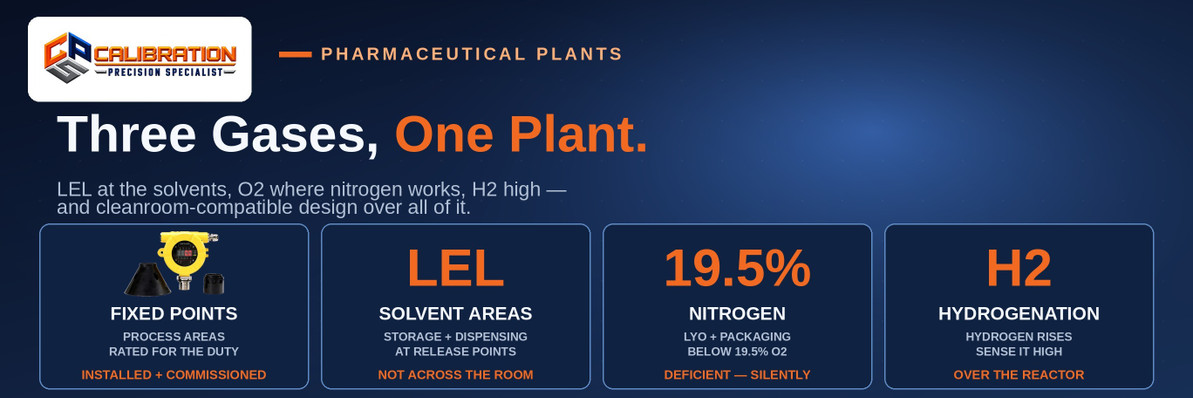
A pharmaceutical plant needs gas detection in four places: LEL monitoring where solvents are stored, dispensed, and processed; fixed oxygen-depletion detection wherever nitrogen does its quiet work — blanketing, lyophilization, packaging — because inert gas drops air below the 19.5% oxygen-deficiency line with no warning at all; hydrogen detection in hydrogenation areas, placed high where hydrogen collects; and portable monitors for maintenance and entry — all of it arranged so the monitoring protects people without compromising the cleanrooms it watches over.
Pharma is really several plants sharing a fence: a chemical operation with solvents and reactions, a utility plant with nitrogen everywhere, and a clean manufacturing core where the rules run the other way — the room itself is a product-quality instrument. Detection has to satisfy all three personalities at once. Walk it by process step, the way the hazards arrive, and the map mostly draws itself.
Solvent Areas: LEL Where Flammable Liquids Live
Ethanol, isopropanol, acetone, and their peers move through a pharma plant in drums, totes, and process vessels — received, stored, dispensed, charged to granulators and dryers, recovered or sent to waste. Each transfer is a vapor opportunity, and solvent vapor is a combustible-gas problem: LEL monitoring belongs at storage and dispensing areas, at the process equipment that heats or sprays solvent, and in the waste-handling corners that risk assessments love to forget. Placement follows vapor behavior and the release points — pumps, manways, open transfers — because an LEL head across the room from the dispensing bench is measuring the room's average luck.
Solvent areas also carry classification consequences: where flammable vapor can be present, the detection equipment itself must be built and installed for that duty — explosion-proof fixed heads and properly rated installation are the pattern, with the plant's own area classification setting the requirements. This is design work, done with the plant's engineers — see fixed system installation for how CPS approaches the install side.
Nitrogen: The Utility That Empties Rooms of Air
Nitrogen is pharma's invisible utility — blanketing vessels, inerting transfers, feeding lyophilizers, flushing packaging lines — delivered from bulk liquid storage that boils off continuously. Every one of those uses is a controlled release of an asphyxiant into a building. The rooms that earn fixed oxygen detection are the ones where the release can beat the ventilation: lyophilization suites where chambers open to the room, packaging halls with continuous flushing, nitrogen storage and manifold rooms, and any small or below-grade space the gas can pool its way into displacing air.
The design rules from the lab world apply at plant scale: sensor at breathing height, alarm that speaks outside the door before entry, and ventilation treated as part of the system. Below 19.5% oxygen, air is deficient — and nitrogen gives a person nothing to notice on the way there, which is why the detector, not the entrant, has to do the noticing.
Hydrogenation and the Rest of the Reaction Map
Where the plant hydrogenates, hydrogen is present in quantity — piped, pressurized, and fed to reactors — in rooms that also hold catalyst handling and solvent. Hydrogen's habits dictate the detection: it leaks eagerly, ignites easily, and rises, so combustible sensing belongs high, over the reactor, the gas supply, and the ceiling's pockets. Autoclave and kilo-lab areas get the same treatment scaled to their inventories, and the pilot plant — where processes change weekly — earns portable survey discipline on top of its fixed points, because fixed detection is always designed for the process that was there at design time.
Maintenance is the other exposure window: line-breaking, vessel opening, and turnaround work put people inside the process's geography. Portable multi-gas monitors with the right channels — LEL and O₂ at minimum for entry work — plus permit discipline are the layer that covers the plant when it is taken apart.
The Cleanroom Constraint: Detection That Doesn't Contaminate
Inside classified cleanrooms, every object is judged as a particle and bioburden source — including the safety equipment. Gas monitoring there is designed with quality, not against it: sensing arranged to serve the space without adding shedding surfaces or un-cleanable clutter, sampling and alarm annunciation planned with the room's classification in mind, and the genuinely hazardous operations (solvent dispensing, nitrogen flushing) watched at their points, which are often at the room's edge, its exhaust, or the less-classified support spaces where the risk actually concentrates.
The principle generalizes across the whole plant: detection follows the hazard's geography — solvents, nitrogen points, hydrogen, entry work — and the cleanroom gets a design that respects what the room is for. Finish with the unglamorous layer that makes any of it trustworthy: every fixed head and portable on a calibration schedule with records a QA audit can read. CPS calibrates in-house at $55 single-gas and $90 for 4- and 5-gas instruments — see calibration services — and portable gas detection covers the personal layer across the site.
Frequently Asked Questions
What gases does a pharmaceutical plant monitor?
By area: combustible vapor (LEL) where solvents are stored, dispensed, and processed; oxygen depletion wherever nitrogen is stored, manifolded, or used — lyophilization, blanketing, packaging; hydrogen (as LEL) in hydrogenation areas, sensed high; and portable LEL/O₂ monitoring for maintenance and entry work. The plant's gas map is its process map, read room by room.
Why is nitrogen a detection problem in pharma?
Because it is everywhere and it is silent. Nitrogen blanketing, lyophilizers, and packaging flushes are continuous, intentional uses of an asphyxiant, backed by bulk liquid storage. Wherever a release can outpace ventilation, room air can fall below the 19.5% oxygen-deficiency threshold with no odor or irritation to warn anyone — so fixed oxygen detection, alarming outside the door, does the noticing.
Where does solvent LEL detection belong?
At the release points and the work: solvent storage and dispensing, equipment that heats or sprays solvent (granulators, dryers, coaters), transfer points like pumps and manways, and waste-solvent handling. An LEL head should measure the air where vapor actually appears, placed for the vapor's behavior — not across the room averaging the plant's luck.
How do you monitor gas in a cleanroom without contaminating it?
By designing with the room's classification instead of against it: keep sensing hardware to what the space can accept, watch hazardous operations at their points — often the room's edge, exhaust path, or adjacent support spaces where risk concentrates — and plan alarm annunciation with quality from the start. The hazard geography decides placement; the classification decides form.
What detection does a hydrogenation suite need?
Fixed combustible (hydrogen LEL) detection placed high — over the reactor, the hydrogen supply, and ceiling pockets — because hydrogen rises, leaks readily, and ignites easily. The suite's solvent inventory adds ordinary LEL thinking at its own level. Placement by buoyancy is the whole discipline; a bench-height head is the classic miss.
Do pilot plants need different detection?
They need the fixed points for their standing hazards plus portable survey discipline, because pilot processes change faster than fixed designs. A fixed system is designed for the process present at design time; when the chemistry changes weekly, portables and pre-job gas surveys are how detection keeps up until the fixed map is redrawn.
What about maintenance and vessel entry?
That is portable territory: multi-gas monitors with LEL and O₂ channels at minimum, used under the plant's permit system for line-breaking, vessel opening, and turnaround work. Fixed systems guard the running plant; portables guard people working inside a stopped one. Both layers need calibration records that survive an audit.
Who designs a pharma plant's gas detection?
The plant's process-safety and engineering functions, under its area classifications and quality system — they own the hazard picture. CPS supplies, installs support for, and calibrates fixed and portable instruments (call 865-900-8844) and services what it sells; solvent, nitrogen, and hydrogen design decisions sit with the plant.
How often do pharma detectors need calibration?
On the schedule their manuals and the plant's safety and quality systems set — with documentation an audit can read, because in pharma the record is part of the safety case. CPS calibrates in-house at $55 single-gas and $90 for 4- and 5-gas instruments, every channel, as-found and as-left data, full certificate.
What is the first step in reviewing a plant's detection?
Walk the process map: solvents (storage → dispensing → process → waste), nitrogen (storage → manifolds → every point of use), hydrogen, and the maintenance calendar. Room by room, ask what gas can be where, how a person would know, and what the alarm makes happen. The gaps announce themselves — usually in nitrogen rooms and waste corners first.
The Bottom Line
Pharmaceutical gas detection follows the process: LEL at the solvents, fixed oxygen monitoring at every place nitrogen can quietly take a room below 19.5%, hydrogen sensing placed high in hydrogenation, portables for the people who open the plant up — and cleanroom-compatible design over all of it, calibrated and documented like everything else in a plant that runs on records.
Reviewing a plant's detection, or calibrating what's installed? Call CPS Calibrations at 865-900-8844 — 109 S. Front Street, Rockwood, TN 37854.
--- CPS Calibrations · 109 S. Front Street, Rockwood, TN 37854 · Fixed System Installation · Portable Gas Detection · Calibration Services
Need a calibration you can file?
In-house calibration at CPS in Rockwood, Tennessee — $55 for single-gas instruments, $90 for 4- and 5-gas — every channel, as-found and as-left data, full certificate.
See Calibration Servicesor call 865-900-8844
Recent Posts
-

What Is Remote Monitoring for Fixed Gas Detection?
Remote monitoring for fixed gas detection means a fixed system's live readings, trends, and alarm hi …Nov 23rd 2026 -

What Are the Key Differences Between the GX-6000 and GX-6100?
The RKI GX-6100 is the current replacement for the discontinued GX-6000: both are pumped 6-gas monit …Nov 22nd 2026 -

How to Read a PID Correction Factor Chart
To read a PID correction factor chart, find your vapor’s row, take the factor under your own lamp en …Nov 21st 2026