
Which B&W Case Do You Need? A Size, Foam, and Fit Guide for Instrument Kits
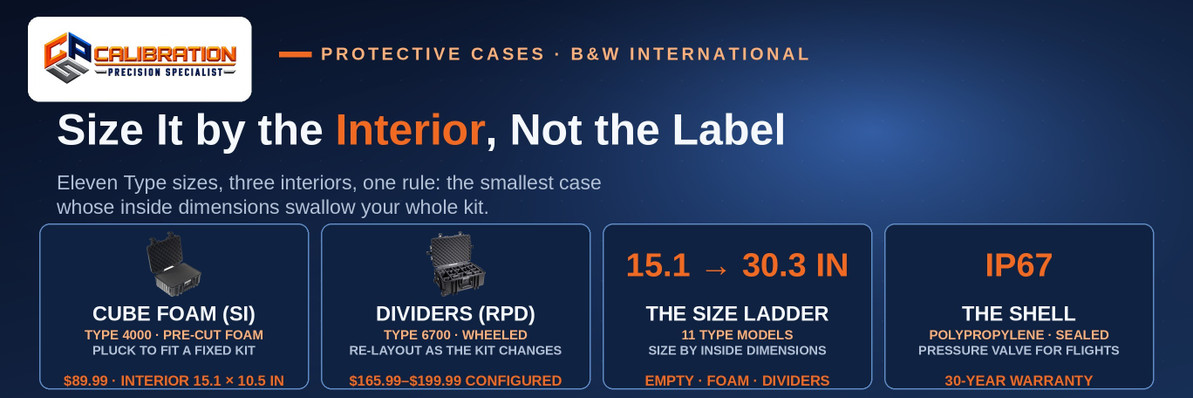
You choose a B&W case by its interior dimensions and interior type, not its model number: the eleven Type outdoor cases CPS sells run from the Type 4000 (15.1 × 10.5 × 6.5 in interior, $89.99) to the wheeled Type 7800 (30.3 × 21.3 × 15 in, $349.99–$564.99 configured) — every one a waterproof IP67 polypropylene shell with an automatic pressure-equalization valve and a 30-year warranty. The right pick is the smallest case whose interior fits your whole kit: pre-cut cube foam (SI) for a kit that never changes, padded dividers (RPD) for a kit that does, and an empty shell for gear that already carries its own protection.
A gas detector's most dangerous hours are rarely the ones it spends in the plant. They are the hours in the truck bed under a sliding toolbox, on the parcel truck between your dock and ours, and on the baggage belt — dropped, stacked, rained on, and vibrated for a hundred miles at a time. The instrument itself is built for the workplace; what it travels in usually isn't. This guide works through the B&W International Type line CPS carries — every size with its real interior dimensions and configured prices — and the three decisions that actually pick the case: how much interior the kit needs, which interior type fits how the kit is used, and when the wheeled end of the line earns its size.

B&W Type 6000 Outdoor Case – Black
The general-purpose field-kit case: 18.75 × 13.75 × 7.75 in interior, IP67 polypropylene shell, in empty, cube-foam, or divider configurations.
$119.99–$157.99 configured
See the Type 6000Why Does a Gas Detector Need a Hard Case at All?
Because of what a meter costs and what a fall does to it. Portable gas detectors on this site run from $640 to past $5,000 configured, and the expensive parts — sensor faces, pump inlets, displays — are exactly the parts a drop onto concrete finds first. A hard case buys four specific things cardboard and soft bags do not:
- Impact structure. A rigid polypropylene shell with foam inside spreads a drop across the case instead of through the instrument. The fall still happens; the meter doesn't take it.
- A weather seal. Every Type case is IP67 — dust-tight and rated for temporary submersion — so a case caught in the rain on a tailgate, or riding in a wet truck bed, keeps its contents dry instead of merely shaded.
- Organization that survives transport. Foam or dividers hold the meter, its charger, and its calibration accessories in fixed places, so nothing grinds against the sensor face for six hours of highway vibration — and a missing charger is obvious at a glance, before the truck leaves.
- A repeatable shipping container. The same case that protects the meter in the field protects it in the parcel network, which is why the ship-in guidance below starts with a case, not a box.
Against a four-figure instrument, the arithmetic is not close: the Type 4000 starts at $89.99, and even the wheeled Type 7800 tops out at $564.99 configured — a fraction of the meter it carries, bought once, under a 30-year warranty.
The B&W Type Line, Size by Size
All eleven Type outdoor cases share the same shell story — polypropylene, IP67, pressure-equalization valve, stackable, two padlock eyelets — so the differences that matter are interior size, depth, wheels, and price. Interior dimensions and configured price ranges below are from the live CPS listings (the configured range covers the empty, foam, and divider versions of each model):
| Model | Interior (L × W × D, in) | Weight | Configured price | Best for |
| Type 4000 | 15.1 × 10.5 × 6.5 | 5.5 lb | $89.99 | Single-meter ship-in and carry kits |
| Type 5000 | 17 × 11.75 × 6.75 | 6.25 lb | $94.99–$115.99 | Meter, charger, and calibration accessories |
| Type 5500 | 17 × 11.75 × 11.75 | 8.7 lb | $104.99–$144.99 | Deep loads — stacked or bulky gear |
| Type 6000 | 18.75 × 13.75 × 7.75 | 8.7 lb | $119.99–$157.99 | The general-purpose field kit |
| Type 6040 | 18.75 × 14 × 4.75 | 7.35 lb | $114.99–$124.99 | Flat, wide kits in a slim profile |
| Type 6500 | 23.03 × 16.34 × 8.27 | 15.2 lb | $169.99–$204.99 | Multi-meter kits, carried by hand |
| Type 6600 | 19.7 × 11.3 × 7.3 | 11.75 lb | $124.99–$189.99 | Long, narrow kits |
| Type 6700 (wheeled) | 21.1 × 14.2 × 8.75 | 15 lb | $165.99–$199.99 | Crew kits that roll |
| Type 6800 (wheeled) | 22.95 × 16.22 × 11.61 | 21.1 lb | $219.99–$286.99 | Deep crew kits that roll |
| Type 7200 (wheeled) | 42.52 × 16.93 × 7.48 | 20.06 lb | $299.99–$433.99 | Extra-long gear |
| Type 7800 (wheeled) | 30.3 × 21.3 × 15 | 28.7 lb | $349.99–$564.99 | Maximum volume — 42.45 gal interior |
Two warnings before using the table. First, the Type numbers are model names, not a ruler: the Type 6600 is narrower than the Type 6500, the Type 6040 is the shallow one at 4.75 in deep, and the Type 5500 doubles the 5000's depth on the same footprint. Compare interiors, never numbers. Second, depth is the dimension buyers get wrong — a kit that fits the footprint but stands taller than the interior depth closes on the lid foam, which is pressure on the instrument, not protection.
Which B&W Case Fits Your Kit?
A single meter, shipping in or riding along
Start at the small end. A portable meter with its charger and calibration cap — a GX-3R-class instrument is only 2.2 × 2.55 in on its face — disappears into a Type 4000 (15.1 × 10.5 in) with room for the accessories around it, and the 4000 comes configured with cube foam or dividers at $89.99. Step up to the Type 5000 ($94.99–$115.99) when the kit adds a calibration cylinder's worth of accessories, a second meter, or paperwork that should travel flat. These are also the two sizes that make sense as dedicated ship-in cases: small enough that the parcel bill stays sane, structured enough that the meter arrives the way it left.
A field tech's daily kit
The middle of the line is built for the kit that works every day: a pumped meter with its probe and hose, a diffusion meter, chargers, and hand tools around the edges. The Type 6000 (18.75 × 13.75 × 7.75 in, $119.99–$157.99) is the general-purpose answer and the card at the top of this post. The Type 6600 trades width for length (19.7 × 11.3 in) for kits built around longer items, and the Type 6040 (18.75 × 14 in but only 4.75 in deep) suits flat kits that ride behind a seat or in a shallow drawer. Daily kits change — meters rotate, a station charger joins, a sensor kit gets added — which is why this archetype usually lands on padded dividers, covered below.
A crew kit, a docking station, or long gear
Past a certain kit weight, wheels stop being a luxury. The Type 6700 ($165.99–$199.99) and the deeper Type 6800 ($219.99–$286.99) roll a two-to-four-meter crew kit with its chargers and accessories; the Type 6500 covers the same territory without wheels for kits that live in one truck. Depth problems — a docking station, stacked cases-within-the-case, bulky PPE alongside the meters — point at the Type 5500's 11.75 in of depth at the small end or the 6800's 11.61 in at the large end. The Type 7200 is the specialist: 42.52 in of interior length for long gear that fits nothing else. And the Type 7800 (30.3 × 21.3 × 15 in, 42.45 gal) is the whole program in one box — the case a crew loads once and rolls everywhere.
Empty, Cube Foam, or Padded Dividers: Which Interior Should You Choose?
The shell is the same either way; the interior decides how the case works. B&W offers most Type models three ways, and each wins a different argument:
- Pre-cut cube foam (SI). A foam block scored into a grid of small cubes; you pluck out the cubes that match your instrument's outline and the meter sits in a fitted pocket, with a convoluted foam layer in the lid. It is the most protective option and the most permanent — the pocket fits the kit you plucked it for. Choose it for a fixed kit: the ship-in case, the one-meter-one-case program, anything whose contents will not change for years.
- Padded dividers (RPD). A fabric divider set with hook-and-loop adjustment that partitions the interior into padded compartments you can re-lay-out in minutes. Slightly less tailored than a plucked pocket, far more forgiving: when the kit changes, the case changes with it instead of needing a new foam set. Choose it for working field kits and crew kits.
- Empty. The bare shell, at the lowest price, for gear that already has its own protection — meters in their own factory cases, boxed accessories, bulk transport — or as the starting point for a custom interior of your own.
Price the configuration, not the headline: on the Type 6000 the three configurations span $119.99–$157.99, and across the mid-size models the foam and divider versions add roughly $10–$67 over the starting price. One quirk worth knowing: the CPS listing for the Type 4000 offers it only in cube foam or dividers — there is no empty 4000 — at $89.99 either way.
What Do IP67, the Pressure Valve, and the Certifications Actually Buy You?
- IP67 means the sealed case is dust-tight and survives temporary submersion — B&W's rating for the whole Type line. For instruments, the practical translation is: rain, washdown splash, a flooded truck bed, and a dusty plant are weather, not damage reports.
- The automatic pressure-equalization valve lets the case breathe pressure without breathing water or dust. Its home territory is air travel and altitude: a case sealed in the valley that can't be opened in the mountains — or that stresses its seals at cargo altitude — is a case working against you. With the valve, the case equalizes and opens by hand.
- Temperature range. B&W rates the shells from −30 °C to +80 °C, so a case living in a truck through a Tennessee summer or a northern winter is inside its design envelope.
- Certifications. The line carries 4H2 certification from Germany's BAM plus STANAG 4280, DEF STAN 81-41, and ATA 300 — the transport standards behind the "indestructible case" reputation, and the reason the same shells show up in military and airline service.
- The everyday details: two eyelets take padlocks (Ø 7 mm) for a meter that shouldn't walk off, the shells are stackable for a fleet that stores in columns, and B&W backs the cases with a 30-year warranty — the case is bought once, which is more than can be said for most of what it protects.
Shipping a Meter to CPS? Pack It Like It Matters
A calibration certificate describes the meter that arrived — and a meter that took a drop in transit can arrive reading differently than it left. When you ship a meter in for calibration or repair, the case is the packing: the instrument rides in its fitted foam or divider compartment with its charger and accessories secured, the latched case goes inside the shipping carton with padding around it, and the IP67 shell shrugs off whatever the parcel network does to the carton. The small Type cases exist for exactly this trip — a Type 4000 or 5000 in cube foam is a meter's safest route to our bench and back, and it is the same protection GX-6100 owners rely on for a six-gas instrument that configures past $5,000.
What About the B&W Tool Cases?
B&W's other CPS line answers a different question. The Jet 3000 and Jet 5000, the Jumbo 6600 and Jumbo 6700, the GO Wheeled, and the Base are tool cases — interiors built with tool pallets and compartments for hand tools, meters' supporting cast rather than the meters themselves. If the load is wrenches, drivers, and fittings, start there; if the load is the instrument, start with the Type line above. Both live in protective cases on the store. (B&W also makes bike cases and bags — good gear, wrong audience for this post, and the one line they get.)
Frequently Asked Questions
Which B&W case do I need for a gas detector?
Size by the case's interior dimensions against your whole kit — meter, charger, calibration accessories — not by the model number. A single portable meter with its charger fits the Type 4000 (15.1 × 10.5 × 6.5 in interior, $89.99, cube foam or dividers) or the Type 5000 (17 × 11.75 × 6.75 in, $94.99–$115.99). A pumped field kit with probe and hose belongs in the Type 6000 class (18.75 × 13.75 × 7.75 in, $119.99–$157.99), and multi-meter crew kits step up to the wheeled Type 6700, 6800, or 7800.
What do the B&W Type numbers mean — is a Type 6600 bigger than a Type 6500?
The Type numbers are model names, not a size scale, and they do not run in strict order: the Type 6600's interior (19.7 × 11.3 in) is narrower than the Type 6500's (23.03 × 16.34 in), the Type 6040 is the shallow model at 4.75 in deep, and the Type 5500 doubles the Type 5000's depth (11.75 vs. 6.75 in) on the same footprint. Always compare the three interior dimensions — length, width, and especially depth — against your kit.
Are B&W outdoor cases waterproof?
Yes — every B&W Type outdoor case is rated IP67: the sealed polypropylene shell is dust-tight and withstands temporary submersion, per B&W International's specification for the line. The cases also carry an automatic pressure-equalization valve that lets the shell equalize pressure without admitting water or dust, and B&W rates the shells from −30 °C to +80 °C.
What is the difference between pre-cut foam (SI) and padded dividers (RPD)?
Pre-cut foam (SI) is a foam block scored into a grid of cubes that you pluck out to form a fitted pocket around a specific instrument — the most protective fit, and effectively permanent once plucked. Padded dividers (RPD) are an adjustable fabric divider set that partitions the interior into padded compartments you can rearrange in minutes as the kit changes. Fixed kits belong in SI; working kits that evolve belong in RPD. On the Type 6000, the configurations span $119.99–$157.99.
Should I buy my B&W case empty or with foam?
Buy cube foam (SI) for a kit whose contents are settled — a ship-in case or a one-meter program — and padded dividers (RPD) for a kit that changes as meters rotate in and out. Buy the empty shell when the contents already carry their own protection, such as meters in factory cases, or when you are fitting a custom interior. Note that the CPS listing for the Type 4000 offers only the SI and RPD configurations — no empty version — at $89.99 for either.
Can I fly with a B&W case?
The case itself is built for it: B&W fits every Type case with an automatic pressure-equalization valve specifically so the shell travels by air without pressure-locking or stressing its seals, the line carries ATA 300 certification, and two eyelets accept padlocks (Ø 7 mm). What the case cannot settle is the instrument's own travel rules — lithium batteries and calibration gas cylinders follow airline and carrier regulations, so check those for the contents, not the box.
What size B&W case do I need to ship a gas detector for calibration?
A Type 4000 (15.1 × 10.5 × 6.5 in, $89.99) in pre-cut cube foam covers a single portable meter with its charger, and a Type 5000 (17 × 11.75 × 6.75 in, $94.99–$115.99) covers a larger meter or a meter plus its calibration accessories. The meter rides in its fitted compartment, the latched case goes inside the shipping carton with padding around it, and the IP67 shell protects it from the parcel network's weather and handling. CPS's ship-in page walks through the rest of the process.
Do B&W cases come with a warranty?
Yes — the B&W Type cases CPS sells carry B&W's 30-year warranty (the CPS product pages list it as an unlimited 30-year warranty). Combined with the polypropylene shell's certifications — 4H2 from Germany's BAM, STANAG 4280, DEF STAN 81-41, and ATA 300 — the case is a buy-it-once purchase: it will outlast several generations of the instruments it carries.
Why is the price higher when I choose foam or dividers?
Because the headline price is the starting configuration and the interior is an add: across the mid-size Type models the cube-foam and divider configurations add roughly $10–$67 over the starting price (the Type 6000 runs $119.99–$157.99 across its empty, SI, and RPD versions; the Type 6600 spans $124.99–$189.99). Compare configured prices to configured prices when shopping the line — the case that looks cheapest empty may not be once both carry the same interior.
Will a docking station fit in a B&W case?
Measure the station's footprint and standing height against the case interiors, with depth as the deciding dimension. The deep options are the Type 5500 (17 × 11.75 × 11.75 in, $104.99–$144.99), the wheeled Type 6800 (22.95 × 16.22 × 11.61 in, $219.99–$286.99), and the wheeled Type 7800 (30.3 × 21.3 × 15 in, $349.99–$564.99). Leave room for the station's power supply and the lid foam — a station that only fits by compressing the lid foam is riding under pressure, not protection.
The Bottom Line
A B&W case is picked on three numbers and one decision: the interior length, width, and depth that swallow your whole kit — measured, not guessed from the Type number — and the interior that matches how the kit lives: cube foam for a fixed kit, dividers for a changing one, empty for gear already protected. The shell does the rest the same way at every size: IP67 polypropylene, a pressure valve for the flights, and a 30-year warranty. Cardboard is free and worth exactly that; the case that carries a four-figure instrument should be bought with the same care as the instrument. CPS Calibrations in Rockwood, Tennessee sells the full Type line alongside the meters that ride in them — and when a meter ships in to us for calibration, the ones that arrive in a fitted case are the ones whose readings we trust most.
Need a calibration you can file?
In-house calibration at CPS in Rockwood, Tennessee — $55 for single-gas instruments, $90 for 4- and 5-gas — every channel, as-found and as-left data, full certificate.
See Calibration Servicesor call 865-900-8844
Recent Posts
-

What Is Remote Monitoring for Fixed Gas Detection?
Remote monitoring for fixed gas detection means a fixed system's live readings, trends, and alarm hi …Nov 23rd 2026 -

What Are the Key Differences Between the GX-6000 and GX-6100?
The RKI GX-6100 is the current replacement for the discontinued GX-6000: both are pumped 6-gas monit …Nov 22nd 2026 -

How to Read a PID Correction Factor Chart
To read a PID correction factor chart, find your vapor’s row, take the factor under your own lamp en …Nov 21st 2026