
Ammonia and CO2 in Poultry Houses: Barn Air Monitoring
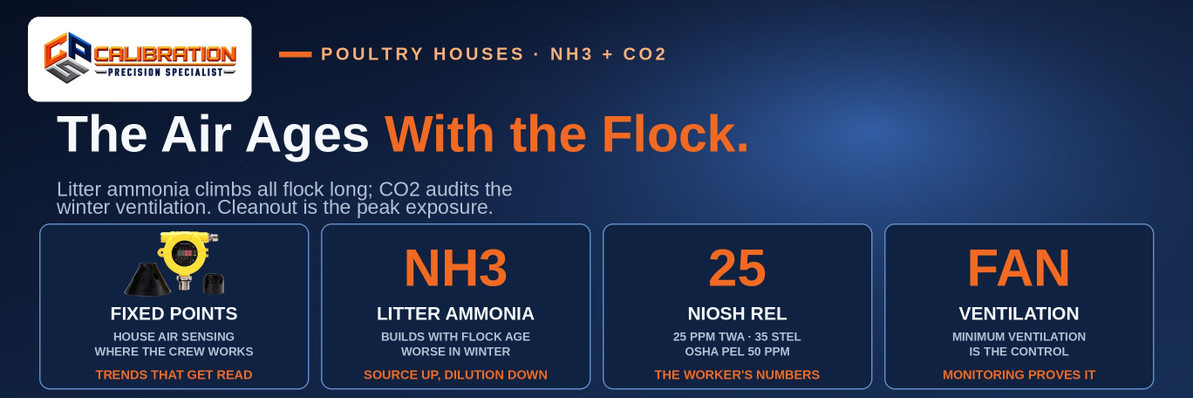
In a poultry house, the air ages with the flock: ammonia released from litter builds week by week as litter moisture and cake accumulate — against worker limits of 50 ppm (OSHA, 8-hour TWA) and 25 ppm TWA / 35 ppm short-term (NIOSH) — while carbon dioxide from birds and heaters rides up whenever winter ventilation is throttled down to hold heat. Monitoring barn air is therefore a flock-long discipline, not a one-time test: fixed sensing where the crew works, ventilation that answers it, and special respect for cleanout, when disturbed litter gives up its ammonia all at once to the people stripping the house.
This is a different ammonia problem from stored manure — for the pit side of the farm, with its hydrogen sulfide hazard, see manure pit gas and H₂S safety. The house problem is chronic, not acute: litter is a slow ammonia generator living under the birds, and the variables that drive it — litter age and moisture, bird density and age, ventilation rate — all trend the wrong way together in winter, which is also when the crew spends its longest hours inside.
Where House Ammonia Comes From, and Why It Climbs
Ammonia in a broiler or layer house is litter chemistry: nitrogen in manure converts as litter microbes work, and the release accelerates with the things a grower watches for other reasons — litter moisture, cake buildup, temperature, and the sheer mass of birds and manure as the flock matures. Early-flock air can be genuinely clean; the same house in week six, on built-up litter, in minimum winter ventilation, is a different atmosphere wearing the same address. Any monitoring plan that samples the good weeks and extrapolates is measuring the farm's best behavior.
Height matters to what a reading means. The birds live at floor level in the ammonia's home layer; the crew works standing. A sensor placed for the crew's exposure and a sensor placed to judge litter conditions are answering different questions, and a serious setup knows which one each reading is for.
CO2: The Winter Ventilation Ledger
House CO₂ is respiration plus combustion: thousands of birds exhaling, plus unvented or partially vented heating working hardest exactly when the house is tightest. CO₂'s role in monitoring is double — it is itself a worker-exposure gas against a 5,000 ppm TWA limit, and it is the practical tracer of whether minimum ventilation is actually exchanging the house's air. Rising CO₂ alongside rising ammonia is the signature of a house being under-ventilated for its load, whatever the controller's setpoint claims; the gases audit the ventilation, continuously, for free.
That makes the monitoring-and-ventilation pair the real system: sensors don't fix air, fans do — but fans run on settings, and settings drift from need as the flock grows into its own heat and moisture production. Continuous readings turn ventilation management from a calendar habit into a measurement.
Cleanout: The Peak Exposure Nobody Schedules Like One
Between flocks, the house gets stripped: litter caked, loaded, and hauled, houses washed and disinfected. Disturbing built-up litter releases its stored ammonia in a rush, into a house whose ventilation may be set for an empty building, worked by a crew doing heavy physical labor — breathing hard — for hours. It is the highest ammonia exposure in the production cycle, and it routinely gets the least monitoring, because the flock (the usual reason for the instruments) is gone.
The practice that matches the hazard: portables on the cleanout crew, ventilation run for people rather than for an empty house, and work paced when readings say so. Single-gas monitors for ammonia duty, or multi-gas portables for crews also working around pits and equipment, are the right scale of tool — personal, present, and read by the person breathing the air.
What to Install, What to Carry
- In the house: fixed ammonia sensing at working height in the crew's zones, tied into the ventilation conversation — alarm or at least trend the grower actually reviews.
- CO₂ as a ventilation check: reading CO₂ alongside ammonia exposes under-ventilation that either gas alone might let you rationalize.
- On the crew: portable monitors for cleanout and litter work, the cycle's peak exposure.
- On schedule: sensor calibration and replacement discipline — barn air is dusty, humid, and corrosive to instruments; house sensors live hard lives and their readings are only as good as their last calibration.
CPS calibrates portables in-house at $55 single-gas and $90 for 4- and 5-gas instruments with full certificates, and supplies fixed and portable detection for agricultural buildings — start at portable gas detection or call 865-900-8844. The through-line of this post: barn air is managed, not assumed, and the instruments are how a grower knows the management is working.
Frequently Asked Questions
What ammonia level is too high for poultry house workers?
The published worker limits: OSHA's PEL is 50 ppm as an 8-hour TWA; NIOSH recommends 25 ppm TWA with a 35 ppm short-term limit. House ammonia that climbs through the flock — especially late-flock on built-up litter in minimum winter ventilation — can press against those numbers for the crew, which is why monitoring tracks the trend rather than a single early-flock sample.
Why does ammonia get worse as the flock ages?
The source grows: more manure nitrogen in the litter, more litter cake and moisture, more birds producing more of everything — while winter ventilation is run at minimum to hold heat. Source up, dilution down. The same house is a genuinely different atmosphere in week six than in week one, and monitoring that only samples good weeks is measuring best behavior.
Why monitor CO2 in a poultry house?
Twice over: CO₂ is a worker-exposure gas in its own right (PEL 5,000 ppm TWA), fed by bird respiration and combustion heating, and it is the practical tracer of whether minimum ventilation is actually exchanging house air. CO₂ and ammonia rising together is the fingerprint of under-ventilation for the flock's current load — the gases audit the fans.
Is poultry-house ammonia the same hazard as manure-pit gas?
Related farm, different hazard. House ammonia is a chronic exposure from litter, managed with ventilation and monitoring across the flock. Manure pits add stored liquid manure and hydrogen sulfide — an acute, knockdown hazard — covered in our manure pit gas post. Crews who work both need both disciplines, and a monitor strategy for one does not cover the other.
When is worker exposure highest in a poultry house?
At cleanout. Stripping built-up litter releases stored ammonia in a rush, in a house ventilated for an empty building, to a crew doing heavy labor and breathing hard. Portables on the crew, ventilation run for people, and work paced by readings are the controls matched to it — the peak exposure of the cycle deserves the most monitoring, not the least.
Where should ammonia sensors go in a house?
Decide which question each sensor answers. Working-height sensors in the crew's zones measure worker exposure. Readings nearer the litter judge litter and flock conditions. Conflating the two produces numbers that answer neither. Fixed sensing should also live where its trend gets reviewed — an unread trend is a diary, not a control.
Do barn sensors need special maintenance?
They live hard: dust, humidity, feather dander, and the ammonia itself all age sensing elements, and response drifts accordingly. Calibration on schedule — and honest replacement when a sensor will no longer hold it — is what keeps house readings as evidence. CPS calibrates portables in-house ($55 single-gas, $90 multi-gas) with full certificates and can advise on fixed heads.
Can ventilation alone manage barn ammonia?
Ventilation is the control; monitoring is how you know the control is working. Fan settings are setpoints, not outcomes — flock growth, litter condition, and weather all move the outcome away from the setting across a flock. Continuous ammonia and CO₂ readings close the loop that a controller set in week one leaves open.
What monitors should a cleanout crew carry?
Personal monitors matched to the work: ammonia-capable portables for litter work (single-gas ammonia units or multi-gas instruments where the crew also works around pits, heaters, and equipment). Personal, alarming, and read by the wearer — that is the layer that follows the exposure, because cleanout exposure moves with the crew, not with the house's fixed points.
What about ammonia and the birds themselves?
Producers manage house ammonia for flock health and performance as well as for the crew — chronically elevated ammonia is hard on birds that live at litter level, in the gas's home layer, around the clock. This post stays with the published worker numbers, but the management direction is the same for both: measure it, ventilate against it, and never let it become a surprise.
The Bottom Line
Poultry-house air is a trend, not a snapshot: litter ammonia climbing with the flock, CO₂ auditing the winter ventilation, and cleanout delivering the cycle's peak exposure to the crew least equipped with monitoring. Fixed sensing in the house, portables on the cleanout crew, and calibration discipline on both turn barn air from an assumption into a managed number.
Outfitting or calibrating barn monitoring? Call CPS Calibrations at 865-900-8844 — 109 S. Front Street, Rockwood, TN 37854.
--- CPS Calibrations · 109 S. Front Street, Rockwood, TN 37854 · Manure Pit Gas Safety · Portable Gas Detection · Calibration Services
Need a calibration you can file?
In-house calibration at CPS in Rockwood, Tennessee — $55 for single-gas instruments, $90 for 4- and 5-gas — every channel, as-found and as-left data, full certificate.
See Calibration Servicesor call 865-900-8844
Recent Posts
-

What Is Remote Monitoring for Fixed Gas Detection?
Remote monitoring for fixed gas detection means a fixed system's live readings, trends, and alarm hi …Nov 23rd 2026 -

What Are the Key Differences Between the GX-6000 and GX-6100?
The RKI GX-6100 is the current replacement for the discontinued GX-6000: both are pumped 6-gas monit …Nov 22nd 2026 -

How to Read a PID Correction Factor Chart
To read a PID correction factor chart, find your vapor’s row, take the factor under your own lamp en …Nov 21st 2026