
Manure Pit Gas: The H2S That Kills on Agitation Day
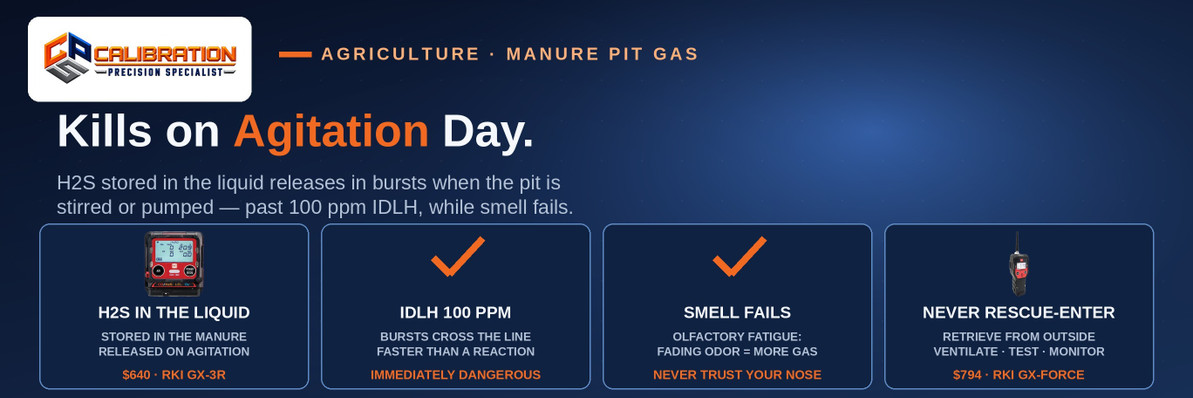
Manure pit hydrogen sulfide is stored dissolved in the liquid manure itself, and agitating or pumping the pit releases it in bursts that can exceed the 100 ppm level rated immediately dangerous to life or health (IDLH) — while H2S olfactory fatigue destroys the victim's sense of smell as concentrations rise. The controls are ventilation, air testing before and during pit work, a personal monitor on every worker near the pit, and an absolute rule: never enter the pit to attempt a rescue.
Most farm gas hazards are steady. A manure pit is not. Day to day, an undisturbed pit releases its gases slowly. On agitation day — a planned, routine, necessary job — the stored hydrogen sulfide comes out of the liquid all at once, in the exact place where people are standing to run the equipment. That is why this gas, on this day, has the record it has. This post explains the mechanism and the work rules that break it.
What Gases Are in a Manure Pit?
Hydrogen sulfide is the killer, but it is not alone. A manure pit's air can hold:
| Gas | Where it comes from | Why it matters |
|---|---|---|
| Hydrogen sulfide (H2S) | Stored in the liquid manure; released in bursts on agitation/pumping | IDLH at 100 ppm; causes olfactory fatigue so smell fails as a warning |
| Methane (CH4) | Decomposition in the stored manure | Flammable — the LEL channel's job around pits and barns |
| Carbon dioxide (CO2) | Decomposition | Displaces oxygen and pools in the pit air |
| Ammonia (NH3) | Manure nitrogen | An irritant exposure for people working over the pit |
A standard 4-gas personal monitor — LEL, oxygen, CO, and H2S — covers the pit's main threats, with the H2S channel doing the work this post is about. The same gas makes the same demands in industry; our H2S personal monitor guidance for oil and gas covers the instrument side in depth, and the discipline transfers directly to the farm.
Why Is Agitation Day the Dangerous Day?
Because the pit stores the gas in the liquid, not just above it. Hydrogen sulfide generated by decomposing manure dissolves and holds in the liquid while the pit sits undisturbed. Agitation — stirring to suspend solids before pumping — breaks that storage open. So does pumping itself. The H2S releases in bursts, fast enough that air at the pit surface and in the surrounding work area can jump from tolerable to past the 100 ppm IDLH before a person can react.
Two traps complete the mechanism:
- Olfactory fatigue. H2S famously smells of rotten eggs — at low concentrations. As exposure continues, and especially as concentrations rise, the gas fatigues the sense of smell itself. The odor fading is widely misread as the gas clearing. It is the opposite: your detector just went offline while the hazard went up.
- The rescue entry. The classic manure-pit fatality is not one victim. It is two or three: the first worker drops, and a family member, employee, or neighbor climbs in to pull him out — into the same air that just dropped a healthy person, with the same result. Never enter a pit to rescue. No exceptions, no "just for a second," no holding your breath. A person down in a pit is retrieved from outside, with ventilation and proper equipment, or by responders equipped for it.
What Are the Work Rules for Pit Agitation and Pumping?
Set up before the agitator starts — not as the work unfolds:
- Ventilate the pit and the work area before and during agitation and pumping, so released gas is diluted and carried away instead of pooling where people stand.
- Test the air before the work, and keep testing during it. A pumped monitor — the RKI GX-Force ($794) draws a sample on a hose — checks the pit air from outside, before anyone leans over it, and keeps sampling as agitation changes the air minute by minute.
- A personal monitor on every worker near the pit. The RKI GX-3R ($640 — LEL, O2, CO, H2S) rides on the worker and alarms where he actually breathes. Pit air is not uniform; the fixed reading at the edge is not the reading at a worker's face.
- Keep people who do not need to be there away from the pit during agitation — and keep everyone out of the pit itself. Pit work during agitation is work done from outside, with the equipment doing the entering.
- Plan the rescue before there is one. Retrieval from outside, ventilation, and a call for equipped responders — decided on a calm day, written down, known by everyone on the crew. A rescue improvised over a downed worker is how the second fatality happens.
Browse the instruments for this work in portable multi-gas monitors, and keep their H2S channels honest: we calibrate every channel, because an H2S sensor that has drifted low on agitation day is the same failure as no monitor at all. Calibration runs through calibration services — in-house, or shipped in from the farm.
Frequently Asked Questions
Why is manure pit gas so dangerous?
Because the pit stores hydrogen sulfide dissolved in the liquid manure, and agitation or pumping releases it in sudden bursts that can exceed the 100 ppm concentration rated immediately dangerous to life or health. The release happens during planned work, where people are standing. Add olfactory fatigue — H2S disables the sense of smell as exposure rises — and the victim's own warning system fails at exactly the wrong moment.
What gases are in a manure pit?
Primarily hydrogen sulfide (H2S), the lethal one, plus methane (flammable), carbon dioxide (which displaces oxygen), and ammonia (an irritant). A standard 4-gas personal monitor covering LEL, oxygen, carbon monoxide, and H2S addresses the pit's main threats, with the H2S channel carrying the greatest risk. Testing before and during pit work is how you know what a specific pit's air actually holds that day.
Can you smell hydrogen sulfide in a manure pit?
Only at first, and that is the trap. H2S has a rotten-egg odor at low concentrations, but it causes olfactory fatigue: continued or rising exposure fatigues the sense of smell, and the odor seems to fade while the gas is actually getting stronger. Anyone who treats a fading smell as the gas clearing has the mechanism backwards. Smell is never a manure-pit instrument — a calibrated H2S monitor is.
What is the IDLH for hydrogen sulfide?
100 ppm. Concentrations at or above 100 ppm H2S are rated immediately dangerous to life or health. The reason agitation day matters is that the release from an agitated pit can cross that line in bursts, quickly, at the pit surface where people are working — not as a slow, noticeable build-up a worker could walk away from.
Why do manure pit accidents kill rescuers?
Because the instinct to climb in after a downed family member or coworker is stronger than the knowledge that the air caused the collapse. The would-be rescuer enters the same H2S concentration that dropped the first victim — often still being released by the agitation that is still running — and is overcome in the same way. The rule has no exceptions: never enter a pit to rescue. Retrieval happens from outside, with ventilation, or by responders equipped for that air.
When is a manure pit most dangerous?
On agitation and pumping days. An undisturbed pit releases its stored gases slowly, but the liquid itself holds dissolved H2S, and stirring or pumping breaks it loose in bursts. The most dangerous day around a pit is a planned work day with people present — which is why ventilation, air testing, and personal monitors are set up before the agitator starts, not improvised once the work is underway.
What monitor do you need for manure pit work?
Two layers. A pumped 4-gas monitor (such as the RKI GX-Force, $794) to test the pit air from outside on a sample hose before and during the work, and a personal 4-gas monitor on every worker near the pit (such as the RKI GX-3R, $640) covering LEL, oxygen, CO, and H2S where each person actually breathes. The pumped unit reads the space; the personal units read the people. Agitation changes the air continuously, so testing is continuous too.
Do you need to ventilate a manure pit before agitating?
Yes — ventilate the pit and the surrounding work area before agitation or pumping starts, and keep ventilating during the work. Agitation releases stored H2S in bursts; ventilation dilutes those bursts and carries them away from the places people stand. Ventilation is a control, not a guarantee, so it runs alongside testing and personal monitors — never instead of them.
Can a worker enter a manure pit if he is only going in for a minute?
No. The lethal mechanism — an H2S burst past the 100 ppm IDLH — acts faster than a minute, faster than climbing back out, and olfactory fatigue means the worker may not even smell the danger rising. Pit work is done from outside with equipment, after testing, under ventilation, with a monitor on the worker. Brief, unmonitored entries are the exact pattern behind the accident record.
How much does gas detection for manure pit work cost?
At live CPS list prices, a personal 4-gas monitor (RKI GX-3R) is $640 and a pumped 4-gas monitor (RKI GX-Force) for testing pit air from outside is $794 — one of each is the working pair for agitation-day discipline. In-house calibration is $55 for a single-gas instrument and $90 for a 4- or 5-gas instrument at CPS; ship-in calibration runs at the same rates, and on-site work is quoted in writing.
The Bottom Line
A manure pit keeps its hydrogen sulfide in the liquid and hands it all back on agitation day — past the 100 ppm IDLH, in bursts, while the gas itself switches off the victim's sense of smell. Ventilate, test before and during, put a monitor on every worker, and never, under any circumstances, enter the pit to rescue.
Setting up monitors for pit work — or for the grain bins covered in grain elevators and feed mills? Call CPS Calibrations at 865-900-8844. The instruments are part of the CPS Calibration Program from the first calibration on.
CPS Calibrations · 109 S. Front Street, Rockwood, TN 37854 · Calibration Services · The CPS Calibration Program
Need a calibration you can file?
In-house calibration at CPS in Rockwood, Tennessee — $55 for single-gas instruments, $90 for 4- and 5-gas — every channel, as-found and as-left data, full certificate.
See Calibration Servicesor call 865-900-8844
Recent Posts
-

What Is Remote Monitoring for Fixed Gas Detection?
Remote monitoring for fixed gas detection means a fixed system's live readings, trends, and alarm hi …Nov 23rd 2026 -

What Are the Key Differences Between the GX-6000 and GX-6100?
The RKI GX-6100 is the current replacement for the discontinued GX-6000: both are pumped 6-gas monit …Nov 22nd 2026 -

How to Read a PID Correction Factor Chart
To read a PID correction factor chart, find your vapor’s row, take the factor under your own lamp en …Nov 21st 2026