
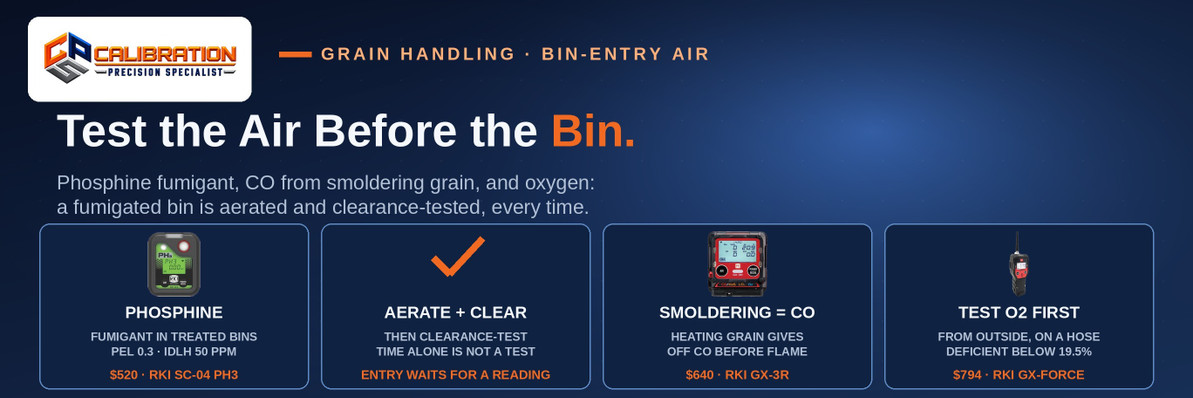
Grain Elevators and Feed Mills: Fumigant, Smoldering Grain, and Bin-Entry Air
Grain elevators and feed mills face three layered gas jobs: phosphine fumigant in treated bins — exposure limit 0.3 ppm, immediately dangerous at 50 ppm — which must be aerated and clearance-tested before any entry; carbon monoxide from grain that is heating and smoldering in storage; and bin-entry air itself, which must be tested for oxygen (deficient below 19.5%) and toxics from outside, before a worker goes in, under OSHA's grain-handling standard (1910.272).
A bin looks like the simplest structure on the farm or at the elevator: a cylinder of grain. The air inside it is anything but simple. One hazard is applied on purpose to protect the grain. One grows quietly in the dark when grain heats. And the third is the air itself, in a space a worker may need to enter. Each job has its own gas, its own instrument, and its own rule — and confusing them is how bins hurt people.
Why Is Phosphine the Fumigant Problem?
Because phosphine (PH3) is the fumigant used to protect stored grain from insects — the gas is there deliberately, applied to do a job, and it remains the bin's problem after the job is done. Its numbers demand respect at very low concentrations: an OSHA permissible exposure limit of 0.3 ppm as an 8-hour average, and 50 ppm immediately dangerous to life or health (IDLH). A limit of 0.3 ppm leaves no room for estimation — nobody's senses measure tenths of a part per million.
The rule that follows is absolute in shape even though every bin's timing is its own: a fumigated bin must be aerated and then clearance-tested before entry. Aeration without a test is a hope; the clearance test — a phosphine measurement with an instrument that reads at fumigant levels, such as the RKI SC-04 phosphine monitor ($520) — is what converts elapsed time into evidence. Feed mills inherit the same job wherever fumigated grain or fumigated spaces move through the process: the fumigant travels with the grain's handling until it has been aerated and cleared.
What Does Carbon Monoxide Tell You About Stored Grain?
That it is heating. Grain stored with too much moisture, or with a hot spot in the mass, can begin to smolder — a slow, deep, oxygen-starved burn that produces carbon monoxide before it produces smoke or flame anyone can see from outside the bin. CO measured in the bin's air is therefore an early-warning instrument for the grain's condition, the same mechanism that makes CO the fire signal in a coal bunker: incomplete combustion speaks in CO first. CO is simultaneously a worker exposure — colorless, odorless, OSHA limit 50 ppm as an 8-hour average — for anyone working in the headhouse, gallery, or bin deck air the bin breathes into. One reading, two meanings: the grain's health and the crew's exposure, from instruments like those in portable multi-gas monitors.
How Should Bin-Entry Air Be Tested?
From outside, before entry, in the right order — because a bin is a confined space with an agricultural standard of its own. Grain handling falls under OSHA 1910.272, and the general confined-space framing (1910.146) supplies the air definitions: an atmosphere below 19.5% oxygen is oxygen-deficient. The entry discipline:
- Test before entry, from outside the space. A pumped monitor — the RKI GX-Force ($794) on a sample hose — draws bin air to the instrument while the tester stays in clean air. Leaning into the bin to test it is not testing; it is entering.
- Oxygen first, then toxics. Oxygen tells you whether the air supports life and whether the other readings can be trusted in context; then LEL, CO, H2S as the bin's history requires — and phosphine, specifically, on any bin that has been fumigated, cleared by its own clearance test.
- Keep testing during the work, with a personal monitor on the entrant. Bin air changes as grain moves and as work disturbs the mass. The entrant carries a 4-gas monitor such as the RKI GX-3R ($640); the pre-entry test describes the bin at one moment, the personal monitor describes the worker's air at every moment after.
- A failed test is a stop, not a discussion. Ventilate, re-test, and enter only on readings that pass — the full method is in how to test a confined space before entry.
Gas is not a bin's only entry hazard, and this post does not pretend otherwise — but the air is the hazard that gives no warning at all without an instrument, which is why testing leads the entry procedure. The companion farm hazard makes the same point with a different gas: manure pit gas stores its H2S in liquid and releases it on agitation day.
Calibration is what makes any of this real. A phosphine monitor that reads low clears a bin that is not clear; a CO channel that drifts destroys the smolder warning. We calibrate every channel on the instruments above, through calibration services — in-house, or shipped in from the elevator.
Frequently Asked Questions
What gas detection does a grain elevator need?
Three jobs: phosphine detection for fumigated bins and spaces (exposure limit 0.3 ppm, IDLH 50 ppm), carbon monoxide monitoring for smoldering grain and worker exposure (limit 50 ppm), and entry testing — oxygen and toxics measured from outside with a pumped monitor before anyone enters a bin, with a personal monitor on the entrant during the work. Grain handling sits under OSHA 1910.272, and the three jobs use different instruments because the gases behave differently and matter at very different concentrations.
How dangerous is phosphine fumigant?
Dangerous at very low concentrations. Phosphine's OSHA permissible exposure limit is 0.3 ppm as an 8-hour time-weighted average, and 50 ppm is immediately dangerous to life or health (IDLH). A limit measured in tenths of a part per million cannot be judged by smell, time elapsed, or experience — only by an instrument built to read phosphine at fumigant levels. That is why fumigated bins are aerated and clearance-tested, not assumed clear.
When can you enter a fumigated grain bin?
After the bin has been aerated and a clearance test with a phosphine instrument shows the air is clear — not after a fixed amount of time has passed. Elapsed time is not a measurement; aeration rates and remaining fumigant vary by bin and by treatment. The clearance test is the entry ticket: a phosphine monitor such as the RKI SC-04 ($520) reads the bin's actual air, and entry waits for its reading.
What does carbon monoxide in a grain bin mean?
Usually, heating grain. Grain that is too wet or has a hot spot can smolder deep in the mass, and smoldering produces carbon monoxide before visible smoke or flame — so a CO reading in bin air is an early warning about the grain's condition. CO is also a direct worker exposure with an OSHA limit of 50 ppm as an 8-hour average, so the same reading protects the crew working the bin deck and gallery.
How do you test a grain bin before entry?
From outside, with a pumped monitor on a sample hose: oxygen first (deficient below 19.5%), then combustible gas and toxics — CO, H2S as the bin requires, and phosphine specifically on any fumigated bin, which needs its own clearance test. Testing continues during the work with a personal 4-gas monitor on the entrant, because bin air changes as grain and workers move. A failed test stops the entry until ventilation and a passing re-test say otherwise.
What OSHA standard covers grain bin entry?
Grain handling facilities fall under OSHA 1910.272, the grain-handling standard. The oxygen definitions used for entry air come from the confined-space framing of 1910.146: below 19.5% oxygen is an oxygen-deficient atmosphere. The practical consequence is the same in both: bin air is tested for oxygen and toxics before and during entry, with instruments — never assumed safe because the bin was fine last season.
What monitor do you need for phosphine clearance testing?
A phosphine-specific instrument that reads at fumigant concentrations — a standard 4-gas monitor's channels (LEL, O2, CO, H2S) do not include phosphine. The RKI SC-04 phosphine monitor ($520) is a single-gas instrument built for exactly this measurement. Bin-entry testing then adds the pumped 4-gas layer (RKI GX-Force, $794) for oxygen and the other entry gases, and a personal 4-gas monitor (RKI GX-3R, $640) on the entrant.
Why can't a standard 4-gas monitor test a fumigated bin?
Because phosphine is not one of its four gases. A 4-gas monitor reads LEL, oxygen, carbon monoxide, and hydrogen sulfide; it can be reading normally on all four channels while phosphine — limit 0.3 ppm — is present above its limit. Fumigated bins need a phosphine instrument for clearance, in addition to the 4-gas testing a bin entry requires. Instruments answer only the questions their sensors ask.
How often do grain facility gas detectors need calibration?
On the interval each instrument's manufacturer specifies — phosphine, CO, and multi-gas sensors do not share one honest number. The failure that matters most here is a phosphine monitor reading low, because its reading is the clearance decision for a fumigated bin: a low-reading instrument clears air that is not clear. Keep every instrument on a written calibration schedule, with as-found and as-left readings documented.
What does gas detection for a grain elevator cost?
At live CPS list prices: a phosphine monitor (RKI SC-04) is $520, a pumped 4-gas monitor for entry testing (RKI GX-Force) is $794, and a personal 4-gas monitor (RKI GX-3R) is $640. In-house calibration is $55 for a single-gas instrument and $90 for a 4- or 5-gas instrument at CPS Calibrations; ship-in calibration is billed at the same rates, and on-site work at your facility is quoted in writing and costs more than bench work.
The Bottom Line
A grain bin holds fumigant that was put there on purpose, CO from grain that may be smoldering in the dark, and entry air that must be proved — not assumed — before a worker goes in. Aerate and clearance-test the fumigant, watch the CO, test oxygen and toxics from outside, and let instruments make the entry decision.
Outfitting an elevator or feed mill for fumigant and entry work? Call CPS Calibrations at 865-900-8844 — monitors, calibration, and the CPS Calibration Program behind them, from Rockwood, Tennessee.
CPS Calibrations · 109 S. Front Street, Rockwood, TN 37854 · Calibration Services · The CPS Calibration Program
Need a calibration you can file?
In-house calibration at CPS in Rockwood, Tennessee — $55 for single-gas instruments, $90 for 4- and 5-gas — every channel, as-found and as-left data, full certificate.
See Calibration Servicesor call 865-900-8844
Recent Posts
-

What Is Remote Monitoring for Fixed Gas Detection?
Remote monitoring for fixed gas detection means a fixed system's live readings, trends, and alarm hi …Nov 23rd 2026 -

What Are the Key Differences Between the GX-6000 and GX-6100?
The RKI GX-6100 is the current replacement for the discontinued GX-6000: both are pumped 6-gas monit …Nov 22nd 2026 -

How to Read a PID Correction Factor Chart
To read a PID correction factor chart, find your vapor’s row, take the factor under your own lamp en …Nov 21st 2026